Making watches at scale
A broken part poses two different problems. Someone must know what shape will work, and someone must be able to make or obtain that shape. In an individually fitted mechanism, a replacement may need to be adapted to this particular watch. In a standardized production system, the maker tries to arrange matters so that another part of the specified type will fit. This difference changes much more than the speed of a repair. It changes design, measurement, tools, inventories and the distribution of skill.
The important word is specified. Interchangeable parts are not parts that fit every watch ever made. They are parts made to a controlled set of requirements for a particular design. A movement can have standardized components while requiring skilled assembly, adjustment and service. The nineteenth-century factory should therefore be understood as a new organization of precision, rather than a place where precision stopped mattering.
This chapter examines how that organization developed through the American factory example and places it alongside Swiss production districts. We will use a contemporary government report as evidence, but also read its enthusiasm critically. Its admiration for machinery is itself part of the history. The report tells us what its authors thought industrial success looked like, as well as describing how watchmaking was being done.
Division of labor is older than the factory
Begin by separating three arrangements that are often confused. Division of labor means that different people perform different tasks. Mechanization means using machines to perform operations. Concentration means gathering work under common management or in a common location. These can develop together, but one does not automatically imply all the others. A network of specialist workshops can divide labor extensively without assembling everyone in a single factory.
For a schematic example, imagine separate specialists making cases, springs, dials and movement components. Another person coordinates deliveries and finishing. This arrangement can produce sophisticated objects, yet the coordinator must manage differences between parts and schedules. Now imagine moving those specialists into one building. Communication may become easier, but incompatible dimensions do not disappear merely because the walls are shared. Standardization requires an additional agreement about what each operation must deliver.
Swiss watchmaking towns provide a useful reminder that an industrial system can be read in streets as well as machines. UNESCO's account of La Chaux-de-Fonds and Le Locle describes housing, workshops and later factories intermingled within planned urban layouts. Their built form accommodated movement from dispersed craft production toward more concentrated manufacture. The evidence supports a history of changing organization, not a timeless picture of solitary artisans unaffected by industry. UNESCO World Heritage Centre.
The distinction matters when national stories become moral tales. It is too simple to make the United States stand for machines and Switzerland for hands. A machine needs design, setup and care; a craft district can contain specialized tools and coordinated production. We should compare identifiable arrangements at particular dates. National origin is useful context, but it cannot perform the explanation by itself.
The factory has to make its own means of production
The watchmaking section of the United States census report for 1900 describes Waltham as an enterprise organized into many departments, with a machine shop at its foundation. It connects the project to experience with interchangeable manufacture at Springfield and follows the movement of expertise into other watch enterprises. The account presents industrialization as an accumulation of people, tools and methods, despite its celebratory language about individual inventors. Twelfth Census, Manufactures, printed pages 494–497.
A watch factory does not simply purchase a room full of finished watches in machine form. Someone must decide how a blank will be held, which surface will establish its position, how a tool will approach it and how the result will be checked. The equipment that makes a tiny part may be much larger and more expensive than the part itself. Industrial production moves some effort away from repeated hand fitting and into the preparation of repeatable operations.
Consider an invented example involving a plate with several holes. If each worker locates the holes by eye, slight errors can accumulate. If the plate is held against a consistent reference and the machine repeats controlled positions, the process can reduce variation. Yet a badly set reference can make every plate wrong in the same way. Repetition is valuable only when the repeated operation has been established and maintained correctly.
The same principle applies to measurement. A gauge creates a shared test of an acceptable dimension. Without a common test, one department's acceptable part may be another department's problem. With a badly calibrated gauge, a whole batch may pass inspection and still fail in assembly. Standardization therefore includes standards for the tools that check the products. The system must keep its own means of judgment dependable.
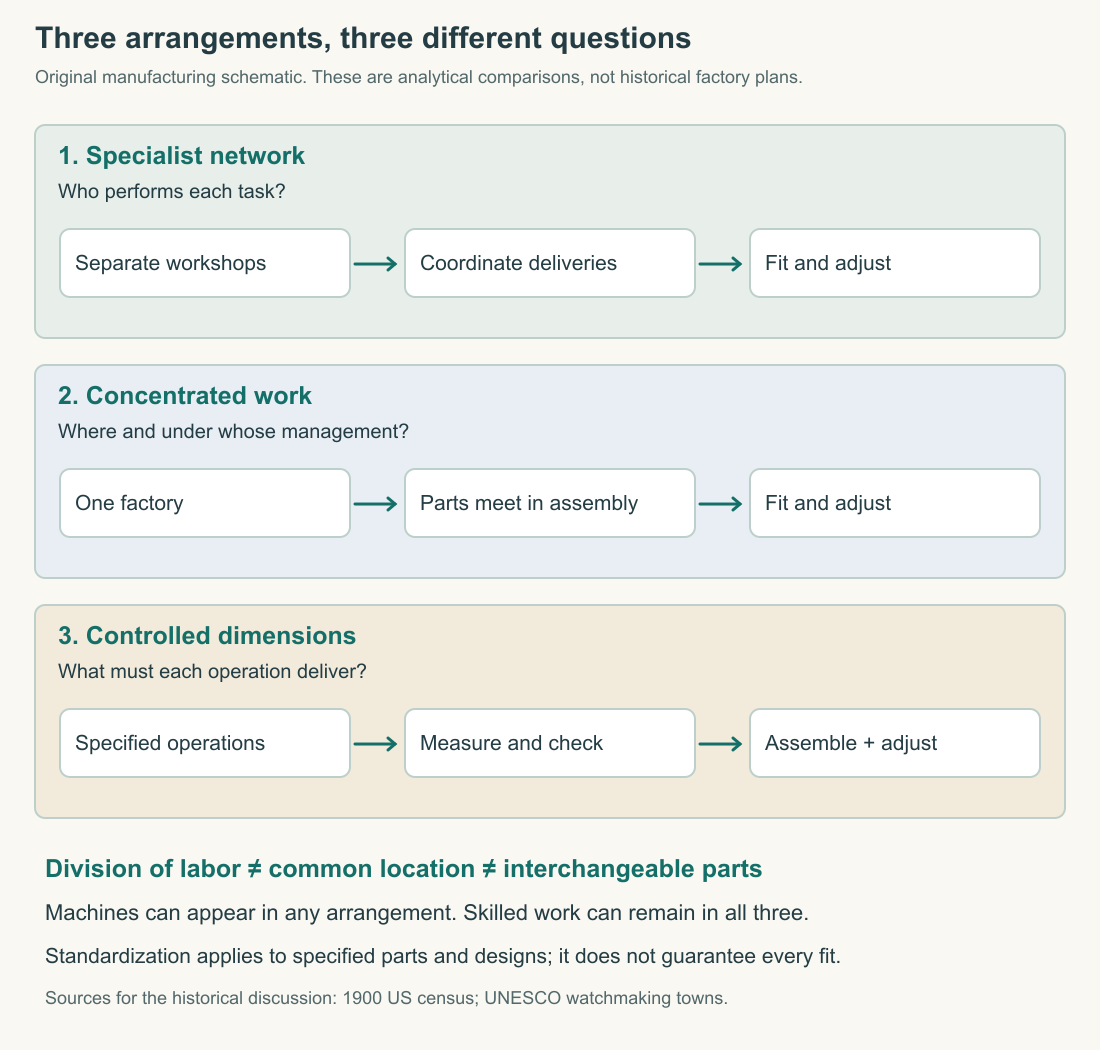
The diagram is schematic. It does not depict a particular historical factory floor. Follow the point at which components must meet. That interface is where a problem originating in one operation becomes visible to another. A well-organized system tries to detect the error before expensive finishing or final assembly, when correcting it would waste more work.
A small spring makes the problem clear
The census report describes a method of testing springs against a standard balance and balances against a standard spring, then grading them for matching. This is more revealing than a photograph of a grand factory. The timekeeping result depends on a relationship between components, so producing many visually similar pieces is not sufficient. Classification and measurement help the assembler choose a combination with suitable behavior.
In an original simplified comparison, suppose ten balances and ten springs have small differences. Random pairing may produce a wide spread of rates. Sorting each set according to measured properties can make matching more systematic. This is not a claim that those twenty pieces reproduce Waltham's exact procedure. It illustrates why production engineers care about distributions and relationships, not just an average dimension or an impressive count of finished parts.
There are several possible responses to variation. Tighten the process so that parts differ less. Measure and sort what it produces. Adjust the assembled mechanism. Reject parts outside the allowed range. Real manufacturing can combine these responses. Each has costs: better tooling, more inspection, more skilled time or more discarded work. The cheapest component is not necessarily the cheapest reliable watch if it creates expensive problems downstream.
This is also why interchangeability should not be imagined as an absolute switch from impossible to perfect. A system can achieve it for some components before others. A part can fit dimensionally while requiring adjustment for performance. A maker can maintain different grades with different standards. Historical claims about interchangeability need an answer to the question: which parts, within which design, and with how much further work? That question applies equally to old and modern production.
What happens to skill?
The census account repeatedly celebrates automatic machinery as reducing dependence on individual skill, yet it also describes specialized finishing, testing and adjustment. Those statements need to be read together. Some operations became less dependent on a worker fitting each part by hand, while the system still required people able to design machines, control processes and judge finished movements. Skill moved and changed; it did not simply evaporate.
The report's language about workers deserves scrutiny too. It refers to girls selecting hairsprings with machinery while reserving the label of skilled watchmaker for particular finishing work. That wording tells us how the author classified labor. It does not demonstrate that the women or girls performing the other operations needed no judgment, dexterity or training. A historian should not reproduce a period hierarchy of esteem as an objective measure of difficulty.
Imagine watching two tasks for only a minute. One person files a unique component; another inspects a stream of similar components and removes occasional failures. The first looks visibly individual. The second looks repetitive. But the second may require recognizing subtle defects consistently under pressure. To compare their training and conditions, we would need observations, wage records, job descriptions and workers' accounts. Appearance alone would not settle the question.
Industrialization also changes dependence. A craft worker may depend on a personal reputation and a network of suppliers. A factory worker may depend on machinery, management and the continuity of a production line. Employers may depend on scarce toolmakers even while claiming that automation has made labor interchangeable. A course about machines becomes more interesting when it notices these changing relationships among people.
Price falls through choices, not magic
The census report distinguishes high-grade watches from intermediate and inexpensive products. Its description of cheap watches emphasizes stamped parts, limited finishing and restricted time for testing and adjustment. It also reports very low selling prices and manufacturers' claims about useful life. Those reported claims are historical testimony, not a warranty we can verify today. What the account clearly shows is that lower prices involved product and process choices together.
Here is a fictional cost model. Suppose a maker spends 10,000 units of money preparing tools for a design and another 20 units producing each watch. At a thousand watches, the tooling contributes 10 units per watch, before any other costs. At ten thousand watches, it contributes one. This arithmetic explains one possible advantage of scale. It does not include financing, rejected parts, sales costs, maintenance or unsold inventory, and it is not a reconstruction of a historical company's accounts.
Now suppose the maker can sell only five hundred watches. Producing ten thousand to make the average tooling cost look attractive leaves a large stock that has not paid for itself. Scale is useful when production, quality and demand can be brought into a workable relationship. A large factory is not automatically a profitable factory. Standardization can reduce unit costs while increasing the financial consequences of choosing the wrong product.
A cheap watch can also be designed to perform a narrower job. Less elaborate finish may reduce cost without changing the time display's usefulness to a particular buyer. Less testing may increase uncertainty about rate. A less durable construction may create a shorter useful life. These are different tradeoffs. We should not compress all of them into a single judgment that cheap means bad or that expensive means necessary.
Repair becomes a supply problem as well as a bench problem
A stock of suitable replacement parts can make repair quicker, but only if the right parts remain available. Someone must identify the movement, maintain inventories and distribute components to the places where watches are used. A standardized part that is no longer stocked can still be difficult to obtain. Conversely, a skilled repairer may keep an older individual mechanism running by making or adapting a part. Neither system guarantees immortality.
Suppose two fictional watches suffer the same kind of damage. One has a readily available replacement costing little relative to the complete watch. The other requires several hours of specialist work. Repair may be economically easier in the first case, but an owner may still choose the second because the object has personal significance. Industrial manufacture changes possibilities and costs; it does not determine what every owner values.
The census text itself notices attachment to watches when discussing replacement and repair. We should treat its generalization cautiously, but the observation fits the distinction established by Oriani's gift: the manufacturing history of an object and its later personal history are not identical. A product made in a series can become irreplaceable to its owner. A technically repairable object can also be discarded if parts, money or interest are unavailable.
Access needs evidence of its own
It is reasonable to investigate whether cheaper and more plentiful watches widened access to portable time. It is not enough to assume that they did so evenly. To learn who gained access, we would need to compare prices with incomes and household obligations, examine where retailers operated and investigate credit or secondhand markets. A low advertised price can still be a significant purchase for a person whose money is already committed to necessities.
An advertisement is evidence of an offer. A sales ledger records transactions in a particular business. An inventory records possession at a particular moment. A factory report records production under its own definitions. Each can contribute to a history of access, but none is a substitute for the others. If the available evidence only establishes a lower offered price, that is the conclusion we should state.
The geography of production is similarly uneven. Waltham and Elgin were places where knowledge, machinery and workers gathered. Swiss districts developed different combinations of workshops and factories. Later, Japanese companies would make their own organizational choices about precision and electronics. We will compare those choices in the quartz chapter, without treating the nineteenth-century arrangement as an unchangeable national destiny.
The durable lesson is that making watches at scale required coordination within production before watches could support coordination outside it. Dimensions had to agree. Tools had to repeat. Parts had to arrive. People had to inspect, assemble and adjust. Once we see those relationships, the factory becomes more than a symbol of progress or a threat to craft. It becomes a specific answer to the difficult problem of producing many small, dependable mechanisms.
Application
Explain how the replacement of an individually fitted part differs from obtaining a standardized part. Then annotate the manufacturing diagram with one possible failure at each interface: component specification, inspection, assembly and final adjustment.
Use the fictional tooling example to calculate the tooling contribution per watch at five hundred units. Model answer: 10,000 divided by 500 is 20 units per watch; adding the stipulated 20-unit production cost gives 40 before all omitted costs. This is a cost illustration, not a historical price or a prediction of profitability.
Read printed pages 494–497 of the linked census scan, focusing on one passage about machinery and one about workers. Write 250–350 words separating the reported process from the author's judgment about it. A strong answer notices that enthusiasm for automation coexists with descriptions of measurement and adjustment. It does not treat national praise, occupational labels or reported useful life as independently established facts.
For your exhibition evidence card, add a field called “production claim.” State what the record actually supports about the chosen object's manufacture and what evidence would be needed to go further. Do not infer a production method merely from a polished surface or a national name on the dial.
Check your understanding: Why does moving specialists into one factory fail by itself to establish interchangeable manufacture?
Expected answer: A shared location does not guarantee controlled dimensions, common gauges or compatible parts. Interchangeability requires specified designs and dependable production and checking procedures; assembly and adjustment may still require skill.