Coordinating modern life
A watch can run accurately and still tell the wrong time for catching a train. The problem may not be in its mechanism. It may have been set to a different local convention, compared with an unreliable clock or read against an outdated timetable. Coordination requires a chain of agreements connecting instruments, people and documents. This chapter examines that chain.
The nineteenth-century railway made the problem particularly visible because trains linked places and schedules. But the underlying issue extends beyond travel. A shift begins, a connection departs, a message must be acted on and several people need to agree on the same moment. The portable watch helps only when its indication can be related to the system governing the activity.
We will examine a railway watch associated with the 1850s and a much later military railway manual from 1948. They are not evidence of one unchanged system. Their separation in time is useful: the watch record shows a response to a particular problem, while the manual makes explicit the repeated procedures needed to keep personal instruments coordinated. Together they let us move beyond the idea that buying a good watch was sufficient.
Shared time is an agreement with machinery behind it
Local solar time relates the day to the Sun's position at a place. Places at different longitudes do not experience local noon simultaneously. For an elementary mean-time illustration, divide a full rotation of 360 degrees by twenty-four hours: fifteen degrees corresponds to one hour, or one degree to four minutes. Two places five degrees apart would differ by twenty minutes in this simplified relation. Actual time-zone boundaries are political arrangements, not lines that must follow this calculation exactly.
For activities confined to one locality, a local reference may be workable. When a timetable links many places, every difference becomes something a traveler or operator must interpret. One response is to state which reference governs a route. Another is to adopt a shared regional standard. Neither requires the Sun to behave differently. The change is in the convention used to name and coordinate moments across space.
NIST's historical account distinguishes several developments: railway standardization in Britain during the nineteenth century, telegraphic distribution from Greenwich, the United States railways' adoption of standard time on 18 November 1883, the 1884 international meridian conference and United States legislation in 1918. These were different institutional steps, not a single worldwide switch. The account also notes controversy around adoption. NIST, World Time Scales.
This distinction between convention and distribution is essential. An institution can declare a standard without every clock immediately showing it. The information must travel, clocks must be set and people must learn which indication applies. Telegraphy changed the practical possibilities of distributing a reference over distance. Yet a received signal still had to be interpreted and used to set or compare instruments locally.
Imagine two fictional stations that agree on the same standard but receive a time message at different delays. If neither accounts for the delay, their clocks may disagree even though their rule is identical. Conversely, perfectly functioning clocks can show different hours because their local conventions intentionally differ. An explanation of a time discrepancy must identify whether the problem is reference, transmission, setting, rate or interpretation.
The railway watch as part of a response
The Smithsonian's railroad watch record connects an English-made Barraud & Lund watch to purchases arranged after an 1853 accident on the Providence & Worcester Railroad. Its account identifies inaccurate timekeeping as one contributing factor and describes orders placed through William Bond & Sons in Boston. Deliveries began in January 1855. The record thus links a portable instrument to procurement, operating rules and public concern about railway safety. Smithsonian, 1999.0278.01.
The wording “one contributing factor” matters. A complex accident should not be reduced to a morality tale about a single bad watch. Rules, communication, equipment and human decisions can interact. Improving the instrument may be valuable without solving every problem. A historical account that turns a disaster into a manufacturer's triumph risks skipping the system in which the instrument had to work.
This object also interrupts a purely national account of American industrial development. The watch was made in London, supplied through a Boston business and associated with American railway needs. The relevant unit of analysis is a network of makers, agents and users. We can recognize American demand and institutional decisions without pretending the timekeeping equipment had to be American-made.
The catalogue's date field and its procurement narrative should not be collapsed. A date associated with making, an order placed later and delivery beginning afterward are distinct. Nor does the surviving watch prove that every employee on every line received the same instrument. The record supports a particular response by particular railways. Wider claims would require broader records of purchases and rules.
A document that shows the routine
Turn now to the United States Army's Operation of Railroads: Transportation Rules, TM 55-280, published in July 1948. Chapter 2 begins with time. In its rules, watches are not treated as private accessories whose owners may consult them whenever convenient. They are instruments subject to prescribed examination, comparison and recordkeeping. Original manual, printed pages 4–6.
Rule 1 identifies sources of standard time and arrangements for its transmission. Rule 2 requires designated personnel to use examined and certified watches, renew the certificate monthly and submit watches for weekly comparison. Rule 3 requires daily comparison before work and specifies alternatives when direct access to a standard clock is unavailable. It also requires comparison among crew members. These overlapping routines address different weaknesses in the chain.
A monthly certificate is evidence that the instrument met a prescribed assessment at a particular time. It cannot guarantee that nothing changes afterward. A weekly comparison checks it again. Daily comparison helps establish the indication used for that day's work. Crew comparison reduces disagreement among people who must act together. The repeated checks are not redundant simply because all involve time: each occurs at a different interval or connection.
Read these rules as historical evidence, not as instructions for operating a railway today. They govern the military and utility railway setting described by this particular manual. They do not prove that every civilian railway in 1883 used the same documents or intervals. What they demonstrate is a fully explicit institutional answer to a recurring problem: how to make portable instruments trustworthy enough for coordinated activity.
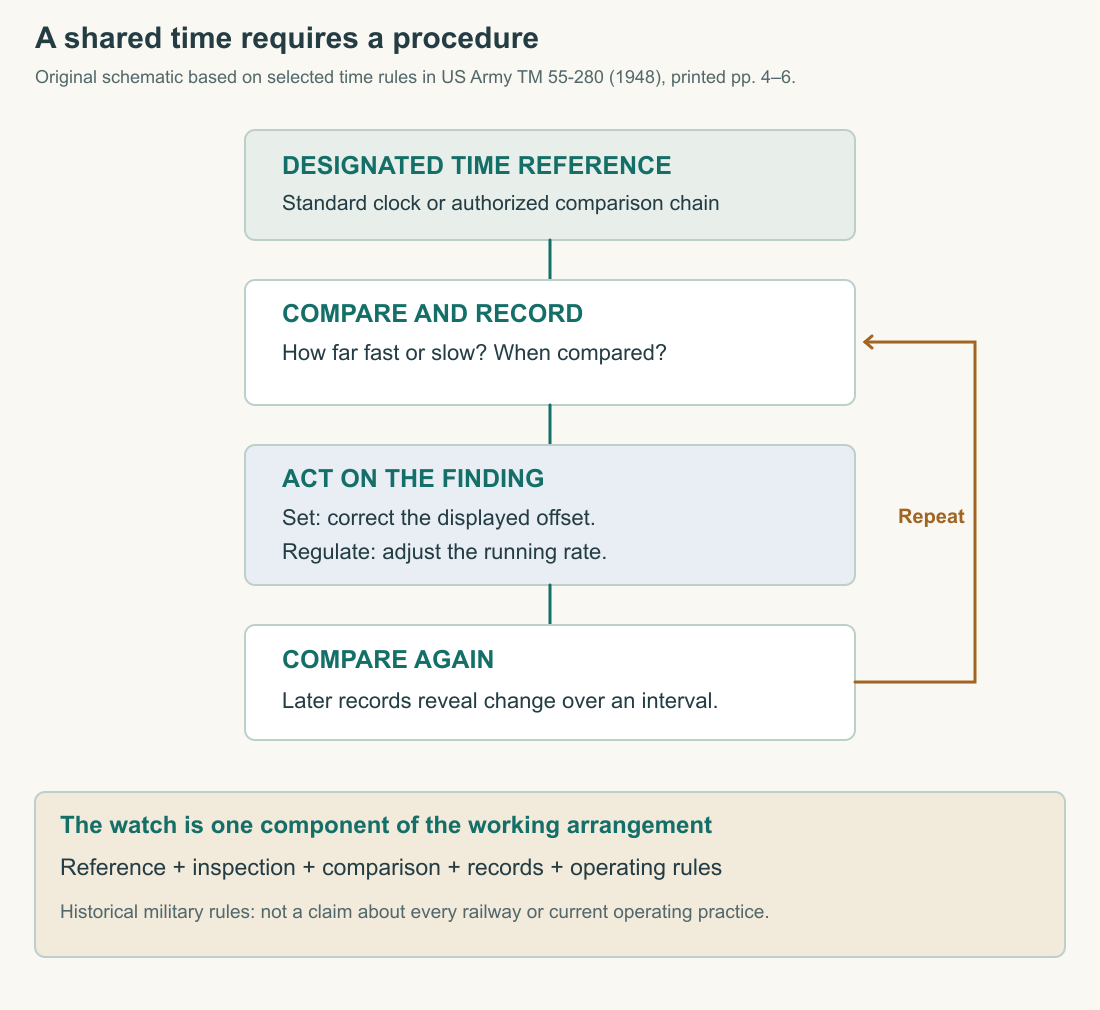
Follow the diagram from the reference to the person using the watch. At each step, ask who does something and what evidence remains. A network of objects becomes a working system through these actions. The diagram is an original explanation of the manual's relationships, not a reproduction of its organizational chart or a current operating procedure.
The form knows what must be remembered
Printed page 5 shows a watch certificate and a time inspection register. The certificate connects an identified watch and movement to a holder and an inspection. The register separates observations of seconds fast or slow from the action taken. These fields are small, but their arrangement is an argument about what an institution needs to know. A simple statement that a watch is good would not preserve the same information.
The printed certificate includes an illustrative holder named John Doe. Do not turn that example into a biography of an actual railway worker. Manuals often include completed sample forms to show how records should be kept. The historian must distinguish such teaching examples from documents produced during an actual inspection. The page is evidence of a prescribed recording practice even when its sample entries are illustrative.
Why separate seconds fast from seconds slow? Direction matters. A watch thirty seconds ahead and another thirty seconds behind disagree by a full minute. Averaging their signed errors would give zero, but no individual would thereby have the correct indication. A group average can conceal the very disagreement that comparison is meant to detect. This arithmetic is our explanatory example, not a calculation reported in the manual.
Why separate observation from action? A watch may be set to the reference, adjusted to change its rate or sent for repair. Recording only that it was inspected would not tell a later reader which intervention occurred. The distinction also helps prevent a common historical mistake: interpreting a record of a correction as proof that the instrument had always been accurate.
A small calculation with large implications
Consider two invented watch logs, observed at the same reference time on successive days. Watch A is five seconds fast on the first day and fifteen seconds fast on the second. Watch B is thirty seconds slow on both days. If neither was reset between observations, A gained ten seconds over that interval, while B maintained a constant offset in this simplified example. The watch with the smaller initial error has the less stable indication over the observed period.
Now change the condition: suppose B was reset just before the second observation. The same pair of recorded numbers no longer supports the same inference about its uninterrupted rate. We need to know the intervention history. That is why a useful log includes when comparison occurred and what was done. A list of readings without context can encourage a confident but wrong explanation.
We should not use these invented figures to declare a historical railway tolerance or decide that a particular error was safe. Acceptable performance depends on the actual rules and task. Our calculation teaches how offset, rate and correction differ. It also explains why a historian studying timekeeping needs forms and procedures alongside the beautiful surviving watch.
The timetable is another instrument
The 1948 manual also defines how its timetable is to be read. Its rules distinguish arriving and leaving times, establish what a single listed time means unless otherwise indicated and explain markings for meeting or passing. These conventions show that numbers do not interpret themselves. A reader must know the document's grammar before using its times.
For a harmless invented example, imagine a printed line containing a station name and “14:20.” Does that mean arrival, departure or a scheduled passing? Without a convention, the number is incomplete. Adding a second time does not solve the problem unless the order is understood. Typography, headings, legends and effective dates are part of the information, not decoration surrounding the real content.
The manual's rule about a new timetable superseding the preceding one adds another dimension: documents have versions. A person can read a number correctly from the wrong schedule. The watch may be synchronized and accurate, yet the action can still be mistimed. Reliable coordination therefore requires agreement about both the time reference and the instructions attached to it.
This is a useful way to read any historical schedule. Establish who issued it, where it applied, when it took effect and what its symbols meant. Only then compare its entries. Do not strip out the numbers and treat them as an independent dataset before understanding the document that gave them meaning. The same habit applies to factory shifts, school timetables and appointment books, although each requires its own evidence.
Whose schedule, whose consequences?
Shared time can make cooperation easier while also organizing authority. The ability to specify when work begins or which train has priority distributes obligations among people. A personal watch may help someone meet those obligations, check another clock or plan around a schedule. The effect depends on the relationship, not merely on owning the object.
A hypothetical employee who can compare a supervisor's clock with an independent reference has information that may matter in a dispute about lateness. But information alone does not establish the power to challenge the supervisor. To tell a historical story about such a dispute, we would need a complaint, testimony, a rule or a negotiated agreement. It would be too easy to make the watch automatically liberating or automatically oppressive.
The Army manual makes authority particularly visible because it names responsible roles and required routines. Its instructions tell us what was expected. They do not demonstrate perfect compliance. To investigate actual practice, we would need completed registers, reports, correspondence or accounts of failures. The gap between a rule and its observance is itself a historical question, rather than a reason to ignore the rule.
From a possession to a coordinated instrument
The watch on a railway worker's person belongs simultaneously to several systems. It is a manufactured mechanism, an object that can be owned or issued, an instrument compared with a reference and a tool used while interpreting a schedule. None of these descriptions cancels the others. Together they explain why improving one component could matter greatly without being sufficient by itself.
This chapter's sources also span different historical moments deliberately. The 1850s object record identifies a particular procurement response. NIST's account locates changes in regional and national conventions. The 1948 manual exposes the daily labor of comparison and documentation. We should connect these as parts of a history of coordination while preserving their differences in date, place and scope.
The next chapter turns to watches designed or selected for demanding tasks. Their stories are often told through famous expeditions and dramatic environments. We now have a better question to bring to them: what did the user actually need, and what combination of design, testing, maintenance and procedure made the watch useful there?
Application
Open printed pages 4–6 of the Army manual; PDF pages 10–12. Identify the source of time, the comparison intervals, an alternative when a standard clock is inaccessible and one field in the inspection register. Explain what failure each provision could help detect. Keep your account specific to this historical document.
Calculate the disagreement between one fictional watch twenty seconds fast and another forty seconds slow. Model answer: sixty seconds. An average error of ten seconds slow would describe neither watch. Explain why the comparison matters to coordinated action without inventing an acceptable railway tolerance.
Write a 250–350-word comparison of the Smithsonian railroad watch and the Army manual. A strong answer uses the object record to discuss procurement and the manual to discuss repeated practice. It does not imply that the 1948 rules governed the 1853 purchase, that the manual's John Doe was an identified historical worker or that a rule proves universal compliance.
For your exhibition, add one contextual document to an object card. State whether it governed this exact object's use or illuminates a comparable problem in a different setting. That distinction should remain visible in the finished caption.
Check your understanding: Why can two steadily running watches still fail to coordinate a meeting?
Expected answer: They may have different offsets because they were set to different references. Stable rates do not remove an initial disagreement; coordination requires an agreed reference and comparison procedure.