Quartz changes the industry
Imagine two watches on a development bench. Both keep remarkably steady time. One can be assembled by a specialist who knows where its components need adjustment. The other has a design that suppliers can reproduce, assembly workers can test, and repair centers can support. A laboratory comparison might place them close together. A manufacturing business might find a gulf between them. The history of quartz watches crosses that gulf: an oscillator became a product, and a product became an industry capable of selling very large numbers of watches.
Three different changes
A battery, a quartz oscillator, and a digital display are three different things. Their histories overlap without becoming interchangeable. A battery supplies electrical energy. An oscillator supplies a repeating event from which time can be counted. A display communicates the count to a person. A watch can therefore be electrical without being quartz, and quartz without displaying numerals on a screen.
Recall the balance wheel from How a Wristwatch Works. It oscillates mechanically. Supplying energy from a battery rather than a wound mainspring does not by itself replace that regulating system with quartz. A tuning fork supplies another possible oscillator. Quartz uses the electrical and mechanical properties of a crystal in an electronic circuit. The resulting oscillations are counted down to a useful timing signal. Hands can still present hours and minutes on a familiar dial.
Seiko's historical account of quartz development distinguishes the Hamilton Electric of 1957, Bulova's Accutron of 1960, and the subsequent quartz wristwatch. These names mark different technical arrangements, not three generations of the same movement. Its first Astron used an 8,192-hertz oscillator; the 32,768-hertz frequency familiar from many later quartz watches should not be projected onto every early example. Technology acquires standards through development. It does not arrive with every later convention already fixed.
The distinction matters when looking at an object. A photograph of a battery does not identify the oscillator. A photograph of hands does not identify the power source. A claim that a watch was an early electronic model requires evidence about its internal operation, not just its appearance. Conversely, a novel display may be historically significant even when the underlying timing principle is shared with less conspicuous watches.
From a working principle to a wrist
A quartz clock on a bench can occupy space that a wristwatch cannot. Shrinking the system means accommodating the crystal, circuit, power supply, display and connections within a wearable case. Power consumption becomes important because the wearer cannot continually replace a large external supply. Shock, temperature, assembly tolerances and serviceability affect the complete product even when the oscillator itself performs well.
These constraints interact. A display that consumes more energy can require a larger battery or less frequent use. A smaller component may be harder to assemble reliably with the available machinery. A protective arrangement may increase thickness. An engineer cannot solve the watch by maximizing the oscillator's performance while ignoring everything attached to it.
Consider an explicitly hypothetical development sequence. A team first demonstrates a timing circuit connected to a laboratory power supply. Next it packages that circuit with a battery and a display. A third version fits a wrist-sized case. A fourth survives the firm's chosen trials. A fifth can be manufactured repeatedly at an acceptable cost. Each success answers a different question. Describing the first demonstration as the introduction of the finished consumer watch would erase most of the work.
Production introduces variation. A hand-selected prototype may combine unusually good components and extensive adjustment. A production design must tolerate an expected range of component behavior or provide an economical way to identify unacceptable combinations. Testing is therefore part of manufacturing capacity. A factory that cannot detect its own failures consistently cannot infer the quality of a shipment from the performance of a celebrated prototype.
Two firms that complicate a national legend
One familiar story gives Switzerland the mechanical watch, Japan the quartz watch, and technological foresight entirely to the latter. Business historian Pierre-Yves Donzé's comparison of Longines and Seiko from 1960 to 1980 makes that division difficult to sustain. Longines actively investigated electronic timekeeping and worked with specialist partners. Its difficulty was not a complete failure to notice the technology.
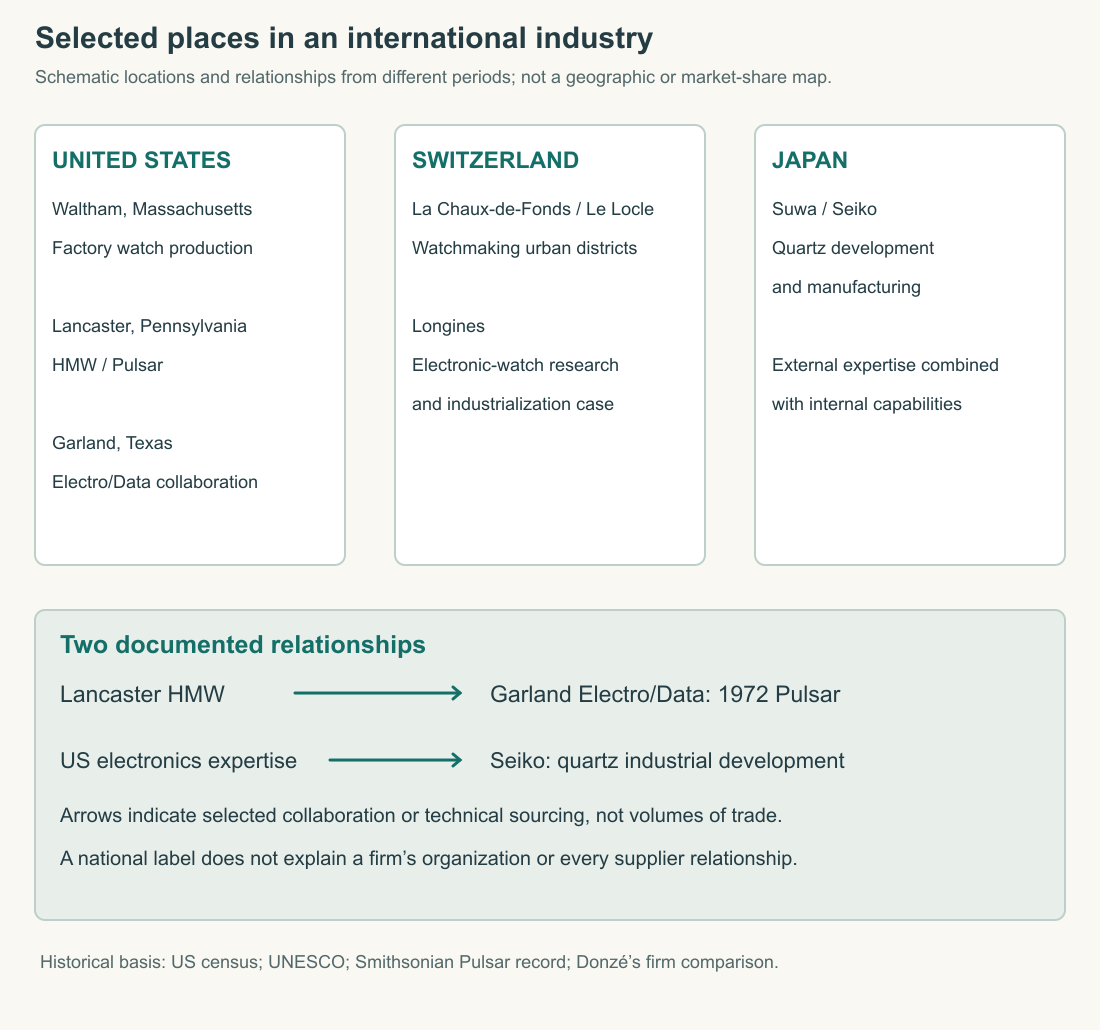
Donzé distinguishes research achievements from their connection to production. Longines showed prototypes but encountered problems moving toward dependable industrial manufacture. Seiko's development involved its manufacturing organization, external expertise and component suppliers as well as internal research. The two cases suggest that an invention's commercial consequences depend partly on how technical work connects to the rest of the enterprise.
This comparison supports an organizational explanation. It does not establish a national character. Two firms differ in size, resources, decisions and industrial surroundings; they are not identical experimental subjects assigned different flags. Nor does a successful Japanese manufacturer demonstrate that every Japanese firm followed the same path. Keep the scale of the evidence attached to the scale of the claim.
A useful term here is industrialization: establishing the processes, equipment, supply relationships, testing and organization required to make a product repeatedly. Industrialization can require inventions of its own. A clever assembly method may never appear on the dial, yet matter enormously to the product's availability. The distinction between inventing and manufacturing is analytical, not a ranking of intellectual worth.
The original diagram below identifies places and relationships discussed in this course. It is a schematic, not a map of market shares or a complete account of watch production. In particular, the American electronics connection prevents the Swiss–Japanese comparison from becoming a picture of sealed national systems.
Integration has more than one meaning
A vertically integrated firm carries out several stages of production within its own organization. A firm using specialist suppliers purchases more of those stages or components from outside. Neither arrangement automatically produces excellence. Internal production may improve communication and control but require large investments and expertise across many activities. Specialist suppliers may offer capabilities that would be slow or costly to reproduce internally.
The practical question is where responsibility, knowledge and feedback sit. Suppose a circuit supplier changes a component and the assembly line begins recording intermittent failures. Can the parties identify the change? Can the manufacturer distinguish a circuit fault from an assembly problem? Are specifications clear enough to resolve the disagreement? Ownership alone does not answer those questions. A close supplier relationship can communicate well; departments within one company can communicate poorly.
Seiko's use of outside electronic expertise is therefore not a footnote to a story of self-sufficiency. It is part of the process being explained. Donzé describes external connections alongside the development of internal capabilities. The resulting arrangement changed over time. Calling a company either integrated or dependent without specifying the stage and period conceals those changes.
A design can also become tied to the tools that make it. Suppose a manufacturer has invested in assembling one circuit arrangement. A revised circuit might reduce component cost but require new fixtures, new inspection procedures and a period of lower output while workers learn the process. The cheapest component is not necessarily the cheapest change. A competitor starting a new line faces a different calculation from a firm with functioning equipment and outstanding orders. This hypothetical example explains why timing matters in industrial history: an investment that made sense when authorized can become a constraint when conditions change. Explaining the constraint does not require assuming that the original decision was foolish. It requires reconstructing what the decision makers could know and what alternatives they could actually finance.
Knowledge also travels through people. Hiring engineers with relevant experience, assigning them to an industrial problem and giving them access to production feedback are different decisions from merely buying components. A firm can possess a patent and lack a workable manufacturing routine. It can purchase parts and still contribute substantial design, assembly and testing expertise.
A launch date is a narrow kind of fact
December 25, 1969 is the commercial release date of Seiko's Astron 35SQ given by the company and corroborated in Donzé's research. That makes it an unusually useful fixed point. It tells us when this model was offered commercially. It does not mean that all previous quartz work occurred that day, that the watch was immediately inexpensive, or that most people began wearing quartz watches in 1970.
Separate four milestones: a functioning demonstration, a wearable prototype, a commercial launch and broad adoption. Their order may be straightforward while their intervals vary greatly. A launch can involve small quantities and a high price. Adoption requires people to encounter, obtain and choose the product. It may also require retail distribution, replacement batteries, repair arrangements and confidence that the new product will remain usable.
A price needs a denominator. An introductory price in yen is not intelligible as an affordability measure merely because it is a large number. Contemporary earnings, competing watches, taxes and the relevant market all affect interpretation. Converting an old price at today's exchange rate answers a different question from comparing it with a worker's earnings at the time. This chapter therefore does not turn the Astron's launch price into an unsupported universal measure of luxury or accessibility.
The same discipline applies to production statistics. Units made are different from units exported, units sold through retailers and watches in use. A shipment in December may be sold the following year. A person may own several watches. Export value may rise while the number exported falls if the mix shifts toward more expensive products. These distinctions become especially important in the next chapter.
Why scale can change the competition
Consider a hypothetical manufacturer with two costs. Developing tools and production procedures costs 600,000 currency units. Each acceptable watch then costs 40 units to produce, before distribution and other expenses. At 10,000 watches, the development cost adds 60 units per watch, producing a combined figure of 100. At 100,000 watches, it adds six, producing 46. The arithmetic illustrates the spreading of a fixed investment. It is not a reconstruction of any historical company's accounts.
Now introduce yield, the proportion of attempted units that meet the relevant standard. If making each attempted unit consumes 40 units and only half are acceptable, the production expenditure per acceptable unit is 80 before any salvage or rework. At an 80 percent yield it is 50. These simplified calculations show why manufacturing reliability can matter alongside the nominal price of components.
Neither calculation guarantees that producing more is profitable. Unsold stock, financing, changing demand, warranty work and distribution can absorb the apparent advantage. Increasing output in advance of demand is a business risk. A technology with the potential for low costs does not make every investment in it sensible.
Scale can nevertheless alter what buyers expect. If dependable timekeeping becomes available at lower prices, a mechanical watch must compete in a market where accurate time alone may no longer justify its cost. That does not make the older object worthless. It changes the comparison. A firm's inherited skills may remain impressive while becoming less decisive for a particular customer's choice.
A new display makes a different proposition
The Smithsonian's 1972 Pulsar record identifies a quartz digital watch developed by HMW in Lancaster, Pennsylvania, with Electro/Data in Garland, Texas. Its light-emitting diode display was activated by a button. The record gives an original price of $2,100. These details locate an American contribution and a particular early product; they do not describe every digital watch.
A button-activated display changes the act of consulting time. The wearer performs an action to illuminate the numerals. That can make the display conspicuous and novel while introducing a different interaction from glancing at continuously visible hands. A display's usefulness depends on circumstances: lighting, available hands, visual familiarity and the information being shown.
Digital numerals also separate the representation of time from the spatial arrangement of hands. This can make an exact numeral easy to read while removing the familiar angular picture of how much of an hour has passed. Neither representation is intrinsically superior for every person and task. Historical explanation asks what users encountered and valued, rather than treating the eventual spread of a format as proof of universal preference.
The Pulsar example also disrupts a simple sequence in which quartz first means cheapness. An early electronic watch could sell novelty and technical distinction at a high price. Later affordability was an industrial and commercial development, not a property visible in the word quartz. The same technology can occupy different market positions at different moments.
What changed, and what still needs explaining
A technical transition can affect several groups differently. Manufacturers face altered investments and competition. Specialist workers may find that established skills are less demanded or move into a different market. Retailers need to explain unfamiliar products. Owners acquire new maintenance routines and expectations. These are related consequences, but evidence about one group does not establish the experience of all the others.
The term quartz crisis usually directs attention to disruption in the established Swiss industry. It is useful if the affected industry and period are stated. Used as a name for the whole world's experience, it obscures firms expanding production and buyers obtaining new choices. A historian can acknowledge serious losses without making those losses the sole meaning of the technology.
The strongest explanation assembled here has several parts. Electronic timing opened technical possibilities. Firms connected research, suppliers and manufacturing with unequal success. Launches preceded mass adoption. Displays and prices gave products different attractions. Changing competition altered the value of older capabilities. None of these mechanisms requires a story in which one country was inherently modern and another incapable of learning.
That account also leaves room for mechanical watches to survive for reasons other than defeating quartz at routine timekeeping. A watch can become desirable as a crafted object, a recognizable design, an association with a person, or a possession around which a community forms. The next chapter examines that shift without assuming that desirability proves technical superiority.
Application
Build a four-column chronology distinguishing demonstration, prototype, commercial launch and broad adoption. Include the Astron and Pulsar records, and mark any column for which the inspected sources do not supply a date or measure. Do not fill a gap with a guessed year.
Then write a 500-word explanation of why a working prototype might fail to become a successful mass product. Use the Longines–Seiko comparison, at least two manufacturing mechanisms and one limitation of the comparison. Keep national identity separate from the organizational explanation.
Check your understanding: Why does the Astron's December 1969 commercial release fail to establish either the beginning of all quartz research or immediate mass adoption?
Expected answer: A commercial release dates a product's availability. Research and prototypes can precede it, while price, production capacity, distribution and buyer decisions shape subsequent adoption. Separate evidence is needed for each milestone.