Connected time and the historical object
Apple's March 2015 launch announcement presented a wrist device that told the time, delivered notifications, supported applications and recorded activity. It also specified a relationship outside the case: the watch required a compatible iPhone and software. That dependency belongs in its history as surely as a winding key belongs in the history of an earlier watch. The object on the wrist is only part of the arrangement that makes it useful.
Read the announcement in its own year
The March 9, 2015 announcement scheduled availability in nine countries for April 24. It described two sizes and three collections, including a gold Edition. It presented the Digital Crown, touch interactions and tactile feedback as ways to operate the device. These are claims and specifications in a manufacturer's contemporary announcement, not an independent evaluation of performance or a description of the current product range.
Keeping the date attached changes how the evidence works. A compatibility statement can describe the 2015 launch without being useful advice for a purchase now. An announced battery duration can show what the company promised under stated conditions without establishing what every owner experienced. A launch announcement can identify availability plans without proving that every customer received a device on schedule.
The source is particularly useful for studying the proposed combination of functions. Timekeeping, communication, activity tracking, applications and personal appearance were offered together. Different buyers could therefore be attracted to the same device for different reasons. Its gold version also makes it difficult to place connected watches in a category concerned only with practical efficiency.
This chapter uses Apple as a documented case. It does not identify the product as the first smartwatch or treat one company's launch as the beginning of computing on the wrist. A priority claim would require a broader comparison, a definition of smartwatch and evidence about earlier devices. The case is substantial enough without that claim.
The boundary of the watch expands
A conventional mechanical watch stores energy and counts time largely within its case, although it still depends on setting, maintenance and the social standards discussed earlier. A connected watch can divide work among the wrist device, a paired phone and remote services. System boundary means the line we draw around the components relevant to the question being asked.
If the question is whether the case fits comfortably, the immediate physical object matters most. If the question is whether a notification arrives, the relevant boundary expands to include software, connections, permissions and the originating service. If the question is whether an old device can still perform its original functions, compatibility and continued service availability become historical evidence.
Consider a hypothetical notification failure. The watch displays the correct time but no message. Its oscillator may be functioning perfectly. The interruption could lie in a phone setting, an application, a connection or a remote service. Calling the watch broken identifies the user's experience but does not yet locate the fault. The same distinction matters when a museum describes a device that turns on but cannot reproduce its former networked behavior.
Dependencies are not inherently defects. They make possible functions that a self-contained movement cannot provide. They also distribute control over continued usefulness. A maker of the case, a software provider and an operator of a service may each affect the owner's experience. Historical analysis asks how that distribution works rather than assuming that independence or connection is always better.
Correct time can come from elsewhere
Earlier railway watches were compared with a reference through an organized human procedure. A connected device can receive time information through an electronic system. The method changes, but the distinction between a local display and a reference remains. A watch can appear correct because it is regularly corrected, not because its unaided oscillator maintains that agreement indefinitely.
This is the difference between synchronization and free-running performance. Synchronization brings clocks into agreement with a reference. Free-running performance describes what a clock does while operating without those corrections. A historical specification that promises close agreement during regular synchronization should not be read as an identical promise for indefinite disconnected operation.
The distinction also changes the meaning of a comparison test. Suppose two hypothetical watches show the same time at noon. One was just synchronized; the other has run without adjustment for a month. The observation establishes agreement at noon. It does not establish equal independent performance. A useful test records the starting conditions and any corrections during the interval.
Civil time includes conventions as well as seconds. Displaying a local hour requires a rule connecting a place and date to a time scale. Automatic adjustment can spare the wearer manual work, but it makes the correctness of stored or received rules part of the system. The railway chapter's concern with authoritative time has not disappeared. Some of the work has moved from people consulting published rules to software applying them.
A wrist is a place for attention
Moving information from a pocket or desk to the wrist changes when it can be noticed. A vibration can call attention without an audible signal. A small screen can make a brief message available during another activity. Whether that is helpful depends on the activity, the message and the person's choices about interruptions.
The original Pulsar's button-lit display already showed that electronic timekeeping could change the gesture of checking a watch. The connected device adds more gestures and more possible reasons to look. A crown can become an input device for navigating information as well as a familiar physical feature. Continuity of form can help introduce unfamiliar operations, even when the mechanism behind that form has changed.
A useful distinction is between a signal and an obligation. A device can signal that a message has arrived. Whether the wearer is expected to respond immediately is a social matter involving work, relationships and personal practice. An advertisement showing effortless connection does not establish the actual expectations people experience. Those would require evidence from users and their settings.
The watch can also make an action visible to others. Looking at the wrist during a conversation might be interpreted as checking the time, reading a message or signaling impatience. The observer may not know which function the wearer used. A multipurpose object can therefore inherit meanings from its older form while acquiring new ambiguities.
Measurement becomes an interpretation
An activity display presents selected measurements in a form intended to help a person understand behavior. A sensor detects a physical signal. Software processes the signal into a quantity or classification. The interface gives that result a name and a visual presentation. These stages should not be collapsed into the idea that the device simply sees the body directly.
For historical purposes, distinguish the function advertised at launch from later functions associated with the product family. It would be misleading to attach a later medical or diagnostic capability to an early device merely because the two share a brand name. The 2015 announcement is evidence for the launch proposition; it is not independent clinical validation.
A hypothetical activity target also illustrates the difference between measurement and judgment. Counting a selected behavior does not establish that the count captures every valuable form of activity or every person's circumstances. A target encodes a choice about what to encourage. Historians can investigate that choice without turning the chapter into personal health advice.
The same care applies to remembered experience. An owner may say that a device encouraged them to move more. That is useful testimony about their interpretation and behavior. It does not, by itself, establish a general effect across all owners. A course on the history of watches can preserve the testimony while keeping the scope of the conclusion proportionate.
Preserving more than the case
A museum can preserve a mechanical watch that no longer runs. Its materials, construction, inscriptions and traces of use still provide evidence. Restoring operation may reveal something about function, but it can also alter original parts or condition. Running is one possible source of information, not the sole measure of historical survival.
A connected watch raises additional preservation questions. A preserved case and circuit may not preserve the application version, phone relationship or remote service that once shaped its behavior. Screenshots, manuals, packaging, software documentation and recorded demonstrations can help establish what the object did. Each records only part of the original experience.
An emulator, a recording and a working original are also different things. An emulator recreates aspects of behavior in another technical environment. A recording shows a selected past interaction. A working original performs under its present conditions, which may differ from those at launch. A museum should identify which kind of demonstration a visitor encounters.
A catalogue can make these dependencies visible through separate fields. For an imagined connected watch, one field might identify the physical unit and its condition; another, the software version observed; a third, the paired device; and a fourth, the functions actually demonstrated on a stated date. A blank field should remain a gap, not acquire a plausible value copied from a different specimen. Such a record allows a later researcher to distinguish a missing function from an untested one. It also prevents a successful demonstration of the clock display from becoming an unsupported claim that messaging, applications and activity functions were all operating.
This is not unique to electronics. The appearance prototype in chapter seven cannot demonstrate the finished mechanism either. A replaced mainspring changes what can be claimed about an early watch's original performance. Across the course, material survival and functional reconstruction have required separate descriptions. Connected devices extend that problem into software and services.
Build an exhibition around a question
The course's final project is a six-object mini-exhibition. Its organizing question might be: how did portable time become something people wore, coordinated by, displayed and connected through? The objects should develop an answer through differences, rather than act as six illustrations of the same claim.
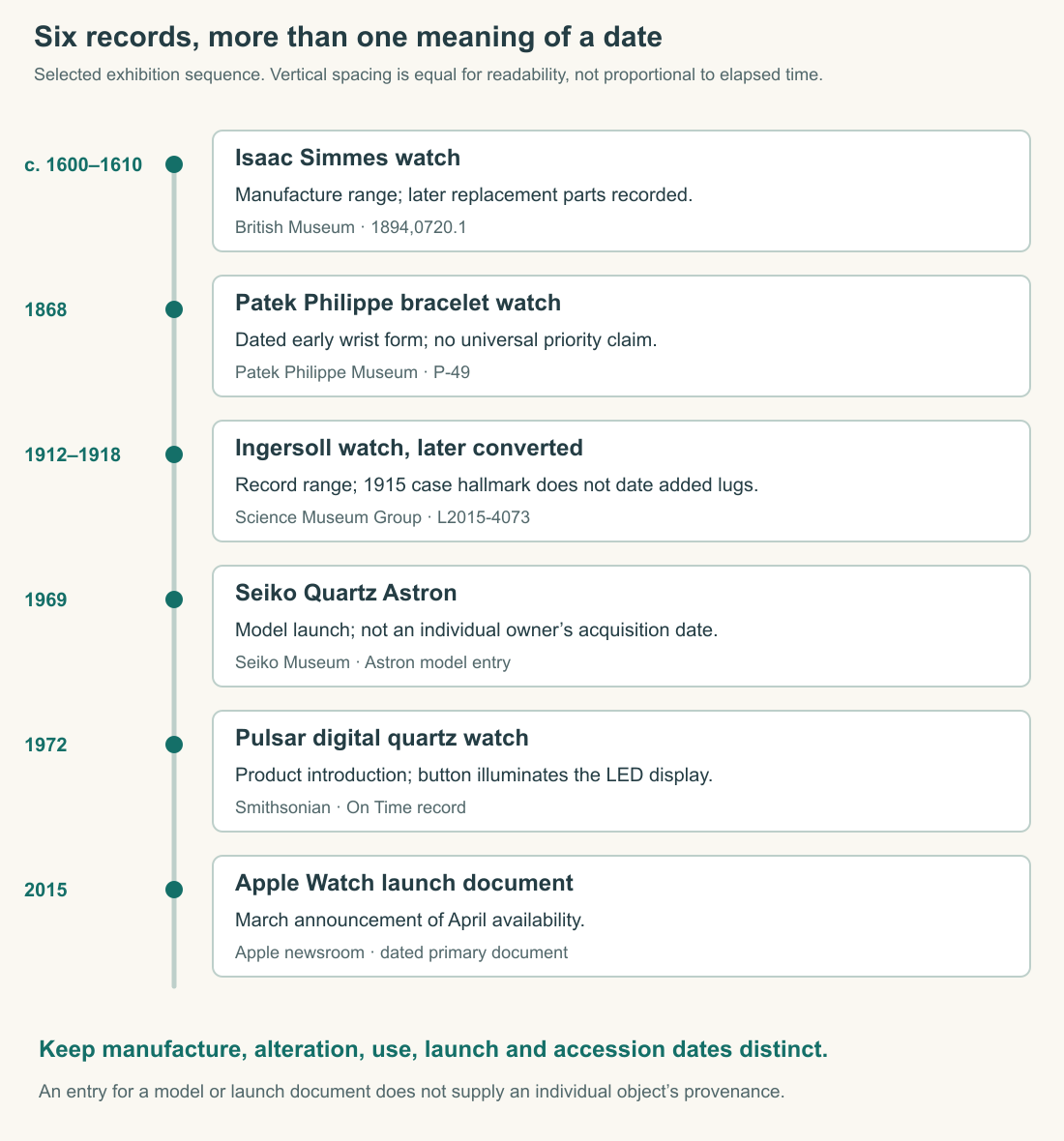
One possible selection begins with the Simmes watch of about 1600–1610. It introduces portable timekeeping before the wristwatch, including an alarm and striking arrangement. The 1868 Patek Philippe bracelet watch, inventory P-49, introduces a documented early wrist form. The Ingersoll conversion then makes alteration central: an existing object could acquire a new wearing arrangement. The record's date range and qualified wartime interpretation must remain visible.
The Seiko Museum's Astron entry introduces a Japanese quartz product launched in 1969. Its collection page identifies the model and year; it does not provide an individual ownership history. The 1972 Pulsar introduces American electronic collaboration and a button-lit display. Finally, the Apple launch document provides evidence for a connected watch's proposed functions and dependencies. This selection crosses Britain, Switzerland, America and Japan without claiming to represent every contribution from any of them.
That final entry is a documented product rather than an individually accessioned museum object. Label the difference. If the exhibition requires six physical museum objects, replace it with an appropriately documented accession and explain the resulting change in the argument. Do not invent an accession number to make the entries look uniform.
A disputed claim belongs in the display
Choose one claim for which the evidence is qualified or contested. The Ingersoll's possible wartime alteration is a manageable example because the museum record itself distinguishes evidence from interpretation. The task is not to manufacture a controversy. It is to show a reader why a plausible account remains less certain than a directly documented date.
A good caption identifies what is visible or recorded, the proposed explanation and the missing evidence. For example, a hallmark can help date a case without dating the later addition of lugs. A production range can locate the original watch without identifying its first owner. A plausible military use requires more than resemblance to watches associated with soldiers.
The exhibition can be coherent without resolving every uncertainty. Indeed, unresolved details can improve its central argument by showing that watches are made, altered, circulated and reinterpreted at different moments. One date cannot always stand for that entire life. An honest label invites attention to the object instead of using it as a prop for an overconfident story.
Application
Create a six-entry mini-exhibition in two to three hours. Use the proposed selection or substitute documented objects that preserve the course's geographical and technical range. For each entry provide a title, a relevant date with its meaning, maker or attribution, provenance or collection identifier where available, a source link and a 120–180-word caption. State whether the entry is an individually documented object or a product represented through a primary document.
Add a 350–500-word introduction that answers your organizing question. Include one explicitly qualified claim and a note explaining what evidence would resolve it. End with a short account of one object you excluded and what its inclusion would have changed. Use your own words; do not copy museum photographs without checking their separate image rights.
Assess the result by asking whether each object contributes a distinct step, whether prototype and production dates remain separate, whether Swiss, American, Japanese and British contributions have been handled accurately across the exhibition and introduction, and whether the reader can distinguish evidence from interpretation.
Check your understanding: Why is a preserved connected watch that powers on insufficient by itself to demonstrate its complete original experience?
Expected answer: Some functions may depend on a particular phone, software, settings or remote service. The physical device can survive while those relationships change or disappear. Documentation or reconstruction can recover aspects of the experience, but must be identified separately from original operation.