Evaluate a listing and a seller
A listing can be detailed and still leave the decisive questions unanswered. It may provide twenty photographs, a long description of the brand and a story about why the owner is selling, while omitting the bracelet's available length or the scope of a claimed service. The task is not to collect the greatest quantity of information. It is to identify the evidence that connects this offered object to your needs brief.
We will use a completely fictional listing. Its reference, seller statements, price and later replies are invented for analysis. They do not describe a real seller or establish market prices. The advantage is that we can examine ambiguous claims closely without turning an educational exercise into an accusation against someone whose object we have not inspected.
Read the offer once without improving it
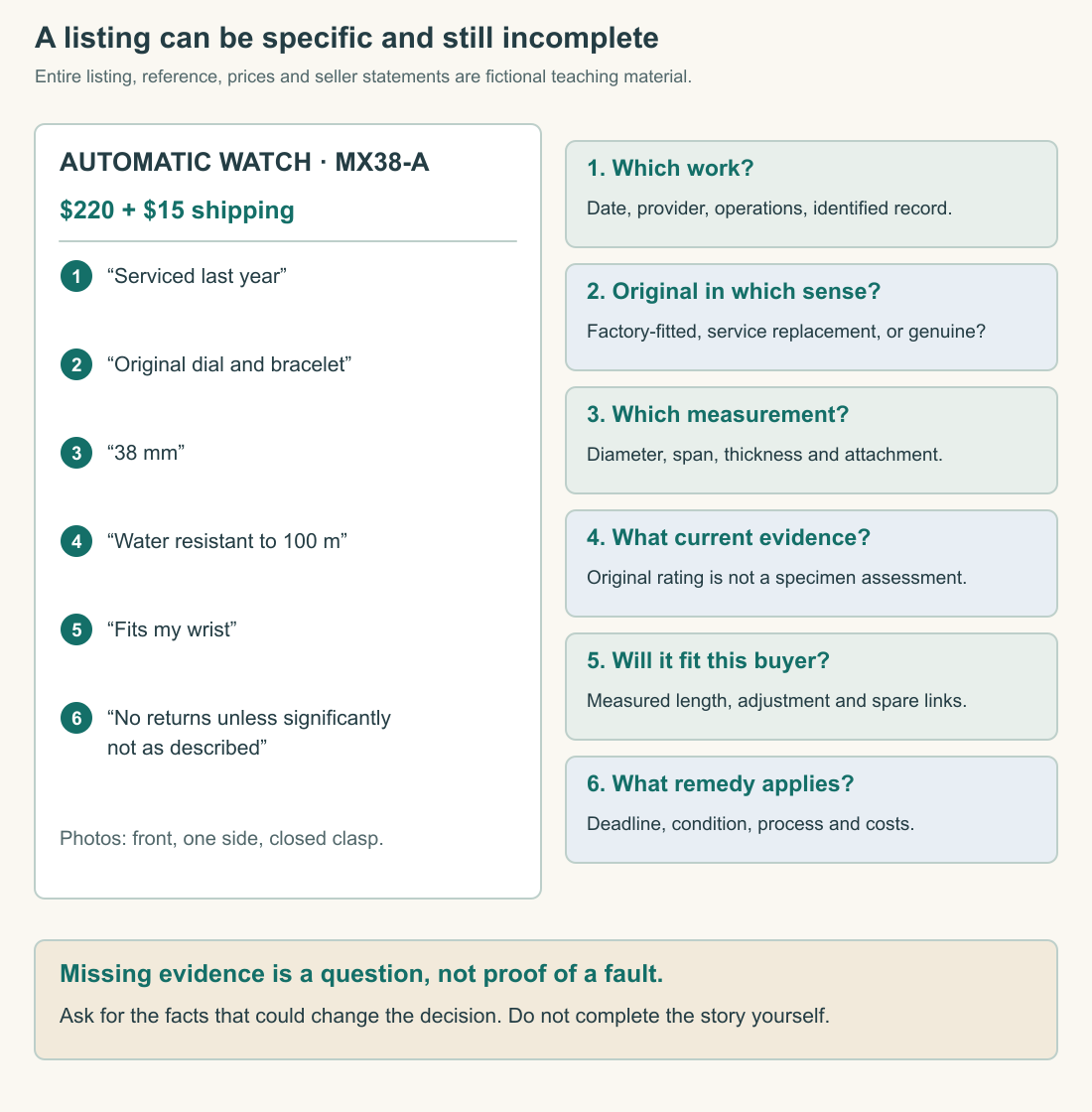
The invented listing reads as follows: “Automatic wristwatch, reference MX38-A. Excellent condition, running well. Serviced last year. Original dial and bracelet. 38 mm. Water resistant to 100 m. Includes box. $220 plus $15 shipping. Fits my wrist. No returns unless significantly not as described.” The photographs show the front, one side and the closed clasp. There is no service document, case-back view or measurement of the bracelet.
Do not silently repair this description. Original may mean several things. Serviced may refer to several operations. Fits my wrist gives no usable dimension for another person. Water resistant may repeat an old specification rather than report present testing. A box can belong to the model family without establishing the history of this particular watch.
First separate what the listing explicitly says from what you find yourself supplying. If you imagine a recent overhaul, a complete bracelet and an easy return route, you have added information. Those additions make the offer seem more complete without requiring the seller to establish anything. The first discipline of evaluation is to stop completing the story on the seller's behalf.
The diagram annotates the same fictional description. Its callouts identify missing evidence, not proven faults. A question mark beside a claim should remain a question mark until an answer or another source changes it.
Establish the identity of the item
A reference number can help locate specifications, compatible documentation and known configurations. A serial or case identifier can help distinguish an individual item where the manufacturer uses such numbering. These identifiers serve different purposes. The reference in a title does not prove that every component in the photographs belongs to that configuration.
Ask for clear views relevant to identification: dial, case back, sides, crown, attachment and any disclosed markings. The request should be proportionate to the value and uncertainty of the purchase. It should not require the seller to open a watch or expose unnecessary personal information. A qualified inspection can address internal questions when that evidence is needed.
Compare the actual photographs with an appropriate documented example, keeping the possibility of variants and service changes open. A mismatch in a hand, dial or clasp is a specific issue to investigate. It is not automatically proof of counterfeit construction. The useful next question identifies the difference and asks for its explanation and evidence.
Photographs should also represent the actual item offered. A catalogue image can establish the intended design but not the specimen's present marks, included links or condition. If a listing mixes catalogue and seller photographs, identify which is which. A well-lit stock image cannot fill a missing view of the actual case.
Ask for views that can change the decision
A request for more photographs is less useful than a request tied to a question. If case edges matter to an originality judgment, ask for clear oblique views in ordinary light. If bracelet fit matters, ask for the measured available length and any spare links. If a mark near the crystal concerns you, ask for a close view that distinguishes a reflection from surface damage.
An image can reduce uncertainty without settling it. A clear photograph may show that a mark is present but not whether it affects a seal. A side view can reveal a protruding pin without establishing why it protrudes. A case-back image can reveal an inscription while leaving its authenticity unresolved. The conclusion should match the evidence received.
Avoid asking the seller to perform destructive or improvised demonstrations. Opening a case, immersing an uncertain watch or exposing it to strong magnets is not a reasonable substitute for appropriate inspection. A functioning video can show that hands or controls moved during the recording. It cannot establish long-term reliability or water resistance.
For the fictional MX38-A, Mara's most useful first requests concern bracelet capacity, service scope, the actual item photographs and return terms. She does not need a longer account of the brand's heritage to answer those questions. An efficient inquiry follows the brief rather than every topic that could be interesting about watches.
Turn a claim into an evidence request
Serviced last year is the first major ambiguity. Mara asks for the service date, provider, work performed, replaced parts and a document identifying the watch. She also asks whether the service included any assessment relevant to the claimed water resistance. That last question does not turn the assessment into a permanent guarantee; it clarifies what the seller is relying on.
In our invented continuation, the seller replies that a local shop adjusted the rate and replaced a gasket, but did not overhaul the movement. The receipt identifies the case reference and date but gives no pressure-test result. The reply is useful. It converts a broad word into a narrower set of operations and reveals what remains unknown.
Mara should update the comparison rather than punish the seller for supplying detail. The watch has documented adjustment and a gasket replacement, not a documented complete overhaul. Current water performance remains unresolved. Whether she continues depends on her use, the total offer and the possibility of relevant inspection. A clarified limitation can be more useful than a vague reassuring claim.
The Seiko 4R service guidance provides a real example of how many different operations and replacements can fall within after-sales work. It does not apply to the invented MX38-A. It illustrates why a buyer must identify the actual scope instead of treating service as one uniform event.
Evaluate the response as evidence
A useful answer addresses the question, distinguishes knowledge from uncertainty and supplies relevant documentation when available. A polite tone alone does not establish condition. A short answer can be adequate if it contains the decisive fact. A long answer can remain uninformative if it repeatedly changes the subject.
Suppose the seller says the bracelet fits a seventeen-centimeter wrist and includes no spare links. Mara needs a larger fit. That answer may be enough to pause the purchase until appropriate links and their cost are established. The watch's attractive dial cannot remove the physical constraint. Nor should she assume that every similar-looking link will fit.
Suppose instead the seller says they do not know the bracelet size but will measure it. That is an unresolved fact, not evidence of dishonesty. If they refuse to provide any measurement while insisting fit is guaranteed, the offer gives Mara less reason to rely on that assurance. She can decline because the evidence is inadequate without making an accusation about motive.
This distinction is useful throughout purchasing. You do not need to prove that an offer is fraudulent to decide that it is unsuitable. A missing fact can be enough when it concerns a firm constraint or a loss you are unwilling to accept. Declining an insufficiently documented offer is a decision about your threshold for evidence.
Separate seller identity from product claims
A seller can have a legitimate business and still make an inaccurate description. A product can be genuine and still arrive in worse condition than expected. A platform can host a listing without independently verifying every claim in it. These are different layers of assurance.
When manufacturer authorization matters to warranty eligibility, check the manufacturer's own channel or obtain confirmation through an appropriate official route. A seller's logo or phrase authorized does not establish authorization by itself. The relevant question is the relationship for the specific brand and market, not whether the website generally looks professional.
Past feedback can reveal reported transactions but has limits. A large count does not tell you that earlier sales involved watches of comparable value or complexity. Recent, specific accounts can be informative, while a summary score hides the underlying experiences. Use reputation as one source of evidence, not a replacement for the actual offer's terms and condition information.
Do not collect personal data that does not answer a legitimate transaction question. The useful information concerns the seller's identity in the transaction, the item, the terms and the route for resolving a problem. Private family details or unrelated records do not authenticate a watch. More intrusive investigation is not automatically more rigorous investigation.
Read the remedy before relying on it
The invented return phrase significantly not as described leaves important questions. Who determines significance? How and when must a concern be reported? What evidence is required? Who pays shipping? What happens if the buyer simply finds the fit uncomfortable? Mara should understand those terms before treating returnability as a solution to her uncertainty.
Compare this with a real policy whose scope is explicit. Seiko USA's direct-store policy, as inspected on September 14, 2026, identifies a thirty-day period after delivery, original condition, included materials and purchaser-paid return shipping. Casio's US direct-store policy requires prior authorization and includes a potential five-percent charge for non-defective returns. Neither policy automatically governs the fictional private sale.
A buyer-protection program, seller return promise and manufacturer warranty are separate documents. They may address different events and require different evidence. Record which promise you are relying on for which concern. Do not assume that the existence of one makes every other gap irrelevant.
If a term is unclear, ask for a written clarification or choose an offer with terms you understand. The course is not deciding the enforceability of a private contract or replacing local consumer-law advice. It is teaching the earlier practical step: identify what the seller actually promises before you make a decision based on it.
Make the costs follow the evidence
The fictional $220 price plus $15 shipping gives an initial subtotal of $235 before any applicable tax or other charges. If the required bracelet links would cost 30 units in our invented scenario, that subtotal becomes 265. If a further 100 units of work proves necessary before use, the total becomes 365. Those figures are stipulated examples, not quotations or predicted service costs.
The final amount would exceed Mara's $350 initial limit even before unspecified charges. That does not establish that the watch definitely needs the work. It establishes that this unresolved possibility matters to the choice. A relevant inspection or firm quotation could change the comparison; a general assurance that it runs well cannot perform the same task.
State what would change your decision. Mara might proceed if appropriate links are available, the inspection finds no immediate work needed and the complete total fits her limit. She might wait if the service question remains unresolved. She might decline if the seller refuses evidence needed for her essential constraints. These are conditional decisions, not indecision.
The inquiry can now end when its purpose has been served. Either the evidence supports an acceptable offer, the remaining uncertainty is acceptable and explicit, or the buyer chooses another option. Continuing to ask questions after a decisive failure can consume time without improving the result. A focused evaluation should make it easier to reach a defensible decision.
Application
Annotate the fictional MX38-A listing with three columns: explicit claim, supporting evidence and missing evidence. Rank the missing items by their ability to change Mara's decision. Draft no more than five concise questions for the seller, each tied to a real constraint or uncertainty. Do not send them.
Update your table using the invented reply about rate adjustment and gasket replacement. Calculate the stated cost scenarios, preserving the unspecified tax and other charges. End with a conditional decision and one sentence explaining why inadequate evidence does not require an accusation of fraud.
Check your understanding: Why is a receipt for rate adjustment and gasket replacement insufficient evidence of a complete movement overhaul or a current water-resistance test?
Expected answer: It documents the operations it identifies. Those operations are distinct from dismantling and overhauling a movement or performing a relevant water-resistance assessment. Unlisted work cannot be assumed merely because the seller used the broad word serviced.