Make and defend a choice
Mara began with a search for a good watch under $350. She now has a needs brief, a way to read specifications, questions about condition and a plan for care. The remaining task is to choose—or to explain precisely why she should wait. More information is useful only if it helps resolve a decision. A comparison that grows indefinitely without changing the next step has stopped serving the buyer.
This final chapter builds a decision memo from three completely fictional offers. Their prices, dimensions, condition reports and terms are stipulated for teaching. They are not offers for the Casio, Seiko or Citizen models documented earlier, and they are not estimates of current market value. The real documents taught us how to examine evidence; the invented offers let us hold that evidence steady while working through a choice.
Keep the brief visible
Mara wants quick access to hours and minutes without notifications. She prefers a round analog dial, needs acceptable comfort with her cuff and will remove the watch for swimming and interfering activities. Her maximum initial total is $350, including any work or attachment necessary before use. She wants the maintenance routine to be manageable. She has not treated prestige or resale gain as a requirement.
The brief contains several kinds of condition. No notifications and the initial limit are firm constraints. A round analog display is a preference. Comfort is essential but must be established through suitable evidence. These distinctions matter because an attractive preference should not cancel a failed constraint, and an unknown should not be counted as a pass.
The final memo should preserve any deliberate changes to the brief. If Mara decides that the pleasure of a mechanical movement matters enough to accept regular restarting, she can say so. If she raises the budget, she must make that a separate decision about what she is willing and able to spend. A comparison table should not conceal either change by quietly moving its thresholds.
Three offers and the option to wait
All three offered watches in this exercise lack connected notification functions.
Fictional offer D is a new digital battery watch. It costs $40 in total under the exercise's stipulated charges, includes an appropriate adjustable resin band and has documented ordinary time and alarm functions. It sends no notifications. Its shape and digital display do not match Mara's preferred appearance. Fit has been checked in the imagined scenario and is acceptable.
Fictional offer M is a used automatic watch with a round analog dial. Its known initial total, including shipping and required links, is $265. Service evidence is incomplete. A further $100 of necessary work is a possible scenario, not a quotation or a probability-based forecast. Its documented approximate reserve does not cover Mara's sixty-two-hour weekend without additional energy. She likes its appearance, but its current mechanical condition remains unresolved. Its fit also remains untested.
Fictional offer L is a new light-powered analog watch. Its stipulated complete initial total is $340. Its documentation identifies the charging routine, and the exercise supplies clear seller terms and appropriate manufacturer eligibility. Mara likes the appearance. The available dimensions suggest it may suit her, but she has not yet tried the case and attachment. Comfort remains unknown.
Waiting costs no new purchase amount in this exercise and leaves Mara using her current phone. It does not immediately provide the dedicated wrist display she wants. It does preserve the opportunity to try L, clarify M's condition or discover that D's practical advantages matter more than she initially thought. Waiting is an option with consequences, not an empty row.
Filter before you rank
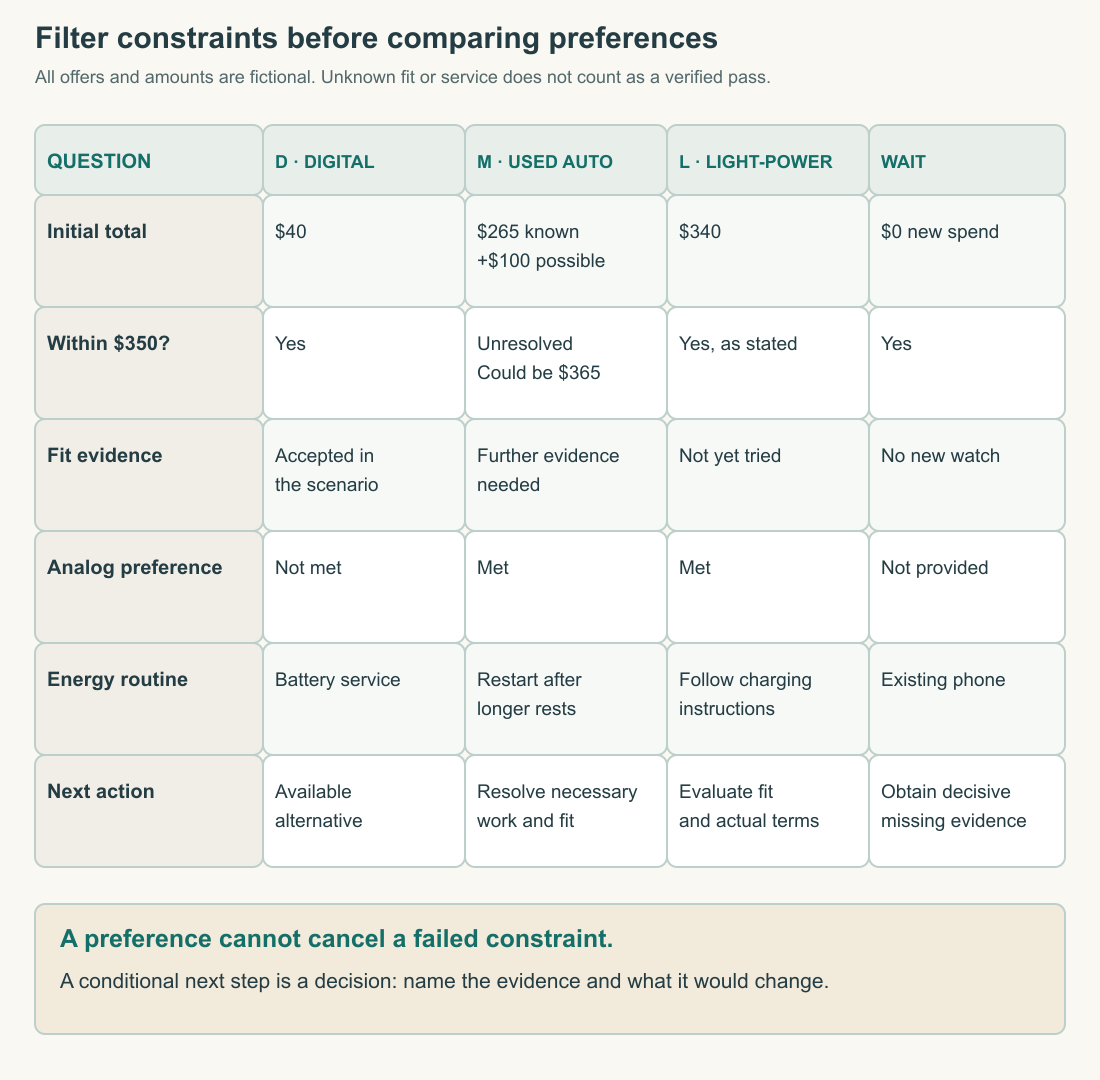
The first pass asks whether each offer satisfies the constraints. D passes the stated spending limit and known fit requirement in the fictional evidence. It misses a preference, which does not automatically eliminate it. M's known subtotal fits, but the possible necessary work would raise its initial total to $365. It cannot be treated as securely within budget until that uncertainty is addressed or accepted on explicit terms.
L fits the initial limit with ten dollars remaining under the exercise's stipulated total. That small margin is not an emergency fund or proof of low future expense. More importantly, its fit is untested. A documented return route may make evaluation manageable, but the buyer must understand its conditions before relying on it. The row remains conditional rather than becoming a verified pass.
A weighted score can conceal these distinctions. If a watch earns many points for appearance and heritage, it might receive the highest total despite failing an essential fit or spending condition. Adding preference points cannot make an unaffordable initial total affordable. Use scores, if at all, only after the constraints and unresolved facts have been made explicit.
The original matrix uses words instead of an invented precision. Each cell tells the reader whether the evidence supports a condition, identifies a preference or leaves a question unresolved. That is enough to make the next action clear.
Identify the decision that is possible now
Mara cannot honestly report that L is comfortable, because that observation has not occurred. She can report that it is the leading candidate to evaluate next. She can also choose D immediately within the exercise if its practical advantages outweigh her analog preference. The evidence supports different kinds of conclusion at different stages.
A useful present decision might read: “I will first try L or obtain a clearly usable evaluation route. If it fits and the actual complete offer remains within my limit, it best matches my preferred display and energy routine. If fit fails, I will reconsider D. I will not proceed with M while necessary work could push the initial total above my limit.” This is a definite sequence with conditions, not a vague promise to keep researching.
The memo should state what would change the sequence. A reliable inspection could show that M needs no immediate work, reducing a decisive uncertainty. Mara might then accept its restarting routine because she values the mechanical interaction. Alternatively, she might discover that D's display is easier for her to read and revise the importance of analog appearance. A good decision process can respond to new evidence without pretending the original reasoning was a mistake.
Do not demand certainty about everything. No purchase can establish every future service event or guarantee permanent satisfaction. The goal is to resolve the facts most likely to affect the decision and state the remaining uncertainty proportionately. A small cosmetic preference and an unknown necessary repair do not deserve equal investigative effort.
Distinguish spending from money held aside
An initial total is the amount required to obtain a usable object under the relevant offer. A maintenance allowance is money reserved for future needs. Actual maintenance spending is what eventually occurs. These three quantities should not be merged into a single figure labeled cost without explanation.
Suppose Mara adopts a wholly invented planning exercise for the next five years. She considers setting aside twenty units per year for D, fifty for M or thirty-five for L. Those amounts are arbitrary teaching allowances, not manufacturer recommendations, service quotations or predicted annual expenses. Over five years they accumulate to 100, 250 and 175 units if none is spent. The arithmetic describes saving under the assumption; it does not forecast the watch's behavior.
Adding those reserves to the stipulated initial totals produces planned allocations of 140 for D, 515 for M before any immediate extra work, and 515 for L. Equal allocations do not establish equal ownership costs. One reserve may remain mostly unused; another may prove insufficient. A real decision should replace arbitrary allowances with relevant quotes and reasonable scenarios where possible.
A cost-per-wear calculation has similar limits. Dividing a purchase price by an assumed number of future wears can make almost any purchase look small enough per day. The result depends on actually using the object as assumed and excludes other costs unless they are included deliberately. It cannot make money available at the moment of purchase or guarantee that the owner will keep wearing the watch.
Keep resale out of unsupported affordability claims
A buyer may eventually sell a watch, but a future sale price is not guaranteed. Condition, demand, fees, the sales route and time all affect the outcome. A current asking price is not a completed transaction, and a completed transaction for a different specimen is not a promise about yours. This course does not ask the learner to forecast appreciation.
Mara should therefore decide whether she can accept the purchase for its intended use without relying on a favorable future resale. If a later sale returns some money, that becomes an actual event to record. It should not be inserted as a certainty to make an initially uncomfortable purchase appear affordable.
An inherited or sentimental object adds another reason to separate market value from ownership value. The owner may have no intention of selling. Maintenance can be worthwhile because this particular object matters. The memo can state that reason directly instead of forcing every choice into an investment calculation.
This separation also protects enjoyment. A watch chosen for use can acquire marks without every mark becoming a failed financial strategy. An owner concerned primarily with preservation may choose a different wearing routine. Both decisions are clearer when their purposes are stated at the beginning.
Carry the choice into an ownership plan
If Mara eventually chooses L, the memo should not end with its attractive features. It should identify the exact delivered model and manual, the charging and setting routine, the attachment, the permitted use and the service contact. A plan based only on a fictional category must be replaced with the real product's instructions before actual use.
If she chooses M after appropriate inspection, the record should preserve what the inspection established, what work was performed and what remains uncertain. Her plan should acknowledge restarting after periods without sufficient energy. A used-watch decision becomes easier to live with when the owner remembers the limitations they knowingly accepted.
If she chooses D, the plan should include the applicable module instructions, alarm and signal settings, battery-service route and attachment care. Choosing an inexpensive digital watch does not require pretending it is maintenance-free. It simply creates a different set of responsibilities.
Waiting also gets a plan. Mara can name a date or opportunity for a try-on, a question to resolve and a point at which she will stop searching if no acceptable option emerges. The plan need not promise a purchase. It should prevent waiting from turning into endless browsing that no longer serves the original aim.
Write for a reader who can disagree
A strong decision memo begins with the choice or next action, then explains the evidence. It should allow another reader to see where a different preference would produce a different result. It does not need to persuade everyone that the selected watch is universally best.
Separate the strongest evidence from the most attractive story. For Mara, the clear initial total and acceptable fit of D are stronger facts than an imagined future attachment to a mechanical movement. That does not mean D must win. It means the memo should identify when an emotional preference is doing the work and whether Mara accepts the practical consequence.
Include one serious reason against the preferred candidate. For L, untested fit is decisive before evaluation; its narrow budget margin may also matter if the actual offer differs from the stipulated one. Acknowledging that reason improves the choice by making the required check visible. It is more useful than adding a token disadvantage that could never affect the result.
The final judgment should be modest in scope and firm in reasoning. This watch, in this condition, under these terms, fits this person's purposes better than the available alternatives—or it does not yet have enough evidence to justify purchase. That sentence captures the work of the course without reducing taste to a score or turning uncertainty into paralysis.
Application
Write a decision memo of 800–1,200 words comparing three candidates and the option to wait. You may use the fictional offers above, your own clearly labeled invented offers or real offers that you actually inspect. No purchase is required. The Seiko USA warranty and Casio US return policy provide examples of documents to read; use the terms actually applicable to your chosen offer. For real prices and terms, record source, region, currency, access date and the scope of the offer. Preserve unknowns rather than filling them with plausible figures.
Include your needs brief, a comparison table, the initial total, relevant future-cost scenarios, condition and seller evidence, a care plan and a clear decision or next action. State one reason against your preferred option and the evidence that would change your mind. Distinguish actual spending, allowances and uncertain future events.
Assess the memo by checking that no failed constraint is hidden by preference points, no untested fit is reported as observed, no service claim exceeds its record and no manufacturer's policy is assigned to an unrelated seller. A good result explains a suitable choice; it does not require a collection, an expensive watch or a completed transaction.
Check your understanding: Why can M and L have equal planned five-year allocations in the invented example without having equal actual ownership costs?
Expected answer: The allocation includes arbitrary amounts held aside, not verified future spending. M also has unresolved possible immediate work. Actual costs depend on what occurs and what the applicable services cost; equal planned reserves plus initial totals do not establish equal outcomes.