Housing and access to the city
A new apartment building opens, rents in the surrounding area rise, and two observers draw opposite conclusions. One says the building caused the increase. The other says it prevented an even larger increase. Both point to the same sequence of events. To evaluate the claims, we need a model of housing demand and supply, an account of who can obtain which homes, and evidence about what would have happened otherwise. Housing is simultaneously shelter, a location, a contractual relationship and an asset. Each aspect creates different interests and constraints.
Begin with the bundle a home provides
A home provides indoor space and access to a location. Its value to a household can depend on work, schools, transportation, family, accessibility and familiar institutions. Two dwellings with similar floor plans may therefore be poor substitutes for a particular person. A lower rent far from a caregiving relationship may not offer the same practical possibility as a nearby home.
This does not mean households have unlimited attachment to one place or never respond to prices. It means the cost of moving includes more than the moving truck. Time, disrupted routines, information and the loss of local support can matter. An explanation of housing choice should identify the relevant alternatives rather than assume that every cheaper dwelling is equally usable.
Tenure describes the relationship through which a household occupies a home, such as renting or owning. A price increase can affect different tenures differently. A renter may face a higher payment when the applicable arrangement permits it; an owner may gain asset value while facing maintenance, financing or other costs. The same neighborhood change can therefore produce different consequences within the same street.
Even the owner category contains variation. An owner living in a home, an owner renting it to others and a person purchasing a future development opportunity do not face identical decisions. The analysis should identify the actor, asset and time horizon. “Housing became more valuable” is not a complete account of who benefited, who paid more or who could remain.
Distinguish demand from need
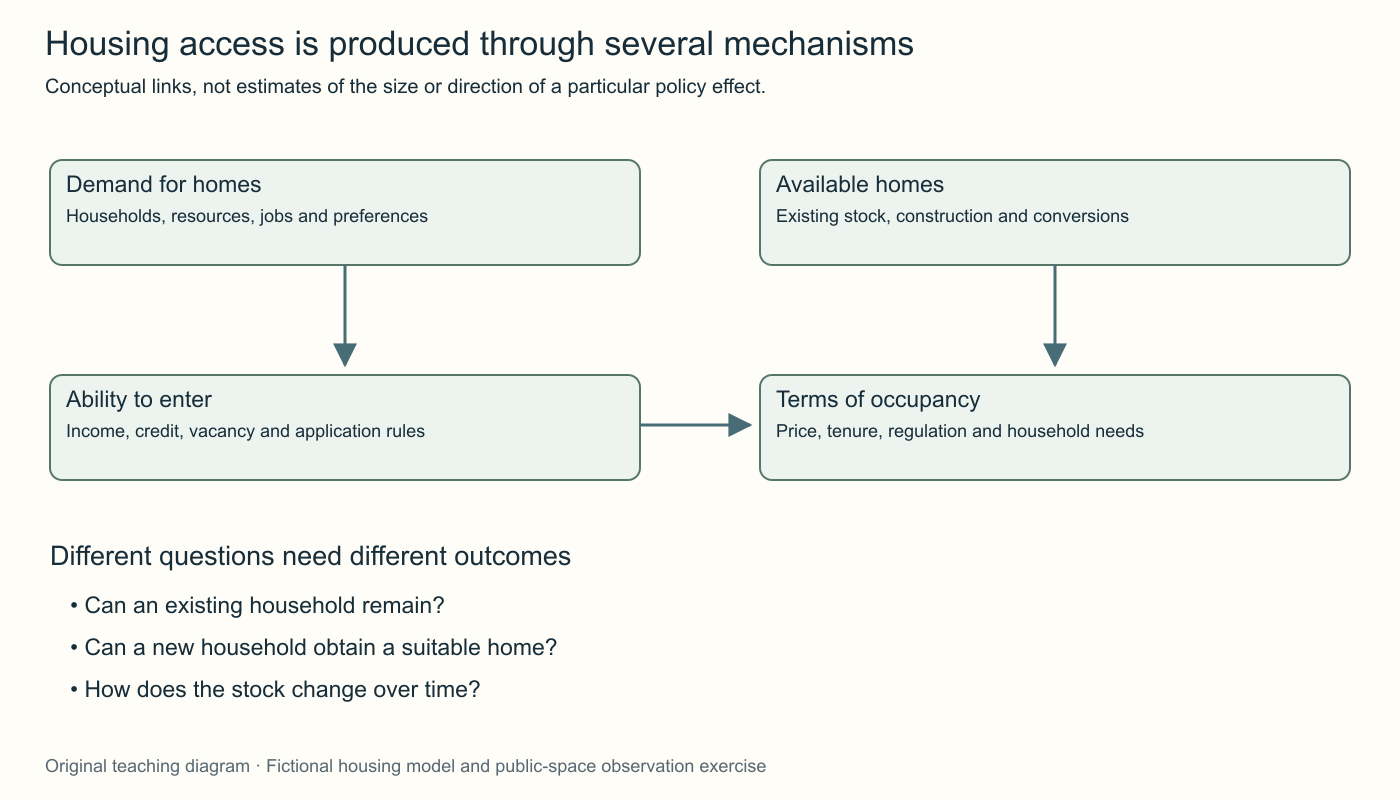
Housing need concerns what people require for adequate shelter and a workable life. Market demand concerns the willingness and ability to obtain housing at particular prices and conditions. Need can be severe without translating into enough purchasing power to secure a home. Confusing the two can make the market's allocation appear to measure the intensity or legitimacy of human need.
In a fictional example, two households seek a two-bedroom apartment. One can pay twenty units per month; the other can pay twelve. The second household may have greater practical need for the location, but a price-based allocation does not automatically reflect that. A subsidy, public allocation rule or other arrangement could change the effective options, each with its own eligibility and resource questions.
Demand can change when employment, household formation, income, borrowing conditions or preferences change. The important causal question is which change occurred in the setting being studied. A popular new café may coincide with higher rents because both respond to rising local purchasing power. Its presence alone does not establish that it generated the entire change.
Likewise, a new building may be constructed because developers anticipate demand growth. Comparing the area before and after construction would then combine the building's effect with the demand conditions that helped produce it. The sequence is real; the causal attribution remains unsettled. We need a credible comparison or stronger evidence about the mechanisms.
Supply is a process with time and constraints
The supply of usable housing depends on existing homes, construction, conversion, demolition, maintenance and whether dwellings are available for the relevant use. A change in the number of rental homes is not necessarily the same as a change in the total number of homes. Converting a rental building to owner occupancy can alter access for renters without removing the physical structure.
Construction requires land, financing, materials, labor, permissions and time. A rule can constrain one part of the process; a shortage of financing can constrain another. Removing a rule does not guarantee that every otherwise unviable project becomes viable. Conversely, identifying other costs does not establish that rules have no effect. A useful explanation locates the binding constraint for a defined class of projects.
A simplified model shows why timing matters. Suppose a town has one hundred homes and demand expands before any new homes can be completed. In the short run, households compete over the existing stock. Over a longer period, additional construction may change the available options. The initial price response and the later response need not be identical.
The model is deliberately incomplete. Homes differ, households share space, some people move away, and vacancies serve purposes such as matching and repair. We use the simplification to identify a relationship, not to calculate an actual city's rent from one number. A serious empirical application must recover the relevant distinctions and explain what the model omits.
Read a San Francisco policy study carefully
Rebecca Diamond, Tim McQuade and Franklin Qian studied San Francisco's 1994 expansion of rent control using differences in coverage among small multifamily buildings by construction period. Their 2019 paper links address histories and property records. It finds greater residential retention among incumbent beneficiaries alongside a reduction in rental supply in affected buildings through conversion and redevelopment. Assignment was quasi-experimental, not a randomized lottery. The study concerns a particular historical expansion; it does not establish the effect of every policy called rent control. See the published paper and abstract and the authors' final draft.
The value of examining both sides is conceptual as well as empirical. A policy changes the situation of current tenants and the incentives of property owners. Focusing only on immediate tenant retention would omit an important response. Focusing only on supply would omit a benefit to people already living in the affected homes. Different outcomes can be true at the same time.
The research comparison also requires scrutiny. Older and newer buildings may differ in ways relevant to later outcomes. A credible quasi-experimental account must address the possibility that those differences, rather than coverage, explain the result. Examining prior patterns, comparable locations and alternative specifications helps assess the claim; the label natural experiment does not remove the need for that work.
Finally, movement and displacement require careful interpretation. An address change records a move; it does not automatically reveal the person's full reasons or preferences. Remaining can reflect valuable stability, a constrained choice or both. A study can estimate residential patterns while leaving aspects of experience to other methods. We should preserve that distinction when translating findings into public argument.
Follow a policy through different groups
Imagine a fictional policy that lowers costs for one hundred incumbent tenants. Eighty remain, compared with seventy under a plausible alternative. That difference may represent an important protection. Now suppose owners convert some rental units to another use, reducing options for future renters. Evaluating the policy requires identifying both populations rather than announcing a single result for “renters.”
Future renters are difficult to represent in local debate because many are not yet present. They may include young adults forming households, newcomers taking jobs and people seeking to return. Incumbents have concrete relationships and immediate risks. Recognizing future access does not erase those risks; recognizing current attachment does not make future access irrelevant.
Owners also differ in exposure and response. Some may continue renting, some may sell, and some may change the property. A theoretical incentive is not a uniform behavioral prediction. The range of legally and practically available responses, the cost of changing use and the owner's circumstances all matter. Historical research can inform that account without substituting for current policy details.
This is why a distributional evaluation asks who gains or loses, through which mechanism and over what period. An aggregate benefit could coexist with concentrated losses, while a visible local benefit could shift costs outward. The ethical judgment requires stated values in addition to the empirical account. The data do not silently select whose interests should dominate.
Credit and screening shape effective access
A household may be able to sustain a payment but fail a screening requirement or lack resources for an initial cost. Conversely, access to borrowing can increase the amount a household can bid without increasing the number of homes immediately available. Credit conditions therefore interact with housing prices and allocation rather than simply reflecting preexisting need.
Use an invented rental example. Monthly rent is ten units, but entry requires thirty units for permitted initial charges and moving costs in this hypothetical setting. Household A has twelve units of monthly available resources and thirty-five saved. Household B has the same monthly resources and five saved. Their continuing budgets look alike, but their ability to enter the tenancy differs.
This example is not a statement about legal deposit limits anywhere. It distinguishes a recurring affordability constraint from a liquidity constraint: having resources available at the moment they are required. Different interventions act on these constraints. Reducing a monthly payment does not necessarily supply an initial sum; financing an initial sum does not necessarily make an ongoing payment sustainable.
Screening can also use proxies. A requirement intended to predict reliable payment may exclude applicants whose circumstances do not fit its conventional evidence. Whether a criterion is informative, necessary or unfairly exclusionary is an empirical and normative question. The analyst should examine the criterion's purpose, predictive performance and alternatives rather than infer merit from acceptance alone.
Affordability is not captured by one median
A median describes the middle of a distribution under a specified definition. Median rent is not the rent every household pays, and median household income is not the income of the household paying the median rent. Dividing the two medians does not generally produce the median household rent burden. The observations and populations are not paired in that calculation.
Consider three invented renter households. Their monthly incomes are 20, 30 and 100 units, and their rents are 10, 12 and 20. The median income is 30 and median rent is 12, giving a ratio of 40 percent. Their individual burdens are 50, 40 and 20 percent, whose median happens to be 40. That agreement is possible but not guaranteed.
Change only the rent assignments: the same incomes now pair with rents of 12, 20 and 10. The medians of income and rent remain 30 and 12. Individual burdens become 60, about 67 and 10 percent, whose median is 60. Identical separate medians now coexist with a different median burden. The relationship among observations is essential.
Our supplied Census comparison later uses household income and gross rent as separate indicators. It will not turn their ratio into a measured affordability burden. It will also distinguish occupied-unit rent from asking prices for available listings. These measures can differ because they describe different populations and moments in the housing process.
Quality changes create another comparison problem. Suppose an area’s average listed rent rises after several large new apartments enter the listings. The increase could reflect a changed mix of available homes even if the asking rent for every previously listed apartment remained constant. To investigate a price change for comparable housing, we would need to account for characteristics such as size, location and condition, or follow the same units over time. That does not make the new listings irrelevant to access. It distinguishes a change in the price of a comparable home from a change in the homes being offered.
The objection: does complexity prevent a conclusion?
A reader may worry that every housing claim has now acquired so many qualifications that no decision is possible. The answer is to make the question narrower. Instead of asking whether construction or regulation is good in general, ask what a specific change does to a defined outcome for a defined population over a stated period.
A narrow question can still have policy importance. Does a particular process add avoidable delay to feasible housing? Does a protection increase incumbent stability? Does a subsidy improve access for eligible households? Each question needs an appropriate design and can produce useful evidence. Broader judgment then assembles those findings while acknowledging tradeoffs and uncertainty.
We should also distinguish uncertainty about magnitude from uncertainty about every mechanism. A supply response may be plausible while its size remains uncertain. An observed retention benefit may be well supported while its value relative to other goals remains contested. A clear account states where the evidence is strong, where it is incomplete and where disagreement concerns values rather than facts.
For neighborhood analysis, the practical lesson is to follow people and housing separately. A building can remain while tenure changes; a household can leave while the area prospers; an incumbent can benefit while a future entrant faces fewer options. These are not paradoxes once the units and time horizons are explicit. They are the ordinary consequences of a city whose homes connect shelter, property, opportunity and attachment.
Check your understanding: Why is median rent divided by median household income not generally a measured median rent burden?
Expected answer: The separate medians do not preserve the pairing of rent and income within households, and the income and rent tables may cover different populations. A burden measure requires the relevant household-level relationship or an appropriately defined published burden table.
Application
Allow twenty-five minutes. Draw a mechanism map for one fictional housing change: new construction, a tenant protection, a subsidy or a conversion from rental to owner occupancy. Identify an incumbent renter, a future entrant, an owner and one possible response by each.
Write 300–400 words separating immediate and longer-term outcomes. Include a serious alternative explanation for an observed price change and name the comparison needed to investigate it. Do not treat the San Francisco study as a universal estimate or the fictional entry-cost example as current law.
A strong response distinguishes need from purchasing power, total housing from rental availability, observed movement from reasons for moving, and an empirical tradeoff from the values used to judge it.