Public space and social contact
At lunchtime, a small plaza is full. At eight in the evening, it is empty. One visitor calls it a successful public space; another calls it lifeless. Their observations may both be accurate. The disagreement concerns the time, purpose and standard used to judge the place. Public space brings people into possible contact, but presence, interaction, belonging and safety are different outcomes. This chapter develops a method for studying those distinctions without turning a brief visit into a confident diagnosis of an entire neighborhood.
Publicness has several dimensions
A space can be publicly owned, publicly accessible, publicly visible or publicly governed in different combinations. Ownership alone does not tell us who can enter, when they can enter or which activities are permitted. An indoor space can be accessible to the public during stated hours, while an outdoor area can have restricted access. A useful description records the actual arrangement.
San Francisco's Planning Department describes privately owned public open spaces, or POPOS, including plazas, terraces, atriums and small parks provided and maintained through private development. The category makes the distinction between ownership and access concrete. It does not establish identical hours or conditions at every location. See the official POPOS overview and guide.
For an observation exercise, read the current signs and public information for the selected site. Record what they say and when you checked them. Do not assume that an old guide guarantees present access. If entry is unclear, use an unambiguously accessible alternative or the supplied fictional observation rather than testing a boundary through confrontation.
Publicness also concerns usability. A place can be open in principle while difficult to find, reach or navigate. An entrance that resembles a private lobby may discourage people who would otherwise be permitted to enter. A bench without a usable route is not equally available to everyone. These are hypotheses about practical access that observation can begin to investigate.
Read Jacobs as an account of a mechanism
In The Death and Life of Great American Cities (1961), Jane Jacobs argues that street activity, bordering uses and people attending to the street can contribute to public safety. Her phrase “eyes upon the street” describes a mechanism involving ordinary presence and attention, not merely formal policing. The excerpt links varied destinations to reasons for using sidewalks. It is a primary argument illustrated through urban observations, not a randomized demonstration that every busy street is safe. Read Jacobs's sidewalk-safety passage.
The mechanism has several steps. Destinations give people reasons to be present. Their presence creates opportunities to observe events. Some observers may respond in ways that discourage harm or help others. Each step can fail. A destination may be closed, people may be distracted, or an observer may misinterpret an unfamiliar person as a threat. The presence of eyes is not the same as constructive attention.
This is a useful way to read theory: identify the proposed sequence and ask what evidence would show it operating. A photograph of a crowded street supports a claim about visible presence at one moment. It does not establish the frequency of harmful events, the willingness to help or the experience of people who avoid the street.
Jacobs also prompts an important challenge to empty-space aesthetics. A place can look orderly in a rendering and provide few reasons to remain there. Yet we should not replace one universal preference with another. Some users need quiet, shade, rest or distance from crowds. Public-space analysis asks which uses a design supports, when, and for whom.
Define the observation before arriving
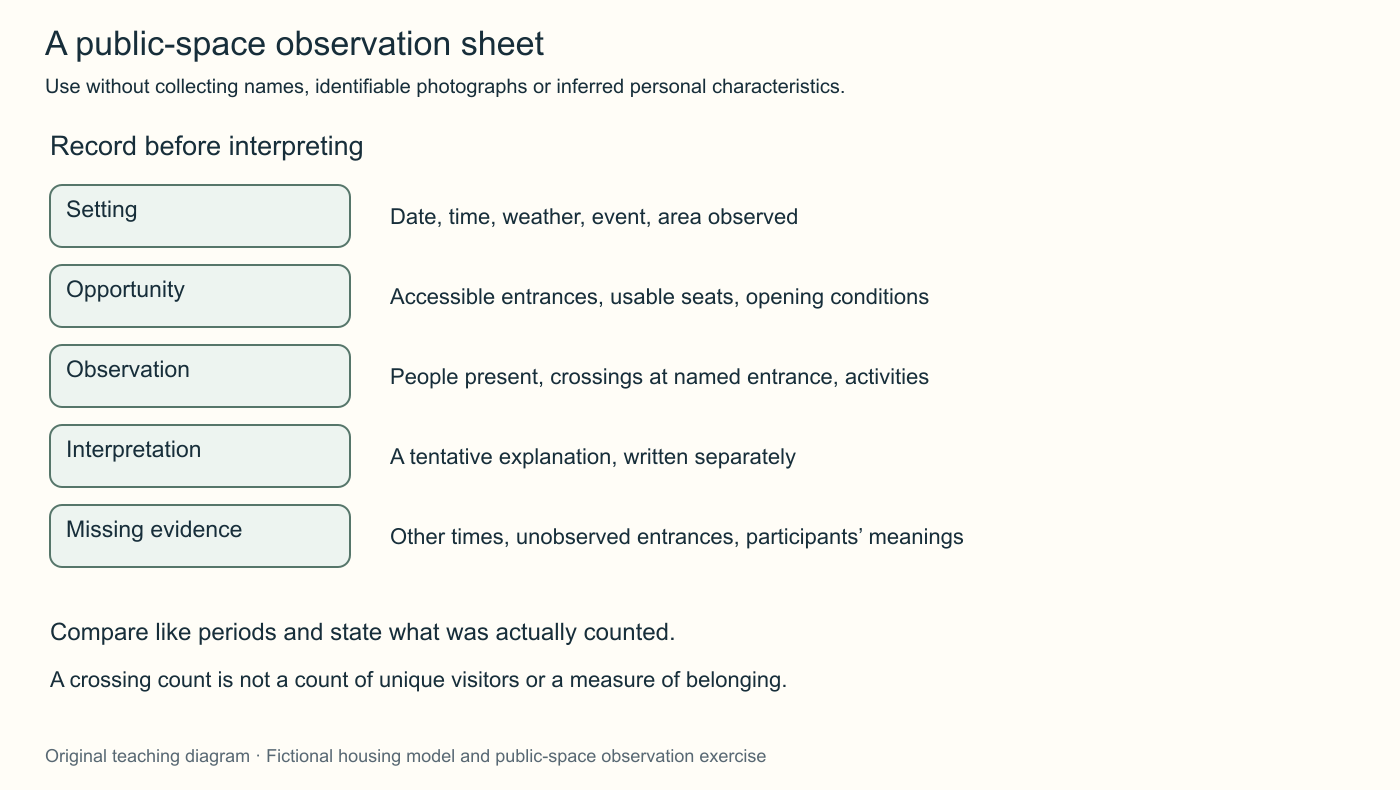
An observation protocol specifies what you will record, where, when and how. It reduces the temptation to notice only details that fit an initial impression. For this course, use a short route or a clearly bounded public space and two comparable observation periods if practical. Record weather, time, access conditions and unusual events that could affect use.
Choose categories that can be observed without intrusive inference. People sitting, walking through, eating or waiting are potentially useful categories if defined clearly. Income, political views, immigration status or the quality of someone's relationships cannot be reliably inferred from appearance. Avoid recording identifying details or following individuals to determine their private circumstances.
A snapshot count asks how many people are present at a specified moment. A flow count asks how many pass a defined point during an interval. These are different measures. Ten people sitting for an hour and sixty people passing through briefly can produce different impressions and different counts, depending on the method.
Write the rule in advance. For example: count everyone visibly seated inside the marked area at noon, then count crossings of the entrance line for ten minutes. If a person crosses twice, decide whether each crossing is an event or whether you are attempting to count unique people. The latter can require tracking you do not need for this exercise; counting events with a clear label is simpler.
Work through a supplied observation
Here is an original fictional record. Plaza A contains twenty seats, a visible entrance and a food stall. At noon, sixteen seats are occupied; during ten minutes, forty entrance crossings occur. At six in the evening, four seats are occupied and twelve crossings occur. The food stall is open at noon and closed in the evening. Weather is dry during both periods.
Plaza B contains twelve seats and two entrances. At noon, six seats are occupied and thirty crossings occur at the entrance being observed. At six, eight seats are occupied and twenty crossings occur at that same entrance. The second entrance is outside the observer's view. These limitations are part of the record, not details to discard before analysis.
Seat occupancy at noon is 80 percent in A and 50 percent in B. In the evening, it is 20 percent in A and about 67 percent in B. Those figures describe use of available seats at the observation moments. They do not measure the proportion of neighborhood residents using the plaza, total visitors over a day or satisfaction with the space.
The entrance counts cannot establish that A has more total movement than B because only one of B's two entrances was observed. A more comparable protocol would cover all entrances or clearly restrict the question to the observed entrance. Consistency of time interval is useful, but it does not repair inconsistent spatial coverage.
Explain without making the observation do too much
One hypothesis is that the food stall helps generate A's lunchtime use. Another is that nearby workers take lunch at the same time regardless of the stall. A third is that seating conditions differ during the day. The record shows coincidence, not which cause dominates. Additional observation at comparable times when the stall is closed could help, though other conditions might also differ.
Suppose the stall closes for repairs and occupancy falls. That strengthens some interpretations but still requires caution. The repair could block seating or coincide with a holiday. A more credible comparison records those changes and considers another similar space or repeated periods. The aim is not to demand an experiment before saying anything; it is to keep the claim proportionate to the evidence.
Qualitative notes can add information that counts miss. Perhaps people move chairs into shade, leave because of loud equipment or pause to read an access sign. These observations suggest mechanisms and design questions. They should be described as observed actions rather than assigned motives unless the motive is directly and appropriately reported.
For example, “three people approached the sign and then walked away” is an observation. “The sign made them feel unwelcome” is an interpretation. It may be plausible, but another explanation is that they were looking for a different destination. Keeping the two statements separate makes the account more credible and identifies what additional evidence would be useful.
Contact is not automatically connection
People can share a space without interacting, interact without developing trust, and recognize one another without becoming friends. Each relationship can still matter. Familiar faces may make a place easier to navigate; a brief exchange can provide information; a public setting can permit sociability without private obligation. The value of contact need not depend on turning strangers into intimate companions.
A fictional observer records five conversations between people who arrived separately. That does not establish that the participants were strangers before the encounter. Nor does a lack of conversation establish hostility. People may be resting, listening, reading or enjoying privacy. A protocol should not define successful public life so narrowly that every quiet use becomes failure.
The same caution applies to group mixing. Seeing different apparent ages in one space does not establish equal participation or equal comfort. Appearance may be misleading, and co-presence does not reveal whose activities dominate. Studying experience requires methods beyond a visual count, such as an appropriately designed voluntary survey with clear consent and a defined sample.
Our course does not require that additional data collection. It asks you to recognize the boundary of your evidence. You can describe opportunities for contact, visible uses and access arrangements without claiming to know the private quality of every relationship. That modesty improves the value of the observations you can actually support.
Rules can enable sharing and exclude uses
Public spaces need arrangements for activities that may conflict. A person seeking quiet and a group practicing music may value the same location for incompatible reasons at the same time. A rule can coordinate use, but it also prioritizes some activities over others. The question is how the rule is justified, communicated and applied.
In a fictional park, a posted schedule reserves one area for organized games at certain hours. The arrangement can reduce conflict by making expectations clear. It can also limit spontaneous use by people unaware of the booking system. Evaluation should examine both effects rather than assume that any restriction destroys publicness or that any orderly schedule is fair.
Informal enforcement matters as well. Users may feel entitled to challenge some people while ignoring similar behavior by others. A space can be formally open and socially uncomfortable. Establishing a pattern of unequal treatment requires more than one ambiguous incident, but observation can identify a question worth investigating through appropriate evidence.
Do not provoke a conflict to create a demonstration. The analytical task is to examine existing arrangements and documented experiences, not to test strangers. A clear description of rules, entrances, seating and visible activities can reveal consequential design issues without turning other people's ordinary day into an experiment they did not agree to join.
The objection: a visitor's gaze can misread a place
A visitor may miss routines that residents understand. An apparently empty area might host an important weekly event. A group that looks closed to outsiders may be welcoming through a language or practice the observer does not recognize. A short visit is especially vulnerable to mistaking unfamiliarity for absence of community.
This objection calls for reflexivity: examining how the observer's position, expectations and methods shape the account. Reflexivity is not an invitation to make the report entirely about yourself. It is a practical effort to identify likely blind spots and adjust the claims. State what you could see, what you could not and why the selected time may be unusual.
Repeated observation can improve coverage, but repetition alone does not eliminate bias. Visiting every weekday at noon still omits evenings and weekends. A large number of observations drawn from one narrow interval can create false confidence. The sample should reflect the question, and the report should describe the periods it represents.
Published plans and local histories can provide context, but they also have perspectives. A promotional guide may emphasize amenities; a complaint record emphasizes reported problems; a preservation report foregrounds historical significance. Combining sources is useful when their purposes are explicit. Agreement is informative, and disagreement should be investigated rather than quietly removed.
Turn observation into a bounded design question
Suppose both real observations and a site's public information show that its only entrance is hard to identify. A proportionate recommendation might be clearer wayfinding, followed by a check of whether more people locate and use the space. That recommendation targets an observed access problem. It does not require claiming that the whole neighborhood lacks trust.
If seating is full at one time, adding seats may help, but the observation alone does not establish demand across the day or whether circulation would be obstructed. A better proposal considers the physical constraint, the intended users and a way to assess the change. Design becomes more defensible when the proposed mechanism is concrete.
The same method can support disagreement. A resident may prefer preserving a quiet area over increasing activity. That is a value judgment worth stating openly. Evidence can clarify current use and likely consequences, but it cannot resolve every conflict among legitimate purposes. A good public-space account distinguishes what is observed, what is inferred and what is preferred.
For the final neighborhood comparison, your observation will therefore be one bounded component. It will accompany maps, dated statistics and historical context. Together, these sources can produce a richer explanation than any alone, provided we resist treating them as interchangeable. The next chapter examines what happens when the place and its population change—and why those changes need separate measures.
Check your understanding: Plaza A has forty entrance crossings and Plaza B thirty during equal intervals, but only one of B's two entrances was observed. Can you conclude that A has more total use?
Expected answer: No. Spatial coverage differs, and crossings measure events rather than all forms of use or unique users. Use comparable coverage and distinguish flow counts from snapshot occupancy, duration and experience.
Application
Allow thirty to forty minutes. Complete the observation sheet for two short, comparable periods at an accessible public space, or analyze the supplied fictional plazas. Record time, weather, boundary, entrances, snapshot counts, flow counts, visible activities and access information. Keep identifying details out of the record.
Write 300–400 words with one observation, two competing interpretations and one additional observation that would help distinguish them. If proposing a change, state its purpose and one possible tradeoff. A strong response does not infer safety, trust, income or belonging from a brief visual impression, and it does not treat a busy space as automatically better for every use.