Families and the transmission of advantage
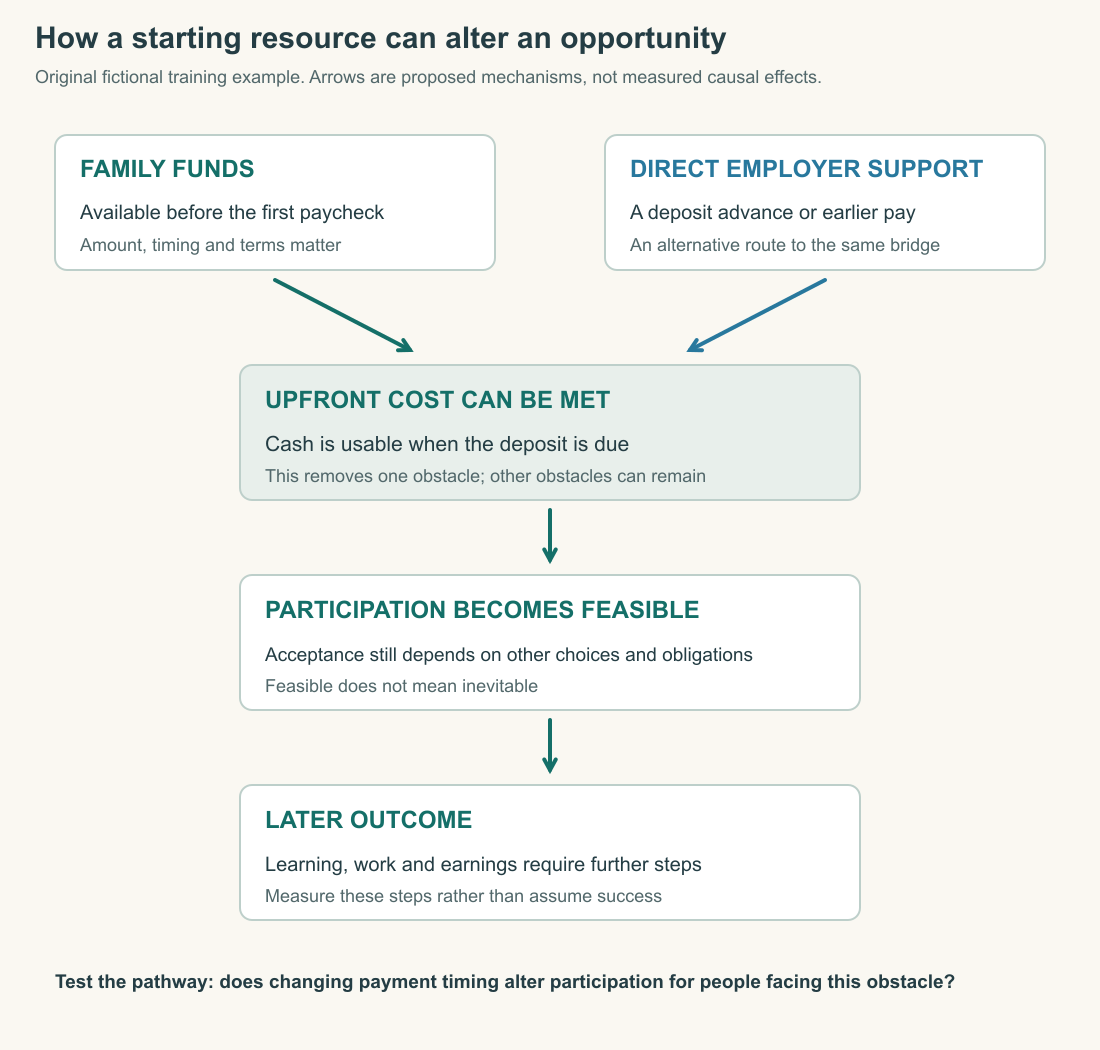
Two fictional graduates, Imani and Rowan, receive the same offer for a paid training position in another city. The first paycheck will arrive six weeks after they move. Both have enough savings for the journey, but neither can pay the deposit and initial rent. Rowan's family can advance the money without needing immediate repayment. Imani's family cannot. Equal qualifications and an identical offer have not created identical opportunities to accept it.
The example isolates a timing problem. It does not stipulate that Rowan is more capable, works harder or will eventually earn more. Nor does it imply that Imani's family is less committed. It shows how an existing resource can change the set of feasible choices before any difference in performance appears. This chapter follows several such pathways and asks how we could distinguish them from other explanations of persistence across generations.
Transmission is a process, not a resemblance
Intergenerational persistence means that parents' and children's positions are associated under a defined measure. Transmission proposes processes that help produce that association. The distinction matters because resemblance alone cannot identify a mechanism. Parents and children may share resources, institutions, locations, relationships and historical circumstances. They may also differ in important ways that a broad category conceals.
In the training example, we can name a sequence: available family funds permit an advance; the advance covers an upfront expense; covering that expense makes acceptance possible. Each arrow is a claim. If the employer instead provides the deposit and pays immediately, the proposed obstacle changes. If Imani can obtain equally suitable nearby training, the consequences of declining may be smaller. The mechanism depends on the available alternatives.
A useful explanation identifies the stage at which a resource matters. Money might purchase preparation, bridge a delay, insure against failure or support a later search. These are not interchangeable pathways. A policy that pays the enrollment fee may leave a cash-flow obstacle untouched. An explanation that merely says “family background matters” cannot tell us which intervention would alter the result.
It is equally important to separate opportunity from realized outcome. Rowan may decline the position for other reasons, or perform poorly after accepting. Imani may find a better route elsewhere. An advantage can increase the range of possible actions without guaranteeing success. Calling the process probabilistic is a substantive claim about multiple pathways, not a way to avoid explaining anything.
Transfers arrive at different times and on different terms
An inheritance is a transfer associated with a death; support can also arrive during a giver's lifetime. For the opening problem, timing matters more than the eventual total. A promise of money decades later cannot necessarily pay next month's deposit. An earlier, smaller transfer may change a decision at the moment an opportunity is available.
The recipient's control also matters. Imagine three versions of Rowan's advance. In one, it is an unrestricted gift. In another, it is a loan with a fixed repayment schedule. In the third, support continues only if Rowan follows the family's preferred occupation. All provide initial cash, but the obligations and discretion differ. A survey that records only the amount received would miss part of the relationship.
Transfers need not be cash. A spare room near the training site, use of a vehicle or several weeks of unpaid childcare could reduce the cost of participation. Measuring only bank transfers would understate those forms of assistance. Yet assigning them a monetary value requires assumptions about quality, availability and what the recipient would otherwise have purchased. There is no reason to pretend that every form of help converts neatly into dollars.
These distinctions also prevent a category error in household statistics. The ACS income definition excludes lump-sum inheritances, although inherited resources can plainly affect a recipient's options. A measure can be correctly calculated while omitting a resource relevant to the research question. That is a reason to select additional evidence, not to call the income measure fraudulent. 2023 ACS definitions, income section.
A buffer can change behavior before it is spent
Suppose the training position has a reasonable chance of ending after three months. Rowan knows that returning home would be possible without immediate housing insecurity. Imani has no comparable fallback. Even if neither family ultimately transfers money beyond the deposit, the available buffer may affect the decision to accept. Resources can matter through credible insurance as well as recorded expenditure.
This is a hypothesis about a particular decision, not a claim that every person with a buffer takes more risks. People differ in goals, obligations and assessments of the opportunity. The important comparison holds those features as stable as the evidence allows and asks whether protection against a bad outcome changes the feasible choice. Without that discipline, observed caution can be mistaken for a fixed personal disposition.
Risk itself is not one quantity shared equally by everyone considering the same project. Losing three months of expected earnings may be manageable for someone with secure housing and damaging for someone facing an immediate eviction. A financial loss can trigger other losses through deadlines and obligations. The same probability of failure can therefore have different consequences for two people.
This helps explain why “take a chance” can be poor sociological advice. It describes an action while omitting the conditions that make the action survivable. A serious account investigates the downside, fallback options and commitments to others. It can still recognize agency: Imani may devise a solution, negotiate payment timing or choose another route. Agency operates through available means and constraints, rather than outside them.
Accumulation requires an explicit model
Consider a separate, entirely stipulated arithmetic example. One person begins with 10,000 units and another with 1,000. Suppose both balances increase by exactly five percent each year for ten years, with no additions, withdrawals, taxes, fees or losses. The first balance becomes about 16,289 and the second about 1,629. The initial ten-to-one ratio remains ten to one, while the absolute difference grows from 9,000 to about 14,660.
The calculation uses repeated multiplication by 1.05. It demonstrates how equal proportional growth preserves a relative ratio while increasing an absolute gap. It is not an investment forecast or a claim about actual returns. Real accumulation can involve unequal returns, interrupted saving, debt, asset-price changes and expenditures. Those features would need to enter a model before it could describe a real population.
Now add a fixed annual cost of 500 units, paid at each year's end after growth. The recurrence is: next balance equals the current balance multiplied by 1.05, minus 500. At 10,000, the five-percent increase exactly covers the cost, leaving 10,000. At 1,000, the first year's ending balance is 550; the second is 77.50. By the third year the stated rule produces a negative balance, which requires a new assumption about borrowing or inability to pay.
That failure is instructive. A simple model can expose a threshold at which its own assumptions stop being adequate. We should not extend it indefinitely and call the result reality. The lower balance would require another source of funds, a reduced expense, a loan or some other adjustment. Fixed costs interact with unequal starting resources differently from proportional costs.
This is one route to cumulative advantage: an earlier resource changes the conditions under which later gains and costs occur. The phrase should always be followed by a mechanism. Does a buffer avoid a fee? Does earlier access provide more practice? Does a completed qualification unlock another opportunity? Different processes can compound, and a diagram helps prevent their being collapsed into a mysterious force.
Information and practice have histories
Return to the two graduates. Suppose the vacancy requires a portfolio and a reference submitted through an unfamiliar system. Rowan has a relative who has used that system and can explain the sequence. Imani has access to the same public instructions but no one who can answer a specific ambiguity. The information is technically public; the practical ability to navigate it differs.
We can distinguish knowing that an opportunity exists, understanding its requirements and receiving usable feedback. An announcement solves the first problem. A clear guide may solve part of the second. A knowledgeable conversation may address an error that a generic guide cannot anticipate. Treating all three as “awareness” would make it difficult to discover where applicants encounter obstacles.
Practice can likewise be uneven without the resulting skill being imaginary. If one applicant has repeatedly rehearsed interviews, the improvement may be real. Acknowledging the social conditions of learning does not require denying competence. It changes the explanation of how competence was acquired and the judgment about whether everyone had a comparable opportunity to develop it.
There is also a competing possibility: selectors may reward familiarity with a social style that adds little to the work. To distinguish useful preparation from rewarded familiarity, identify the tasks and observe performance beyond the interview. A smooth presentation might signal relevant communication, conceal weak knowledge or do both. The question cannot be settled by deciding in advance that every rewarded trait is merit or every reward is arbitrary.
Place bundles several possible pathways
A family address can connect a child to travel times, schools, public spaces, services and other residents. These are separate features even when they cluster geographically. A neighborhood average is not an explanation in itself. If children from two areas later differ in earnings, the difference could reflect who lived there, what the places offered, movements between them or broader changes affecting each area.
Imagine a fictional after-school workshop offered across town. One child can reach it on a direct route in twenty minutes; another needs two infrequent connections and an adult escort. The workshop may be free while participation remains costly in time and coordination. The relevant mechanism here is access through transport and supervision, not a generalized claim that one neighborhood is better in every respect.
Changing the workshop's location could alter that mechanism, but it could create other barriers for current participants. Providing transport might help if schedules align; an online version might help some participants while requiring equipment and quiet space. An account of place should therefore trace concrete connections between a feature, a person's circumstances and an activity rather than rank whole neighborhoods on a single moral scale.
Later in this course, a randomized housing-voucher study will show what researchers can learn by changing access to a bundle of neighborhood conditions. Even that design does not automatically identify which feature of the bundle produced an outcome. The distinction between the effect of an intervention and its internal mechanisms will be central to evaluating responses to inequality.
Families make choices within linked obligations
Support given to one person may affect others. Suppose Imani contributes to a younger sibling's care and shares household expenses. Moving for training would change both the cash budget and the allocation of time at home. A comparison that records only Imani's potential wage may miss the consequences for the household. What appears to be a private career choice can involve several connected lives.
This does not mean that family obligations always constrain the same person or have the same meaning. Some arrangements are negotiated and valued; others involve unequal expectations or coercion. The analyst needs evidence about who decides, whose preferences count and what alternatives exist. It is possible to recognize meaningful care while examining an unequal distribution of its costs.
Parents also make decisions under uncertainty. They may not know whether a course will be useful, whether a move will succeed or which opportunity will remain available. Observing a poor outcome later does not establish that the earlier decision was irrational given the information and resources then available. Retrospective explanations should reconstruct the decision situation instead of granting past actors knowledge of the future.
Family transmission can therefore include resources, obligations and interpretations. The task is to connect them without assuming a single family interest. The source of support, its recipient and other household members may value the same action differently. A precise account leaves room for negotiation, disagreement and changes over time.
What evidence would establish a pathway?
Suppose a survey finds that graduates whose parents have more wealth are more likely to enter distant training programs. That association fits the deposit mechanism, but it also fits differences in academic preparation, preferences, information and the kinds of offers received. Measuring the family balance sheet and the final decision alone does not distinguish these accounts.
More informative evidence would follow the sequence: offers, upfront costs, available funds, requests for help and acceptance. A program that changes payment timing could test whether the bridge matters, especially if access to the change is assigned in a way that supports causal comparison. The outcome should include who applies and who accepts, because an obstacle can deter people before they appear in the final applicant pool.
Interviews can identify experiences and proposed mechanisms, while records can establish dates, amounts and transitions. Neither should be asked to do everything. A person's account of why they declined is important evidence of interpretation; it may not reveal all causes or establish what would have happened under another arrangement. Combining evidence is most useful when each source addresses a distinct uncertainty.
Finally, persistence is compatible with substantial individual movement. A pattern can exist while many people depart from it, and an exceptional biography cannot by itself measure its strength. The aim is to explain how starting conditions alter probabilities and choices across a defined population. Imani and Rowan illustrate one pathway. Whether it is common, how large its consequences are and which response works best remain empirical questions.
An additional difficulty arises when researchers adjust for a factor that lies on the pathway they want to study. If family support makes relocation possible, and relocation enables participation, holding relocation fixed can remove part of the very process under investigation. That adjustment might answer a narrower question about support among people with the same location, but it would not estimate the full pathway through moving. Variables are not automatically helpful simply because a dataset contains them. Their role in the proposed sequence determines what an adjusted comparison means.
Application
Draw two pathways connecting family resources to acceptance of the fictional training offer. For each, identify the intermediate steps, one alternative explanation and a change that would weaken the proposed obstacle. Then verify the accumulation calculations and explain why the fixed-cost model requires a new assumption once its balance becomes negative.
Check your understanding: If children from wealthier families are more likely to obtain a qualification, does this establish that direct payments for tuition caused the difference?
Expected answer: No. The association is compatible with several pathways, including preparation, information, living costs, location, timing and selection into applications. Establishing the tuition pathway requires evidence about the proposed sequence and a credible comparison that separates it from alternatives. An advantage can change probabilities without determining every child's outcome.