What heat changes in proteins
An egg becomes firmer as it cooks. A piece of beef in a long braise may eventually become easier to pull apart. A fish fillet can begin to separate into flakes and then become dry if cooking continues too far. These familiar changes seem to contradict one another. If heat makes protein firm, why does longer cooking sometimes make food tender?
The apparent contradiction comes from asking one word to describe several structures. Protein is a class of molecules, not a single cooking material. An egg mixture, a muscle fiber, the connective tissue around muscle, and an entire irregular piece of food organize those molecules differently. Heat can produce several changes at once. The result you notice depends on which structure limits the bite at that moment.
This course follows those differences through eggs, fish, poultry, tender cuts, and cuts suited to braising. The purpose is practical: select a method that fits the actual ingredient, judge its culinary result, and meet the applicable food-safety requirements. The examples in this opening chapter are explanatory scenarios; the optional exercise uses a published hard-cooked-egg preparation. No comparative kitchen trial by this course is implied.
Three scales of structure
Begin at the smallest scale we need. A protein molecule is a chain of amino acids whose arrangement and shape matter to its behavior. Denaturation is a change in a protein's native folded structure. Heating can promote that change. Coagulation or aggregation concerns proteins associating with one another into larger structures. These ideas are related, but they name different events; unfolding one molecule and constructing a network are not identical descriptions.
Egg white makes the distinction tangible. A raw white flows, while a cooked white can hold a shape. Heating changes the proteins and their associations, producing a network that helps account for that transition. The Exploratorium's egg-protein explanation gives an accessible account. The drawing you might imagine is a simplified model, not a claim that every protein in an egg unfolds at the same temperature or behaves identically.
At a larger scale, meat contains muscle fibers: elongated cells arranged in bundles. Within them are protein filaments involved in contraction in the living animal. Around and between muscle structures is connective tissue. The Exploratorium's account of meat structure introduces that organization. A piece of meat is therefore not a bowl of dispersed proteins waiting to set in the same way as beaten egg.
At the largest scale is the piece you put in the pan. It has a thickness, an outline, surfaces in contact with the vessel, and perhaps skin, fat, or bone. A thin edge and a thick center experience different heating histories. Molecular structure helps explain what heat can change; the piece's geometry helps explain where and when those changes occur. Both scales matter to the result.
Setting does not mean losing all water
When an egg changes from flowing to set, it has not simply become dry. A cooked egg still contains substantial water. The new structure and its interaction with that water help determine whether the result feels tender, rubbery, or wet around its edges. Thinking of cooking only as evaporation misses why a set custard can remain moist and why a firmer mixture can release liquid.
The Exploratorium's discussion of egg mixtures under heat describes toughening and expelled liquid after prolonged heating. That combination is worth noticing: more liquid visible around a cooked mixture does not necessarily mean the mixture itself feels more succulent. Water surrounding a structure and water retained within it contribute differently to the eating experience.
Imagine two fully cooked egg preparations described by a learner. In one, the white cuts easily and feels tender. In the other, the white is more resilient and a little liquid appears on the plate. These observations are consistent with a difference in heating history, but they do not isolate its cause. Egg size, method, added ingredients, and handling could differ too. The next useful question is what changed between the preparations.
A spoonful of sauce could make the second egg easier to eat, but it would not reverse the earlier protein changes. This distinction separates improving a served dish from restoring its original structure. Both concerns matter, yet they call for different expectations. A finishing adjustment can help dinner without erasing what happened in the pan.
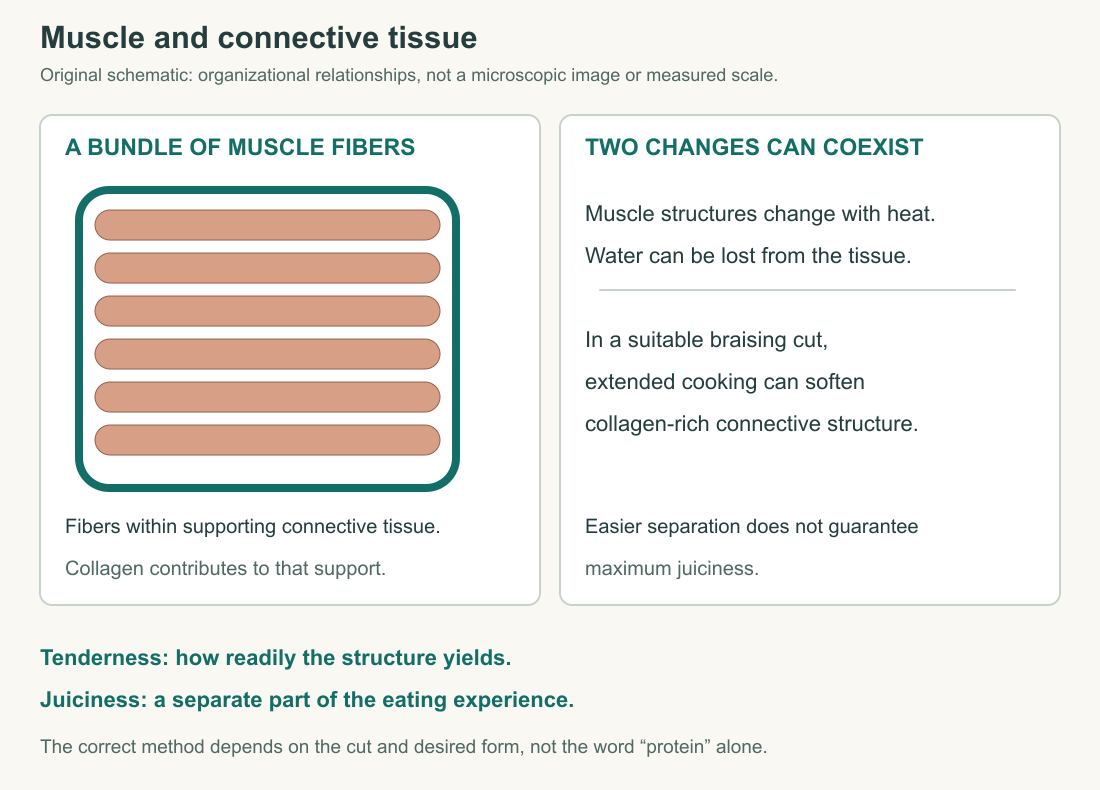
Muscle and connective tissue can pull in different directions
During meat cooking, changes in muscle proteins can accompany contraction and water loss. Meanwhile, connective tissue containing collagen can change over sufficient time under suitable cooking conditions. Collagen-rich cuts are often suited to moist, extended methods such as braising, which can turn resistant connective structures into a less restrictive part of the bite. The Exploratorium's tenderness discussion introduces this distinction; it does not justify a rule that every cut improves the longer it cooks.
Picture a bundle of fibers held together by a resistant supporting structure. Making the fibers firmer and weakening the support can happen within the same extended process. What you call tender depends partly on whether your teeth or fork must fight that support to separate the bundle. A change at one level can therefore offset or coexist with an undesirable change at another.
Now compare a hypothetical cut with little resistant connective tissue to one selected specifically for a braise. The first may have little to gain from a long process aimed at weakening support. The second may need that process to become pleasant to pull apart. The question is not whether both contain protein; it is which structures the chosen method is intended to change.
This also explains why tenderness and juiciness should be recorded separately. A piece can separate readily into fibers yet feel dry within those fibers. A moist sauce may accompany it without restoring water to exactly where it was originally retained. If your notebook says only tender, it can hide that difference. Describe both the force needed to separate the food and what happens as you chew it.
Fish is not a miniature beef roast
The muscle and connective organization of an ordinary fish fillet differs from that of a beef roast. Fish muscle fibers are generally shorter, and the connective structure can soften readily during cooking, allowing the flesh to separate into flakes. The Exploratorium's fish-cooking article explains this structural contrast. Use that explanation for method choice; the course follows current official safety guidance rather than the older article's lower suggested endpoint.
If you choose a delicate fillet because you want intact portions, the method must account for the weakening of the structure that holds those portions together. Repeated rough turning may become more damaging as cooking progresses. A broad supporting utensil or a preparation that reduces movement can serve the desired result. The detailed fish chapter will connect handling to the actual fillet rather than giving every species one identical treatment.
Suppose a cooked fillet breaks apart during transfer. That observation could reflect the expected fragility of cooked fish, excessive cooking, rough handling, or some combination. It does not automatically mean the fish was unsafe or that the recipe's temperature was wrong. A useful diagnosis separates the internal cooking endpoint from the mechanical action used to move the food.
Likewise, a thick center can lag behind a tapered edge. The species name alone does not describe this geometric problem. Before searching for a new seasoning, inspect the shape of the piece and how the recipe expects you to accommodate it. An ingredient's structure includes the form in which it was cut and sold, not merely its biological category.
Time and temperature describe a history
A temperature reading is a measurement at a location and moment. It does not by itself describe the entire preceding process. A surface may have experienced much more intense heat than the center, and two pieces reaching a similar final reading may have arrived there through different schedules. That history can affect their culinary textures.
The practical consequence is to keep the method attached to the target. An oven setting is not an internal-food reading. A pan's temperature is not the temperature everywhere inside a chop. A timer gives useful information about exposure, but it does not measure the center. Treat these as different observations with different jobs.
Consider an imagined thick piece and a thin piece placed into the same environment. The thin piece has a shorter route between its heated surface and interior. It may reach its target sooner, while the thick piece remains uneven. There is no universal arithmetic here that lets you double thickness and confidently double the cooking time. Use the chosen recipe and appropriate measurement, then record the actual result.
This is one reason a reliable method cannot be reduced to use high heat or use low heat. High or low relative to what, applied for how long, to which shape, and toward which endpoint? A useful instruction answers those questions through its ingredients, equipment, sequence, and checks. The later chapters teach you to recognize that information and identify when a recipe has left a consequential gap.
To see why weight alone cannot settle timing, consider two imaginary pieces made of the same uniform material. One is a cube three centimeters on each side; the other is a slab nine centimeters long, three wide, and one thick. Both have a volume of twenty-seven cubic centimeters and, under the stated uniform-material assumption, the same mass. Yet the cube's center is one and a half centimeters from its nearest face, while the slab's center is only half a centimeter from a broad face.
This is a geometry exercise, not a meat recipe. It does not establish a threefold cooking-time difference, because heat transfer and the actual food's properties are more complicated. It does show why an instruction based solely on equal weight can miss a consequential change. Flattening or portioning an ingredient changes the path into its interior while potentially leaving its total amount unchanged. When adapting a preparation, record the shape you used along with its weight. Otherwise the next cook may reproduce the shopping quantity accurately and still be working with a substantially different heating problem.
Safety and texture answer different questions
Current US consumer guidance distinguishes foods and forms. FoodSafety.gov lists poultry at 165°F, fish at 145°F, and the listed beef and pork steak, roast, and chop categories at 145°F followed by a three-minute rest. Ground-meat and egg categories have their own requirements. Consult the complete official chart for the exact food. These are safe-preparation targets, not promises that every ingredient will have its most desirable texture at the same point.
A cut intended for braising may satisfy an applicable minimum before it reaches the texture the recipe seeks. That does not make the minimum wrong; it means safety and culinary transformation are different criteria. Conversely, an attractive exterior cannot replace the required measurement and process. A browned surface and a safe center are separate claims about different parts of the food.
For whole eggs in the exercises, follow FDA's advice to cook until white and yolk are firm; scrambled eggs should not remain runny. See FDA's egg-safety guidance. This course does not ask you to taste raw mixtures to locate a setting point. A scientific discussion of protein behavior is not authorization to replace safe preparation with a visual experiment.
When a recipe includes a rest required for safety, it belongs to the process. When it discusses resting to manage texture or serving, that is another reason to preserve the instruction, but the two rationales should not be conflated. In either case, you need the actual method rather than a vague belief that food always finishes itself after leaving the heat.
Read one egg preparation through the model
Food Hero's Perfect Hard-Cooked Eggs provides a manageable first exercise. Its method uses eggs in a single layer, cold water covering them, heating just to a full boil, and a covered off-heat stage whose duration depends on egg size. Follow the full directions, including cooling and storage. The important observation here is that removing the pan from the burner does not remove the heat already present in the water and vessel.
Before cooking, identify the start and end of each stage. The off-heat interval is still part of the cooking process. Cooling is a later action with a different purpose. If you accidentally continue boiling throughout, you have changed the method, even if the same total number of minutes passes. A timer without stage definitions cannot tell you whether the procedure was followed.
After safe preparation and cooling enough for handling, cut a peeled egg on a stable surface. Observe the white and yolk separately. Do they hold their form? How readily do they cut? Record what you actually find, including any difference from the intended result. There is no need to deliberately spoil a second egg to demonstrate that cooking can be excessive.
The exercise gives you a modest but useful kind of knowledge. You have connected a sequence to a visible structural transformation, distinguished the heat source from the food's continuing thermal history, and retained the safety endpoint. You have not proven a universal molecular law from one egg. That is enough to begin making better decisions about the next ingredient.
Application
Follow the complete Food Hero hard-cooked-egg method linked above, with the appropriate timing for the egg size and current egg-safety guidance. Use clean handling and equipment, avoid raw tasting, and observe the white and yolk after safe preparation. Record the stages, actual outcome, and one question for another attempt.
If eggs are unsuitable or cooking is unavailable, use this supplied scenario: preparation A is fully cooked, holds its shape, and cuts readily; preparation B is fully cooked but more resilient, with a little expelled liquid. Name a plausible mechanism, two other variables that would need checking, and the limit of your conclusion.
Then explain why a delicate fish fillet and a collagen-rich braising cut should not receive an identical method merely because both contain protein.
Model interpretation: The egg contrast is consistent with different protein-network and water-retention changes, but differences in size, added ingredients, or heating stages could contribute. Fish may lose structural support readily during cooking, while a braising cut may require extended suitable treatment to weaken resistant connective tissue. Both still require the applicable safe-preparation process. A method should address the actual structure, not the broad label protein.