Choosing the method yourself
You have one burner, a suitable skillet, a small refrigerator, and an hour before dinner. The shop has eggs, thin fish fillets, a large chicken, and a chuck roast. Each ingredient can become worthwhile food, but they are not equally good answers to tonight's problem. Technique begins with recognizing that the meal's constraints are part of the choice.
Later in the week, you may have several hours available and want food for more than one meal. The same chuck roast can become a sensible choice. The ingredient has not improved; its fit with your time, equipment, and intended result has changed.
The final task is to plan and, if suitable, prepare two contrasting protein dishes. You will explain why each method fits its ingredient, how you will establish completion, and what the finished texture should contribute. Readers who do not wish to handle or eat these foods can complete the supplied cases. The standard for reasoning is the same; the claim of hands-on performance is different.
Start with the meal's real constraints
Write down who will eat, any dietary exclusions or allergies, the equipment available, the time you can actually devote to cooking, and the storage you can use. These are requirements, not inconveniences to dismiss after choosing an impressive dish. An ingredient that someone cannot eat does not become appropriate because its technique is educational.
Separate active attention from total elapsed time. A scramble may need close attention near serving. A braise can demand a long elapsed period with a different monitoring pattern. Neither description alone tells you whether the method fits the evening. If you will be away from a cooking setup that requires your attention, the plan does not fit merely because the clock allows enough hours.
Count the final stages as work. Measurement, required resting, lifting fish, carving poultry, finishing sauce, and handling leftovers all take space and attention. A plan that ends at turn off the burner has left part of the meal undesigned.
Choose a complete published preparation from the course whose ingredient form and equipment match your situation. Its quantities and sequence supply a baseline. Your explanation should identify why you chose that baseline rather than merely announcing that the dish sounds appealing.
Build two contrasting plans
For the capstone, select two preparations that reveal different structural decisions. Eggs and a braising cut make a clear contrast: one forms a setting network, while the other requires extended change in connective structure. Fish and a whole bird contrast delicate handling with uneven large-scale geometry. A tender steak and a pot roast contrast relatively short cooking with a longer softening process.
You do not need the most expensive pair or the largest quantities. A small practical preparation plus a carefully analyzed supplied case can be appropriate when diet, cost, or equipment limits the second activity. State which part you performed and which you reasoned through.
For each plan, name the ingredient precisely enough to select a method: the egg preparation, fish cut and starting condition, poultry form, or named meat cut. Include relevant thickness, size, skin, bone, and package instructions. Then describe the intended finished form. Broad scramble curds, an intact fish portion, sliced roast chicken, and yielding pot-roast chunks are different targets.
Next, explain the method in terms of those targets. Identify which stage develops a surface, which brings the interior through cooking, which changes structure over time, and which finishes the dish. Not every preparation needs all those stages. The useful plan includes the ones that actually serve its result.
Work through a constrained evening
Consider this original hypothetical case. A learner has a burner, the skillet specified by Health Canada's egg recipe, basic utensils, and a suitable thermometer. They have the recipe's ingredients and want a modest meal without leftovers. They choose the Egg and Veggie Scramble rather than attempting a whole roast chicken without an oven.
The explanation should do more than mention speed. The vegetables have a preparation stage before the eggs enter; the setting mixture then receives its own heat and movement. The target is separate curds, so folding belongs in the process. The learner prepares the serving setup before the final stage to avoid holding finished eggs in the hot pan unnecessarily.
Now change one condition: the only skillet available is much smaller than the recipe specifies. The original plan no longer matches the layer depth. The learner should select a complete preparation suited to the equipment or use the supplied route rather than claiming that the unchanged timing will necessarily work.
A good plan also survives an interruption. If the eggs finish while another component is delayed, recognize that leaving them on a warm burner changes their thermal history. Plan simple accompaniments that can be ready first. The solution begins before cooking, through a sequence that protects the ingredient's brief finishing stage.
This case demonstrates flexibility without pretending that every substitution is harmless. You can change the menu to fit the kitchen, or choose a documented method suited to a new condition. Flexibility comes from understanding the role of the changed condition and preserving the requirements that still matter.
Work through a longer cooking day
In a second hypothetical case, the learner has a suitable stovetop pot and enough time to follow the complete Classic Beef Pot Roast preparation. They buy the named cut and plan several meals. They choose this method because the desired texture requires more than the short preparation appropriate to a tender steak.
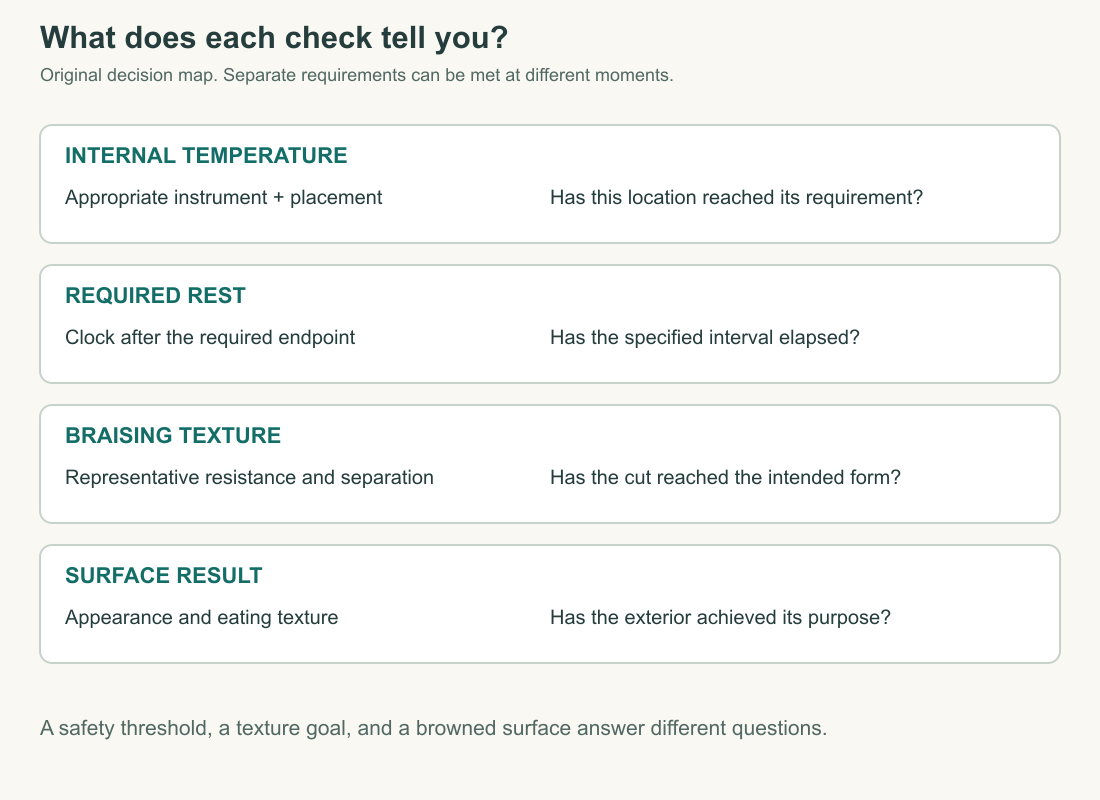
Their schedule includes the recipe's later vegetable addition. Their checks distinguish the meat's internal safety requirement from the texture sought by the braise. Their serving plan includes a way to assess the sauce separately if the meat and liquid do not reach their desired states together.
The multiple-meal intention adds a storage requirement. Before starting, the learner clears refrigerator space and prepares suitable shallow containers. The USDA leftovers guidance supplies the handling and reheating rules. The later meals depend on those steps, not simply on having cooked a large quantity.
Suppose the learner instead buys a tender roast because it looks similar and keeps the entire original schedule. That is a new structural assumption. They should choose a method appropriate to the actual cut rather than treating appearance and total weight as sufficient evidence of equivalence.
The two cases contrast more than short and long. The scramble's form is built through setting and movement; the pot roast's form changes through extended cooking and controlled separation. One emphasizes a closely watched final stage, while the other emphasizes a sustained process and later component checks. Both require deliberate handling after active heat.
Make the budget comparison honest
Budget planning can use simple arithmetic without pretending that current prices are universal. Suppose a hypothetical purchase costs twelve currency units and provides four portions you will actually eat. The ingredient cost is three units per used portion. A different eight-unit purchase that provides only two used portions costs four units per used portion. These are invented numbers illustrating the calculation, not market prices.
The word used matters. A large purchase is not economical if substantial edible food is discarded because the schedule or storage plan failed. Nor should you count bones and packaging as if they were identical to served meat. Use the actual outcome of your kitchen when comparing later purchases.
Include other costs relevant to your choice: required ingredients, equipment you lack, cooking energy where meaningful, and your available time. You do not need to assign a monetary value to every minute. You do need to recognize when an apparently inexpensive ingredient requires a process you cannot reasonably complete.
A dietary restriction changes the set of suitable choices before price comparison begins. The supplied-observation route is a legitimate way to study the course without buying an excluded ingredient. It preserves learning while avoiding a purchase that serves no useful meal.
State what would change your decision
A strong plan anticipates a few meaningful branches. If a valid internal reading is below the applicable endpoint, continue appropriate cooking and recheck. If a braising cut remains resistant during the correct process, allow the necessary further cooking rather than stopping solely at a minimum number. If the surface has progressed too quickly, preserve that observation for a method adjustment that addresses the mismatch.
Keep immediate action distinct from next-attempt improvement. During the current meal, you must complete safe preparation with the food and equipment already present. Afterward, you can choose more uniform portions, a different documented method, or a simpler sequence. Replacing the entire strategy in the final minute may create more unknowns than it solves.
Name the observation that would challenge your explanation. If you blame a broken fish portion on overcooking, ask whether it actually broke during a narrow unsupported lift. If you blame a pale steak on low heat, check whether the pan was crowded and the surface wet. This habit prevents the first plausible story from becoming an unquestioned rule.
Record only what you can support. A photograph can show shape and surface appearance, but it cannot establish the temperature throughout a portion. A thermometer reading can establish a measured condition when taken properly, but it cannot tell you whether the seasoning was pleasant. Each piece of evidence has a useful, limited job.
Evaluate the completed work
For each preparation, report the intended result, the method used, the relevant checks, and the observed outcome. A short narrative is often clearer than a score alone. Explain one decision that worked and one you would revise, tying each to a specific observation.
Do not give yourself credit for a safety check that you meant to perform but omitted. Do not call a supplied case a kitchen trial. Equally, do not treat a modest but well-executed preparation as inferior because it lacks elaborate plating. The course values a defensible process and a worthwhile eating result.
The most convincing comparison explains why the two methods differ. If your final answer says only that one used a pan and the other used a pot, it has not reached the structural lesson. Explain what heat and movement were intended to change in each ingredient, and why a copied schedule would not serve both.
Finish by choosing one ordinary meal in which you can use the learning again. It might be a scramble served promptly, fish supported carefully during transfer, poultry measured in the right locations, or a braise given enough time for its intended texture. Repeating a useful decision in a familiar setting is how the course becomes part of your cooking.
The achievement is a form of practical judgment: recognize the ingredient, choose a fitting process, observe what is actually happening, verify what needs verification, and adjust the part that evidence shows needs work. Those decisions let you move beyond memorized timings while remaining accountable to the food on the plate.
Application
Capstone: submit two contrasting preparation records. Use two practical attempts, one practical attempt and one supplied case, or two supplied cases according to dietary preferences, budget, and equipment. Identify the route clearly.
For each, include:
- The actual or supplied ingredient, dimensions, starting condition, and constraints.
- A matching complete published method from the course.
- The desired structure and the reason this method fits.
- Measurement locations, applicable official endpoint, required rest, and separate texture checks.
- Serving and leftover plans.
- Observations or supplied evidence, one justified conclusion, and one specific revision.
Supplied pair: a hypothetical baked fish portion meets its valid measured endpoint but breaks when lifted by one corner. A hypothetical correctly managed chuck roast exceeds its applicable safe minimum while remaining resistant, then becomes yielding with further appropriate cooking. Explain why more cooking would not address the first failure in the same way it addresses the second.
Model interpretation: the fish case identifies a mechanical support problem after cooking; a wider supported lift directly addresses it. The roast case concerns the structural transformation for which the cut and method were selected. Its temperature and tenderness checks answer different questions. The comparison should preserve that distinction rather than assign one universal rule to both foods.
Completion standard: your records make the ingredient-to-method reasoning clear, use relevant evidence for completion, distinguish safety from quality, and propose improvements linked to observations. Practical skill is claimed only for actions you actually performed.