Where heat goes
Two pans are hot. You put the same amount of food into each. One continues to produce the result you expected; the other seems to lose its momentum. You turn up the burner under the second pan, but now one area darkens much faster than the rest. “Use a hot pan” sounded like a complete instruction. It did not tell you how the pan would respond once cooking began.
The missing idea is movement. Energy moves from the source into the vessel, through the vessel, into the food, and onward within the food. At the same time, energy leaves for the room and may help water evaporate. A temperature reading describes a condition at a place and time. Cooking depends on how those conditions change through the whole arrangement.
This chapter gives you a way to follow that movement. You do not need to calculate dinner from first principles. You do need to distinguish the temperature you set, the temperature a surface reaches, and the rate at which the food receives energy. That distinction helps you decide whether to change the heat, the vessel, the quantity, the arrangement, or the time.
A temperature is not an amount of heat
Imagine a spoonful of hot soup and a whole pot of that same soup at the same temperature. The temperature does not tell you which contains more thermal energy associated with its amount of material. The pot can give up much more energy while cooling through the same temperature range. Quantity matters alongside temperature.
In thermodynamics, heat is energy transferred because of a temperature difference. Net spontaneous transfer goes from the hotter region toward the colder one. Heat capacity tells us how much energy an object needs for a given temperature change under specified conditions. NASA's introduction uses those distinctions to connect heat transfer with temperature change. NASA Glenn: Heat Transfer
For cooking, ask three separate questions. How hot is the relevant place now? How much will its temperature change when energy enters or leaves? How readily can energy reach the next place? The first concerns temperature, the second heat capacity, and the third heat transfer. An instrument answering one does not automatically answer the other two.
The burner setting is different again. It controls an appliance's operation, often its power or a pattern of switching on and off. The label “medium” is not a measurement of the pan's temperature. Change the pan, its contents, or the appliance, and the same-looking setting may produce a different result. Recipes use such settings as practical starting instructions, then rely on appropriate observations and measurements.
Follow a route through the meal
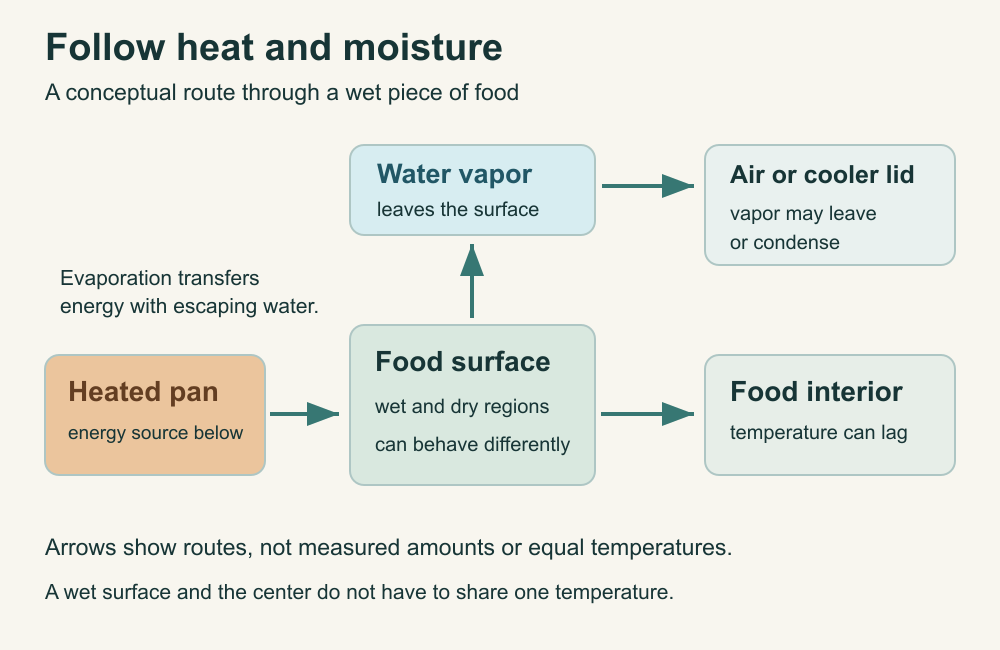
Take a piece of vegetable touching a warm metal pan. Energy can move through the metal and across the contact into the vegetable by conduction. Within a relatively still solid piece, conduction continues the movement from warmer regions toward cooler ones. Contact and internal travel are two different parts of the same route.
Now put the vegetable in a pot of moving hot liquid. The liquid carries energy as it circulates; heat transfer involving that bulk fluid motion is called convection. At surfaces and within the vegetable, conduction still matters. A label such as “boiling” names the overall cooking method without making every other mechanism disappear.
An oven adds thermal radiation from hot surfaces as well as heat transfer involving air. Radiation transports energy through electromagnetic waves and does not require direct contact. The food may also conduct energy from a baking tray. Conduction, convection, and radiation can therefore operate in one meal at once. OpenStax/TEA: heat transfer
| Situation | A useful route to follow | A decision it helps explain |
|---|---|---|
| Food on a skillet | source → pan → contact surface → interior | Whether contact, heat spreading, or thickness is limiting the result. |
| Food in a pot | source → pot → circulating liquid → food | Why liquid movement and the condition near the bottom matter. |
| Food in an oven | hot surfaces and air → food; tray → underside | Why position, airflow, tray contact, and thickness can create different surfaces. |
These routes are simplified. They do not assign percentages or claim every oven and pan behaves alike. Their purpose is to prevent a common mistake: changing the source while overlooking an obstacle farther along the route.
The pan changes when the food arrives
A preheated pan and its newly added food are at different temperatures. Energy transfers into the cooler food, and the pan can cool while this happens. Meanwhile, the burner continues supplying energy. Whether the pan's temperature falls sharply depends on that balance, the food load, and the pan's thermal response.
The phrase “holds heat” usually points toward heat capacity, although cooks may use it loosely. A pan with a larger heat capacity needs a larger energy change for the same temperature change. That can make it more resistant to sudden cooling when food enters. It can also make a needed temperature reduction slower. The same property can help one task and complicate another.
Consider an original numerical model. Pan A has a heat capacity of 800 joules per degree Celsius. Pan B has a heat capacity of 1,600 joules per degree Celsius. Suppose each gives up 24,000 joules during an imagined brief interval. Ignore the burner and other transfers for this calculation, and assume the capacities stay constant. These are invented model inputs, not measured specifications for particular pans.
Divide the energy transfer by heat capacity. Pan A cools by 24,000 ÷ 800, or 30°C. Pan B cools by 24,000 ÷ 1,600, or 15°C. Beginning at the same temperature does not make their temperature drops equal. The larger capacity produces the smaller drop under the stated equal-transfer assumption.
Real cooking does not hold all these assumptions fixed. The food and source continue exchanging energy, surface contact varies, water may evaporate, and different regions of the pan need not share a single temperature. The calculation earns its place by isolating one relationship. It does not provide a predicted cooking temperature or justify touching a pan to test it.
Holding energy differs from spreading it
A pan can resist a rapid overall temperature change while still having uneven temperatures across its cooking surface. Heat capacity and thermal conductivity describe different properties. Conductivity concerns how readily energy moves through a material along a temperature gradient; capacity concerns energy and temperature change. The culinary-fluid-mechanics review treats these as separate quantities in its account of thermal transport. Mathijssen and colleagues, section V.1
Imagine a wide pan heated most strongly in a small central region. Energy must travel outward if the rim is to approach the center's condition. The result depends on material properties, thickness, construction, time, and losses. Turning the source higher can intensify the central heating before the rest catches up. “The pan is not hot enough” may be an incomplete diagnosis of an uneven pan.
This is why a cookware comparison needs more than the material's name. Two pans can differ in thickness, layered construction, diameter, base shape, and mass. A heavy object is not automatically the most even one, and a responsive object is not automatically poor at every task. Match the vessel to the method and the heat source, following its operating limits.
Food placement provides another variable. A piece at the center may experience a different contact condition from one at the edge. Turning or moving appropriate foods can redistribute their exposure, but it does not erase the underlying differences. Observe the pattern before making every change at once. A consistent center-to-edge pattern suggests a different next test from uniformly pale food.
The source is not always underneath the same way
With a conventional electric element or a gas burner, energy reaches cookware through the particular contact, hot gases, and radiation the appliance provides. Induction uses an electromagnetic field to produce heating in compatible cookware. The US Department of Energy describes that difference in where heating is generated. DOE: induction mechanism
That distinction does not mean the food skips the pan-to-food route on an induction stove. Nor does it guarantee perfectly even heating or a cool surface after use. Hot cookware can transfer energy back into surrounding surfaces. Use compatible equipment and the manufacturer's instructions, and treat cookware and the cooktop as potentially hot.
For diagnosis, identify what your control actually changes. Increasing an induction power setting and turning up a gas flame are different appliance actions that may both increase energy supplied to the pan. Neither directly commands the center of a thick piece of food to reach a particular temperature. The route through the food still takes time.
A more responsive source can make adjustments easier to observe, but it cannot substitute for making the right adjustment. If the surface is already cooking too rapidly relative to the center, supplying still more energy may worsen the difference. Good control includes deciding when less intense surface heating and more time suit the intended result.
What stirring changes
In a pot, warmer and cooler regions can move around. In many familiar cooking liquids heated from below, density differences help drive natural circulation. Stirring produces additional movement. The review's discussion of a heated water pot distinguishes transfer through the pot from transport associated with moving liquid. Mathijssen and colleagues, section V.3
Stirring can bring cooler material toward a hot region and carry warmer material away. It also changes which food touches the bottom and how ingredients are distributed. Those effects explain why stirring can help a mixture heat more evenly. They do not imply that every dish benefits from continuous stirring: a method may need an undisturbed contact surface, a delicate structure, or a particular mixing history.
A thick mixture may move much less freely than a thin one. You can therefore see energetic heating near the bottom while the upper material changes more slowly. Increasing the burner without addressing local movement can concentrate the problem. Use the stirring action and vessel specified by a reliable recipe, including reaching the relevant areas without damaging the pan or risking splashes.
Notice the distinction between stirring and correcting heat intensity. Stirring can redistribute exposure, but it does not make every source setting suitable. If a mixture is heating too aggressively, changing the source may still be necessary. Several controls can matter together, even when an experiment temporarily isolates one.
The oven heats surfaces before the center catches up
Picture a thick piece of food in an oven. Energy reaches its exposed surfaces and its contact with the tray. Its interior temperature depends on onward transfer through the food. The outer region can change substantially while the center remains comparatively cool. An attractive exterior is therefore incomplete information about the whole piece.
Thickness changes the distance between an interior point and a heated surface. Shape changes the available routes as well. A thin sheet and a deep mound made from the same mixture are different thermal arrangements. Keeping the oven setting unchanged does not establish that the same elapsed time suits both.
Airflow changes one part of the arrangement. A fan can alter the transfer associated with moving air and can affect surface drying, while radiation and tray contact still contribute. Follow the recipe's and oven's instructions when selecting settings. There is no single temperature adjustment that is guaranteed to convert every preparation between all conventional and fan-assisted ovens.
Shielding an exposed surface, changing position, or choosing a different vessel can also alter particular routes. Such changes need to suit the recipe and equipment; they are not interchangeable tricks. Before adjusting, state the problem precisely: an underside darkening too quickly, an exposed top changing ahead of the center, or an entire dish progressing slowly. Each description identifies a different place to investigate.
Diagnose a pattern, then choose a test
Return to the two pans from the opening. One explanation for a large temperature drop is that the food load demands energy faster than the source and pan arrangement supply it. Another is poor or uneven contact. Another is a difference in how energy spreads across the surface. The visible result alone may not identify which explanation dominates.
Make the next comparison informative. Use similar portions and preparation, a suitable method, and the same starting conditions where feasible. Record the vessel and source. Observe whether the difference is widespread or localized. Do not measure unsafe surfaces with your skin or add water to hot oil to provoke a response. Use an appropriate instrument only within its stated operating conditions.
If fewer pieces behave differently in the same pan, the load is a plausible contributor. That comparison still changes spacing and evaporation as well as the total amount of food, so it does not isolate heat capacity by itself. Chapter two develops that complication. A useful kitchen explanation admits what the comparison can and cannot separate.
The immediate benefit is practical. Instead of repeatedly turning the burner higher, you can consider the load, contact, vessel, movement, thickness, and time. Each becomes a possible intervention attached to a reason. Heat stops being a vague quantity described as “more” or “less” and becomes a route you can follow through the meal.
Application
Observation task: During a familiar, safely conducted preparation, sketch the main routes of energy from source to food. Identify one control that changes the source, one that changes contact or movement, and one feature of the food that affects the route to its interior. Use a reliable recipe and the safety guidance in Kitchen Foundations. Do not perform empty-pan overheating or water-splash demonstrations.
Check: In the hypothetical model, Pan A and Pan B start at the same temperature. A learner says they must therefore cool by the same amount when each loses 24,000 joules. What is missing?
Model interpretation: Their heat capacities differ. With the stated capacities, the calculated drops are 30°C and 15°C respectively. The prediction assumes the same specified transfer, constant capacity, and no other energy transfers during the modeled interval. It is not an observed comparison or a complete cooking forecast.
Transfer: A thick food becomes too dark outside before its center reaches the required condition. Explain why increasing the source may worsen that pattern. A strong answer distinguishes surface input from travel toward the center, retains applicable food-safety endpoints, and proposes a suitable tested method with a different balance of heating intensity and time rather than relying on surface color.