Acidity and balance
A cook tastes a bowl of lentils and calls it heavy. Another cook tastes the same bowl and calls it bland. They might reach for different ingredients, yet both descriptions are too broad to guide the next addition. Is the bowl insufficiently salty? Does it need a sharper contrast? Is the texture monotonous? Has a generous dressing left oil pooling underneath? Lemon juice might improve one of these problems while leaving another almost untouched.
Acidity is useful because it changes the experience of a dish in ways that salt alone cannot. It is also easy to misuse as a universal finishing gesture. This chapter will help you identify the change you want, choose an ingredient that can plausibly make it, and judge the result in a representative mouthful. The target is a coherent dish, not the largest possible number of tastes in every bite.
Three meanings that should stay separate
In a kitchen conversation, “acid” can refer to an ingredient, a chemical property, or a sensation. Lemon juice is an ingredient containing water, acids, and other substances. Acidity describes chemical properties of a mixture. Sourness is a sensory experience. These meanings are connected, but they are not interchangeable measurements. Knowing how much lemon juice went into a dish does not by itself reveal its final pH or tell you how sour every diner will find it.
pH is a logarithmic measure related to hydrogen-ion activity. Introductory calculations often approximate this through hydronium-ion concentration in sufficiently dilute solutions. Lower pH indicates greater hydrogen-ion activity; the scale is not a direct percentage of lemon juice or a rating of deliciousness. You do not need to calculate it to season dinner, but recognizing what it measures prevents several bad inferences. OpenStax, pH and pOH.
For example, a bottle's stated vinegar acidity and a pH reading are different kinds of information. Neither supplies a complete flavor description. An acidic ingredient can bring an identifiable aroma, sweetness, color, or texture along with sourness. Treating all acidic liquids as interchangeable because they share one culinary role discards those differences before you have tasted the finished dish.
This course uses ordinary food ingredients to explore flavor. It does not ask you to handle concentrated acids, infer safety from taste, or adjust preservation formulas. For canning and fermentation, the tested proportions and process have a different job from a last-minute seasoning adjustment. The National Center for Home Food Preservation explicitly warns against casually changing vinegar, food, and water proportions in its preservation guidance. NCHFP, general information.
Balance needs an intended result
Balance is a judgment about how the parts of a dish work together. It does not require equal perceived sweetness, sourness, saltiness, and bitterness. A tart accompaniment can be appropriate beside a rich main component while being too sharp to eat by the bowlful. A dessert may intentionally lead with sweetness. The question is whether the relationships suit the food and its role in the meal.
Imagine three uses for the same dressed lentils. In the first, they are the main bowl, eaten with a spoon. In the second, a small portion accompanies a plain grain. In the third, they sit beside an already sharp tomato salad. The best finishing decision may differ across those settings. Tasting the lentils alone answers only the first version of the question reliably.
Before adding anything, describe the intended bite. Include the approximate proportions of its components. If one spoonful includes lentils, dressing, and a small piece of cheese, that is a more representative sample than dressing alone. A sauce that seems forceful off a spoon may be suitable in a small quantity on the food it is meant to season. Conversely, a sauce that tastes mild alone may become excessive when another component contributes the same dominant quality.
This gives balance a practical definition: enough contrast and coherence for the intended serving, without an unwanted feature taking over. It leaves room for preference while still allowing criticism. “I wanted a mildly tart main dish, but the lemon now obscures the lentils” is a clear mismatch. “Every dish must taste equally sour and sweet” is an arbitrary rule pretending to be a principle.
What a squeeze can change
Think of an acidic addition as a proposal with several possible effects. It may increase sourness, introduce a recognizable aroma, add liquid, or change the relation among tastes. Which effect matters most depends on the ingredient and the dish. A spoonful of lemon juice and a spoonful of a sweet, dark vinegar need not move the same food in the same direction.
The familiar phrase “cuts through richness” describes an eating impression, not a claim that acid makes the fat vanish. If lemon improves an oily dish, the oil is still present. That matters when the actual problem is a puddle of dressing. Adding enough lemon to make the puddle taste sharper may produce an acidic puddle rather than a better proportion of dressing to food.
Ask whether you need a new taste or a different quantity of something already there. If the dressing amount is excessive, using less dressing on a fresh portion tests a different explanation from adding acid to the existing portion. If the amount is appropriate but the flavor feels dull beside the rest of the meal, a small acidic addition is a plausible comparison.
The same discipline applies to bitterness. “Bitter” may describe a desired leafy note, an unwanted burned patch, or something the cook has not identified accurately. Acid is not an all-purpose eraser for those distinct situations. First locate the sensation: throughout the dish, in one ingredient, or in isolated pieces. The location can direct you toward changing the component or preparation rather than layering another strong taste over it.
Sweetness and sourness can change each other's prominence
Adding sugar to a sour mixture can make it seem less sour, but that observation does not establish chemical neutralization. You have added a sweet-tasting ingredient and changed the mixture. “Less sour to me” and “less acidic by a specified chemical measurement” are separate claims. This distinction is useful whenever a cook says sugar has removed the acid from a sauce.
A 2020 study comparing specified sucrose, citric-acid, and tartaric-acid solutions with Chinese and Danish consumers found lower mean sweetness and sourness ratings in the combined mixtures than in the corresponding single-taste samples. The study also examined variation among participants. It supports taste interaction under those conditions, not a universal sugar-to-acid correction ratio for dinner. Taste Interactions between Sweetness and Sourness.
For a cook, this creates a useful possibility and a limit. A small sweet addition may bring a sharp sauce closer to the intended flavor. It may also move the sauce toward a style you did not want. If you dislike the new sweetness, the fact that sourness is less prominent does not make the adjustment successful. Evaluate the whole change, including its cost.
Do not keep alternating large additions of sweet and sour ingredients in pursuit of a disappearing target. Each addition changes the total mixture and may create another problem to counter. Small portions let you explore a direction before committing the entire pot. If a dish is far from its intended character, dilution with a compatible unsalted base or starting again may be more sensible than constructing a much larger dish from repeated corrections.
Choose the ingredient for more than its category
A recipe that names a particular acidic ingredient may be asking for more than acidity. The ingredient can contribute a recognizable identity. If you replace it, ask which of those roles you want to preserve and which differences you are willing to accept. A substitution may work well without recreating the original dish exactly.
Consider an invented menu problem: cooked beans, a grain, and a dressing are ready. The recipe's lemon is unavailable, but two commercially produced culinary vinegars are on hand. One is relatively plain; the other is visibly dark and sweetened. Neither should be poured in at the lemon quantity merely because all three belong to the category “acid.” Begin with a small representative portion and a modest addition of one candidate.
Record the candidate's aroma and sweetness as well as the resulting sourness. If the darker vinegar gives a flavor you like but colors the beans, decide whether that matters for this meal. If the plain vinegar gives the desired sharpness but lacks the citrus character the recipe intended, recognize the difference rather than describing it as an exact replacement. This is an informed adaptation, not a failed act of imitation.
Keep the practical scope visible. This kind of tasting-based substitution belongs to immediate-use food where the ingredient is being adjusted for culinary effect. It does not authorize changing an acid ingredient in a validated preservation process. The same bottle can play different roles in different recipes; the role determines how much freedom the cook has.
A four-portion comparison
The following is an original proposed exercise, not a physically tested course recipe or a reproduction of the research study. It uses a familiar, fully cooked, safely handled smooth soup as a base. Choose a soup without a strongly dominant sour or sweet taste, and use only ingredients compatible with your dietary needs. You can instead analyze the hypothetical observations below without tasting.
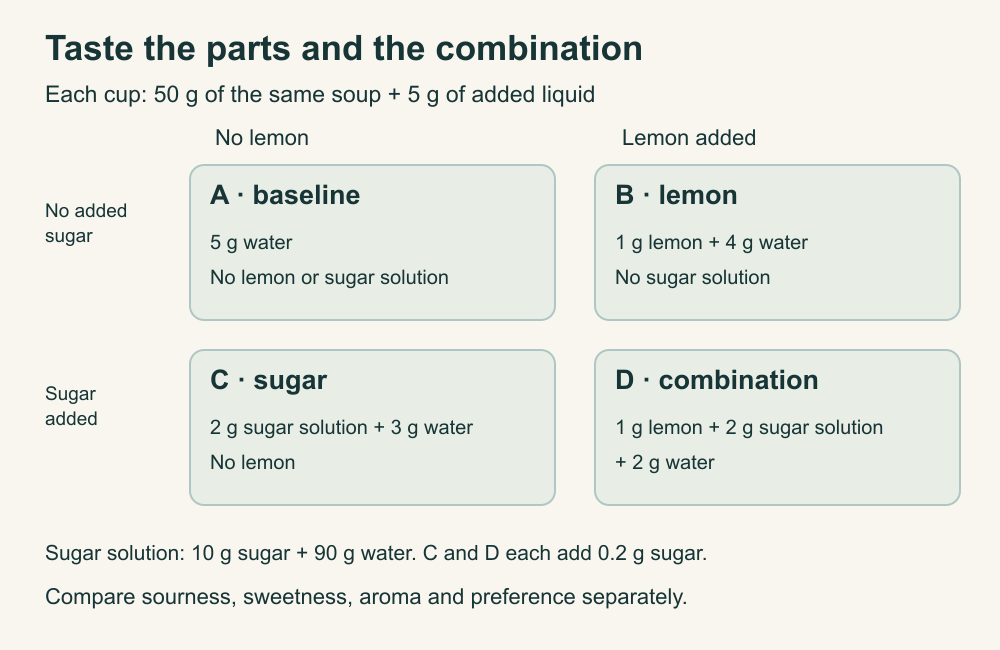
Prepare four clean cups containing 50 grams of the same well-mixed soup. Use ordinary culinary lemon juice from the same container for every relevant addition. Make a small sugar solution by dissolving 10 grams of table sugar in 90 grams of drinking water. Label it and use it only for the comparison. All four cups will receive 5 grams of additional liquid.
| Sample | Lemon juice | Sugar solution | Plain water | Question it helps test |
|---|---|---|---|---|
| A | 0 g | 0 g | 5 g | What is the equally diluted baseline? |
| B | 1 g | 0 g | 4 g | What changes with this lemon addition? |
| C | 0 g | 2 g | 3 g | What changes with this sweet addition? |
| D | 1 g | 2 g | 2 g | How does the combination compare? |
The sugar solution introduces 0.2 grams of added sugar into C and D. The table does not specify a pure-acid mass, because lemon juice is not pure acid and its composition is not being measured here. These are deliberately modest starting additions. If differences are unclear, that is a valid outcome. Do not escalate them simply to force every column of the notebook to look dramatic.
Mix consistently, keep temperatures comparable and comfortable for tasting, and use clean utensils. Taste small amounts with pauses as needed. Write separate observations for sourness, sweetness, recognizable lemon aroma, texture, and preference. You do not need a numerical score; “noticeably sharper but still suitable” can be more informative than an unexplained seven out of ten.
The equal added-liquid amount helps keep dilution similar across these samples. It does not control every property, because lemon juice and sugar solution contribute different substances. That is acceptable for a culinary comparison. The purpose is to decide what those ordinary additions do to this food, not to isolate a receptor-level mechanism with laboratory precision.
Read the pattern across the cups
Suppose A seems acceptable but dull, B is more lively and preferred, C is noticeably sweet without improving the dish, and D is less sharp than B but now too sweet. Those are invented observations. They would suggest testing the lemon direction further while leaving out the sugar. They would not justify the claim that sugar is always wrong in savory food.
A different pattern might show B too sharp and D more coherent. That could make the combination worth exploring for this soup. Compare D with both B and C, rather than concluding from D alone that you have discovered the perfect ratio. The baseline and single-addition cups explain what the combination is doing in relation to its parts.
If B and D seem equally sour to you, write that down. A home comparison need not reproduce a published group mean. Your soup contains many things absent from an aqueous research mixture, and the proposed additions use different quantities and ingredients. The useful question is what your observation supports about this meal, not whether your palate can be made to validate a paper.
Before adjusting the main pot, remember that it has not received the comparison's added water. Try the promising direction in another representative portion under the actual serving conditions. The sample table makes comparisons clearer; it does not produce an automatically transferable recipe. The final decision still belongs to the food you will serve.
Keep the dish recognizable
A good adjustment makes a reasoned improvement without losing track of the original intention. If you wanted a lentil bowl with gentle tartness, there is no need to keep adding lemon until it tastes unmistakably of lemon. The most successful change may be one a diner cannot name easily but can appreciate in the combined bite.
On the other hand, a deliberately lemon-forward dish should not be judged by a rule that acidity must hide itself. State the aim. This prevents vague praise such as “more balanced” from becoming a way to avoid explaining your preference. Describe what became easier to enjoy: the main ingredient, the contrast with another component, or the sequence of tastes across a mouthful.
Your final record can be brief: the initial problem, the tested addition, the result, and the remaining limitation. Over several meals, those records build a repertoire of decisions. You learn which ingredients suit your cooking and which comparisons are worth making. That is more flexible than memorizing a universal finishing squeeze, and more reliable than trying to repair every disappointing dish with the same bottle.
Application
Diagnose the proposed repair
In this hypothetical case, a grain bowl has a large puddle of dressing. The cook describes it as greasy and proposes adding enough lemon juice to “remove the fat.” A small lemon-adjusted portion tastes sharper, but the amount of dressing still overwhelms the grain.
- Identify the unsupported chemical claim.
- Distinguish the taste change from the quantity problem.
- Propose a comparison that would address the quantity problem directly.
Model interpretation
The lemon has not made the oil disappear. The sample supports a change in eating impression, especially sharpness, while leaving excessive dressing as a separate problem. Compare a fresh representative portion with less dressing, keeping the grain and other components similar. If that improves the bowl, the next action may be a different dressing-to-food proportion rather than more acid. Additional acidity can still be tested afterward if the intended bite needs it.
Explain your four-portion result
Complete the comparison or use either hypothetical pattern in the chapter. Write which sample best suits a stated meal, which single comparison supports that decision, and what you would test before changing the whole batch. Include one sentence explaining why a sweeter, less sour-tasting sample is not evidence that its acid has been chemically neutralized.
Successful work defines balance in relation to an intended dish, distinguishes sensory and chemical claims, compares combinations with their component changes, and carries a promising result back to the actual serving context before committing the batch.