Sauces that hold together
Three cooks complain that a sauce is too thin. One is looking at a vinaigrette that has separated into layers. Another has a starch sauce that never reached the recipe's cooking endpoint. The third has a large quantity of weak broth. All three might reach for the same spoonful of flour, but they are facing different problems. Before thickening a sauce, identify what is supposed to give it structure.
This chapter compares three mechanisms: dispersing droplets, developing starch thickening, and reducing water. Each can change how a sauce flows, but they do not change its composition or eating qualities in the same way. Understanding the difference gives you a better starting point for both making a sauce and deciding whether an imperfect one can be repaired.
Dispersed does not mean dissolved
When sugar dissolves in water, the resulting solution is different from oil broken into droplets within a watery liquid. The oil droplets remain a distinct phase. An emulsion is a dispersion of one immiscible liquid in another. In an oil-in-water emulsion, the oil forms droplets and the water-rich phase surrounds them. In a water-in-oil emulsion, the arrangement is reversed. The continuous phase is the surrounding medium, not necessarily whichever ingredient sounds most important in the recipe. Oklahoma State University, Food Emulsifiers.
Whisking or shaking can break a body of oil into droplets. That action creates much more boundary between oil and water. An emulsifier can help stabilize that boundary and slow the droplets' return to a separated state. Many familiar emulsifiers contain regions with different affinities for oil and water. They act at the interface rather than magically turning oil into water-soluble material. AOCS, how emulsions work.
The ingredients and the process therefore do different jobs. Mixing creates a dispersion; suitable interfacial material helps preserve it. A recipe can fail because the dispersion was not formed adequately, because the formulation does not support the intended structure, or because later conditions disrupt it. Adding more of a stabilizing ingredient cannot substitute for every missing part of the process.
This is why a dressing's ingredient list alone does not tell you how it will behave. The amount of each phase, the mixing method, and the other materials present matter. A sauce that looks uniform for a few minutes may be perfectly suitable for immediate service without being permanently stable. “Holds together” needs a time and a purpose.
Small droplets create a large boundary
A little geometry explains why droplet size matters. Imagine one spherical oil droplet with radius r. Its volume is proportional to r cubed, while its surface area is proportional to r squared. Divide that droplet into eight equal spherical droplets. Each new radius is half the original, because eight spheres of that radius contain the same total volume.
Each smaller sphere has one quarter of the original surface area. Eight of them therefore have twice the original total area. The oil quantity has not changed, but the boundary that must be maintained has doubled. This is an original geometric model, not a measured image of a real dressing. Actual droplets differ in size and need not remain perfect spheres under all conditions.
The model gives a reason to think about mixing and formulation together. Breaking oil into finer droplets produces more interface. Whether that dispersion persists depends on what is happening at the interface and in the surrounding liquid. The cook cannot infer adequate stabilization simply from having used a powerful blender.
It also explains why the phrase “a drop of oil” is too vague for a structural account. One visible drop and many microscopic droplets can contain the same oil but present a different organization to the rest of the sauce. Your eyes may show a gross change in appearance; they do not measure the entire droplet-size distribution.
Two kinds of separation
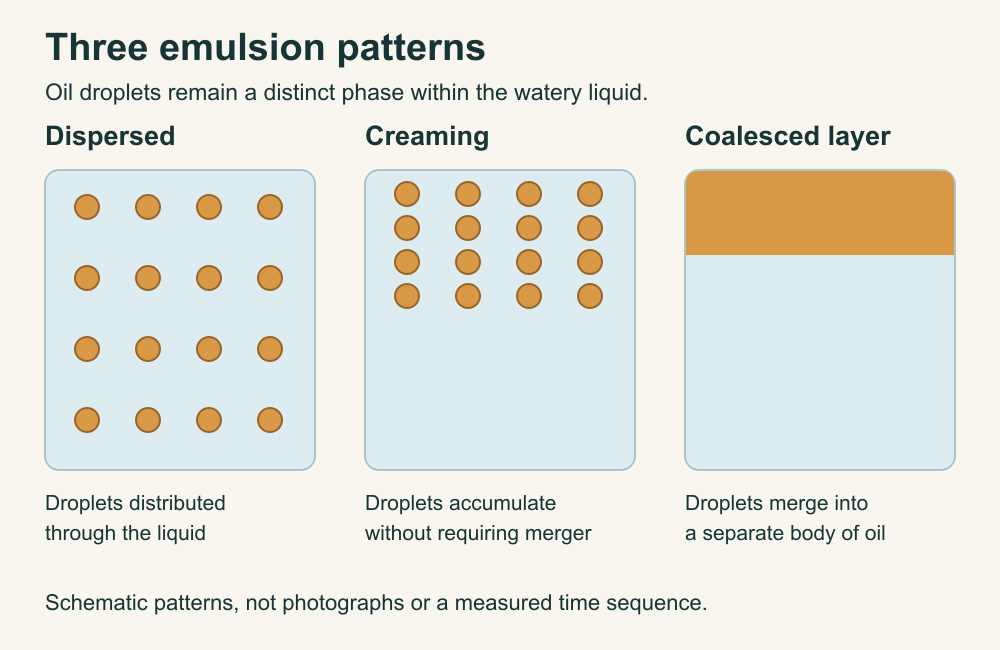
Droplets can move toward one region of an emulsion without immediately merging into a single body of oil. When less-dense droplets accumulate upward, the process is called creaming. When droplets merge into larger droplets, it is coalescence. These processes can occur together, but they are not the same event. A creamy upper region and a clearly separate oil layer provide different clues. AOCS, separation and stability.
Imagine a dressing that looks cloudy throughout immediately after mixing, then develops a thicker-looking upper zone. Another dressing develops a distinct clear oil layer. Those observations suggest different degrees or forms of change, although a kitchen inspection cannot prove every microscopic detail. The useful next question is whether the intended structure can be restored by the mixing method appropriate to that dressing.
A simple vinaigrette may be intended to be shaken again before use. Separation in that setting is not necessarily a ruined recipe. A sauce that needs to coat food evenly throughout service may require a more persistent dispersion. Judge the behavior against its purpose rather than demanding that all dressings resemble commercial mayonnaise.
Do not confuse physical stability with food safety. A uniform sauce can have been handled unsafely, and a safely handled oil-and-vinegar dressing can separate. The appearance answers a structural question. Ingredient-specific storage and handling requirements answer another question and remain in force.
Starch takes a different route
Ordinary native starch is organized in granules containing glucose polymers, principally amylose and amylopectin. Heating a suitable starch-water mixture changes the granules' ordered structure. Gelatinization names this loss of order, associated with hydration and swelling; the wider development of a thick paste also involves changes such as polymer release and granule disruption. The exact behavior depends on the starch and conditions. Wang and colleagues, cereal starch gelatinization.
This is not oil being broken into droplets. It also is not gelatin being added: the similar word does not make starch and gelatin the same ingredient. A flour-thickened sauce, a cornstarch-thickened sauce, and a gelatin-set preparation need not respond to heat, cooling, and substitutions identically.
For a cook, the first task is to disperse the starch so that it can interact with the liquid without forming persistent dry-centered clumps. A slurry mixes starch with a cool liquid before it enters the hot preparation. A roux uses flour and fat as a cooked mixture before the liquid is incorporated. These are different preparation routes, chosen for the intended sauce and recipe.
If dry starch lands in a hot liquid as a compact lump, its exterior can thicken while the inside remains poorly dispersed. More heat may cook the outside further without correcting the original distribution. The prevention belongs earlier in the sequence: disperse as the recipe directs, then add and mix appropriately. Do not taste raw flour or uncooked starch mixtures to evaluate whether a lump is ready.
Give the thickening stage a chance to happen
A cook sees little change immediately after adding slurry and adds another spoonful. A moment later, the sauce becomes much thicker than intended. The second addition was made before the first one's effect had been assessed under the recipe's required heating conditions. The error was not necessarily a wrong ingredient; it was a decision made too early in the process.
The published Argo white-sauce preparation provides a concrete example. It reserves cold milk for dispersing the cornstarch, incorporates that mixture into the hot milk, and specifies a boiling stage before the final low-heat additions. Read and follow the complete one-cup version for the optional practical exercise. The sequence supplies more information than the instruction “add starch until thick.”
Use the named starch and the preparation's quantities. A spoonful of flour is not automatically equivalent to a spoonful of cornstarch, and an instant modified thickener may behave differently from ordinary native starch. If you need a substitution, use a preparation designed for it rather than assuming that all white powders have the same thickening power.
The final assessment also belongs at a relevant temperature. A sauce can flow differently when hot and when cooled. If it will be served warm, judge its coating at that condition rather than repeatedly thinning it to match a chilled sample. If it will be chilled, its warm appearance may not describe the final texture. Follow the recipe's handling and cooling instructions as well as its cooking stage.
Reduction changes the whole concentration
Reduction removes liquid, commonly water, through continued cooking and evaporation. It can concentrate the remaining material and alter flow without adding a new thickener. It also concentrates nonvolatile dissolved substances that remain, including salt in a simplified water-loss model. It cannot be treated as a texture adjustment that leaves flavor concentration unchanged.
Take an invented 600-gram sauce containing 6 grams of salt. If it loses only water and finishes at 400 grams, the salt fraction rises from 1 percent to 1.5 percent by mass. That is a fifty-percent increase in the fraction, even though not another grain of salt was added. The same arithmetic cannot predict every aroma change, because volatile compounds need not all remain in the pot.
Suppose the sauce is already pleasantly seasoned but flows more freely than intended. Reducing it substantially may solve one problem while creating another. A suitable starch-thickened preparation could change structure with less water removal, but would give a different result and require its own quantities and method. The choice depends on the sauce you want, not on a rule that reduction is always more refined.
Conversely, if the sauce is both weak in flavor and too abundant, reduction may fit the problem well. Inspect it as it develops and stop at the intended yield and eating result. The last part of reduction is not an excuse to leave a small quantity unattended in a hot pan. Less remaining liquid means less margin before an unwanted change.
Choose the mechanism before the repair
The three opening problems can now be described more precisely. A separated vinaigrette needs assessment of dispersion and stability. An underdeveloped starch sauce needs its ingredient proportions and heating sequence checked. A weak broth may need concentration, seasoning, or a different intended use. “Too thin” did not identify any of those causes by itself.
| What you observe | What to inspect first | Why the obvious quick fix may fail |
|---|---|---|
| Separate oil and watery layers | The dressing's intended mixing and stability | Flour does not recreate the intended emulsion by itself |
| Starch added, but little thickening yet | Starch identity, amount, dispersion, and required heating stage | Another dose can overshoot once both additions develop |
| Sauce thick enough but too salty | Final yield and earlier reduction | Further reduction concentrates the problem |
| Lumps in otherwise thin sauce | How the thickener was introduced | More of the same poorly dispersed addition can create more lumps |
Use the table to choose an inspection, not to skip the recipe. A real sauce may use more than one mechanism: milk already contains dispersed fat, while added starch contributes further structure. Calling it “an emulsion” does not mean every defect is an emulsification problem. Ask which part of the preparation changed before the defect appeared.
Observe a vinaigrette over time
For the first optional practical exercise, use the University of Maryland Extension vinaigrette dressing. Read the complete ingredient list, choose its stated options, and follow its whisking or shaking method. Use ingredients compatible with your dietary needs. No raw egg is needed, and this author has not physically performed the exercise.
Set aside a small portion in a clear food-safe container and observe it immediately, then after a brief interval such as five minutes. Keep the rest for prompt service and follow normal perishable-food handling. Note whether the mixture remains uniform-looking, develops a denser region, or forms a visible layer. A photograph can document the macroscopic pattern without pretending to show microscopic droplets.
Remix that small portion using the recipe's method and observe again. Has the visible structure returned? How does it distribute over the intended food? You are investigating whether remixing serves this dressing's purpose, not trying to prove indefinite stability. An unchanged appearance during a short observation period establishes only that no visible change was detected in that period.
Record the mixing method and the interval, because “it separated” without a time is incomplete. A sauce that separates after several minutes may be entirely adequate if mixed immediately before dressing the food. Another meal may require different handling. The useful result relates behavior to service.
Make and assess the starch sauce
For the second optional exercise, follow the linked Argo one-cup white sauce if its ingredients suit you. Read the quantities and full sequence before beginning; this is a manufacturer's published preparation, not a new formula supplied by the course. Use appropriate hot-pan protection and supervise the heating. Readers who cannot make it can trace the sequence and analyze the supplied cases instead.
Record three stages: after the cold starch mixture is dispersed, after the required heating stage, and at the intended serving condition. Describe the flow with a spoon and the presence or absence of lumps. A small sample can be allowed to reach a comfortable tasting temperature; never place hot sauce on your skin to test its coating.
If the sauce is unsatisfactory, reconstruct the sequence before changing it. Was the full starch quantity used? Was it dispersed in the reserved cold liquid? Did the cooking stage occur as directed? Was more liquid added afterward? A record of those events can distinguish a preparation error from a preference for a different thickness.
Compare the two exercises in words. The vinaigrette activity used mechanical mixing to organize immiscible liquids. The white-sauce activity developed starch structure through a specified dispersion and heating sequence. Both affected how a sauce reached the food, but success depended on different operations. That distinction is the foundation for the final chapter's repairs.
Application
Explain the surface-area change
An idealized spherical oil droplet becomes eight equal droplets of half its radius. State what happens to total oil volume and total surface area. Explain why this supports considering the emulsifier and mixing process together rather than assuming that finer mixing alone guarantees stability.
Model answer
Total volume stays constant: eight times one eighth of the original volume equals the original volume. Total surface area doubles: eight times one quarter equals twice the original area. A finer dispersion creates additional interface. Its persistence depends on the formulation and interfacial stabilization as well as the mechanical work used to create it. The model does not specify how much mustard a real recipe needs.
Select the next action
In an invented case, a cook adds a cornstarch slurry to a sauce, immediately judges it thin, and adds a second equal amount. After completing the recipe's heating stage, it becomes too thick. Another cook finds an oil-and-vinegar dressing separated after standing and decides it must be discarded.
For each case, explain the likely error in reasoning and the first question you would ask before proposing a repair.
Model interpretation
The first cook judged the dose before its effect developed under the required conditions. Ask about the actual starch and liquid quantities, heating sequence, and intended serving temperature before thinning. The second cook treated physical separation as automatic failure. Ask whether that dressing is designed to be remixed before use and whether it has been safely handled. Remixing can be appropriate for a vinaigrette; it is not a remedy for unsafe storage.
Successful work identifies the structural mechanism, distinguishes droplets from dissolved substances, accounts for reduction's concentration effects, and chooses an inspection or repair that fits the actual sauce.