The escapement and the oscillator
Picture a spring-powered train of gears with no effective restraint at its fast-moving end. It would run according to the available torque, inertia, and resistance, rather than the pace required to measure seconds. Now picture the opposite arrangement: a wheel held permanently against a stop. Its spring could remain wound, but its hands would tell you nothing about the passing afternoon.
A working escapement occupies the useful territory between these two arrangements. It holds the train, releases it at appropriate moments, and transfers energy to the oscillator that governs those moments. The mechanism must sustain motion without allowing the energy source simply to dictate the watch's pace.
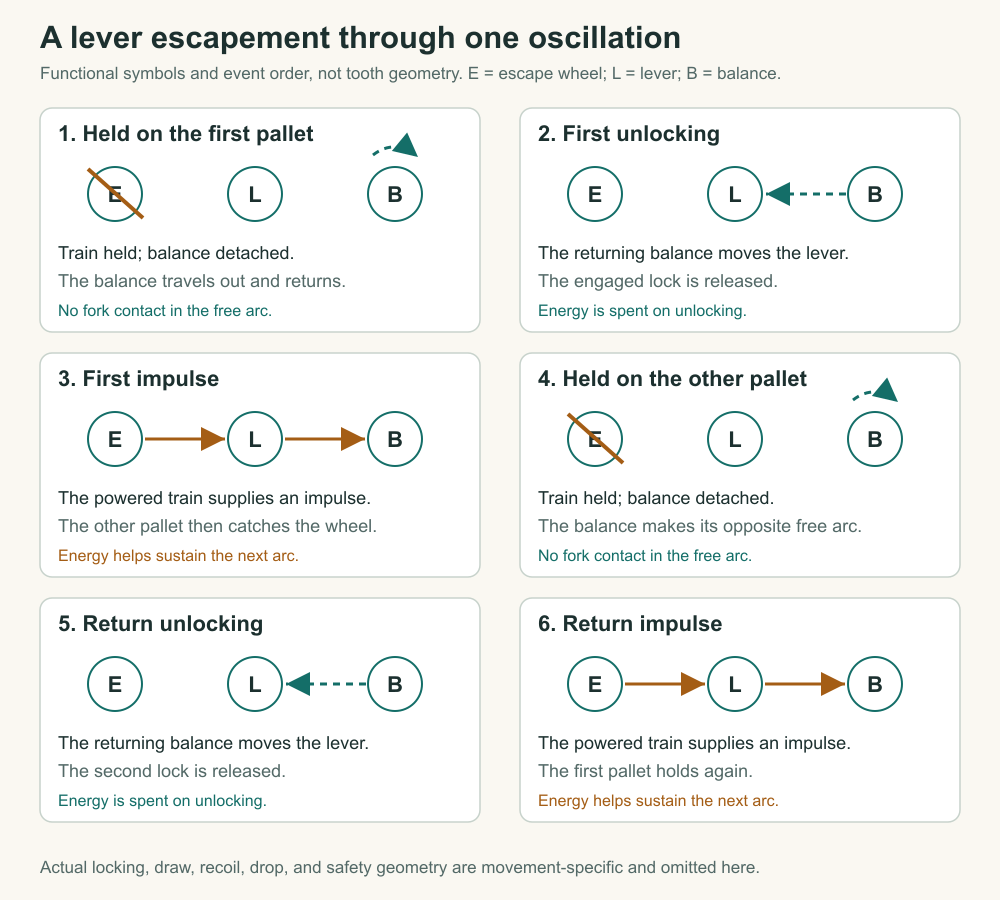
We will follow a simplified detached lever escapement. The familiar Swiss lever is an important example of this family. The stages below describe its functional sequence, not the exact geometry of every movement. Keeping the stages separate will answer an initially puzzling question: does the balance move the lever, or does the lever move the balance? During different parts of the interaction, each statement is true.
A balance does not turn like a train wheel
A train wheel normally progresses in one direction as the movement runs. A balance wheel oscillates: it rotates away from a central condition, slows, reverses, passes through the center, and goes toward the other extreme. The balance spring supplies a restoring torque that tends to bring the balance back toward its equilibrium position.
Inertia carries the moving balance beyond that position. The spring then increasingly opposes its motion until the balance reverses. On the return journey, the spring helps accelerate it toward the center again. The combination can exchange energy between motion and elastic deformation. This is an oscillator, not a wheel trying to complete continuous revolutions in one direction.
The rotational counterpart of mass in this explanation is moment of inertia: how strongly an object's distribution of mass resists changes in rotational motion about the chosen axis. Moving mass farther from that axis changes the moment of inertia even if the total mass is unchanged. The balance's distribution of mass therefore matters along with the properties of its spring.
In an ideal model with restoring torque proportional to angular displacement, the period depends on the balance's moment of inertia and the spring's stiffness. It does not depend on the swing's amplitude, meaning its maximum angular displacement from equilibrium. Real balances, springs, contacts, and losses depart from this ideal. OpenStax develops the corresponding ideal spring-oscillator relationship; the watch uses rotational rather than straight-line motion. OpenStax: simple harmonic motion
The ideal is useful because a portable watch cannot depend on exactly the same swing size under all conditions. The aim is a period that remains consistent while energy supply and disturbance vary within the movement's intended operation. Replacing the lost energy helps the motion continue; good design also limits how that replacement disturbs the period.
Name the interacting parts
The escape wheel sits at the regulated end of the train and receives power from it. A lever, often called the pallet fork, carries two pallet stones at its working end. Their contact surfaces alternately hold and interact with the escape-wheel teeth. At the lever's other end, a fork engages an impulse pin associated with the balance assembly during part of its passage.
The balance itself has a staff, or central shaft, and a roller assembly that carries the impulse pin. “Pin” here names a small functional contact, often a jewel. It moves with the balance assembly. The fork does not remain attached to it throughout a complete oscillation. That limited contact is what lets the balance spend much of its travel detached from the escapement.
Seiko's museum describes the lever placed between the balance and escape wheel and explains the use of pallet stones at working contacts. Its account also distinguishes the familiar club-tooth Swiss lever form from earlier constructions. We will use that functional arrangement without treating its historical development as a universal blueprint. Seiko Museum: the lever escapement
Make three simple marks on paper: a toothed circle for the escape wheel, a rocking lever with two contact pads, and an oscillating balance with an off-center pin. The marks do not need realistic dimensions. Leave room beside them to write which part is acting and which part is responding at each stage.
First, the train is locked while the balance travels
Start with an escape-wheel tooth resting against the locking surface of one pallet stone. The spring-powered train exerts torque, but the geometry holds the escape wheel in place. The lever rests toward one side of its allowed travel. The balance continues its free arc, moving away from the brief region in which its impulse pin contacts the fork.
“Locked” describes the train's condition. It does not mean every part in the watch is stationary. The balance can continue moving while the escape wheel remains held. If a diagram shows both parts frozen at every moment except a tick, it has concealed the oscillator's continuous back-and-forth journey.
The balance reaches an extreme and returns under the spring's restoring action. During that free travel, it is not being continuously pushed around by the mainspring. It carries motion acquired earlier and exchanges energy with its own spring. This is why the balance's spring and inertia have a central role in establishing the interval before the next encounter.
Then the returning balance unlocks the train
As the balance returns through the interaction region, its impulse pin enters the fork and moves the lever. That action withdraws the engaged pallet's locking surface enough for the escape wheel to progress. Unlocking requires an expenditure of energy by the balance; it is not a free signal transmitted without mechanical contact.
H. R. Playtner's technical lecture makes this reversal of roles explicit: the pin first acts through the fork to unlock the pallets; after unlocking, the fork transmits power back to the balance. The geometry is complicated, but the direction of the exchange is the essential idea. Playtner: fork and roller action
In a detailed Swiss lever analysis, the tooth's contact during unlocking can involve a very small recoil before forward advance. Our functional sequence leaves those small motions unscaled rather than pretending the escape wheel moves at a uniform speed through release. A simple arrow marked “release” should not be read as a machining drawing.
At this instant, saying “the balance drives the whole watch” would still be misleading. It has performed a local unlocking action. The mainspring remains the continuing energy source for the train. The balance determines when that stored energy can produce the next controlled advance; it does not replace the stored energy.
The released train gives an impulse
Once the lock is released, the powered escape wheel advances. Contact between its tooth and a pallet's impulse surface moves the lever, which acts through the fork and impulse pin to give energy to the balance. The term impulse here names the brief sustaining action within the escapement's cycle.
This action helps replace energy lost through friction, air resistance, and the work of interacting with the escapement. It is timed near the balance's passage through the central region, rather than being applied throughout its whole free arc. The exact contact angles belong to the particular construction and adjustment.
The balance now emerges from the interaction with enough energy to continue the next part of its swing in normal operation. The train has also advanced. A single event has therefore achieved two results: it has let the transmission progress, and it has helped sustain the oscillator that will govern the next event.
Notice the difference between an impulse and a command to reverse. The fork does not need to follow the balance to its farthest point and turn it around there. The balance spring produces the restoring action during the free arc. The escapement supplies energy in the short interaction region; the oscillator continues the journey.
The opposite pallet catches the wheel
At the end of the impulse interaction, the escape wheel progresses far enough for another tooth to be caught by the other pallet's locking surface. The mechanism is now held on the opposite side. The balance's pin leaves the fork, and the balance travels freely toward its other extreme before returning.
The next half-swing repeats the functional pattern with the opposite pallet involved: free travel, unlocking, impulse, and a new lock. The wheel accumulates forward advance while the lever rocks between its working positions. A complete balance oscillation contains the two complementary half-swings. The naming of a tick and a tock reflects that repeated alternation, not two different energy sources.
Horopedia's detailed operational account distinguishes resting, unlocking, impulse, and the motions leading into the next secure rest. Its explanations show why a drawing of just two static positions omits the important exchange between them. Our account simplifies the sequence for learning and does not adopt its numerical geometry or repair recommendations. Horopedia: Swiss lever operation
We have described the order of events without assigning one full escape-wheel tooth pitch to each beat. The actual relationship between wheel teeth, alternating pallet contacts, and advance must be established from the mechanism. “One tick means one whole tooth” is an unsafe shortcut if you have not checked what the drawing counts.
Why the balance must be free for part of the journey
An oscillator can provide a useful rhythm because its own mechanical properties strongly govern its motion. A contact that drags on it throughout its entire journey can add a changing influence to that rhythm. A detached arrangement limits the interval during which the lever and balance exchange force.
Detachment does not mean isolation from all disturbance. The balance still turns in bearings, moves through air, and experiences the forces associated with being worn. Its spring is a real material with a real geometry. The escape wheel and lever still interact with it during unlocking and impulse. Good timing depends on managing the whole system, not removing every contact.
There is also a practical need for the lever to remain in the intended position while the balance is detached. Banking surfaces limit lever travel, and safety features help prevent an accidental displacement from putting the fork on the wrong side of the returning pin. Detailed construction varies; these features should appear as a note on a simplified map rather than being silently assumed away.
A schematic earns trust by telling the reader what it omits. Our sequence omits exact locking depths, draw angles, oil locations, contact clearances, and the dimensions of the safety arrangement. Those omissions allow a beginner to understand the functional cycle. They also establish why the illustration cannot be used to make or adjust the parts.
An energy account for repeated beats
Consider an invented oscillator that begins a cycle with one hundred energy units. Suppose it loses four units over the cycle through all relevant dissipative effects, including its interaction with the escapement, while the two sustaining impulses together add four. It can return to the same stored oscillation energy at the corresponding point of the next cycle.
If the impulses add only three units under otherwise unchanged assumptions, the account ends at ninety-nine. Repeated deficits reduce the motion until the assumptions cease to hold or the mechanism stops. If they add five, the motion initially grows; a real system reaches an operating balance only as its losses and interactions respond. These invented units are an accounting model, not measured watch values.
Equal energy per cycle does not prove correct timekeeping. Two oscillators can each balance their losses and input while having different natural periods. One could be designed for three complete cycles per second and the other for four. Sustained operation concerns the energy account; the correct interval concerns the oscillator and the way its events are counted.
Nor is amplitude simply another name for accuracy. A larger arc tells you about the extent of the balance's motion. It does not, without other information, show that the period is closer to its target. A movement has an appropriate operating range, and a timing assessment needs its specifications and measurement conditions.
What the sound can and cannot tell you
A mechanical tick is produced by brief contacts in this repeating mechanism. A timing instrument can use the timing of such sounds to estimate aspects of the movement's behavior. Hearing a regular sound by ear is much less specific. It does not tell you the daily rate to a fine tolerance or identify the precise condition of each contact.
Imagine an audio recording that contains two indistinguishable clicks every quarter-second. Before calculating a frequency, you must know whether those clicks represent two distinct beats, multiple contacts within one beat, or recording artifacts. Counting peaks in an unfamiliar waveform without understanding their origin can produce a persuasive but incorrect number.
The same principle applies to a slow-motion video. Playback speed changes what you hear and see, and the frame rate limits which events are distinguishable. The video can reveal a sequence while failing to provide an accurate real-time frequency. A diagram and a recording serve different evidential purposes.
You can now explain a conventional lever-controlled watch without the vague phrase “the gears keep it steady.” The balance approaches and unlocks; the powered train advances and supplies an impulse; the opposite pallet locks; the balance travels and returns. The sequence allows repeated mechanical events to govern accumulated motion. The next chapter follows that motion into hands and calendar indications.
Application
Reconstruct one complete oscillation
Draw a six-panel sequence or use six written panels. Begin with the escape wheel locked and the balance traveling freely. Cover unlocking and impulse on the first passage, the new lock and opposite free arc, and unlocking and impulse on the return. End at the corresponding locked state one complete oscillation later.
In each panel, answer three questions: Is the train held or advancing? Is the balance in contact with the fork or detached? Which component is transferring energy to which? Label the result as a functional sequence with simplified geometry.
Test three explanations
Explain what is missing or wrong in each fictional statement:
- “The fork pushes the balance all the way to its turning point and then pulls it back.”
- “The balance supplies the energy that runs the watch because it moves the fork.”
- “A larger balance swing must mean a more accurate watch.”
Finally, use the invented hundred-unit oscillator. Its losses total five units per complete cycle and its two impulses add two units each. What is the net change after one cycle under those assumptions? Can that arithmetic establish the number of seconds it gains in a day?
Model interpretation
The free-travel panels show the balance moving while the train remains held. During unlocking, the returning balance acts through its pin on the fork. During impulse, the powered escape wheel acts through the lever and pin on the balance. The next lock transfers the holding role to the opposite pallet while the balance becomes detached again. Repeating the complementary interaction completes the oscillation.
The spring provides the balance's restoring torque during its free travel; the fork is not attached throughout that motion. Moving the fork during unlocking is a local expenditure by the balance, whose sustained energy ultimately comes through the mainspring-powered train. Amplitude describes swing size, whereas accuracy requires comparison with a time or frequency reference.
The energy account gives 100 − 5 + 2 + 2 = 99 units, a loss of one unit per cycle under the stipulated conditions. It says nothing sufficient about the period or counting ratio, so it cannot determine a daily timing error. A physical watch's evolving motion would also change the conditions that the simple arithmetic holds fixed.