Why a watch gains or loses time
A watch is twenty seconds ahead. Is that good timekeeping? The number is incomplete. It could be the result of a poor setting ten minutes ago, a small daily gain over several weeks, a changing rate that happened to arrive there, or a reference comparison made imprecisely. We need a record of how the difference developed.
This final chapter turns the mechanisms you have learned into a way of judging evidence. You will separate an offset from a rate, read a supplied observation log, and connect possible influences to the relevant parts of a movement. The aim is a useful explanation and an appropriate next question, rather than a diagnosis from one glance.
The course's final task then joins the two main architectures. You will trace energy and timekeeping through a conventional mechanical watch and a common analog quartz watch. A complete answer should explain how each works and what observations would be needed to judge its performance.
Begin with the sign of the difference
Define time offset as the watch's indication minus the reference indication at the same observation. Positive means the watch is ahead; negative means it is behind. Keeping this convention explicit prevents “gains” and “loses” from becoming ambiguous when the watch starts on the wrong side of the reference.
The average rate difference over an interval comes from the change in offset divided by the elapsed reference time. If a watch begins ten seconds behind and ends four seconds behind one day later, its offset changed from −10 to −4 seconds. The change is +6 seconds: it gained six seconds during that day, although it remains behind.
Conversely, a watch can lose time while still being ahead. An offset that moves from +20 to +15 seconds in a day represents a loss of five seconds over the interval. Describing only its final position would miss that direction of change. The initial reading matters even when you believe you set the watch carefully.
NIST distinguishes the consistency of an oscillator's behavior from whether its frequency is close to the intended value. The same discipline applies here: report the measured differences and their consistency before assigning an overall verdict. A stable offset from the desired rate and an unstable rate are different patterns. NIST: frequency stability
A log with two different stories
The following is an invented teaching record, not a measurement of a real watch. All observations occur at the same reference time, twenty-four hours apart. The watch is not reset or stopped. The notes describe ordinary wear and overnight storage; they do not claim laboratory control.
| Observation | Offset in seconds | Conditions during the preceding interval |
|---|---|---|
| Start | +20 | Initial comparison |
| Day 1 | +24 | Ordinary wear; dial-up overnight |
| Day 2 | +28 | Ordinary wear; dial-up overnight |
| Day 3 | +32 | Ordinary wear; dial-up overnight |
| Day 4 | +30 | Travel day; crown-up overnight; temperature unrecorded |
| Day 5 | +28 | Travel; crown-up overnight; temperature unrecorded |
| Day 6 | +26 | Travel; crown-up overnight; temperature unrecorded |
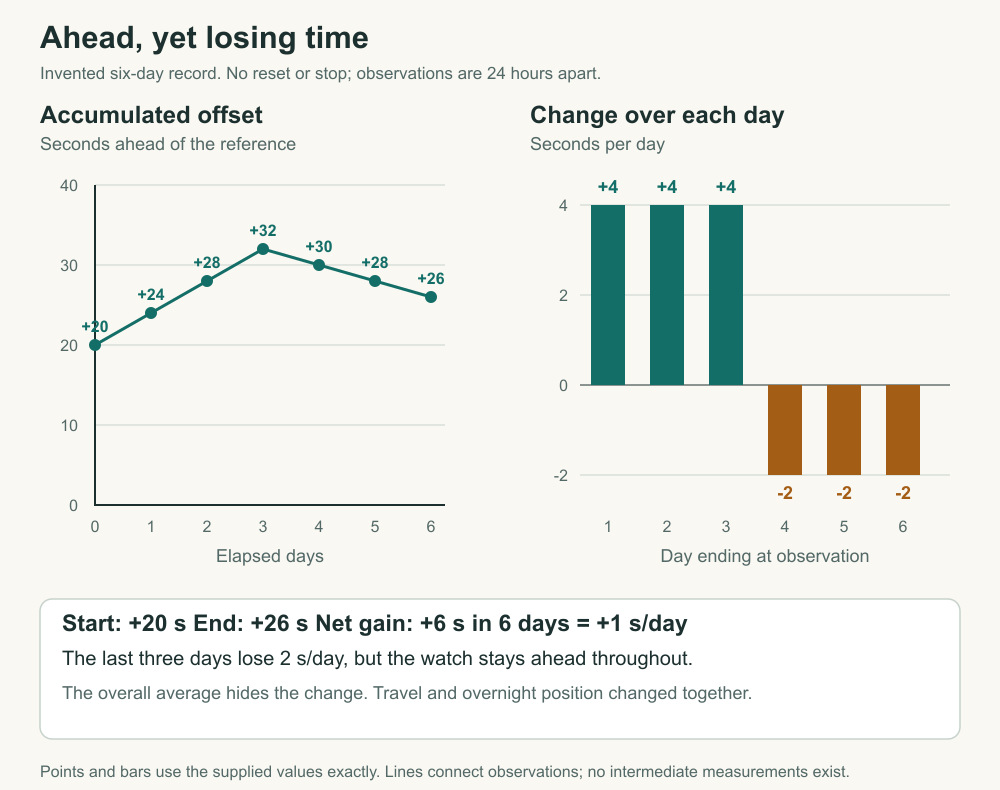
The first three daily changes are each +4 seconds. The last three are each −2 seconds. Over the full six-day interval, the offset changes by only +6 seconds, giving an average gain of one second per day. That overall average is arithmetically correct but conceals the change in pattern.
The final offset is +26 seconds, not +6. Twenty seconds were already present at the start. Subtracting the starting offset lets us describe the timing accumulated during the record. Resetting the watch each day without recording the correction would make this kind of continuous comparison harder to reconstruct.
A plot of offset against elapsed days makes the distinction visible. The line rises for three days and then falls, while remaining above zero. A separate plot of daily rate differences has three values at +4 and three at −2. One graph shows accumulated position; the other shows changes over successive intervals. They answer related questions, but their vertical axes do not mean the same thing.
A changed condition is a hypothesis
The log changes overnight position at the same time as travel begins. The apparent association makes position worth investigating. It does not prove position caused the changed rate. Temperature, activity, winding input, observation conditions, and other factors may also have changed.
A stronger observational comparison would record those factors and repeat the contrast while keeping as much else comparable as practical. Even then, an owner-level record has limits. It can guide a question to a watchmaker or help interpret everyday use without identifying the exact condition of a balance spring, bearing, or electrical component.
Do not improve the fictional evidence after seeing the result. It would be tempting to say, “The warmer climate slowed the watch,” because that sounds physically plausible. The temperature was not recorded. A source explaining a possible temperature effect cannot turn an unmeasured condition into an observed cause.
This is the difference between a mechanism and evidence that the mechanism operated in this case. You need both for a strong causal explanation. The course has supplied possible routes; the record must still show enough to distinguish among them.
Reading uncertainty limits small claims
Suppose, in another explicit simplification, each offset observation could be wrong by up to one second. The difference between two observations could then be wrong by up to two seconds in the worst case, if their errors went in opposite directions. A calculated daily change of one second would not support great confidence about the exact rate from that single interval.
An endpoint comparison over three days spreads that same possible two-second difference error across a longer interval. Dividing by three gives about two-thirds of a second per day. This does not remove systematic reference problems, but it shows why a persistent small rate difference becomes easier to assess over longer observations.
These are bounds for the stated reading-error assumption, not a statistical confidence interval. We have not assigned probabilities or demonstrated that errors are independent. A calculation becomes more useful when its assumptions are visible, not when it is decorated with more decimal places than the observations justify.
For the supplied log, a precise-looking daily-rate plot should therefore remain labeled as invented data. If you make your own log, retain the original observations, indicate their likely reading precision, and record interruptions or corrections. An honest approximate result is more informative than a falsely exact one.
Power state and position affect a mechanical system
The mainspring's delivered torque can change as it unwinds. The balance's motion and its interaction with the escapement can respond to that changing supply. A design aims to keep the period useful through its operating range, but sustained motion and perfectly unchanged rate are not the same achievement.
Position changes the movement's orientation relative to gravity. It can change how loads and imperfections influence a real balance, spring, and their supports. The exact effect depends on the movement and its condition. “Crown up makes watches lose” is not a universal principle that follows from the existence of a balance.
Seiko's 6R55/6R5J accuracy guidance identifies winding state, wearing conditions, position, and temperature as relevant influences and recommends looking at behavior over several days. This is movement-specific context for the kinds of variables in our log. It does not identify the cause of the fictional change. Seiko: mechanical accuracy
An occasional observation cannot fully describe a power-reserve interval either. If you compare only immediately after full winding, you have sampled one part of the operating state. If the watch later stops, the elapsed period that includes the stop is no longer a simple measurement of its running rate. Note the interruption rather than averaging it into an unexplained huge loss.
Temperature is a design problem in both architectures
Temperature can change dimensions and material properties. In a mechanical oscillator, both the balance and its spring are part of the resulting timing system. The influence is not usefully summarized as “metal expands, therefore all watches run in one direction.” The construction, materials, compensation, and operating range matter.
Quartz oscillators also have temperature-dependent behavior. Electronic timekeeping does not mean the physical resonator is unaffected by its environment. A manufacturer can characterize the response and compensate for it, but the existence and method of compensation must be established for the particular movement.
Grand Seiko describes the 9F system as pairing oscillator characteristics with its circuit and using internal temperature measurements for compensation. That is an example of an engineering response to a physical effect. It should not be generalized into a claim that every quartz watch includes the same system or remains perfect at any temperature. Grand Seiko: 9F temperature compensation
For an ordinary observational exercise, use normal wearing and storage conditions within the watch's instructions. There is no need to expose it deliberately to extreme heat or cold. A record that preserves the object and identifies uncertainty is sufficient for this course's purpose.
Shock and magnetism do not produce one signature
A shock can disturb a moving mechanism, and a sufficiently severe event can damage or displace components. Whether a watch continues operating afterward does not establish that every property remains unchanged. Equally, a rate change observed after an event does not identify which component was affected without further evidence.
Magnetic effects depend on susceptible materials and the architecture. The Seiko 6R55/6R5J manual specifically identifies the balance spring as a part that can be influenced by a strong external magnetic field. It describes possible gain, loss, or stopping and directs affected owners toward service. Seiko: magnetic effects
That list itself warns against diagnosing magnetization solely from the sign of a timing error. “It gains, so it is magnetized” is not a logically sufficient conclusion. A named cause can produce a symptom while other causes produce that symptom too. The relevant question is what evidence discriminates among them.
Consult the exact handling guidance rather than deliberately testing shock or magnetic resistance at home. The manual for the example movement cautions against strong vibration and magnetic exposure. Those instructions define use limits; they do not establish the history or current condition of an unidentified secondhand object. Seiko: handling cautions
Read the specification's conditions
A timing specification is a claim with a quantity, unit, interval, and conditions. Seconds per day and seconds per year are not interchangeable labels. An average under specified tests is not a promise that every short interval produces the same value. A stated range should remain attached to the manufacturer's qualifications.
For a constant-rate mathematical comparison, an invented gain of two seconds per day would accumulate to sixty seconds in thirty days. That calculation does not convert a real monthly specification into a guarantee about each day. A device's error can vary during the month and partly cancel, just as our supplied log's gains and losses did.
Certification, where present, also needs its actual test scope. The name of a test does not tell you whether it concerns a movement before casing, a completed watch, particular positions, or particular environmental conditions. Without the relevant standard or documented program, do not supply a confident interpretation from the label alone.
This course has used selected manufacturer documentation to explain mechanisms, not independently tested a collection of watches. A reader comparing products should keep manufacturer claim, direct observation, and inference separate. That habit makes appreciation more informed without pretending a short course is a certification laboratory.
Decide what the evidence supports
Return to the invented log. You can say the watch stayed ahead throughout, first gained and then lost, and averaged a net gain of one second per day over six days. You can say that a change in recorded conditions accompanied the changed pattern. You cannot assign that pattern uniquely to position, temperature, winding, or a fault.
You can also propose a proportionate next step: verify the reference and observation method, preserve a longer record with meaningful condition notes, and consult the identified movement's instructions. If an actual watch has stopped unexpectedly or changed behavior markedly, an appropriate professional assessment can examine the mechanism rather than relying on the log alone.
Most importantly, you can connect evidence to a complete mechanism. You know where energy enters, which oscillator supplies the local rhythm, how events become accumulated indication, and how setting relates that indication to a reference. That is enough to explain why a watch works, to notice when an explanation is incomplete, and to distinguish measured performance from the reasons you might enjoy wearing it.
Application
Interpret the supplied log
Calculate the daily changes, the average change over Days 0–3, over Days 3–6, and over the full record. Explain why the watch loses time during the second half while still being ahead. Identify two confounded conditions and one improvement to the observation method.
Assuming each endpoint offset can be wrong by at most one second, calculate the worst-case bound on the six-day average rate due to those endpoint reading errors alone. State one source of uncertainty that this calculation does not include.
Final task: explain two complete watches
Prepare two annotated diagrams and a 500–800-word explanation. The first diagram should show a conventional automatic mechanical movement with a lever escapement. The second should show a common battery-powered analog quartz movement. Label them as functional schematics.
In each, distinguish energy paths from timing relationships. Show where winding or electrical supply enters, what sustains oscillation, how events are counted or translated, what moves the hands, and where an external reference enters during setting. Explain the escapement's exchange of roles in the mechanical diagram and frequency division in the quartz diagram.
Use one worked number from the course, state its assumptions, and explain one observation that would not by itself diagnose a physical fault. End with three separate judgments: a measurable performance question, a reliability question requiring longer evidence, and a personal preference that the mechanism alone does not settle.
Model interpretation
The daily changes are +4, +4, +4, −2, −2, and −2 seconds. The first three-day average is +4 seconds per day, the second is −2, and the full six-day average is +1. The offset remains positive because the initial lead and first three days' gain exceed the subsequent loss. Travel and overnight position changed together; temperature and winding input were not controlled. A stronger record would identify the reference, preserve all corrections, and record the relevant conditions consistently.
Endpoint errors can change the total six-day offset difference by at most two seconds under the assumption. The resulting average-rate bound is 2 ÷ 6, or about one-third of a second per day. A reference correction, an unrecorded interruption, or a systematic comparison problem is outside that simple bound.
A strong mechanical diagram shows crown or rotor input winding a mainspring, then barrel and train output to the indication and through the escapement to the balance. The balance's return unlocks the escapement; the powered train subsequently supplies an impulse. The free arc and balance spring's restoring action remain visible in the explanation.
A strong quartz diagram shows the battery powering the resonator's sustaining circuit, electronic counting and drive circuitry, and motor. The timing events pass through counting before the motor drives gears and hands. The reference establishes or checks the starting indication; it is not an implied continuous radio connection.
An appropriate worked example might use the fifteen-stage division of a nominal 32,768-Hz signal and show that a constant twenty-parts-per-million error remains the same relative error after division. A performance question might ask for observed rate over a specified interval. A reliability question might ask whether the watch continues functioning under documented use over time. A preference might concern the pleasure of a visible balance. These are legitimate questions with different kinds of answers.