Eggs, nests, and parental work
A bird's life does not begin with a small version of the adult performing the same tasks less efficiently. The developing animal obtains materials, exchanges gases, and maintains workable conditions through arrangements that change as it grows. Before hatching, the egg and its surroundings participate in those functions. After hatching, parents can supply food, warmth, and protection while the young animal's capacities continue to develop.
Our comparison is between Anna's hummingbirds and Western gulls. Their hatchlings differ visibly, and their adults divide parental work differently. Neither pattern is a universal description of birds. The comparison lets us connect reproduction with the earlier chapters on energy, exchange, temperature, and behavior without treating the nest as a separate decorative addition to the adult's physiology.
Building an egg is already an investment
An egg contains materials acquired and assembled by the female. Producing it therefore belongs in her resource account before incubation begins. The relevant requirements include usable energy, water, proteins, lipids, and minerals. A diet described only by calories would miss the need for the particular materials from which tissues and supporting structures are made.
In the chicken, fertilization occurs before albumen and shell are added in the oviduct. Early cell divisions occur in a disc associated with the yolk; development is already under way by laying. This is why “the embryo starts when the egg leaves the mother” is an inaccurate description. The familiar shelled object is a later stage in a process. Gilbert, Developmental Biology: early bird development.
The shell, yolk, albumen, membranes, and embryo should not be confused with one another. The embryo is the developing animal. Other components provide resources, boundaries, or supporting arrangements. In the chicken reference case, much of the embryo's subsequent development takes place using material already enclosed at laying, while exchange with the environment remains essential.
For an original accounting model, suppose a female has twenty resource units available over an interval. Maintenance requires twelve, leaving eight for other allocations. If making an egg requires six units of an appropriate mixture, that allocation leaves two under the model's assumptions. Increasing food availability might change the balance, but adding only one abundant nutrient may not solve a shortage of another. These numbers describe no actual bird; they show why an energy total and a material budget answer different questions.
The timing matters too. A resource available after laying cannot retroactively become material deposited in that egg. It may instead support incubation, later eggs, or feeding young. A seasonal account must therefore ask when a resource becomes available and which stage can use it, rather than averaging all food across the year.
The shell is a boundary with exchange
A shelled egg is not sealed against all movement. Oxygen enters through microscopic pores, while carbon dioxide and water vapor can leave. In a developing chicken, vascular extraembryonic surfaces contribute to gas exchange before pulmonary breathing takes over. One important later surface is the chorioallantoic membrane, where blood vessels lie near the shell-side exchange route. The shell itself is not a lung containing blood vessels. Mueller, Burggren, and Tazawa: avian embryonic physiology.
This arrangement revisits the exchange problem from the breathing chapter. Oxygen must cross a barrier and then reach living tissues. A route through the shell is useful only if subsequent transport supports the embryo. Conversely, a circulation cannot deliver oxygen that never crosses the external boundary. Exchange and internal transport operate in series.
A boundary also has more than one consequence. Consider an original membrane model with the same material and thickness but twice the effective open area. Under the same concentration gradient, a simple diffusion model predicts greater transfer. Yet an increase that helps one substance move can also alter the loss of another. “More permeable” is therefore a description requiring a substance and conditions, not an automatic judgment of improvement.
The egg's surrounding air belongs in this explanation. Transfer depends on a difference across the route, as well as properties of the route itself. Changing the external conditions can change exchange without changing the shell. An anatomical photograph cannot supply a complete physiological account because it omits the gradients that make movement possible.
Incubation changes the local environment
Incubation is often described as keeping eggs warm. That is useful as an introduction, but a more complete account concerns the conditions under which the embryo develops. Heat transfer depends on contact, insulation, air movement, and the temperature differences involved. In many birds, a vascular bare area of skin—the brood patch—helps transfer heat between adult and eggs. Nest material and parental posture also alter the local environment. Mueller and colleagues: incubation and heat transfer.
A nest is consequently part of a heat-transfer arrangement, but it does not create warmth from nothing. Insulating material changes a rate of exchange. An adult supplies metabolic heat and changes contact or exposure through behavior. The embryo's own metabolism also changes during development. Different components of the account become important at different times.
Imagine two otherwise identical invented eggs in environments differing only in air movement. If the moving air increases heat loss under those conditions, maintaining the same egg temperature would require a compensating change somewhere else. More contact with a warm adult could be one possibility in the model; a different nest structure could be another. The model identifies relationships without prescribing how a real species must respond.
The same reasoning prevents a misleading interpretation of an unattended interval. Observing an adult leave tells us something about behavior. It does not directly reveal the egg's temperature, the duration of earlier attendance, or the eventual outcome. A photograph of an empty-looking nest is particularly weak evidence about an entire incubation schedule.
Two nests, two arrangements of work
Cornell describes the female Anna's hummingbird building a small cup with plant down and binding material such as spider silk. The female provides the care; the sexes do not form a parental pair. The species account lists two eggs, an incubation period of about sixteen days, and hatchlings with closed eyes and very little down. These are reference descriptions, not a guarantee for every nest. Cornell: Anna's hummingbird nesting.
For this bird, an adult's time spent obtaining her own food and time spent attending offspring belong to one connected schedule. The observation that there is one caregiver changes the allocation problem. It does not establish that a particular absence is excessive, or that a human observer could improve the schedule by intervening.
Western gulls commonly use sheltered ground sites. Both members of a pair contribute to nesting, incubation, defense, and feeding the young. Cornell describes hatchlings as alert and covered in camouflaged down, with the capacity to leave the nest cup at about a day old. Their ability to move does not eliminate parental feeding. Cornell: Western gull nesting and care.
Here, the schedule can involve coordination between two adults. One adult's departure is not necessarily a period with no care. A record that follows only one parent can therefore miss an important part of the system. The comparison is about documented distributions of work, not an assertion that two caregivers always produce a better outcome than one.
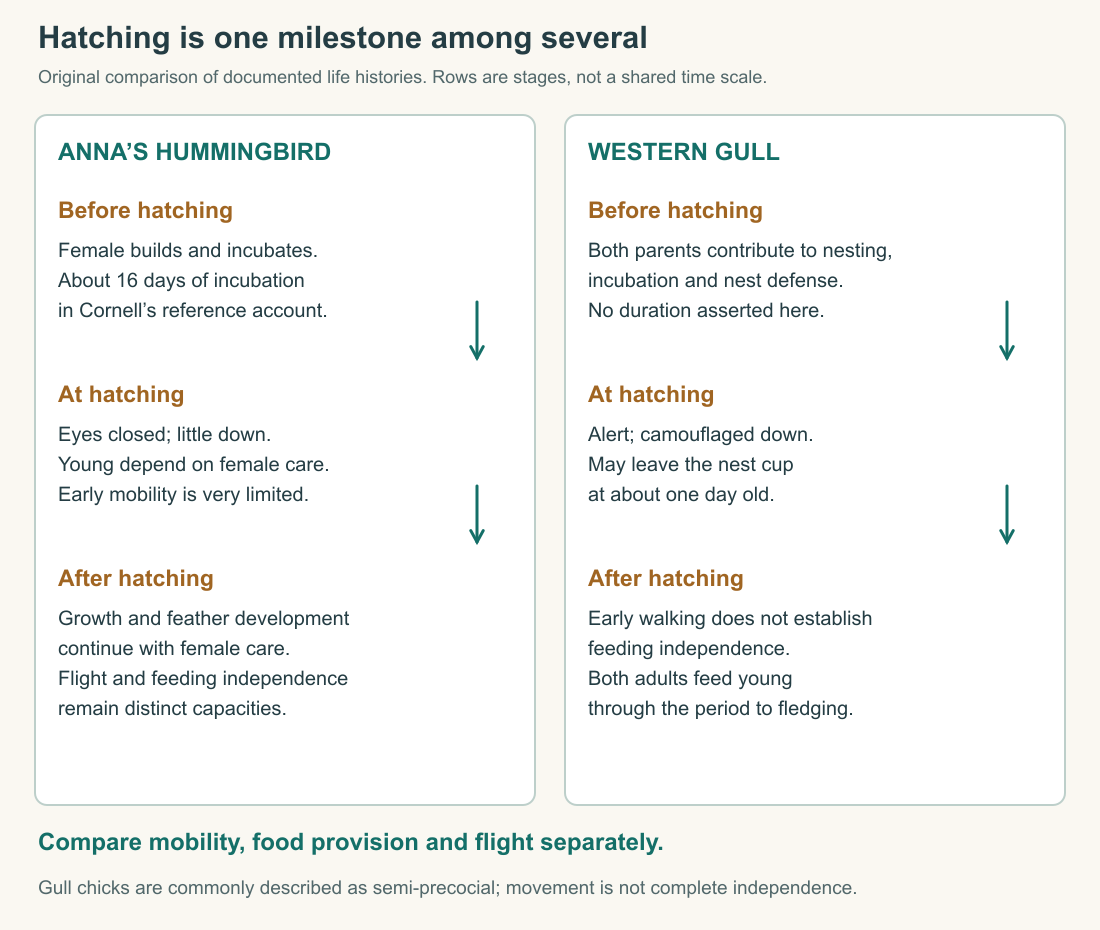
The diagram keeps the milestones separate. Hatching, leaving a nest cup, becoming capable of flight, and obtaining food independently are not synonyms. A single line labeled “grown up” would hide the changes we need to explain.
Development has several dimensions
Altricial and precocial describe broad developmental patterns, but real comparisons involve multiple traits. Eyes may be open or closed, down may be abundant or sparse, and mobility and feeding ability may develop on different schedules. Gulls are commonly described as semi-precocial: their young are relatively mobile and downy while still receiving food from parents. A category is most helpful when followed by the actual traits it summarizes. Ehrlich, Dobkin, and Wheye: developmental categories.
Imagine two hypothetical young animals that both walk on their first day. One can locate and process suitable food, while the other follows adults and receives meals. Their similar movement does not imply similar nutritional independence. If a field observer records only walking, the observation cannot choose between those feeding accounts.
We should also avoid treating development as a single speed contest. A species can be relatively advanced in one capacity at hatching and remain dependent in another. The relevant question is how the combination works within its environment. Early mobility can change where a young bird encounters exposure or danger; remaining in a nest can concentrate care while tying the young to a particular site.
These consequences suggest hypotheses about evolutionary tradeoffs, but a plausible story is not a historical demonstration. To establish why different patterns evolved, researchers need comparative evidence that takes ancestry and other correlated traits into account. Two living species illustrate alternatives; they do not independently reconstruct every selective pressure that produced them.
Feeding young connects a nest to a landscape
The nest may be stationary while its food supply is distributed through a larger area. An adult's trip links the two. Travel, search, capture, processing, and return occupy time before a meal reaches the young. A change at any stage can alter delivery even if the adult spends the same total time away.
Consider an explicitly invented example. A round trip takes ten minutes and delivers two food units. If all trips were identical and continuous, that would permit six trips and twelve units per hour. If travel conditions lengthen the trip to fifteen minutes with the same delivery, the modeled maximum becomes four trips and eight units. The arithmetic identifies a consequence of time per trip; it does not describe a measured hummingbird or gull feeding rate.
Now change the example so the longer trip delivers four units. Four trips would yield sixteen units per hour. The more distant resource could provide a larger return under those assumptions. Distance alone therefore does not determine the outcome. The useful account includes trip duration, load, usable composition, and the costs paid by the adult.
Real trips also vary, and the adult must maintain its own body. A delivery rate does not measure how much food the adult consumed, how much energy it expended, or how its reserves changed. If we observe arrivals but cannot see the load, we should report arrivals. Relabeling them as nutritional input creates precision the observation does not support.
This makes habitat part of the developmental account. Resource distribution can affect a caregiver's schedule, while shelter and exposure affect conditions at the nest. The effects may interact: a change that reduces searching time could permit more attendance, but the actual response depends on what else constrains the animal. One environmental change can therefore reach several physiological processes through behavior.
A count needs a stage and a denominator
Reproductive success is not adequately represented by the largest clutch someone has photographed. Laying, hatching, fledging, survival, and later reproduction are different stages. A count at one stage cannot be silently substituted for another.
Suppose a hypothetical study records ten nests containing thirty eggs in total, of which twenty-four hatch and eighteen young later reach a defined fledging criterion. The hatching fraction is twenty-four divided by thirty, or eighty percent. The fraction reaching the later criterion among hatchlings is eighteen divided by twenty-four, or seventy-five percent. The fraction among the original eggs is sixty percent. All three numbers can be correct because their denominators differ.
If another study reports “seventy-five percent success,” the number is uninterpretable until we know its unit and definition. It might concern eggs, hatchlings, nests producing at least one fledgling, or something else. Good comparison requires compatible stages and observation periods.
Even a carefully defined outcome does not identify its cause. A difference between two sites could involve food, weather, predators, adult age, disease, or the way nests were found and followed. We can propose explanations and seek discriminating evidence without converting the most visually striking feature into the cause.
The complete developmental account now extends beyond the egg or nest alone. The adult acquires and allocates materials; the egg supports a developing body while exchanging with its surroundings; behavior alters incubation conditions; hatchlings begin with different combinations of capacities; and parental work connects their growth to resources beyond the nest. Following those connections gives reproduction its proper place in the operation of a bird.
A tradeoff needs a constraint
Calling two activities a tradeoff requires more than noticing that both occur. They must compete through some limiting resource or consequence. Time provides a straightforward example: during a specified interval, one adult cannot simultaneously occupy two distant places. Energy and materials can also constrain allocation, but their availability and storage must be considered rather than assumed.
Imagine two invented caregivers. One obtains twenty usable resource units per day and allocates six to offspring. The other obtains thirty and allocates eight. Across these individuals, parental allocation and the resources left for other purposes are both higher in the second. That positive association does not prove there is no allocation constraint. Within either individual's fixed budget, increasing one use without increasing supply would still leave less for another.
This distinction between differences in acquisition and differences in allocation helps interpret life-history data. A well-supplied adult may both maintain itself and provision young effectively. Comparing it with a poorly supplied adult could hide the cost that either would face if it increased provisioning while its own intake remained fixed.
To test a proposed tradeoff, specify what is held constant, what changes, and which consequence is measured. Does greater attendance reduce opportunities to obtain food under those conditions? Can another caregiver compensate? Does the response differ when food is nearby? These questions turn an attractive story about sacrifice into a set of relationships that evidence could support or revise. They also explain why the number of caregivers alone cannot rank entire reproductive systems: supply, offspring demand, timing, and coordination can differ alongside that number.
Application
Create two timelines, one for Anna's hummingbirds and one for Western gulls. Use separate rows for egg development, mobility, food provision, and parental work. Include only timings supported by the linked species accounts; leave other intervals unnumbered rather than inventing dates.
Write a 400-word explanation of how a hypothetical increase in foraging-trip duration could affect care. State your assumptions, offer one compensating possibility, and identify two observations needed to distinguish the outcomes. This is a paper analysis. Do not approach nests, alter their surroundings, or test parental responses.
Check your understanding: Does a gull chick leaving its nest cup demonstrate feeding independence?
Expected answer: No. Locomotion and food acquisition are separate developmental capacities. Western gull young can move early while continuing to receive food and other care from their parents.