Fresh water and salt water
A river reaches the sea, and its fish face a boundary that has no wall. They can swim across it. Whether they can remain on the other side depends on movements much smaller than swimming: water crossing a tissue, sodium entering a cell, chloride leaving blood. An animal can have sufficient oxygen and still fail to maintain the fluid in which its cells operate. Our steelhead makes this transition during its life. A garibaldi occupies a marine setting. A leopard shark inhabiting coastal water confronts the same surrounding sea with a different internal chemical arrangement.
The problem is often described as keeping salt out. That description is already wrong for the freshwater phase of a trout's life, when retaining and acquiring ions is essential. It also misses the distinction between controlling water quantity and controlling dissolved substances. Those are linked tasks, but one can change while the other initially does not. We will build separate accounts, connect them, and then ask what must change when the environment changes.
Water follows a difference across a boundary
A solution contains a solvent and dissolved substances. Here the solvent is water; the dissolved substances include ions and organic molecules. Osmosis is net water movement across a selectively permeable barrier driven by a difference in water's chemical potential. In a simple comparison with equal pressure, and solutes that cannot cross, water tends to move toward the side with the greater dissolved-particle concentration. Individual water molecules still move both ways. The visible result depends on the imbalance between those movements.
Consider an original model with two compartments. One contains water and a dissolved substance that cannot cross their dividing membrane. The other contains purer water. Water can cross; the substance cannot. Initially, the more concentrated compartment gains water. Its dissolved material has not multiplied. Its volume has increased, and its concentration has fallen. If a rigid enclosure prevents that expansion, a pressure difference can develop instead. This is why a membrane's permeability, the pressure difference, and the solutes themselves belong in the explanation. “Water seeks salt” conceals all three.
For fish physiology, we often compare the total concentration of dissolved particles using osmolality: osmoles of particles per kilogram of water. This differs from salinity, a measure of dissolved salts in the surrounding water. A nonionic substance can contribute to osmolality without contributing sodium or chloride. Two fluids can therefore have similar total particle concentrations while differing substantially in which particles they contain. The shark will make this distinction consequential.
An animal also has many barriers rather than a single bag wall. Water first crosses a surface separating the environment from internal fluids; internal fluids surround cells with their own membranes. A disturbance outside a cell may change its volume even before a whole animal has gained or lost much total mass. We begin with the whole-body account because its bookkeeping is simple, then use that account to locate the harder work.
A freshwater fish has too much access to water
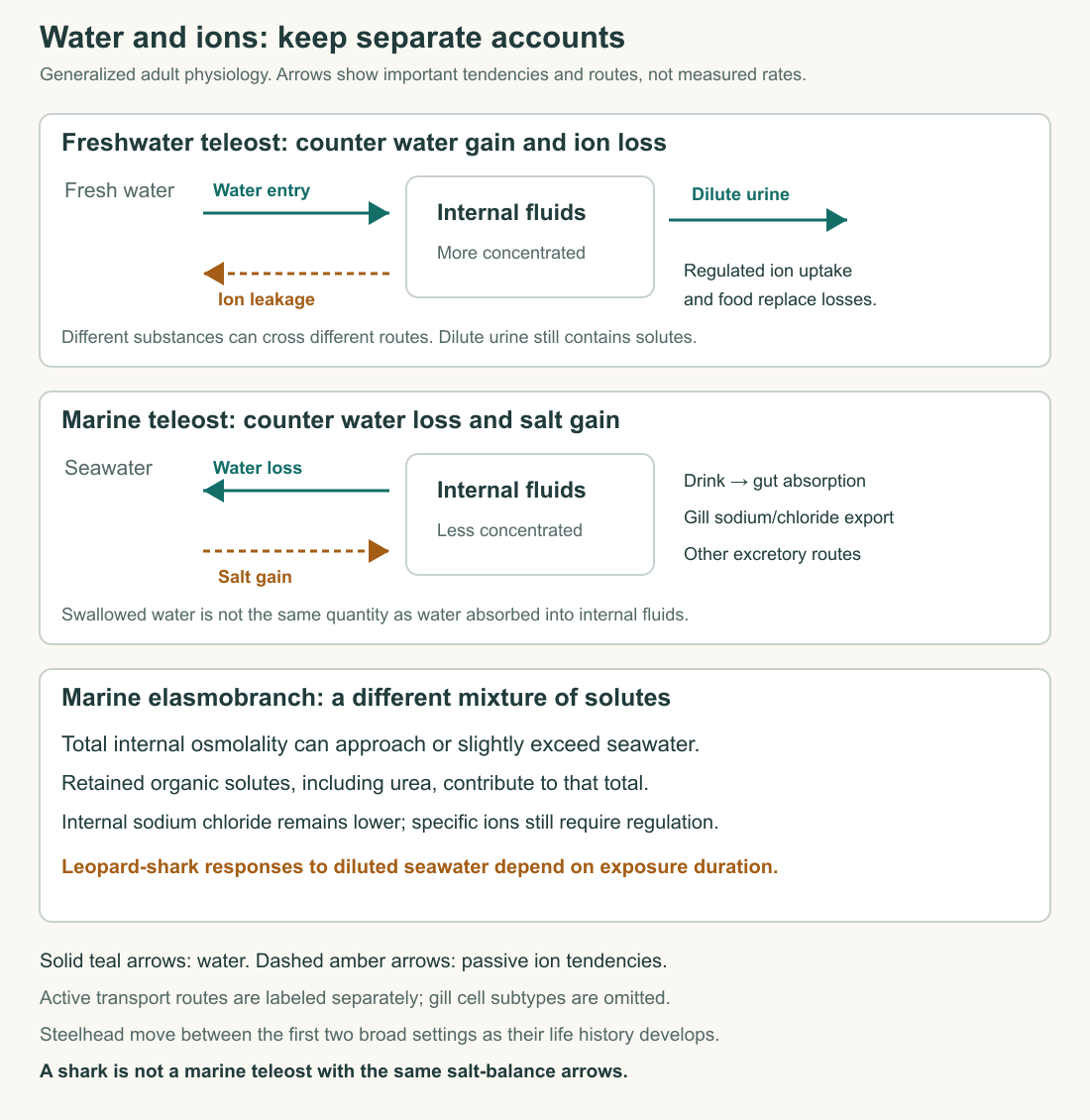
Compared with fresh water, a teleost's internal fluids contain more dissolved particles. Its permeable exchange surfaces therefore expose it to net water gain, while important ions tend to leak outward. A freshwater fish counters these tendencies by taking up ions and eliminating relatively dilute urine. Seawater teleosts face the opposite broad imbalance. This contrast is established physiology, not an inference from whether a fish happens to drink in a video. Kültz's salinity review provides the comparative framework.
Draw two arrows into your freshwater fish, but label them differently: passive water entry and regulated ion uptake. They may point in the same direction while using different mechanisms. An arrow for a substance is incomplete without its route. Water crosses permeable tissues; specialized transport cells participate in ion uptake; urine exits through the urinary system. Food also supplies ions. The diagram is a budget of processes, not a suggestion that all material passes through one opening.
Use assigned numbers to test that budget. Suppose a model animal gains 12 milliliters of water each day through all included inputs and loses 2 milliliters through nonurinary outputs. To keep its water volume constant, urinary loss must be 10 milliliters per day. If urine falls to 6 while everything else remains unchanged, water accumulates at 4 milliliters per day. A measurement of constant body-water volume would tell us that this proposed combination cannot persist. At least one measured flow, omitted flow, or assumption must change.
Now keep a separate sodium account. Give the model 100 arbitrary units of sodium at the start. It loses 8 units across an exposed surface and 2 in urine, while food supplies 3. Maintaining its initial amount requires another 7 units of uptake. Producing urine solves a water problem but can worsen an ion problem. Making urine dilute reduces this conflict; dilute does not mean chemically empty. These numbers describe a teaching ledger, not a trout's daily requirements.
A steady amount does not imply an absence of exchange. If ten units enter and ten leave each day, the total remains constant despite continuing throughput. If both flows stop, the same total can initially remain. Those two states look identical in a snapshot but respond differently to disturbance. Add a temporary extra two units of loss: the first state can recover if uptake increases, whereas the second has no ongoing replacement process in the model. In a living fish, maintaining a difference from the surroundings commonly involves continuing activity. A flat line on a graph of internal concentration can therefore be the visible result of work, not evidence that the environment has stopped exerting an influence.
A marine teleost must obtain usable water
For a marine teleost, the external solution has a greater dissolved-particle concentration than its body fluids. Passive water loss and salt gain must be countered. Drinking seawater, absorbing water through the digestive tract, and exporting excess ions form a coordinated solution. The gills play a major role in sodium chloride secretion, while renal and intestinal routes matter for other components. The historical experimental basis includes measurements separating intestinal absorption from branchial secretion. Evans's account of teleost osmoregulation summarizes that division of labor.
Drinking does not make the ocean into fresh water before it enters the mouth. Nor does every swallowed milliliter become retained body water. Follow a parcel through the gut: some water may be absorbed, some remains in material later expelled, and the ions absorbed with it create additional demands elsewhere. For our garibaldi comparison, use this general marine-teleost arrangement. We are not assigning a measured garibaldi drinking rate or claiming that every marine species uses identical transporter proportions.
Here is another original ledger. A model swallows 10 milliliters, absorbs 8 through its gut, and loses the other 2 with gut contents. If it subsequently loses 7 across other surfaces and 1 in urine, retained water balances at zero change. Counting all 10 swallowed milliliters as an internal input while also ignoring gut output would invent a surplus. The location of the accounting boundary determines which number belongs in the calculation.
Suppose the same gut absorption introduces 15 units of an ion and other routes introduce 5. At constant body ion amount, total export must be 20 units. If urinary export is 2, the remaining included export routes must account for 18. That residual does not identify an organ by itself. To attribute it specifically to gills, one needs route-specific evidence. Conservation narrows the possibilities; measurements locate the mechanism.
A transport cell has two different faces
An ionocyte is a cell specialized for ion transport. Its membrane facing the environment or an epithelial passage is called apical; its tissue-facing membrane is basolateral. Location matters because moving an ion into the cell is only one part of moving it across the entire tissue. A transporter can produce the correct local movement while the complete pathway remains blocked at its other end.
In the established seawater salt-secretion model, basolateral sodium–potassium pumps maintain gradients that support cotransport into an ionocyte; chloride can then leave through an apical channel. Sodium has a route between neighboring cells. Studies of juvenile alewives found the relevant transport proteins in different locations, including seawater-associated apical chloride channels. The alewife study supplies a concrete example of how cellular localization informs the model.
To understand the logic, imagine a house with a street door and a courtyard door. Delivering a package through the courtyard door does not establish delivery into the street. You need a second step and the right direction at each boundary. The analogy stops at the doors: proteins are molecular structures, gradients supply driving forces, and some steps require metabolic energy directly while others depend on gradients maintained by energy-consuming processes.
This also explains why “the pump reverses” is a poor account of migration. An epithelium can change its transport proteins, their abundance, their regulation, and the cells expressing them. It need not run every existing component backward. Work on Japanese seabass moving from seawater toward fresh water distinguished ionocyte types by transporter distribution and followed changes in those patterns. That is evidence about a reorganizing tissue, rather than a single valve flipping direction. Japanese seabass ionocyte study.
The steelhead must prepare for a different account
Steelhead are the ocean-migrating life-history form of rainbow trout, Oncorhynchus mykiss. They begin in fresh water, grow at sea, and return to fresh water to reproduce. Other individuals remain in fresh water. The name therefore identifies a life history within a species, not a separate mechanism shared by every trout at every age. NOAA's steelhead account establishes this sequence.
The juvenile transition toward ocean life is called smoltification. Physiological preparation can begin before seawater entry. A useful experimental comparison comes from Atlantic salmon, a different salmonid: investigators followed forms of the sodium–potassium pump in gill cells during smolt development and subsequent seawater exposure. Their results distinguish preparation in fresh water from the later response to seawater. We use that study to illuminate the kind of transition involved, without assigning its exact seasonal timing or fold changes to steelhead. McCormick and colleagues' pump-isoform study.
Picture the freshwater budget being carried unchanged into seawater. The former passive water input becomes a loss; the old strategy of discarding substantial water becomes costly. Ion uptake suited to dilute surroundings no longer describes the needed net result. Successful migration therefore requires coordination between movement and physiological state. A passage may be physically open while conditions along it are poorly matched to a particular fish's present capabilities.
Acclimation means adjustment by an individual to changed conditions. Evolutionary adaptation concerns inherited characteristics shaped across generations. Smolt development also involves an organized life-stage transition. These explanations can operate together, but they answer different questions. “The fish adapted” does not tell us whether a measured change happened in that individual over days, during development, or across ancestral populations.
The shark changes the composition of the problem
Marine elasmobranchs retain organic solutes, notably urea, so their overall internal osmolality can approach or slightly exceed seawater even though internal sodium chloride is lower. Their rectal gland contributes to salt secretion. Similar total particle concentration therefore does not mean their blood is seawater. Nor does it mean no regulation is needed: retaining particular substances while exporting others requires selective control. This is the shark–teleost distinction in Kültz's comparative account.
Try a deliberately simplified composition puzzle. Fluid A contains 300 units of dissolved particles, all represented as one category. Fluid B contains 100 units of that category and 200 of another. Their totals match. Removing the second category from B leaves a very different osmotic comparison, despite leaving its first category unchanged. The assigned categories are bookkeeping devices, not measured shark blood chemistry. They show why measuring sodium alone cannot establish total osmolality.
Leopard sharks provide an experimental case rather than merely a generic shark illustration. Dowd and colleagues compared juvenile responses to reduced salinity over shorter and longer exposures, measuring internal chemistry, tissue responses, and behavior. Some internal concentrations were maintained initially, while longer exposure produced a different pattern. Increased short-term activity was interpreted cautiously as possible avoidance, not proof of a fish's intention. Leopard-shark salinity study.
The time comparison matters. Two animals sampled after one day and three weeks have not necessarily reached equivalent states simply because their tanks have the same salinity. Stable internal concentration might reflect successful regulation, a temporary lag, or compensating water and solute changes. To distinguish these possibilities, measure trajectories and multiple quantities. A photograph of a shark in brackish water cannot establish unlimited tolerance of fresh water.
Read concentration together with amount
Return to our original sodium model. Suppose 100 units occupy 10 milliliters: concentration is 10 units per milliliter. Add 2 milliliters of water without changing sodium amount. Concentration falls to about 8.33. Alternatively, remove 20 sodium units while retaining the original 10 milliliters. Concentration becomes 8. The two lower concentrations have different causes and require different explanatory accounts. Concentration is a ratio; its numerator and denominator can both move.
Now imagine a field record showing a steelhead entering a saltier reach, followed later by an internal concentration near its previous value. That observation is compatible with successful regulation, but it does not reveal the energetic expenditure or the route of every ion. Add a series of measurements across the transition, identify the fish's developmental stage, and distinguish surrounding salinity from internal chemistry. The investigation becomes more informative without pretending a single instrument measures the whole mechanism.
Our three fish now differ in more than habitat labels. The steelhead changes between contrasting external conditions during its life. The garibaldi illustrates a marine teleost maintaining internal fluids unlike seawater. The leopard shark uses a different mixture of retained solutes while controlling particular ions. Each must keep the exchange surfaces that sustain life from allowing the environment to dictate every internal condition. Salt balance makes a fish's location a physiological achievement.
Application
A fictional fish begins with 120 units of a dissolved substance in 12 milliliters of body water. After a change in external salinity, its concentration is measured at 8 units per milliliter.
- Give two different changes that could produce the measured concentration, one changing only water and one changing only solute amount.
- State the extra measurement needed to distinguish those two explanations.
- A second model absorbs 9 milliliters of water through the gut per day, loses 7 across other surfaces, and loses 3 in urine. Calculate its daily net water change. Explain why knowing the swallowed volume would not by itself correct the account.
- Explain why an ocean-migrating steelhead, a garibaldi, and a leopard shark should not receive one identical diagram labeled “saltwater fish.” Use a mechanism, not just a habitat name, for each distinction.
Model interpretation
With solute fixed at 120, water volume must rise to 15 milliliters to give concentration 8. With water fixed at 12, solute must fall to 96 units. Measuring water volume or total solute amount distinguishes these assigned alternatives; actual animals may change both. The second model changes by 9 − 7 − 3 = −1 milliliter per day. Its internal input is absorbed water, not everything swallowed. Steelhead require a life-stage and migration context; the garibaldi represents marine teleost ion export and water retention; the leopard shark's organic solutes alter the total osmotic comparison while specific salts remain regulated. None of these accounts supplies an unmeasured rate for an individual fish.