Supplying a small active body
A hovering moth must supply active flight muscles while it remains almost stationary beside a flower. “It breathes air” is true but leaves the important route unexplained. Where does that air enter? How does oxygen reach the cells? Does it first enter blood pumped from a lung? In a terrestrial insect such as our moth, importing the mammalian route would produce the wrong diagram.
Follow oxygen rather than the familiar organ names
Air enters an insect's tracheal system through openings called spiracles, generally distributed along the sides of the thorax and abdomen. A spiracle connects the exterior to branching internal airways called tracheae. Smaller branches lead toward fine tracheoles associated with tissues. Oxygen ultimately crosses short distances through fluid and cell boundaries to reach the places where cells use it. Air does not pour directly into a mitochondrion through an open hole.
The arrangement brings the gas pathway close to demand. In a human, oxygen normally crosses the lung into blood and is then transported through the circulation. In our terrestrial insect examples, the tracheal system provides the principal oxygen-delivery route, while circulating hemolymph has other major transport functions. This is a difference in organization, not evidence that insects have no circulation or that oxygen can reach every tissue without crossing a barrier.
A tracheole is a fine tube, not an individual cell floating through the body. The distinction matters when interpreting simplified teaching descriptions. Likewise, an insect trachea is not a miniature version of the one large human trachea connecting the throat to the chest. The shared name does not guarantee the same arrangement. The NC State respiratory overview introduces the branching route; read it with the tissue boundary and the limits of generalization in mind.
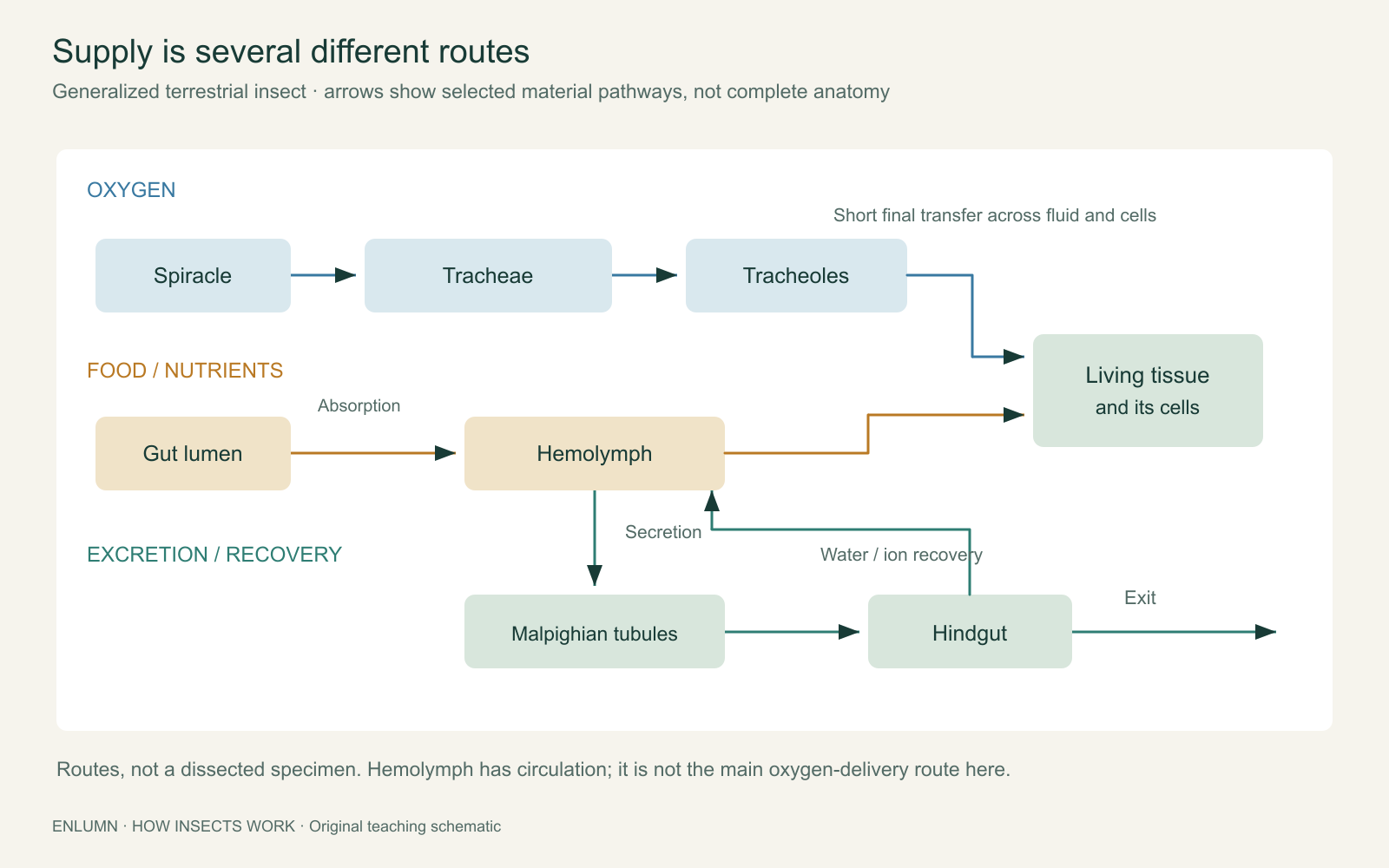
The diagram deliberately separates oxygen and nutrient arrows. If both arrows are drawn through the heart simply because that is familiar from human anatomy, the explanation fails. If the nutrient arrow bypasses circulation because the oxygen arrow does, it fails in the other direction. Each material needs its own route. A good physiological map is a set of linked transport problems, not a list of organs placed in approximate positions.
Diffusion and ventilation solve different parts of the route
Diffusion is net movement resulting from random molecular motion down an appropriate concentration or partial-pressure gradient. It is especially effective over short distances. For a simple comparison in the same medium, the characteristic time required for diffusion rises with the square of distance. Doubling that distance makes the characteristic time about four times as large. This is a scaling relationship, not a stopwatch prediction for an entire insect.
Ventilation moves a bulk volume of gas. Body movements and changes in airway or air-sac volume can help move air through an insect's respiratory system. Diffusion still matters at the fine end of the route. These processes are complementary: moving air along a larger pathway does not abolish the final transfer into tissue, and short-distance diffusion does not mean that an active insect must rely on passive movement along every part of its respiratory network.
Consider two hypothetical systems with identical terminal exchange distances. One continually brings fresh air to a large conducting tube; the other allows oxygen near the entrance to become depleted. The final distance is the same, but the maintained gradient can differ. Now hold the external supply constant while increasing the final diffusion distance. That creates a different limitation. Separating these changes is more informative than saying vaguely that one body “breathes better.”
Spiracles can be regulated rather than remaining fully open at all times. Opening them supports gas exchange but also provides a route for water loss. Closing them indefinitely would prevent sustained exchange sufficient for ongoing metabolism. The balance depends on activity, environment and species. Some insects show discontinuous patterns of gas exchange under particular conditions; that observation should not be generalized into a single breathing rhythm for every insect in flight, rest or development.
Carbon dioxide must also leave. It is produced in cellular metabolism and moves outward through available exchange routes. Do not assume every molecule follows precisely the reverse of one oxygen molecule's path, or that an external abdominal movement is a direct measurement of oxygen consumption. A visible pumping motion can suggest ventilation. Measuring gas exchange requires a method that actually tracks gases and accounts for experimental conditions.
Size asks for space as well as time
The familiar claim that insects are small because oxygen cannot diffuse far enough is incomplete. Insects vary their respiratory architecture, and bulk gas movement can supplement diffusion. The better question is what it costs to supply a larger active body. Bigger airways or more respiratory volume occupy space that could otherwise contain other tissues. A local narrow passage into a leg may impose different constraints from the roomy center of the body.
Kaiser and colleagues' 2007 study examined forty-four individuals from four darkling-beetle species using X-ray imaging. Larger species devoted a greater fraction of body volume to tracheae, with a particularly marked difference in the leg passage. The authors used the pattern to support a hypothesis about spatial constraints on oxygen supply. Their proposed size limits involved extrapolation; they did not grow every insect lineage to a measured universal maximum.
This distinction changes the lesson. The measurements show an anatomical relationship in the sampled beetles. The broader claim about historical giant insects is an inference built from that relationship and additional assumptions. Neither should be discarded, but they should occupy different sentences. “Measured respiratory proportions changed with size in these beetles” is stronger evidence than “therefore oxygen alone determines all insect size.” The second statement would exceed the study.
An original planning analogy may help. Suppose a narrow service passage must carry a pipe, cables and a moving linkage. Enlarging the pipe could improve one supply function while crowding the others. The problem is not merely the total floor area of the building. It is the local passage through which several necessary structures must fit. An insect is not engineered from a blueprint, but this geometric conflict makes the spatial hypothesis understandable.
Food takes another route
A caterpillar bites plant tissue with its mouthparts. Food enters the gut, where mechanical processing, enzymes and the properties of the gut environment help make nutrients available for absorption. The gut is a passage with specialized regions, commonly described as foregut, midgut and hindgut. Material inside its lumen is not yet equivalent to material available to every living cell. Absorption across the gut wall is a necessary part of the route.
An adult Manduca takes up liquid through a proboscis rather than chewing a leaf with the caterpillar's feeding apparatus. The change affects food acquisition, but nectar reaching the gut still has to support metabolism through absorption and subsequent processing. A sugar-containing liquid is not converted directly into wing movement at the mouth. Cells use chemical reactions to supply ATP, which supports muscle activity and many other processes.
Hemolymph is the circulating fluid in an insect's open circulatory system. “Open” means that the fluid is not confined throughout its circuit to a closed network of vessels like vertebrate blood. It does not mean that the animal is open to the air or that circulation is absent. A dorsal vessel and other pumping arrangements help move the fluid, which transports nutrients, signaling substances and metabolic products and contributes to immune defense and internal pressure.
The NC State circulatory account gives an overview of these roles. Its broad contrast with vertebrate oxygen transport is useful for our terrestrial examples. It should not be turned into an exceptionless claim about every aquatic insect or every respiratory pigment. The essential point is that hemolymph remains biologically important even when it is not the principal vehicle delivering oxygen to active tissues.
Follow one imaginary nutrient molecule without giving it intentions. It enters with a meal, becomes available through digestion if necessary, crosses the gut epithelium, enters internal transport and is taken up by a tissue. Its carbon may eventually be oxidized, incorporated into a structure or stored. The route depends on the molecule and the animal's state. “Food becomes energy” is convenient shorthand, but food also supplies material for bodies and offspring.
Water balance includes the gut and excretory system
An insect needs to manage water and dissolved ions as well as remove metabolic wastes. In many insects, Malpighian tubules contribute by transporting substances from the hemolymph side into a fluid that enters the gut near the midgut–hindgut junction. The hindgut can then recover water and useful ions before material leaves the body. This organization differs from attaching a tiny mammalian kidney and bladder to an otherwise unchanged diagram.
Secretion and reabsorption name directions relative to an epithelial barrier. Secretion into a tubule moves material toward the fluid being formed; reabsorption returns material from the lumen toward the internal environment. The terms do not mean that every secreted substance is harmful or every retained substance is always useful. Their value depends on amounts and conditions. Excess salt and insufficient salt create different problems for the same organism.
Research on insect tubules shows that active ion transport and associated water movement are central to fluid production. A study of Aedes aegypti transport tissues places these processes in the context of changing water and salt loads. This mosquito is a comparison, not our moth in disguise. The general epithelial principle is transferable; the detailed rates, channels and regulation require species- and stage-specific evidence.
Imagine an invented balance sheet over one interval: an animal gains ten water units and loses eight, leaving a net gain of two before any other exchange is added. If a hidden pathway loses three more units, the conclusion reverses to a net loss of one. The arithmetic is simple, but the physiological lesson is substantial. A claim about water balance needs the important inputs and outputs, not just the most conspicuous one, such as a visible droplet leaving the body.
Nitrogenous waste also has to be managed. Many terrestrial insects can dispose of nitrogen in relatively water-conserving forms, but the exact chemistry and storage or excretion pattern vary. It would be misleading to teach one universal sequence in which all insect waste becomes urea and then uric acid inside every tubule. The useful introductory distinction is between unwanted products of metabolism and undigested material passing through the gut. They can leave through a shared final outlet while arising by different routes.
The environment changes the whole calculation
Our main diagram is terrestrial. Aquatic insect stages can obtain oxygen through different arrangements, including tracheal gills or access to atmospheric air, depending on the group. A tracheal gill is not a miniature fish gill with the same blood circuit. The respiratory interface has changed, while the insect's internal organization retains its own history. The word “aquatic” alone cannot tell you whether a larva must visit the surface.
A primary study of the mayfly Hexagenia rigida examined ion transport across several tissues and found contributions from the gut, Malpighian tubules and tracheal gills. This is a useful reminder that one structure can participate in more than one exchange problem. The course does not ask you to infer a numerical salt balance for our terrestrial grasshopper from the mayfly measurements.
Now return to the hovering moth. Sustained activity requires oxygen delivery, available fuel, functional muscles, coordination and workable temperature and water balance at the same time. A failure in one component can limit the whole performance. Seeing a moth leave a flower does not identify which component changed: it might have finished feeding, been disturbed or responded to another cue. An integrated physiological explanation should create testable alternatives rather than turn every departure into a story about exhaustion.
Check your understanding: A diagram sends both oxygen and absorbed sugar from an insect lung into blood, then through arteries to flight muscle. How should it be corrected for our terrestrial moth example?
Expected answer: Replace the lung-and-blood oxygen route with spiracles, branching tracheae and fine tracheoles supplying tissue across short exchange distances. Keep the separate route from food through gut absorption into internal nutrient transport, including hemolymph. The moth has circulation, but its principal oxygen-delivery organization is not mammalian.
Application
Make a three-color map for oxygen, an absorbed nutrient and water destined for excretion. Name the barriers crossed, and identify where two routes share a tissue or final outlet without becoming the same process. Add a 250-word account of how higher activity could increase demands on more than one route.
Then label the beetle study's observation and its extrapolation in separate sentences. A successful answer reports the sampled anatomical pattern while refusing to turn four beetle species into a universal measurement of all possible insect sizes. No gas, feeding or immersion experiment is required.