Metamorphosis and changing niches
The caterpillar and the moth are not two animals taking turns in one life cycle. They are successive stages of one developing individual. Yet calling them the same individual should not hide the scale of the change. A leaf-chewing body becomes a flying nectar feeder, with different locomotor structures, sensory arrangements and immediate demands. Metamorphosis makes continuity and reconstruction part of the same biological process.
Draw a sequence before explaining its advantage
For Manduca sexta, begin with an egg deposited on a plant. A larva emerges and passes through larval instars as it feeds and grows. Near the end of larval life, its behavior changes before pupation. The pupa is followed by the adult moth, which can mate and contribute to the next generation. This sequence is called complete metamorphosis: egg, larva, pupa and adult. The terms name stages, not four equally long pieces of time.
The University of Florida Manduca account documents the contrast between leaf-feeding larvae, a pupal stage in soil or litter and nectar-feeding adults. We need that bounded life history before asking what the transition accomplishes. The account does not give a universal schedule for every climate, diet or individual, and this course does not use its approximate durations as instructions for rearing insects.
An arrow from adult to egg represents reproduction, not an adult shrinking into its former egg. This is an easy error in circular diagrams. Within one individual, the sequence runs from egg through later stages. The cycle closes because adults produce a new generation. A diagram should distinguish developmental transitions within an individual from reproduction between generations, even if both are drawn with arrows.
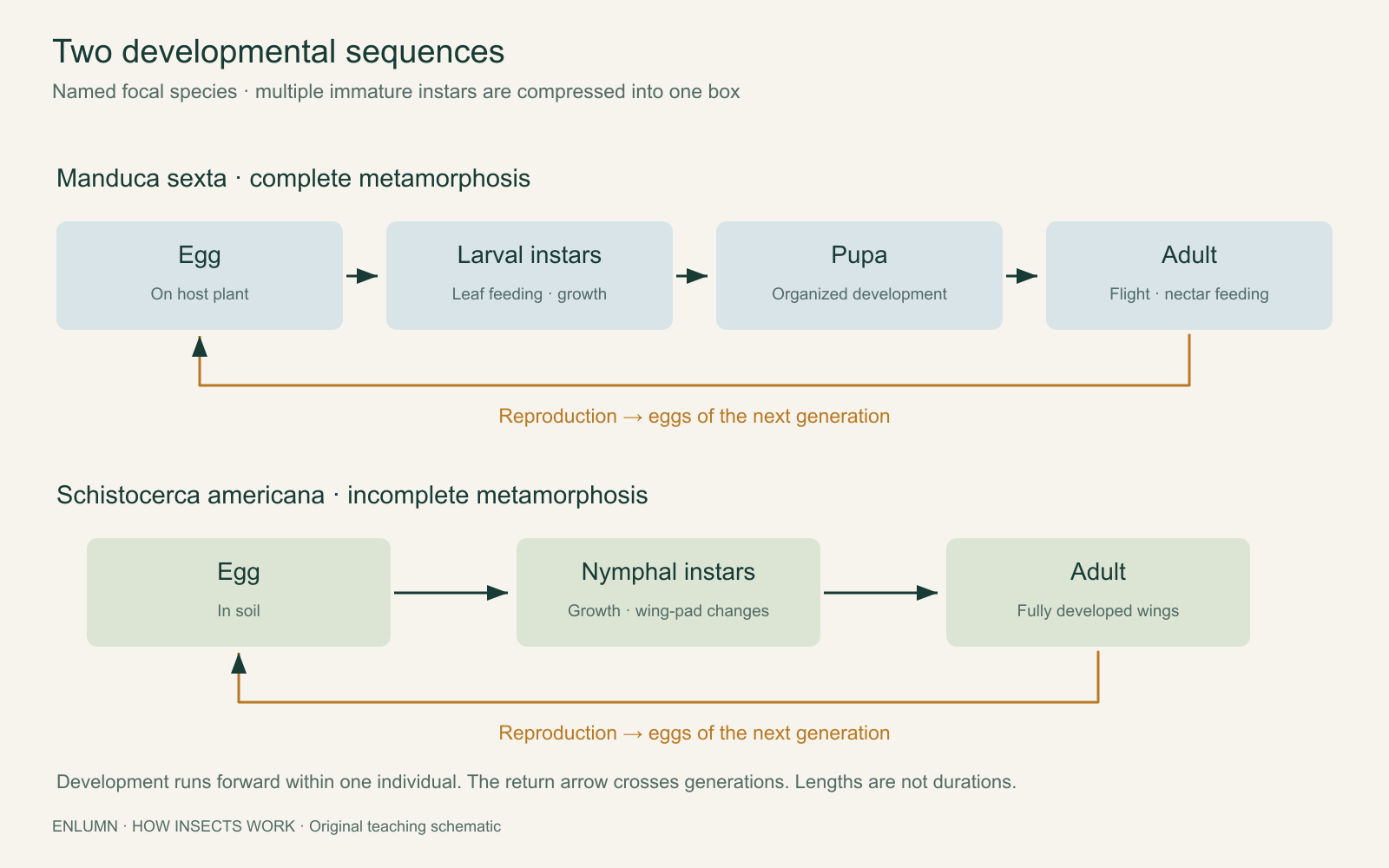
For the American grasshopper, draw egg, nymphal instars and adult. There is no pupal stage. Nymphs already have a broadly grasshopper-like organization and develop through successive molts, including changes in wing pads before the fully winged adult. This is incomplete metamorphosis. “Incomplete” is a conventional developmental term; it does not mean that the animal failed to finish an evolutionary project or possesses a defective adult body.
The nymph is more than a small adult
The University of Florida Schistocerca americana record describes changes in wing development and coloration through nymphal stages. Those differences matter because an immature insect cannot necessarily disperse in the same way as a winged adult. Similar overall body organization does not imply identical movement, feeding rate, vulnerability or reproductive capacity. A scaled-down adult illustration can conceal those distinctions.
At the same time, nymphal and adult grasshoppers can overlap substantially in feeding and habitat. The mere fact of development does not guarantee a radical shift from one resource to another. Our Manduca comparison is striking because chewing leaves and taking nectar differ so visibly. The grasshopper prevents that example from becoming a rule that every immature stage must occupy a wholly separate ecological world.
A niche is a description of how an organism uses resources and interacts with conditions and other organisms. It includes more than a place name. Two stages can occur on the same plant while using different resources, or occur in different locations while sharing a feeding mode. “Lives in a garden” is therefore not a complete niche description. Ask what is eaten, how it is obtained, when activity occurs and which conditions constrain it.
Use a small comparison matrix. The rows are stages; the columns are food acquisition, movement, location and reproduction. For the moth, the larva and adult differ strongly in the first two columns. For the grasshopper, some entries overlap while wings and reproductive maturity change others. Empty cells should be marked unknown until a source supports them. The matrix is useful because it prevents one dramatic difference from standing in for the whole life history.
A pupa is an active developmental stage
A pupa may look inactive from outside, but its tissues are undergoing organized changes. Cells can proliferate, differentiate, change shape, remodel connections or die. Some adult structures develop from groups of cells established earlier; some larval tissues are dismantled; some tissues persist and are modified. The balance varies among structures and species. There is no need to imagine the entire animal becoming an undifferentiated liquid before a new animal appears.
The popular “caterpillar soup” image contains a small truth stretched into a poor explanation. Extensive breakdown occurs, but wholesale loss of organization would erase the very continuity developmental biology investigates. A living pupa still needs exchange, metabolism and coordinated tissue development. Stored resources help support a stage that, in our focal moth, is not acquiring food in the manner of its feeding larva or adult.
Levine and Truman's 1985 study followed identified Manduca motor neurons associated with abdominal muscles. The published abstract reports several outcomes: some neurons retained a target, some died, and many survived while acquiring new adult targets and changing their branching. That is direct evidence against a universal account in which every larval neuron simply disappears. It does not mean that every neuron survives or that every memory remains unchanged.
The companion lesson from Weeks and Ernst-Utzschneider's 1989 study is that outcomes can depend on segment and stage. Their account follows neurons associated with larval prolegs and reports structural regression, selective survival and later changes. A cell's developmental fate cannot be read from the adult silhouette alone. Researchers need ways to identify and follow particular structures, not just compare two whole animals of different ages.
Notice the difference between a cell surviving and a function remaining the same. A neuron can persist while its branches and targets change. Conversely, a similar adult function can depend on newly formed structures. Continuity at one level does not imply sameness at every level. This is a general principle of development that the conspicuous transformation of an insect makes unusually easy to ask about.
Development needs resources before the visible change
The pupa's apparent stillness can make it seem disconnected from earlier feeding. In fact, a developmental transition depends on resources accumulated and processed beforehand. The larva must acquire material for its present body and for later development. Its success affects what is available when feeding stops. An adult stage with different food acquisition still carries consequences of its earlier history.
Consider a deliberately simplified budget. A hypothetical larva acquires one hundred energy units through assimilation. Suppose sixty are used in maintenance and current activity, twenty-five in the energetic costs of growth, and fifteen remain as stored chemical energy for later demands. Those numbers are invented, with all entries expressed in the same energy unit over one interval. A separate material budget would be needed to track body constituents. The exercise illustrates why energy intake cannot all be counted as energy available for future reproduction.
Now suppose poor conditions increase current maintenance costs while intake remains fixed. Something else in the budget must change. The response could involve slower growth, reduced reserves, altered timing or failure to complete development; the specific outcome needs evidence. We should not choose whichever outcome makes the most appealing adaptation story. A conservation constraint narrows possibilities without specifying the exact biological response.
Developmental experiments can test those links by changing diets or conditions and following later outcomes. But a difference between laboratory groups must still be interpreted with care. A diet change may alter several nutrients at once, and the adults that survive to be measured may be a selected subset of the original larvae. A later average does not necessarily describe what happened to every initial individual. Keeping the whole cohort visible improves the explanation.
Timing is part of the life history
The same named stage can last different lengths of time under different conditions. Temperature affects physiological rates, but the relation is not an unlimited rule that warmer always means faster and better. Beyond workable conditions, development can be impaired. Food, moisture and other environmental features can also matter. A stage diagram should therefore avoid pretending that its arrow lengths are a calendar unless actual timing data are supplied.
Some insects enter diapause, a regulated state of arrested or slowed development associated with surviving unfavorable periods. Diapause is not simply an animal moving slowly because the air happens to be cold at that moment. The physiological program and its cues matter. For our purposes, distinguish a regulated seasonal developmental state from an immediate temperature effect; neither requires conscious anticipation by the insect.
Overwintering stage is species- and population-dependent. The moth and grasshopper accounts provide contrasting examples, including pupal overwintering in Manduca under relevant conditions and adult overwintering in Florida populations of Schistocerca americana. Do not turn either into a rule for all moths or grasshoppers. A population's seasonal pattern should be attached to a location and conditions, not detached into a universal monthly timetable.
An observer who sees only adults during summer may miss most of the developmental story. Eggs, larvae, nymphs or pupae can be less conspicuous or occupy another location. Absence from a casual survey can therefore reflect the method and season. A question about population decline needs appropriate repeated sampling and stage coverage, not merely a comparison between two walks in different weather.
Benefits are hypotheses with costs and history
Complete metamorphosis can allow different stages to specialize in different tasks and resources. A feeding larva and a mobile reproductive adult need not make the same structural compromises. This is a useful functional interpretation. It does not prove that reduced competition between stages was the single original cause of complete metamorphosis, or that every species now obtains the same benefit from it.
There are costs and constraints. Reorganizing a body takes resources and time. A stage with limited movement or no feeding can depend on stored resources and suitable surroundings. Specialization on a larval food source can restrict where reproduction succeeds even if adults travel widely. An adult visiting many flowers does not imply its larvae can grow on the leaves of all those plants.
Historical explanations require comparisons across lineages and evidence about development and ancestry. Functional plausibility alone cannot reconstruct the sequence of evolutionary changes. Saying “the pupa exists so the larva and adult do not compete” skips from a possible present-day consequence to an exclusive historical explanation. A better sentence identifies the consequence and leaves the historical claim to evidence capable of testing it.
The same restraint applies to rankings. A grasshopper's incomplete metamorphosis is not an inferior halfway step toward becoming a butterfly. It is part of a successful lineage with its own developmental organization. Living groups are not arranged on a ladder whose top is whichever life cycle humans find most spectacular. Comparison becomes more informative when it asks which constraints differ rather than which animal is more advanced.
Trace one disturbance through the sequence
Imagine a hypothetical local change that removes a moth's larval host plants while leaving abundant adult nectar flowers. Adult feeding opportunities remain, but successful development of the next generation could still be constrained. Now imagine the reverse: larval food remains while adult feeding opportunities change. The effects would depend on the species' adult requirements and opportunities. The two scenarios cannot be collapsed into a single measure called “plenty of flowers.”
For a grasshopper with overlapping nymphal and adult plant use, the same habitat change may affect several stages more directly. That does not mean the response will be identical at every stage. Body size, mobility, feeding demand and exposure can differ. A useful prediction traces the change through named processes: resource availability, acquisition, growth, transition and reproduction. It identifies where evidence is missing rather than hiding uncertainty in a broad population claim.
This is the practical purpose of the paired life-cycle diagram. It lets you locate a question in a sequence and avoid importing the wrong transition. You can ask which stage is exposed, which structure changes, what resources are available and what later consequence could follow. The diagram is not an answer machine, but it gives the answer a structure that can be checked.
Check your understanding: Why do neither “the pupa is asleep” nor “the larva completely dissolves” adequately explain Manduca metamorphosis?
Expected answer: The pupa undergoes active, organized development while maintaining physiological functions. Some tissues break down, some structures develop and some cells persist while changing their connections or roles. Identified-neuron studies demonstrate selective survival and remodeling, not universal destruction or unchanged continuity.
Application
Draw the complete life history of Manduca sexta and the incomplete-metamorphosis sequence of Schistocerca americana. Distinguish development within one individual from reproduction producing the next generation. Do not make arrow lengths proportional to time unless you have appropriate data.
Add a four-column stage comparison for food acquisition, movement, location and reproduction. Write 300 words explaining one constraint that links two stages, such as the need for larval resources before nonfeeding development. A strong answer preserves overlap where it exists, avoids an evolutionary ranking and identifies one claim that would require additional evidence.