Bureaucracy and discretion
The booking coordinator encounters a form with an unfamiliar address format. The applicant lives in the district, but the software rejects the entry. Three responses are possible: reject the request, accept an alternative document, or ask a supervisor. Each response can be defended by invoking a different responsibility. The coordinator must preserve consistent records, avoid excluding eligible residents, and stay within her authority. Discretion begins where carrying out a rule requires judgment about a case that the rule does not fully settle.
A category must meet a particular person
Classification means placing a case into a category that changes how the organization treats it. “Resident,” “complete application” and “eligible group” are classifications. They compress varied circumstances into a manageable set of decisions. Without some compression, the center would have to reinvent its entire process for every request. But the category boundary can become the place where people encounter difficulty.
Imagine that residency is established by a utility bill. The underlying question concerns where a person lives; the document measures a particular contractual relationship. Those are not identical. A resident sharing housing may not hold a utility account. The requirement can therefore produce a false negative: an eligible person is classified as ineligible because the proxy fails to represent the condition it is supposed to establish.
A false positive is the converse: accepting someone who does not meet the underlying condition. A person might retain an old bill after moving. The existence of possible errors in both directions matters. Removing all verification may increase one type while strict document requirements increase the other. A defensible process asks what evidence is sufficiently informative and what the consequences of each mistake would be.
For this fictional room-booking system, we can reason about these errors without pretending to give legal guidance about residency. The point is methodological. Before evaluating a rule, distinguish its substantive target, the observable evidence used to assess that target, and the decision triggered by the evidence. Otherwise a document's absence can be mistaken for the absence of the underlying fact.
Discretion is a distribution of choices
Discretion is the authorized or practically available room to choose among actions. It can exist at several stages. Staff may decide how clearly to explain a requirement, what counts as equivalent evidence, when to ask a supervisor, and which requests to address first. Even a highly detailed rule leaves choices about attention and interpretation. Eliminating a visible choice may move discretion elsewhere rather than remove it.
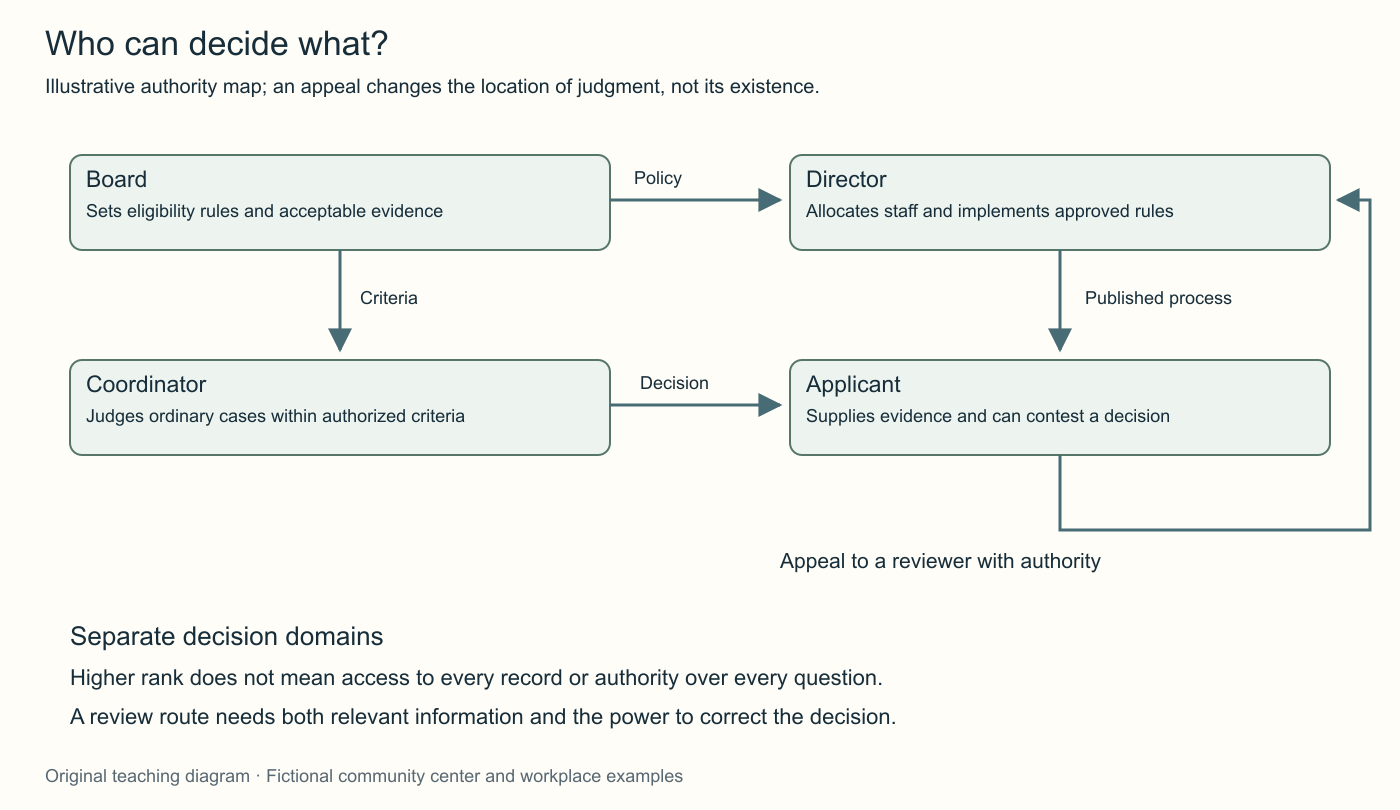
Suppose the board bans alternative documents but allows the supervisor to grant exceptions. Frontline discretion has narrowed, while supervisory discretion has expanded. Applicants who know an exception exists may benefit; others may withdraw. The reform changes where judgment occurs and who can reach it. Counting fewer exceptions at the first desk would not establish that the process has become more equal.
Now compare three designs. In design A, any coordinator can accept equivalent evidence without recording a reason. In design B, equivalent evidence is accepted under published criteria with a recorded reason. In design C, every unusual case waits for a weekly committee. A is fast but difficult to review. B combines judgment with a standard and a record. C centralizes decisions but may impose avoidable delay.
None is automatically best for every task. A decision carrying large irreversible consequences may justify more review than reserving a meeting room. The important comparison concerns the risk, reversibility, frequency and information needs of the decision. An organization that imposes its most demanding review on every minor case may use scarce attention poorly while still failing to scrutinize genuinely difficult decisions.
Burdens accumulate across small requirements
An administrative burden is a cost imposed through the process of obtaining or maintaining an organizationally governed benefit or status. We can separate learning what to do, doing it, and coping with the experience of doing it. These are analytical distinctions, not three charges that appear on an invoice. A process can demand little money while consuming substantial time, uncertainty and attention.
In a fictional example, an applicant spends fifteen minutes locating instructions, forty minutes obtaining a document, ten minutes submitting it and twenty minutes resolving a contradictory email. The total is eighty-five minutes. If staff record only the ten-minute submission, their estimate omits most of the applicant's work. Adding a simpler form would address only one part of the burden.
Timing also matters. Forty minutes during a flexible afternoon is different from forty minutes requiring an unpaid absence or a childcare arrangement. The rule can be identical while its practical cost differs. This does not mean every difference in cost is unjustified, but it does mean that equality of wording is insufficient evidence of equality of access.
The organization may unintentionally transfer work outward. Requiring applicants to reconcile conflicting records saves the coordinator from contacting another department. The staff budget looks better because the applicant's time does not enter it. A complete process map includes work performed beyond the organization's payroll. Otherwise efficiency can mean that the same work has become invisible to the evaluator.
Test a mechanism with an actual experiment
A study by Marianne Bertrand, Simeon Djankov, Rema Hanna and Sendhil Mullainathan followed 822 license candidates in Delhi during 2004–2005. Participants were men over eighteen seeking a first license. Random assignment created a comparison group, a group offered a reward for obtaining a license quickly, and a group offered driving lessons. The researchers measured licensing and independently assessed driving. The bonus increased licensing but also licensing without adequate skills; the lesson intervention offered a contrasting route. Payments through intermediaries and a separate audit informed the authors' account of circumvention. Follow-up differed across groups, and the paper examined attrition concerns. This is a specific historical experiment, not a description of present-day India. See the 2007 primary paper, especially its research design and results.
Why is this design informative? Merely observing that people who pay more obtain licenses would leave several explanations open. They might have better training, stronger urgency, more free time or greater familiarity with the process. Randomly offering a bonus changes an incentive without asking participants to select themselves into the bonus group. It creates a more useful comparison than sorting people afterward by what they happened to spend.
The study also refuses to equate administrative success with the public purpose of the process. Obtaining the document and possessing the relevant ability are distinct outcomes. If we measured only the first, a process that became more responsive to applicants could look unambiguously improved. Measuring the second makes it possible to ask whether speed and competence moved together.
The general lesson is a question, not a universal verdict: when an organization allocates a valued status, what independently measured condition is that status meant to represent? For a fictional training certificate, we could measure certificate receipt and performance on a relevant task. For the center, we could measure booking confirmation and actual usable access. An official output is evidence of an organizational decision, not automatic proof that its underlying purpose has been fulfilled.
Separate what was changed from what was explained
Random assignment does not make every step of a mechanism randomized. Offering a bonus is an intervention; choosing to hire an intermediary afterward is a response. Comparing people who did and did not hire intermediaries can reintroduce selection. Those choices may reflect resources, urgency or information. A credible interpretation keeps the experimental contrast distinct from additional evidence about how it operated.
Likewise, independent assessment improves measurement without making the outcome perfect. A driving assessment samples performance under particular conditions; it is not every possible future road event. For our fictional certificate, a practical test could miss teamwork or unfamiliar tasks. The correct response is to specify what the measurement captures and supplement it when the question requires more, not to treat the measure as either omniscient or worthless.
Attrition means that some initially assigned participants are missing from later measurement. If missingness differs across groups and relates to the outcome, the observed comparison can be misleading. A simple invented example shows the problem. Begin with one hundred people in each group. Suppose eighty are observed in A and all one hundred in B. A's observed success rate of 75 percent means sixty known successes, but the twenty missing outcomes remain unknown.
If all twenty missing people succeeded, A's total success rate would be 80 percent. If none succeeded, it would be 60 percent. A reported 75 percent among observed cases is therefore not the same quantity as success among everyone assigned. These bounds do not solve every research problem, but they show why a follow-up account belongs beside an effect estimate.
Rules can protect against personal domination
The strongest objection to expanding discretion is that judgment can become favoritism. An official can describe a friend's exception as humane flexibility and a stranger's identical request as noncompliance. Publishing the rule, recording reasons and providing review can make such differences more visible. These protections are especially important where applicants cannot easily leave for another provider.
But discretion can also correct a poorly chosen proxy. Refusing every applicant without a utility bill may be consistent and still systematically exclude residents in shared households. The serious choice is not between benevolence and rules. It is among different combinations of standards, evidence, judgment, transparency and review. A better design may make equivalent documents explicit rather than relying on private generosity.
There are costs to documentation too. Requiring a page-long justification for every obvious correction could discourage staff from making justified adjustments. A short reason code plus a free-text option might preserve reviewability at lower cost, while a sample of decisions receives closer examination. Whether that would work is an empirical and operational question, not a fact established by the attractiveness of the proposal.
The design should also permit challenge without requiring unusual confidence. An appeal hidden behind an informal phone call privileges people who know how to ask. An accessible explanation of the decision and the next step makes the route more usable. Providing an appeal still does not guarantee a fair result, but it changes the practical opportunity to contest classification.
A further distinction concerns knowledge. A supervisor may have more formal authority but less knowledge of an unusual case than the person handling it. Requiring escalation is then useful only if relevant information travels with the request. A checkbox reading “exception requested” may omit the very circumstances that justify an exception. In our center, sending the software error message and the evidence already supplied would let the supervisor distinguish a formatting problem from missing evidence. This illustrates why oversight cannot be evaluated solely by counting how many signatures a decision receives. Additional approval can improve accountability, duplicate work or obscure responsibility, depending on what each reviewer knows and is expected to decide.
Bring the analysis back to one decision
Return to the rejected address. A useful case record would include the intended residency criterion, the software error, the evidence supplied, the decision-maker's authority and the outcome. It would distinguish a technical validation failure from an actual finding of ineligibility. If the record simply says “invalid applicant,” a software constraint has been converted into an apparently substantive judgment.
A reform could let staff correct formatting while preserving an audit trail. Another could accept published equivalent evidence. A third could remove a redundant check after establishing that another stage already verifies residency. These changes act on different causes. The choice should follow the map and evidence rather than the general instruction to reduce red tape.
Evaluation then needs a balanced set of outcomes. Track eligible applicants incorrectly refused, ineligible applicants accepted, elapsed time, applicant work and staff workload. The measures may pull in different directions. A process that accepts everyone quickly is not necessarily serving a legitimate allocation rule, while a process that avoids every conceivable false positive may exclude many intended users.
The central skill is to recognize how categories, evidence and discretion interact. A rule becomes real through a sequence of encounters, documents and judgments. Improving that sequence requires both respect for the protection rules can provide and attention to the burdens their implementation can create. The next chapter follows the same problem into schooling, where the status being allocated can shape opportunities far beyond a single organization.
Check your understanding: A reform moves all exceptions from the coordinator to a supervisor. Has it eliminated discretion, and what should an evaluation examine?
Expected answer: It has relocated discretion. Evaluation should examine who learns about and reaches the exception route, how decisions vary, the reasons recorded, the errors corrected or introduced, and the additional delay and work.
Application
Allow twenty-five minutes. Redesign the fictional residency check using a stated substantive criterion, two acceptable forms of evidence, a correction route and a review procedure. Explain how the design could create both false positives and false negatives. Do not present your invented standard as an actual government rule.
Then use the attrition example. If group B has seventy successes among its one hundred observed members, compare its 70 percent with A's possible 60–80 percent range. Explain why the observed 75 percent in A does not establish an advantage for everyone assigned.
A strong response locates judgment at specific steps, preserves a usable correction route and acknowledges uncertainty in the missing outcomes. It distinguishes the process's output from the substantive condition that output is supposed to certify.