Workplaces and professions
A repair team receives a new target: close more service tickets each day. Within a month, the dashboard improves. Customers, however, report returning with unresolved problems. The manager suspects poor effort; workers say complex repairs are being split into several tickets because the system rewards closures. The fictional case contains a central organizational problem. A measure can be useful for observing work and still change how people perform it. To understand the result, we must examine authority, expertise, incentives and the information that the measure leaves out.
Work has a purpose and an observable surface
A service ticket is a record of a request and its handling. Closing it is an administrative event. A repaired device is a material outcome. A customer able to use that device for the intended task is another outcome. These events often coincide, which makes ticket closure a convenient indicator. But their connection is contingent on the rules governing closure and the quality of the underlying work.
Suppose one worker resolves a difficult fault in ninety minutes and another closes six ten-minute inquiries. The second worker has more closures, but the count alone cannot establish greater contribution. We need task difficulty, consequences and the definition of completion. A simple count can be a useful starting point while remaining a poor standalone judgment of performance.
This does not imply that measurement should be abandoned. Without records, managers may rely on visibility, personal preference or the confidence with which workers describe themselves. Measurement can reveal neglected work and challenge favoritism. The problem is to understand the relation between the measure and the objective, then watch how that relation changes when rewards depend on it.
Our fictional team has a legitimate objective: resolve requests accurately with reasonable delay. A balanced account would include completed requests, repeat contacts, unresolved cases and the distribution of waiting times. It might also include whether workers have time to document difficult repairs so that others can learn. No single measure contains all of these purposes.
Read Taylor as a proposal about control of knowledge
Frederick Winslow Taylor's 1911 The Principles of Scientific Management proposes that managers gather workers' practical knowledge, organize it systematically, select and train workers, and plan tasks. In chapter II, he describes “classifying, tabulating” knowledge and specifies a division between planning and execution. He presents the arrangement as cooperation and improved efficiency. These are an advocate's claims, not neutral proof that every example worked as promised. Read the primary passage beginning with the managers' new duties.
The sociological question is who gains the capacity to define the task. When practical knowledge remains with an experienced worker, that worker can exercise considerable judgment. When it is recorded in instructions and built into a scheduling system, others can inspect it, teach it and use it to evaluate performance. Codification can preserve knowledge beyond a single person's employment and also alter that person's bargaining position.
Consider an invented workshop where only one employee knows how to diagnose a recurring fault. Recording the procedure lets colleagues solve it when she is absent. That is a real coordination benefit. But if management treats the procedure as exhaustive, workers may be penalized for taking time to investigate a new fault the instructions do not cover. The same document can support learning or suppress adaptation, depending on how it is used.
A serious reading therefore asks both what the proposal makes possible and whose experience can contest it. Are task standards revised when workers discover a problem? Who decides whether a slower method produces better quality? Can employees report strain without being treated as uncooperative? These questions investigate the organization of knowledge rather than assuming that technical efficiency settles every workplace value.
Hierarchical authority and expertise can diverge
A manager may have authority to allocate staff but less technical knowledge than a specialist. A specialist may understand a fault but lack authority to purchase replacement equipment. A receptionist may know recurring customer difficulties that never appear in engineering reports. An effective organization must connect these forms of knowledge and decision-making rather than pretending that every relevant insight travels automatically upward.
Expertise is developed competence in a domain. Professional authority adds recognized standing to make judgments associated with that competence. A profession commonly links specialized preparation, standards and claims to jurisdiction over particular work. These arrangements vary; calling an occupation a profession does not establish that its members agree or that outsiders have no legitimate knowledge.
Professional autonomy can protect judgment from inappropriate pressure. A quality specialist who can reject defective work despite a production target provides a useful counterweight. But autonomy can also make decisions difficult for outsiders to scrutinize. A person may invoke expertise to avoid explaining an error. The institutional problem is to preserve informed judgment while maintaining an intelligible basis for accountability.
In the repair team, let the technician decide whether a device passes a specified functional check, while the manager controls scheduling. If the schedule leaves insufficient time for the check, formal separation does not resolve the conflict. The organization needs a way to surface the incompatibility and revise resources or expectations. Otherwise the worker must privately absorb it through overtime, shortcuts or unfinished work.
An incentive changes the payoff to an action
An incentive is a feature of a situation that changes the expected consequences of acting in one way rather than another. Pay matters, but so do promotion, criticism, professional pride, peer approval and the avoidance of blame. A worker can care deeply about service and still respond to a system that penalizes time spent on complex cases.
Use a deliberately simplified model. A worker has sixty minutes. An easy case takes ten minutes; a difficult case takes thirty. If each closure earns one point, six easy cases produce six points, while two difficult cases produce two. Selecting easy cases maximizes the recorded score even if difficult cases are more consequential. The model establishes a potential incentive, not evidence that real workers inevitably follow it.
Now award three points for a difficult case. The arithmetic aligns time more closely: either mix can produce six points per hour. But difficulty must be classified, and classification creates another judgment. If workers can label cases without review, the new metric may reward relabeling. If every label requires approval, the review can consume time the reform was meant to protect.
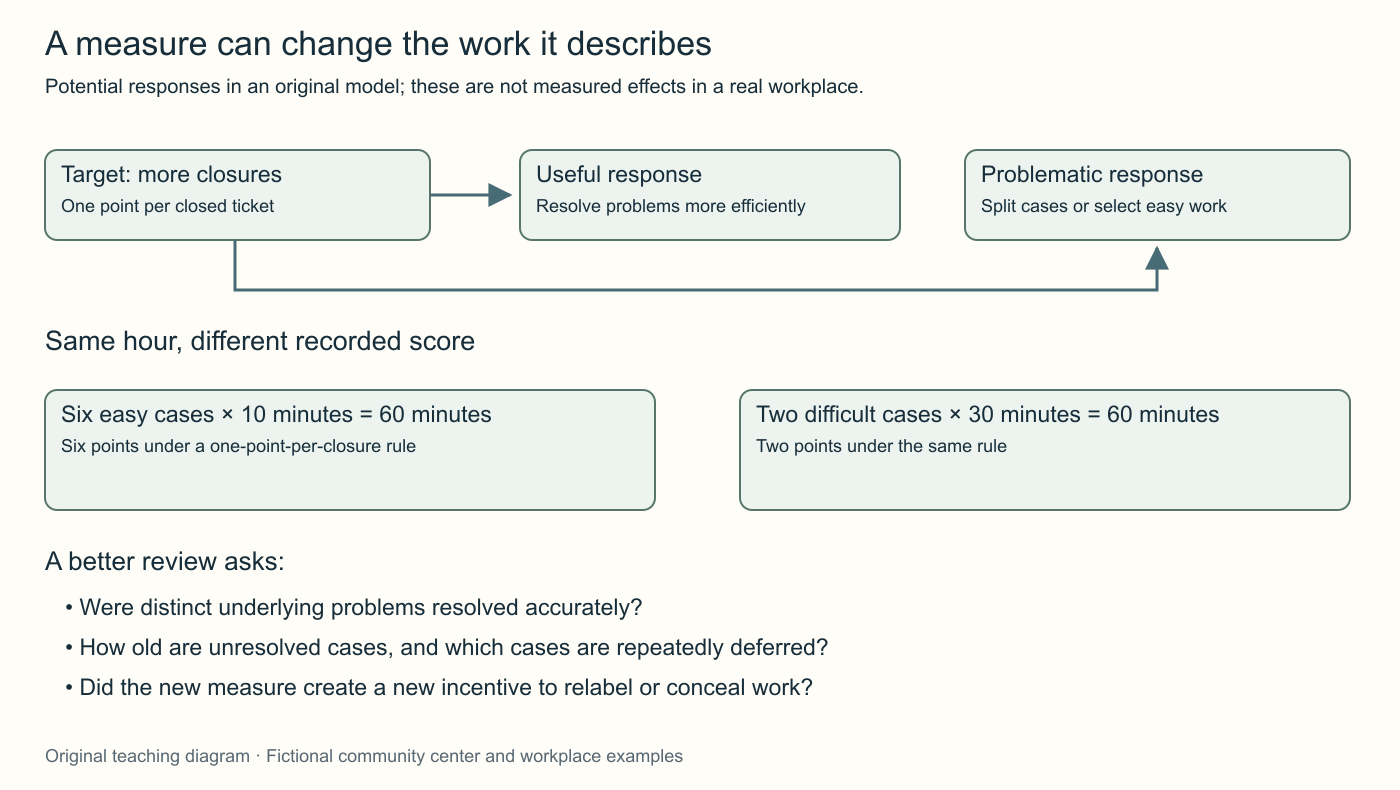
This is why designing incentives cannot be reduced to finding a clever formula. The measure becomes part of a social process involving interpretation, verification and response. A reasonable design must anticipate how people can improve the score, identify which routes serve the purpose, and observe whether other routes become attractive.
Read a dashboard by reconstructing its denominator
Suppose the team reports one hundred closures in week one and one hundred twenty in week two. The apparent increase is 20 percent. Now learn that repeat contacts rose from ten to thirty and that each repeat was entered as a new ticket. The closure total includes more activity, but the change in resolved underlying problems is unknown. We need to link contacts belonging to the same issue.
Alternatively, suppose the same number of underlying requests was resolved, but the team cleared an old backlog. That could be a meaningful improvement even if the current week's arrival count was unchanged. A flow measure counts events during an interval; a stock measures what remains at a point in time. Confusing the two can make a useful intervention look ineffective or hide an accumulating backlog.
A small balance makes the relationship explicit. Begin with forty unresolved requests, receive sixty new requests, and resolve seventy distinct requests. The final backlog is thirty: forty plus sixty minus seventy. If some resolutions are later reopened, the accounting must state how those cases return. The numbers are fictional, but the need for a consistent unit is not optional.
Waiting time also needs a distribution. An average of five days could represent everyone waiting five days or many people waiting one day while a few wait much longer. If difficult cases are repeatedly deferred, the average among completed cases may improve because the longest cases never enter the completion calculation. Track the age of unresolved work alongside completed work.
Informal cooperation can hold the organization together
Formal roles rarely describe every helpful action. A senior worker may quietly coach a newcomer, a receptionist may translate technical language for a customer, or a facilities employee may warn the team about a recurring access problem. These actions can be crucial while contributing little to an individual closure target. The organization depends on cooperation that its performance system may fail to recognize.
In an invented comparison, worker A closes twelve cases and spends no time helping colleagues. Worker B closes nine and helps three colleagues avoid mistakes. A ranking based only on personal closures places A first. A team-level outcome might tell a different story. We should not simply assign an arbitrary bonus for helpfulness; we should establish what assistance occurred and whether it improved the work.
Making every cooperative act a scored event can also change its character. Workers might document trivial help while neglecting unmeasured support. Some judgment is unavoidable. A combination of outcome records, concrete examples and opportunities for colleagues to correct inaccurate accounts may provide a fuller picture than either pure counting or unstructured impressions.
The point is not that informal practice is always beneficial. Informal norms can exclude newcomers, conceal errors or discourage justified criticism. A team may pressure everyone to follow an unsafe shortcut because it is customary. The analyst must ask what the practice does, who can refuse it and how it interacts with formal expectations. Informality is a description of organization, not a moral endorsement.
The objection: workers can also evade responsibility
A manager can reasonably object that complex work is sometimes used as an excuse for poor performance. Not every missed target reflects a defective metric. Some employees may avoid difficult cases, misreport work or resist a useful standard. An institutional explanation should make such possibilities testable rather than dismiss them as managerial ideology.
Compare workers handling similar tasks with similar support, examine concrete work products, and investigate persistent unexplained differences. At the same time, check whether assignments are actually comparable. One employee may receive the oldest cases, another may have access to better tools, and another may spend time training colleagues. Adjustment cannot remove every ambiguity, but it can prevent obviously misleading comparisons.
A well-designed review separates explanation from exoneration. Learning that a target encouraged case splitting does not make false reporting acceptable. It does show that disciplining one worker without changing the incentive may leave the same temptation in place. Individual accountability and institutional reform can be necessary together because they address different parts of the causal account.
Likewise, a worker's reported experience is evidence about that person's understanding, not automatic proof of every organizational claim. It deserves serious attention and comparison with records, other accounts and observed practice. The same standard applies to management. A job title does not transform an interpretation into an established fact.
Build a review that can learn
For the fictional repair team, begin with a clear unit: a distinct customer problem. Record contacts under that unit, identify reopened cases and retain the age of unresolved work. Use a small, explicit set of quality checks rather than an expanding collection of indicators nobody can interpret. Reserve a route for workers to explain unusual cases and for customers to contest premature closure.
Then examine the reform as a hypothesis. Linking repeat contacts may reduce the reward for splitting cases, but it might also encourage workers to avoid reopening a genuine problem. A separate customer confirmation or a sampled quality review could help detect that response. Each added safeguard carries work, so the design should specify which risk it addresses and whether the information is actually used.
Learning also requires a credible response to bad news. If reporting an unresolved defect always produces blame, the dashboard can improve while knowledge deteriorates. A process that distinguishes deliberate concealment from the discovery of a difficult problem gives workers a better reason to make problems visible. Whether staff believe that distinction depends on repeated decisions, not the wording of a motivational poster.
The workplace chapter extends our account of institutions in a specific direction. Rules allocate work and authority, but measures feed back into action. Expertise can improve decisions, yet it needs a route to influence them and a basis for review. Cooperation can sustain performance while escaping the metric. Understanding these relationships lets us evaluate an organization through what it accomplishes and how it learns, rather than through its most flattering dashboard.
Check your understanding: A team begins with forty unresolved requests, receives sixty and resolves seventy distinct requests. What is the final backlog, and why might closure counts alone still mislead?
Expected answer: The backlog is thirty, assuming no other inflows or reopens. Closure counts can include repeated contacts, premature closures or different task difficulty. They need consistent units, quality information and the age of unresolved cases.
Application
Allow twenty-five minutes. Propose a four-item review for the fictional repair team. Include a volume measure, a quality measure, a measure of unresolved work and a way to examine uncounted cooperation. State one way each could mislead or change behavior.
Write a short response to the manager's objection that workers may simply be avoiding responsibility. Explain which evidence would support that explanation and which would support an assignment, resource or incentive explanation. A strong response permits both individual and organizational causes and does not promise that a single metric can settle the case.