A pulse, a current, and a moving body
Watch the outline of a swimming moon jelly and you can count contractions. Watch its position and you can measure travel. Those records are related, but they are not interchangeable. A jelly can move while its bell barely changes shape, or contract repeatedly while making little progress against a current. The movement of the surrounding water completes the explanation.
We will build one swimming cycle in stages, then use it to interpret a sequence of positions. The immediate aim is to explain how a deforming body exchanges forces with water. The larger aim is to recognize when a visible motion supports a claim about propulsion and when it merely invites one. A pulsating bell supplies excellent evidence of changing shape; it does not, by itself, measure energy expenditure or establish the animal's destination.
Contract, recover, and retain the water's history
The swimming musculature acts on the bell, changing its shape. In broad moon-jelly medusae, the moving margin interacts with water both beneath and around the bell. Treating the animal as a rigid bottle that simply squirts out a narrow jet misses much of this interaction. A comparative review of biological jet propulsion distinguishes jet-dominated propulsion in more elongated bells from the rowing contribution of flatter bells. These are descriptions of fluid movement and geometry, not two perfectly sealed categories.
Begin with the bell expanded. During contraction, the margin moves inward and changes the space beneath it. Water accelerates as the deforming surface pushes and draws it into a new flow pattern. During recovery, the bell expands again, with elastic material contributing to the return. Water enters the widening subumbrellar region. The digestive cavity remains a separate system: the repeated movement of this external water is not repeated swallowing.
A useful mechanical account has to follow a full cycle. Imagine judging a rower by the blade's backward stroke while ignoring how the blade returns for the next one. The recovery can alter drag, timing, and the next stroke's starting conditions. In a jellyfish, it also interacts with water already moving from the preceding contraction. Reversing the movement of a body surface does not necessarily reverse the complete surrounding flow.
Water has inertia. Once set in motion, it need not stop when the bell stops contracting. Rotating flow can organize into a vortex ring: a three-dimensional ring of circulation, rather than a solid ring carried through the sea. In a flat slice through such a ring, two rotating regions may appear on opposite sides. A pair of swirls in a diagram can therefore represent one ring seen in section. Without that spatial interpretation, the drawing appears to introduce two independent little whirlpools.
Gemmell and colleagues examined swimming in animals identified as Aurelia aurita using body tracking, flow measurements, and computational pressure estimates. They found a contribution to forward motion after bell recovery, associated with flow induced by a vortex beneath the bell. Their 2013 study calls this passive energy recapture. The body–water interaction continued to generate a useful force during part of the interval between contractions. That result is more informative than saying simply that the jelly coasted.
“Passive” here does not mean energy appeared without a source. Earlier muscular work deformed the bell and moved water. Stored elastic energy and the evolving flow affected later phases. If you stretch a spring and release it, the release can perform work without a second pull at that instant. The earlier input still belongs in the energy account. Likewise, observing a useful force between bell contractions does not make the swimming cycle metabolically free.
Read a sequence rather than a dramatic frame
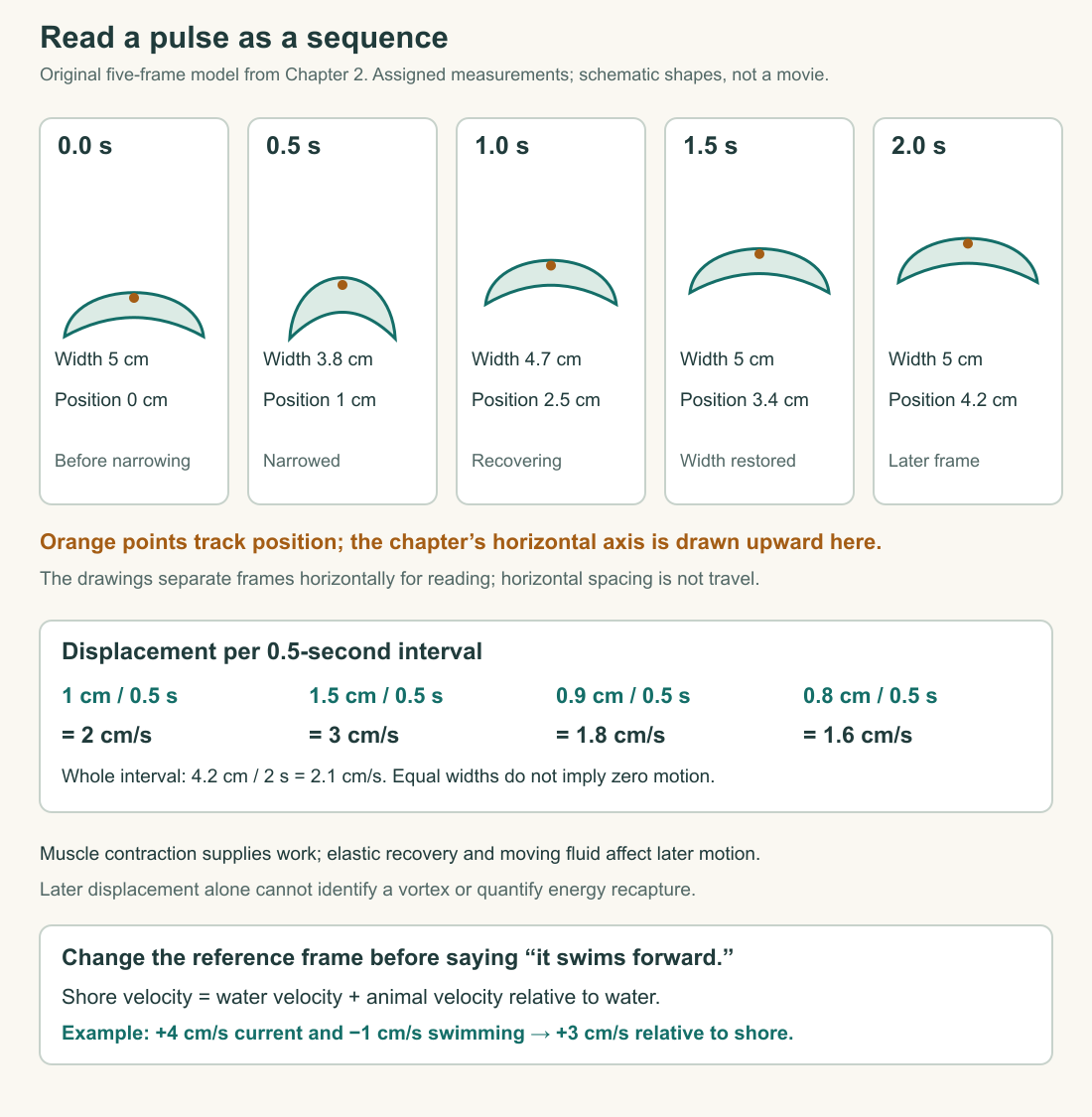
Here is an invented record for a jelly moving along a straight horizontal axis in still water. Each row is half a second after the previous one. Position refers to a consistently tracked body-center estimate, and width is the projected bell width in a fixed side view. These assigned numbers are for learning how to read a record, not measurements from the research paper.
| Time, seconds | Center position, centimeters | Bell width, centimeters |
|---|---|---|
| 0.0 | 0.0 | 5.0 |
| 0.5 | 1.0 | 3.8 |
| 1.0 | 2.5 | 4.7 |
| 1.5 | 3.4 | 5.0 |
| 2.0 | 4.2 | 5.0 |
The narrowest listed bell occurs at 0.5 seconds. Yet the largest displacement between listed frames is the following interval: 1.5 centimeters from 0.5 to 1.0 seconds. The final interval shows another 0.8 centimeters of travel despite unchanged listed width. You cannot determine instantaneous acceleration from those statements alone. You can already reject the rule that the animal moves only while the bell becomes narrower.
Divide each displacement by its interval to obtain average speeds: 2.0, 3.0, 1.8, and 1.6 centimeters per second. The overall average is 4.2 centimeters divided by 2 seconds, or 2.1 centimeters per second. The fastest interval average differs from the whole-cycle average. Neither is necessarily the maximum instantaneous speed, because movement within each half-second interval remains unresolved.
The unchanged last two width entries also deserve care. The margin could have made a small movement between frames and returned. A change perpendicular to the image plane might barely affect projected width. Even a genuinely unchanged outline would not establish that every muscle was inactive. Body shape, muscle activation, force, and metabolic expenditure require different kinds of evidence. Keeping these quantities separate lets a simple film answer the questions it actually contains.
If you followed the bell apex instead of a center estimate, deformation could shift your tracking point relative to the rest of the animal. That is not automatically a bad measurement: researchers can define and interpret a reproducible landmark. It becomes a problem when a point's deformation-related movement is silently described as translation of the whole body. Mark the landmark and explain what it represents.
To make the record more useful, take more frequent frames across the contraction and keep a scale in the same plane as the animal. A ruler close to the camera does not necessarily calibrate an animal farther away. A second view can reveal rotation out of the first plane. Repeated sequences establish whether the chosen cycle is typical. These are improvements to observation, not instructions to manipulate a living animal; the exercise can be completed with the supplied numerical sequence.
Put the current back
Now place the same reasoning in moving water. Choose east as positive. If the local water moves east at 4 centimeters per second and the jelly moves west relative to that water at 1 centimeter per second, its shore-relative motion is 3 centimeters per second east. Its body can be making an active westward swimming contribution while its geographic position shifts eastward.
The relationship is a signed addition: animal velocity relative to shore equals local water velocity relative to shore plus animal velocity relative to water. It concerns direction as well as speed. A number without a reference frame leaves out part of the measurement. In two or three dimensions, the same idea applies to vector components; movement northward cannot simply be subtracted from movement eastward as though both lay on one line.
Suppose a fixed camera records a jelly moving east at 2 centimeters per second. There are at least three compatible accounts: it could be swimming east in still water, drifting with a 2-centimeter-per-second current, or swimming west at 1 centimeter per second in water moving east at 3. Position alone does not choose among them. Bell activity may help establish active movement, but a current measurement is needed to separate these numerical possibilities.
Nearby particles can supply clues, yet “nearby” does not automatically mean “undisturbed.” A particle directly in the swimming wake is moving partly because of the jelly. A sinking particle is not a perfect water tracer. A useful current estimate samples an appropriate region and acknowledges such limits. Measuring the background flow and measuring the animal-generated flow are related but different tasks.
Vertical movement adds another possibility: gravitational and buoyant forces can affect travel. A sinking animal need not be propelling itself downward. Changing depth may nevertheless change which horizontal current carries it. Consider an assigned two-layer sea: the upper layer moves east at 6 centimeters per second and a deeper layer at 2. An animal that reaches the deeper layer and then remains there has altered its future eastward transport without swimming west fast enough to overcome either current. This is a physical possibility, not a demonstrated behavioral strategy for every moon jelly.
Turning is more than pointing somewhere new
A jelly's oral–aboral axis can rotate while its body center continues along much of its previous path. A car turning a corner often encourages us to imagine that orientation and travel direction always coincide. A body moving through water can retain sideways motion as it rotates. The path and the body axis therefore need separate arrows in an observation diagram.
A 2024 study of Aurelia aurita turning reports asymmetric timing of opposite bell margins and rotation around a translating center. Its public author abstract describes these turns as involving a skid. The narrow result we need is that opposite sides need not move synchronously and that turning can combine translation with rotation. The abstract alone does not supply a complete neural explanation for every spontaneous turn.
Draw a center moving right across four frames while its body axis rotates upward. An arrow along the axis represents orientation; the line connecting successive centers represents trajectory. If those arrows differ, the animal is not necessarily drawn incorrectly. Next mark the left and right margins at the beginning of contraction. A timing difference could contribute to asymmetric forces, but seeing the difference is not the same as measuring those forces. The next chapter on coordination will consider how nervous activity can organize body movements.
Efficient at which task?
“Good swimmer” could mean fast, maneuverable, economical over distance, or able to hold position in a current. An animal can perform well by one measure and poorly by another. The 2013 energy-recapture study combined swimming information with respiration data to estimate transport cost; it did not derive metabolic expenditure from a beautiful wake photograph alone. Its methods make the required combination of measurements and assumptions visible.
For an original arithmetic example, assign swimmer A an energy expenditure of 12 joules over 6 meters and swimmer B 9 joules over 3 meters. A uses 2 joules per meter; B uses 3. B spends less total energy on its shorter trip, while A has the lower expenditure per distance. If A is twice as massive, a mass-specific comparison changes the numerical ratio again. Before declaring a winner, state the task and the denominator.
There is another accounting choice: total expenditure versus the extra expenditure associated with swimming. Suppose A's assigned 12 joules include 4 joules of baseline activity over the same interval. Subtracting that baseline gives an estimated 8 joules attributable to the added task, or about 1.33 joules per meter. The subtraction is useful only if the baseline is appropriate to the comparison. A measurement from a different temperature or physiological state could change the answer for reasons unrelated to swimming mechanics.
Time also matters. A low expenditure per meter does not guarantee arriving before food disappears or escaping an approaching predator. Nor does a high maximum speed establish economical routine travel. For a hypothetical animal facing both demands, different performance measures can favor different motions. There is no need to assign an evolutionary explanation before understanding the immediate tradeoff.
The salp comparison shows why mechanism must accompany the metric. In a first-person WHOI research account, Kelly Rakow Sutherland describes muscle-driven pumping through two siphons, with a mucus feeding mesh in the water path. Flow visualization compared wakes among salps. This through-flow arrangement differs from an Aurelia bell repeatedly displacing external water beneath itself. Both animals move water, but their plumbing connects movement and feeding differently.
The comb rows of Mnemiopsis provide another contrast: numerous beating cilia supply locomotion through a distributed arrangement rather than a pulsing bell. The MBL organism account identifies this mechanism. Transparency and life in the water column do not tell us which motion to count. For a moon jelly we might measure bell phases; for a comb jelly, ciliary coordination and body displacement pose a different observational problem.
One pulse now contains more than a squeeze. There is muscle-driven deformation, elastic recovery, water carrying the history of earlier movement, and a body whose position depends on the surrounding flow. The same water motion can also carry potential prey toward feeding surfaces. That connection leads to the next question: how does a small animal encountered in the flow become a meal?
Application
Use the supplied five-frame table. Mark contraction and recovery intervals supported by the width measurements. Calculate average displacement speed for each interval. Explain why the final interval cannot prove passive energy recapture by itself.
Model interpretation: width decreases from 0 to 0.5 seconds, then increases through 1.5 seconds. Interval speeds are 2.0, 3.0, 1.8, and 1.6 cm/s. Continuing travel at unchanged sampled width is compatible with several mechanisms, including inertia and ongoing fluid forces. Establishing energy recapture requires an appropriate force/flow account and comparison; these invented positions alone do not establish it.
In a second assigned record, the jelly travels east at 1 cm/s relative to shore while undisturbed local water travels east at 3 cm/s. Find its eastward water-relative velocity. Then describe what changes if the camera itself moves east at 1 cm/s.
Model answer: water-relative velocity is 1 − 3 = −2 cm/s, meaning 2 cm/s west. Relative to the moving camera, the animal appears stationary and the water moves east at 2 cm/s. Their relative velocity remains −2 cm/s. A stationary image does not establish the absence of swimming.