More than the medusa
The adult moon jelly is the conspicuous part of a much less conspicuous life cycle. A photograph of a bell gives no obvious reason to look beneath a floating dock for small attached polyps. Yet understanding where new medusae come from requires connecting those two habitats. The animal in the water column and the attached stage are not unrelated organisms that happen to share a name.
Our task is to draw the connections without turning the cycle into a misleading circular biography. Some arrows describe a body developing into a different form. Others describe the production of additional bodies. A single arrow labeled “becomes” cannot adequately represent both. The difference changes how we count individuals, identify offspring, and explain a seasonal appearance of swimming jellies.
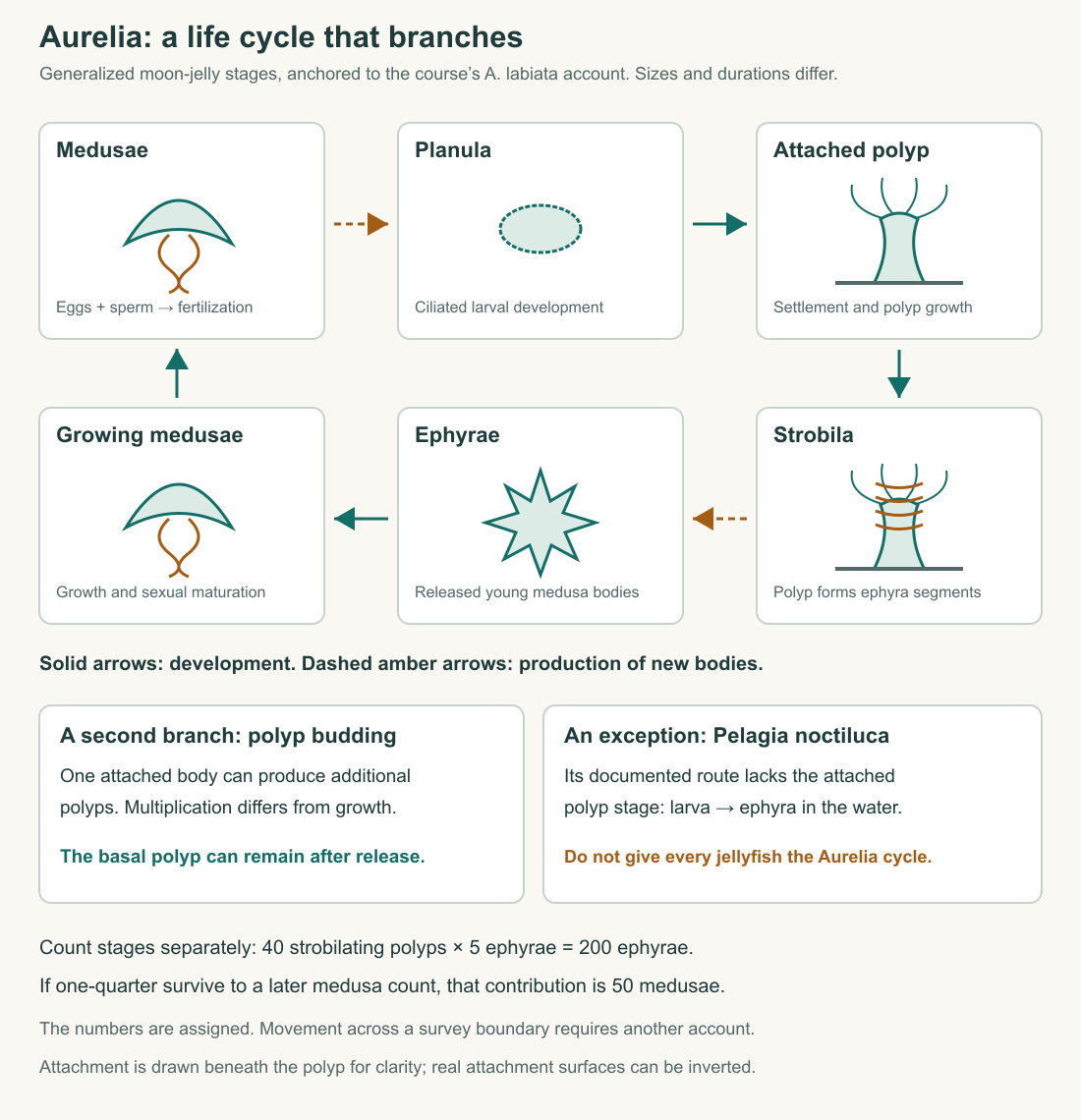
Begin with fertilization, then follow a body
Sexual reproduction involves eggs and sperm, whose fusion produces a fertilized egg. Development then generates a multicellular larva called a planula. In the familiar moon-jelly cycle, this ciliated larva can settle and develop into an attached polyp, also called a scyphistoma. Monterey Bay Aquarium's account of Aurelia labiata describes larval brooding associated with the female's oral arms and the subsequent polyp and medusa-producing stages. The aquarium's identification anchors the cycle to our recurring species.
A planula is not a tiny adult bell waiting to inflate. Its organization belongs to its developmental stage. Settlement changes the animal's relationship to its surroundings: an attached surface becomes part of its environment, while water and suspended material continue to move around it. The polyp has an oral region and tentacles rather than the adult medusa's broad swimming bell. Familiar functions remain—feeding, sensing, maintaining tissue—but their physical arrangement differs.
In a drawing, mark the attachment separately from the mouth. A polyp attached to the underside of a surface can have its oral end directed downward. “Mouth up” is therefore a page convention, not an anatomical law. If all stages in a life-cycle diagram are rotated to make the arrows fit, label oral direction or the attachment surface so that readers do not confuse a changed view with a changed body connection.
For these early transitions, following a particular body through time makes sense. A developing larva settles; that settled body differentiates as a polyp. Its size, cell types, and organization change. We do not need to invent a new species name at each transformation. The scientific name follows the organism's lineage through a succession of forms.
The line branches
Polyps can reproduce asexually, including by budding additional polyps. This is multiplication, not merely an increase in the size of the original body. The attached population can therefore expand before the production of swimming medusae. A study of environmental control in two Adriatic Aurelia species distinguishes polyp multiplication, resting-stage formation, and production of ephyrae. These are alternative or connected developmental activities, not interchangeable names for growth.
Suppose a fictional record begins with one settled polyp. It produces two buds, and both separate and persist. You now have three attached bodies in the record. If each later produces one additional polyp, there are six. The original polyp has not become six times longer; the number of bodies has changed. A time-lapse diagram should branch at each multiplication event rather than drawing one increasingly large polyp.
The asexually produced bodies belong to a clonal lineage. In a simple account they inherit essentially the same genetic starting material, while mutation and later differences remain possible. Sharing a clonal origin does not guarantee identical size, nutritional condition, or future reproductive output. Two bodies can be genetically very similar and encounter very different food supplies or microenvironments.
This distinction gives “individual” more than one useful meaning. If you are measuring how much food a polyp captures, a separately functioning body may be the relevant unit. If you are asking how many distinct lineages arose from sexual reproduction, counting every clonal body as a new sexual origin would be wrong. State the biological question before choosing the unit. There is no need to resolve every philosophical question about individuality to count the right thing for an experiment.
Strobilation produces a different kind of offspring
During strobilation, a moon-jelly polyp develops transverse divisions associated with the formation of ephyrae, the young swimming medusae. A stack of developing units can look superficially like a pile of shallow plates. That appearance is memorable, but the units are living, differentiating structures. An ephyra is not a slice accidentally torn from a polyp and immediately identical to an adult.
The developing ephyrae acquire structures needed for swimming and feeding. Release separates them into the water column, where they continue to develop. The basal portion can remain as a polyp rather than the entire attached body being exhausted in one compulsory final event. The developmental account in Aurelia sp. 1 describes the ordered release from a strobila and persistence of the basal polyp. This is a branching life cycle, not a line ending whenever one ephyra departs.
Distinguish three records. A polyp grows but produces no offspring: body size changes. A polyp buds a second polyp: attached-body number changes. A strobila releases ephyrae: swimming-stage number changes. Combining all three under “reproduction increased” makes it impossible to tell what was measured. A study interested in future adult medusae must distinguish the pathway leading to ephyrae from the pathway multiplying the attached population.
Our original drawing uses solid arrows for development of a continuing body and branching arrows for multiplication. The polyp-to-strobila transition changes developmental state. Ephyra release creates separately swimming bodies. A return arrow from the basal remnant to the polyp symbol records continued attached life. These conventions are tools for reading the cycle; actual biological transitions are continuous processes, not instantaneous jumps between icons.
A young swimmer is not just a scaled-down adult
An ephyra has a lobed outline and developing swimming structures. As it grows toward the more familiar medusa form, changes in proportions and tissues accompany changes in size. You cannot take an adult bell drawing, reduce it to one-tenth scale, and assume that it accurately represents a newly released ephyra. Development affects both geometry and operation.
The distinction between growth and development is useful here. Growth often means increasing size or mass. Development includes changes in organization, differentiation, and stage. They can occur together without being the same variable. An animal might increase in size slowly while progressing in some developmental features, or grow without having reached reproductive maturity. A diameter measurement alone does not identify every aspect of its stage.
Consider three fictional observations: an ephyra increases in diameter, its margin becomes less deeply lobed, and it later produces gametes. The first records size, the second shape, and the third reproductive function. To connect them, you need a sequence or other evidence showing how those properties change together. A collection of differently sized individuals taken on one day is not automatically a time series of a single individual's development.
The date of an observation is also different from developmental age. Two ephyrae released on different days can appear together in one sample. A small animal collected late in the season may be recently released rather than an unusually slow-growing member of an early cohort. A cohort is a group linked by a defined starting event or period, such as release during one week. Following cohorts lets you compare growth with elapsed time while still recording individual variation. If the smallest individuals disappear between samples, the average size of the survivors can increase even without an equivalent increase in every individual's size. The population average and the growth trajectory of a particular body answer different questions.
The cells must also build the tissues required by the next stage. This raises a mechanistic question that silhouettes cannot answer: are existing structures remodeled, or do new structures arise through different cellular processes? Helm and colleagues compared muscle development in pelagiid jellyfish. Their findings supported separate origins of polyp cord musculature and ephyra swimming musculature in the studied comparison. The result illustrates why an adult muscle's function does not reveal its developmental origin by itself.
A seasonal cue needs a biological interpreter
Temperature, light, salinity, and food can affect developmental timing or output. They are not buttons that guarantee the same response in every population. A cue acts on a body with a particular history and physiological state. “It got warmer” therefore needs to be connected to a specified transition, measured conditions, and an appropriate organism.
Purcell's 2007 experiments with Aurelia labiata from Puget Sound compared environmental treatments and measured asexual reproductive outcomes. Temperature and salinity affected ephyra production, while light conditions affected timing and frequency of strobilation in the tested arrangements. This is direct evidence that more than one environmental variable matters. It is not a formula stating that every degree of warming produces a fixed number of additional jellies everywhere.
Fuchs and colleagues investigated molecular regulation in Aurelia aurita and reported roles for retinoic-acid signaling and temperature-associated secreted proteins in the polyp-to-medusa transition. This brings the explanation inside the animal: environmental conditions are connected to changes in biological signaling and development. The public abstract supports that bounded account; it does not give us a complete predictive model for our local species.
An original comparison separates cue from resource. Suppose two groups receive the same seasonal signal, but one has acquired much less food beforehand. The signal could initiate a developmental response in both while their eventual offspring outputs differ. Conversely, ample food might support growth without supplying the timing cue associated with a particular transition. Observing a seasonal coincidence alone cannot tell you whether a variable acted as a signal, an energetic resource, a constraint, or several at once.
Time history is part of the environment. Two polyps currently at the same temperature could have arrived there after different periods of cooling or warming. A snapshot thermometer reading would then leave out a potentially relevant part of the comparison. To test a developmental response, record the trajectory of conditions as well as their values at the moment you inspect the animal.
Use an exception to test the diagram
The mauve stinger, Pelagia noctiluca, develops through a route that lacks the attached polyp stage in the documented comparison. Its larva develops toward an ephyra in the water column. The pelagiid developmental study makes this contrast explicit. The moon-jelly cycle therefore cannot stand for all jellyfish, even among animals with a recognizable swimming medusa.
Apply the difference to a habitat question. If an observer proposes that adding an attachment surface must increase a jellyfish population, ask whether the focal species actually uses an attached stage. The proposed mechanism could be relevant to one life cycle and absent from another. Even in an attached-stage species, additional surface does not guarantee settlement, survival, or successful ephyra production. The diagram narrows the possible explanation before a field experiment begins.
The exception is not a ranking of better and worse life cycles. An attached stage creates certain opportunities and dependencies; a wholly pelagic route creates others. Their consequences depend on food, transport, mortality, and reproduction in the environments concerned. Evolutionary explanation requires evidence about those consequences and ancestry, not admiration for whichever cycle has fewer boxes.
From a cycle to a population account
Take an assigned starting population of 100 polyps. During a defined interval, suppose 40 strobilate and each releases five ephyrae. The output is 200 ephyrae. If one-quarter of those survive to a later counted medusa stage, the contribution is 50 medusae. The other 60 polyps need not have died: they simply did not strobilate during this interval. Production and survival are separate quantities.
Double ephyra output while reducing subsequent survival from one-quarter to one-eighth. The same calculation still yields 50 later medusae. An increase in one stage's reproductive output can be canceled by a decrease in later survival. This is why an experiment measuring abundant ephyra release cannot, by itself, predict an equally large increase in adult abundance.
The location of the later count matters too. Ephyrae can leave the observed area, and young medusae can arrive from elsewhere. A locally disappearing individual may have died or departed. The next chapter will put movement across boundaries into the population account. For now, the life-cycle diagram has supplied the stages that must be followed.
The familiar medusa is consequently both a working body and a stage in a branching history. It can grow from an ephyra, participate in sexual reproduction, and connect through larvae to an attached population that multiplies and produces new swimmers. Reading that history accurately prepares us to evaluate a much larger claim: what does a sudden crowd of jellyfish tell us about the sea?
Application
Draw the documented moon-jelly cycle with fertilization, planula, settlement, polyp, strobila, ephyra, and medusa. Add polyp budding as a branch and show that a basal polyp can persist after ephyra release. Label development, asexual multiplication, and sexual reproduction differently. State that the drawing is a generalized Aurelia cycle, with A. labiata as the recurring local example.
Check: fertilization joins gametes; it is not the same event as a polyp budding. An ephyra develops toward a medusa; it does not first become a planula. The diagram must permit several swimming descendants from an attached lineage. It must not show every adult returning bodily to the start of its own egg stage.
For a second diagram, remove the attached polyp/strobila branch to represent the documented Pelagia noctiluca contrast. Explain why a survey of dock undersides would be an inappropriate way to count that species' missing polyp stage.
Finally, 80 assigned polyps include 20 that strobilate, releasing four ephyrae each. Half the released ephyrae reach the specified later stage. Model calculation: 20 × 4 × 0.5 = 40 later-stage animals. The statement does not supply a total population forecast because other cohorts, migration, and the fates of remaining polyps are unspecified.