Walking, climbing, flying, and swimming
The front limb of a deer meets the ground. A bat's front limb helps support an aerodynamic surface. A seal's front flipper participates in movement through water. Viewed only from the outside, they can look like unrelated pieces of equipment. Inside, their bones preserve relationships that make the comparison possible.
The aim of this chapter is to connect those relationships with different mechanical tasks. We will follow forces through a limb, examine contact with ground and branches, and then move into air and water. Shared ancestry explains why corresponding parts exist. It does not tell us that those parts have identical proportions, movements or functions today.
Identify the correspondence before comparing performance
In the familiar mammalian forelimb pattern, the humerus lies between shoulder and elbow; the radius and ulna occupy the forearm; wrist bones lead to the hand and digits. Across lineages, proportions change, elements can become reduced or fused, and the surrounding tissues vary. A recognizable historical relationship can persist through substantial modification.
Such corresponding structures are homologous: their relationship rests on common ancestry. Similar function can also evolve independently. Bat and bird forelimbs are homologous at that anatomical level, while their specialized flight surfaces evolved along different histories. Saying simply that their wings are “the same” or “different” leaves the level of comparison unspecified. OpenStax: homology and evolutionary evidence.
An original map below aligns major regions rather than presenting measured skeletons. The same color follows a corresponding region across the examples. It does not mean that equal colors carry equal loads or occupy equal fractions of the limb.
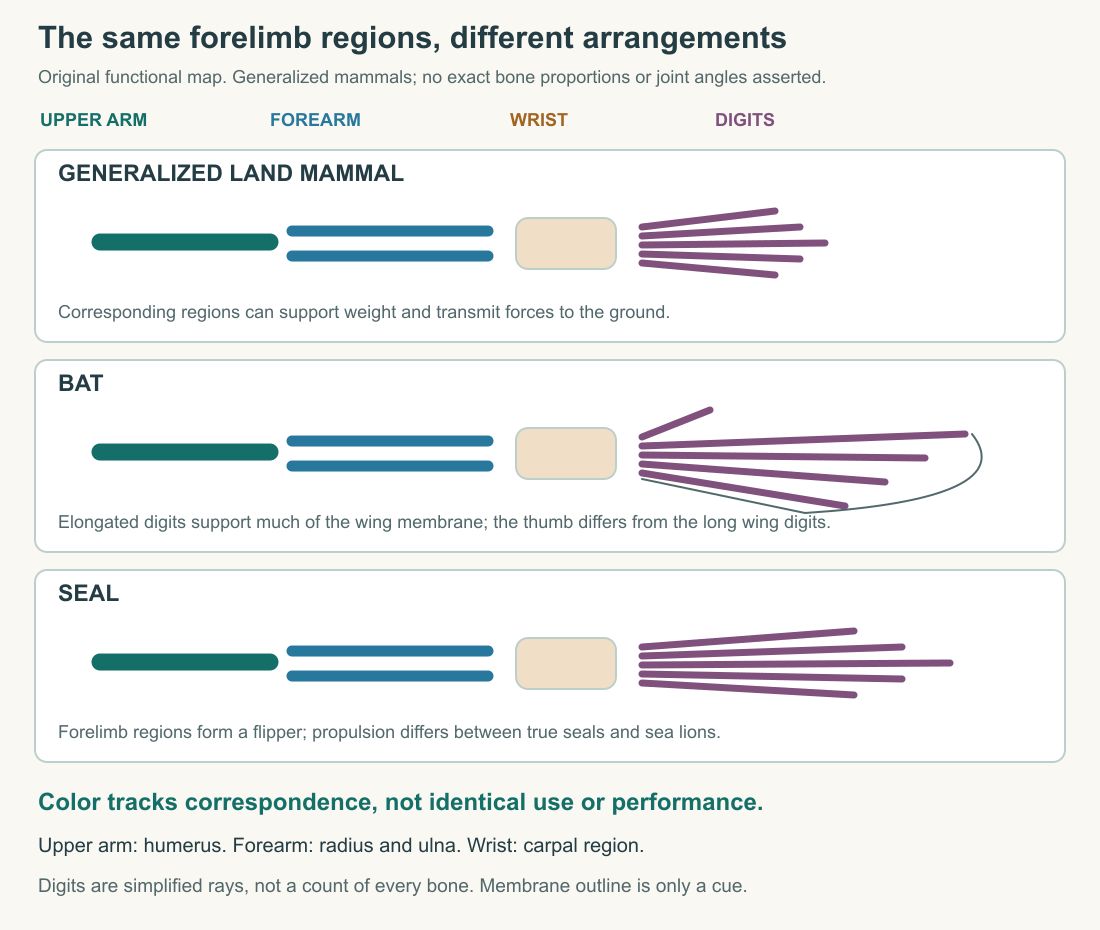
Read from the body outward. If you start at a conspicuous tip and name it from appearance alone, you may mistake a modified hand for an entirely new organ. Following connections makes the comparison more reliable. A functional question comes next: what forces act through each region during the movement being considered?
A limb is a system of forces
Muscles produce tension and transmit it through attachments, often involving tendons. A muscle's action around a joint depends partly on where its line of pull lies relative to that joint. The relevant turning effect is torque: force multiplied by the perpendicular distance from the axis of rotation to the force's line of action. OpenStax: forces and torques in muscles and joints.
Use an invented hinge model. A load exerts ten force units at a perpendicular distance of six length units, producing sixty torque units. A pulling cable attached with a moment arm of two length units must provide thirty force units to balance that torque, ignoring other forces and the weight of the lever. The cable tension is three times the external load.
This is why the force inside a limb need not equal the weight visibly supported at its end. Geometry matters. Moving the load farther from the joint increases its turning effect; changing posture changes moment arms. A photograph of two animals carrying the same external load would not establish the same internal forces.
The model omits several features of a living joint: multiple muscles, changing contact, elastic tissues, acceleration and three-dimensional motion. Its value is specific. It teaches us to ask where a force acts, rather than treating muscle size as the only determinant of movement.
A foot obtains a reaction from the ground
During terrestrial movement, the animal exerts forces on the ground, and the ground exerts forces on the animal. Those reactions support weight and can accelerate, brake or turn the body. The direction changes through a step. “The leg pushes backward” can describe part of forward propulsion, but it is not a complete account of every contact in a stride.
Imagine a foot set on a firm surface and another on loose material. Similar muscular activity need not produce the same body movement. If the surface deforms or the foot slips, some motion occurs at the contact instead. Contact mechanics belongs in the explanation alongside the skeleton.
For the mule deer, it is useful to distinguish what the limb can do from what a particular observation demonstrates. A still image can reveal posture and which feet appear to contact the surface. It cannot by itself show the order of contacts through a stride, the ground-reaction force, or whether the animal is accelerating.
A sequence offers more. Track one foot through contact, departure and return. Then ask how that sequence relates to the other feet and the body's movement. The point is not to memorize a gait name as quickly as possible. It is to identify an organized pattern with evidence about timing.
Standing still and moving require different accounts
A stationary body can be approximately balanced when forces and torques sum to zero. A moving body can also have balanced average forces during steady travel, while experiencing changing forces within each cycle. Acceleration requires a net force; constant speed does not mean muscles are inactive or energy use is zero.
Suppose an invented animal moves steadily across level ground. Over a complete stride, its average forward acceleration is zero. During that stride, however, it can repeatedly brake and accelerate. Averaging erases those fluctuations. A useful explanation must match its time scale to the question.
Climbing adds a change in gravitational potential energy. Raising a mass by a given vertical height requires an increase proportional to mass and height. A longer, gentler route to the same height does not remove that gravitational requirement, although it changes forces, time and other costs along the way.
These elementary accounts help explain why “fast,” “efficient” and “powerful” are different claims. Speed concerns distance per time. Mechanical power concerns work per time. Efficiency relates useful output to input under a defined measure. An animal can perform a task rapidly without being the least costly mover per meter.
A branch is a different contact problem
An animal crossing a narrow branch must maintain secure contact on a curved surface that may bend or move. When climbing a trunk, it must resist sliding as well as support and reposition its body. Mammalian climbers solve these problems through different combinations of gripping, claws, posture and limb mobility. There is no single climbing hand shared by every climbing lineage. Animal Diversity Web: climbing adaptations.
Consider an original tabletop analogy: a block resting on a broad board and the same block balanced on a narrow rod. The load has not changed, but the set of positions that remain stable has. Add movement of the support, and maintaining contact becomes an ongoing control problem.
The analogy does not turn a squirrel into a rigid block. It identifies the problem the animal must solve. Moving a foot, changing the body's position or obtaining another contact can change stability. Flexible limbs can matter because they permit those adjustments.
Claws and grasping are also different mechanisms. A claw can engage irregularities in a surface; a grasp can apply forces around a support. The effectiveness of either depends on the substrate. A feature useful on bark does not imply equal purchase on every smooth or wet surface.
This is a good place to resist an evolutionary shortcut. A living climbing mammal is not necessarily a model of the direct ancestor of a bat. Climbing can illuminate mechanical possibilities, but reconstructing the origin of flight requires historical evidence beyond a resemblance in behavior.
A bat wing changes shape as it moves
A bat's wing includes elongated forelimb elements and a thin skin membrane spanning regions between the body, limbs and digits. It is a deformable surface with living tissues, rather than a rigid paddle. Comparative anatomical work has documented organized elastic fibers and muscles within wing membranes across many bat species, with variation in their arrangement. Cheney, Allen and Swartz, 2017: abstract.
Deformation matters because aerodynamic forces depend on the wing's shape and movement relative to the air. The air loads the membrane, and the membrane responds. Muscular control and passive material properties therefore act together. We should not force the whole explanation into either “the wing bends automatically” or “the bat actively sets every point.”
Imagine a flexible sheet held at several points. Changing the supports changes its overall form; changing tension affects how it deforms under a load. A bat's tissues are far more complex, but this distinction helps explain why both skeletal movements and membrane properties can influence the resulting surface.
Camber describes curvature across the wing's chord, the line running from its leading toward its trailing edge. It is different from wingspan and from the angle at which the wing meets the air. A wing can change curvature without simply becoming longer. Naming the variable makes an experiment easier to interpret.
Inspect an illustration, then ask what the experiment measured
Brown University's account of a 2014 study includes an illustration marking a roughly parallel array of small muscles in the membrane between the body and the outer supporting elements. The red lines identify a region of the wing, not a second set of bones. The accompanying caption and text identify the example as a Jamaican fruit bat. This is an external source image; the diagram in our course is an independently drawn comparison. Brown University: wing-membrane illustration.
The illustration can show where the proposed mechanism lies. It cannot show when a muscle becomes active during flight. Cheney and colleagues addressed that question by recording electrical muscle activity in flying Jamaican fruit bats at two speeds. Their abstract reports activity concentrated around the downstroke, with timing differences between speeds, supporting a possible role in controlling membrane stiffness. Cheney and colleagues, 2014: abstract.
The distinction between location and activity is the key lesson. A muscle may be anatomically present without the image telling us how it participates in a particular movement. Electrical recordings add a time-dependent observation that the still illustration cannot supply.
Nor should we silently change the species. The study's Jamaican fruit bat, Artibeus jamaicensis, is a comparison species here. It is not our focal big brown bat, Eptesicus fuscus. The result motivates questions about bat wings more broadly, while direct claims about the tested behavior retain their original scope.
Disabling a component asks a stronger question
A later experiment by Cheney and colleagues temporarily disabled the relevant membrane muscles in Jamaican fruit bats. The abstract reports greater armwing camber, changes in wing motion, and a loss of very-low-speed flight under the experimental conditions. Those responses supported an active role for the muscles in controlling the wing's aerodynamic behavior. Cheney and colleagues, 2022: abstract and figure descriptions.
This moves beyond observing that two events happen together. Changing a component and observing a response can test a proposed causal role. Yet the result still concerns a particular intervention in a particular species and setting. It does not establish an exact contribution for every bat, every speed or every maneuver.
The compensating movements are especially instructive. An animal is not a machine whose other settings remain fixed when one component changes. Its behavior can adjust. The final performance reflects both the altered component and the responses elsewhere in the system.
For our course comparison, that is more informative than a claim that bats possess “perfect wings.” Their wings work through interacting structures and controls. Performance has a range, and altering a small part can narrow that range even when the animal can still fly.
Water changes the forces, and seals differ from sea lions
Water supports a body's weight through buoyancy while also resisting movement. An immersed animal still has mass and inertia. Buoyancy does not mean that accelerating or turning a large body costs nothing. Shape, speed and the moving surfaces influence the forces involved.
True seals, including northern elephant seals, use hind flippers prominently in propulsion through water. Sea lions use their large front flippers for propulsion and can rotate their hind flippers beneath the body for terrestrial movement. These are useful contrasts within pinnipeds, rather than one generic “seal swimming” pattern. NOAA: recognizing seals and sea lions.
The forelimb map must be read with that distinction in mind. A seal's front flipper is homologous to a bat's forelimb, but the two need not be the principal propulsive structures in the same sense. A diagram organized by ancestry is not automatically a diagram organized by locomotor contribution.
An original fluid model supplies another caution. Under a simplified drag relationship with fixed shape and drag coefficient, resistance increases with the square of speed. Doubling speed then gives four times the drag, and the power required to overcome that drag increases eightfold because power also includes speed. Real swimming involves changing shapes, strokes and flow, so the calculation is a conditional model, not a measured seal cost.
It nevertheless explains why an apparently modest speed increase can change a locomotor budget substantially. Faster transit may reduce time in one location while increasing the rate of expenditure. The feeding chapter's time account and the movement chapter's force account meet here.
Compare tasks rather than awarding a winner
A deer, bat and seal move within different combinations of support, resistance and access to resources. The bat's flight reaches aerial prey; the seal's swimming reaches underwater prey; the deer's terrestrial movement connects feeding areas, cover and other resources. Their corresponding forelimbs participate in those lives through different proportions and roles.
A good comparison names a task, follows the relevant forces, and identifies the structures and evidence that support the explanation. It also names a tradeoff: a feature's consequences can differ between land and water, between slow and fast flight, or between stable ground and a moving branch. No universal ranking of mammalian movement follows from success in one setting.
We now have the mechanical route from muscle activity to movement through an environment. Sustaining that activity introduces another requirement: supplying tissues with oxygen and removing carbon dioxide. For an animal that works underwater while breathing air, that requirement creates the distinctive problem of a dive.
Application
Annotate the original forelimb map twice. First label corresponding anatomical regions. Then use a different color to describe the role of each complete limb in one specified movement. Explain why those two annotations answer different questions.
Open the linked Brown University illustration. Describe only what its marked muscle region shows, then explain what the electrical-recording experiment adds. Keep the Jamaican fruit bat distinct from the big brown bat. No live-animal experiment is part of this activity.
Write a 400-word comparison of terrestrial walking, branch climbing and swimming. Include an original torque calculation, a contact condition and one limitation of inferring movement from a still image.
Check your understanding: If two limbs are homologous, must they generate propulsion in the same way?
Expected answer: No. Homology describes a relationship through ancestry. Proportions, tissues, motion and present function can differ, and another body region may provide much of the propulsion in one of the animals.