Reproduction and parental investment
A bat pup can have wings without being able to fly. A deer fawn resting alone can still depend on a mother that is temporarily elsewhere. A seal mother can feed her pup without eating during the nursing period. Each scene becomes less puzzling when we stop treating birth, feeding, movement and independence as the same event.
Reproduction connects two bodies across time. Materials acquired by an adult support developing offspring, while the adult continues to meet its own needs. Some transfers happen before birth or hatching, others afterward. The timing changes the places, activities and physiological processes through which the costs are paid.
Draw more than one developmental clock
Begin a developmental account with named milestones: fertilization, birth or hatching, first effective movement, first independent feeding, and the end of milk dependence. Not every milestone can be observed equally easily. A camera might record emergence from a shelter while missing nursing inside it. The visible event should not silently substitute for the harder measurement.
Weaning is the transition away from dependence on milk. It can involve a period in which milk and other foods overlap. First tasting solid food therefore need not establish weaning. Nor does moving away from a parent establish that the youngster can obtain enough food to support itself.
The word development covers changes in form and function, not merely increasing mass. A growing limb can change its proportions and performance; sensory and motor processes also change. An animal approaching adult mass may still differ in experience, behavior or reproductive maturity. There is no single percentage of adult size that proves adulthood across mammals.
The diagram keeps these events separate. Its rows are conceptual sequences, not a common calendar or a claim that equally wide boxes represent equal durations. This matters: aligning every animal at birth makes some comparisons convenient but can obscure substantial differences in development before that event.
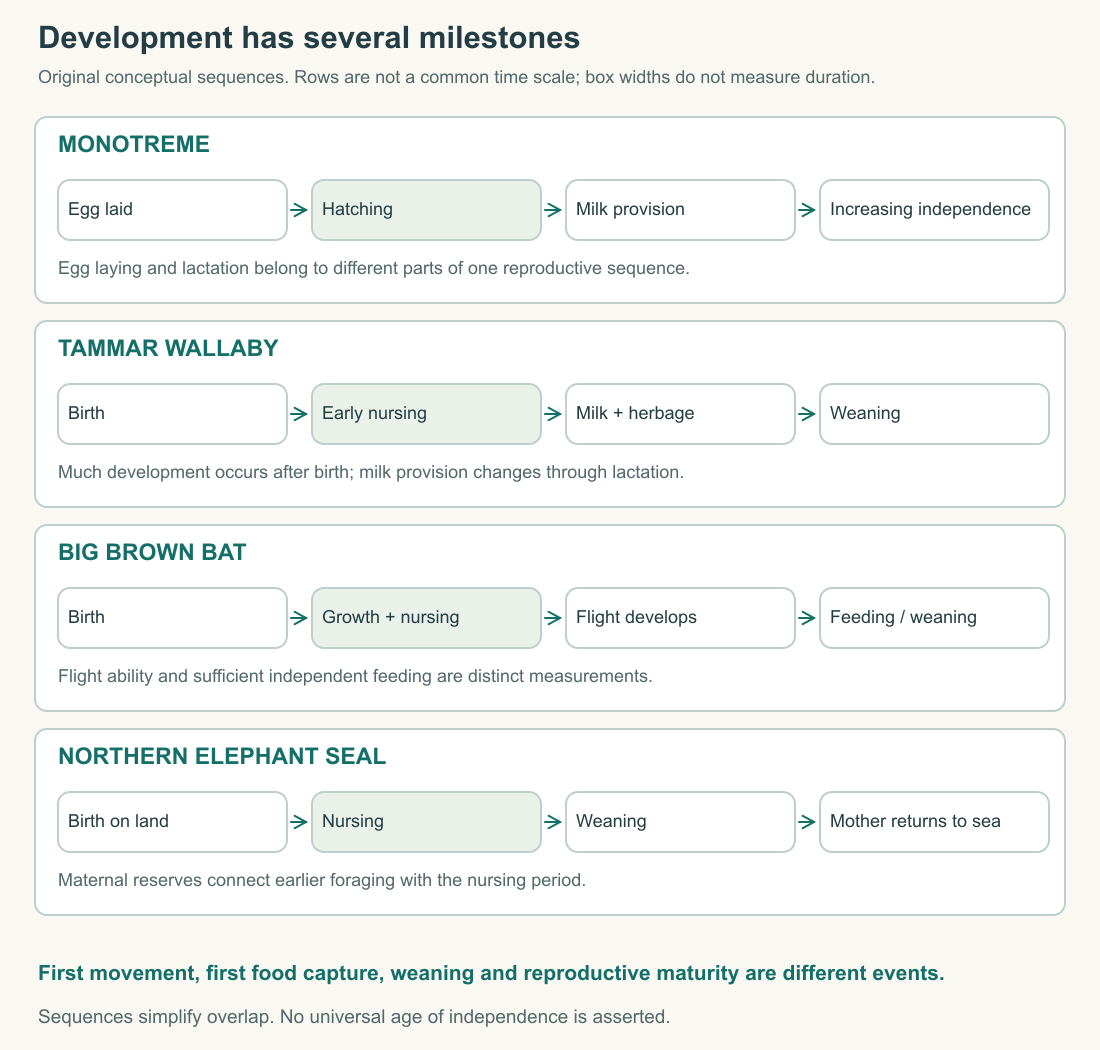
Egg laying does not remove lactation
Monotremes, including platypuses and echidnas, lay eggs and produce milk. They lack nipples; milk reaches the skin through mammary openings. These features make them a useful corrective to a definition of mammals based on live birth. Egg laying and milk provision describe different stages and can occur in the same reproductive sequence. Australian Museum: monotremes.
Consider what an egg does in a developmental account. It places some resources around an embryo before the offspring begins receiving milk. That transfer is real even though it is not a later feeding visit. Counting only visible deliveries after hatching would omit the materials already packaged in the egg.
This is an accounting principle rather than a claim that every mammal pays an identical total cost. To compare reproductive expenditure, specify the beginning and end of the measurement. A study beginning at hatching cannot by itself tell us the full cost from egg formation onward.
The same issue occurs with live birth. Measuring only milk after birth leaves prenatal transfers outside the observation window. An accurate comparison can have a narrow window, but its conclusion must retain that boundary. Otherwise, a difference in study design can masquerade as a difference in biology.
Marsupials shift much development into the milk-fed period
The tammar wallaby gives birth to a very small, immature young after a short pregnancy relative to its long lactation. Elizabeth Pharo's review describes milk composition changing through the nursing period as the young develops and eventually supplements milk with herbage. The nutritional relationship is a changing sequence, not a single constant fluid delivered for a fixed purpose. Pharo, 2019: review abstract.
A marsupial's short pregnancy does not mean an absence of a placenta. Guernsey and colleagues examined placental and mammary gene expression in the tammar, comparing aspects of these tissues with those in other mammals. Their work provides a molecular comparison of reproductive tissues; it does not support placing marsupials outside placental exchange altogether. Guernsey and colleagues, 2017.
The broader lesson concerns how stages are distributed. Imagine two original paper schedules with the same three tasks: obtaining materials, developing a movement system and sustaining the young. In one schedule, more movement development occurs before birth; in another, more occurs during later nursing. The location of a task on the schedule changes which protective setting and transfer pathway support it.
This does not rank the schedules from unfinished to complete evolution. Living marsupials are contemporary animals with their own histories. Calling one pattern primitive can conceal the actual questions: which structures function at a given stage, where does growth occur, and what resources support it?
A bat study separates appearance from performance
Mayberry and Faure followed captive-born big brown bats through growth and behavioral development. Eyes opened, fur developed and flight abilities appeared at different stages; early wing movements were distinguishable from sustained powered flight. Their sample included both twins and single pups. A single litter count or birthday therefore cannot stand for every individual or population. Mayberry and Faure, 2015: developmental study.
The study's captive setting matters. Food access and activity opportunities differed from those of free-ranging bats, so measured growth should not become an unqualified wild timetable. Equally, observing a first flight attempt does not demonstrate successful independent insect hunting. These are distinct performances requiring distinct evidence.
A useful developmental record would give each milestone its own column. Suppose an invented record marks wing flapping on day A, sustained flight on day B, and repeated independent food capture on day C. If A precedes B and C, the gap is biologically informative. It identifies a period in which a visible structure is present before all of its adult uses have been demonstrated.
Do not fill a missing entry by copying an adjacent one. A blank under independent feeding means that the record does not establish its timing. This is a better account than a neat but invented life cycle. Developmental biology depends on measuring transitions carefully enough to notice that they do not all coincide.
A resting fawn can remain part of a care relationship
The National Park Service describes mule deer fawns resting alone while awaiting their mothers' return. A momentary separation is consequently insufficient evidence that a fawn has been abandoned. The visible youngster and the adult's whereabouts are different parts of a longer sequence. National Park Service: mule deer in Zion.
Care can include transfers separated by intervals. To measure it, an observer needs an appropriate time window and a clear behavior to count. Presence beside an offspring is easy to see, but time together is not interchangeable with milk intake, protection or the eventual outcome for the young.
Consider an invented comparison. One parent is beside a youngster for forty minutes, another for ten. If nothing else is known, which transferred more energy? The observation does not answer. The rate of transfer during contact could differ, and the longer visit could include substantial non-feeding time.
The interpretation also depends on the youngster's behavior. Resting, hiding and following are different ways of occupying space while still receiving care. The analytical task is to connect those behaviors with documented conditions, not to decide that a solitary-looking scene is necessarily a failure of parenting. This course requires no approach to a fawn or search for its mother.
A seal can finance nursing from earlier feeding
Northern elephant seal females nurse their pups on land and return to sea after weaning, which NOAA describes as occurring after about a month. That short description becomes more revealing when nursing is connected to the mother's earlier foraging and stored reserves. The feeding site and the milk-transfer site need not be the same place. NOAA Fisheries: northern elephant seal.
Research on lactating northern elephant seals explicitly examines the physiology of fasting while supporting milk production. Crocker and colleagues measured aspects of protein use and renal function during lactation. Fowler and colleagues compared fatty acids in blubber and milk, showing that changes in maternal stores require a more detailed account than treating all stored fat as chemically interchangeable. Crocker and colleagues, 1998: abstract; Fowler and colleagues, 2014: abstract.
The important connection is across seasons and compartments. Energy acquired at sea can be stored in the mother and later support both her maintenance and transfer to a pup. Milk is a route through which some resources move into the offspring; it is not a new source of energy independent of the mother's body.
A photograph of a nursing seal cannot reveal the full chain. To estimate it, measurements might include earlier body condition, changes in reserves, milk production and pup growth. Each describes a different part of the process. Pup mass gain alone does not identify every component of maternal expenditure.
Work through a resource account
Here is an original model using invented energy units. A parent begins a period with 1,000 usable reserve units. Over ten days, maintenance and activity consume 300 units, and producing and transferring milk costs another 400. If no energy is acquired during that interval, the remaining reserve is 300 units.
Now give a second parent the same starting reserve and expenditures, but allow it to acquire 250 usable units during the period. Its closing reserve is 550. The difference does not establish that it cared more or less. It shows that current intake changes the relation between reproductive expenditure and reserve depletion.
In this deliberately simplified model, the milk-related term includes the parent's total energetic cost of that process. It is not identical to the energy retained as new offspring tissue. The youngster also uses received energy for maintenance and activity, and transfer has costs. Keeping these accounts separate prevents us from turning maternal loss directly into offspring growth.
Time can constrain the second parent's apparent advantage. Obtaining the extra 250 units requires some combination of searching, travel, processing and digestion. If those activities alter other expenditures, the original equal-cost assumption must be revised. A comparison that adds food while holding every consequence fixed is a useful first calculation, not a complete ecological result.
Composition, rate and duration all matter
A milk comparison needs more than a photograph of nursing or a single percentage. Concentration, quantity delivered, frequency and duration contribute different information. A concentrated fluid delivered in a small amount can transfer less of a nutrient than a more dilute fluid delivered in a sufficiently large amount.
For invented values, milk A contains eight nutrient units per volume unit and transfers three volume units per day: twenty-four nutrient units. Milk B contains five per volume unit and transfers six: thirty units. Calling A richer in that nutrient is compatible with B delivering more of it during the day.
The numbers say nothing about which milk is better for an unrelated species. Different young have different developmental conditions, and this arithmetic is not a feeding recommendation. Its purpose is to distinguish composition from delivery. In comparative work, a measured concentration should not silently become a measured daily intake.
Duration adds another dimension. Even if two animals receive the same amount per day at one sampled stage, their totals can differ over the full nursing period. Since composition and production may change, multiplying one late sample by the entire duration can introduce a substantial error. A changing process requires measurements that represent its changes.
More offspring is not a complete measure of success
Litter size counts young at a specified stage. Reproductive outcome can also involve survival, subsequent development and the parent's later opportunities. A count at birth and a count at independence answer different questions. Neither should be called lifetime success without the relevant follow-up.
Imagine two invented groups, each with ten parents. Group A produces twenty newborn young; group B produces ten. If eight from A and eight from B reach a stated later stage, the total survivors match despite different initial counts. Survival fractions differ: eight of twenty is 40 percent, while eight of ten is 80 percent.
This does not prove that one strategy caused either fraction. Food, disease, weather, parental condition and many other differences might contribute. It demonstrates why the denominator and endpoint must accompany a comparison. A plausible life-history explanation becomes stronger when these competing influences are measured rather than merely named.
Parental investment refers to resources and effort directed toward offspring with consequences for the parent's other possibilities. It is not a moral score. Mammalian reproductive arrangements cannot dictate how humans ought to organize relationships; moving from a biological observation to an ethical requirement requires arguments that animal physiology does not supply.
Compare costs over the same interval
A useful comparison can fail simply because its clocks begin in different places. Suppose an invented reserve-based parent acquires 600 units during a preceding month and transfers some during the following nursing period. A second parent acquires resources throughout nursing. If we count only food collected while the young are present, the first parent's acquisition disappears from the table even though it helped make the transfer possible.
Choose an interval appropriate to the question. A study of daily nursing can legitimately focus on nursing days. A study of total reproductive cost needs a broader account, with assumptions about the parent's maintenance costs and changes in condition. Extending the window does not automatically solve every problem, but it makes previously hidden inputs visible. The most revealing comparison often begins before the photograph and ends after it.
Read the whole sequence
Return to the bat, deer and seal. The useful comparison follows development, resource acquisition and transfer together. It asks when an offspring can perform a task, what remains supplied by a parent, and where the parent obtains the resources. Shared lactation opens the comparison; it does not finish it.
A good life-history account also identifies its missing interval. Perhaps prenatal cost was not measured, feeding occurred out of view, or the animals were followed only until weaning. Naming the gap preserves a valuable result while preventing it from answering a larger question than the evidence allows.
Application
Create a four-row developmental comparison for a monotreme, tammar wallaby, big brown bat and northern elephant seal. Use the chapter's linked sources. Mark birth or hatching, milk provision, a documented change in independent activity, and weaning where the source establishes it. Leave uncertain dates blank. Explain in a caption why the rows are not a shared time scale.
Then write 450–600 words comparing the bat and seal. Include one distinction between movement and independence, one resource transfer before or after birth, and one limitation of the evidence. Add the invented reserve calculation from this chapter with current intake changed to 150 units; show the closing reserve and explain why that number is not the pup's growth.
Finally, evaluate this claim: “The parent seen beside its young longest has invested most.” Identify two missing measurements and give an alternative interpretation. Work from sources and the supplied paper examples; do not approach wildlife or inspect a maternity roost.
Check your understanding: Why can first flight, first independent feeding and weaning occur at different points, and why does that matter when comparing reproductive investment?
Expected answer: They measure different abilities and transfers. Flight does not by itself establish sufficient food capture, and milk can remain important after independent activity begins. Comparing investment requires a specified interval and evidence about actual resources or care, rather than substituting a visible movement milestone for the end of dependence.