Moving with muscle and water
A squid can accelerate with a pulse of water. An octopus can extend an arm even though the muscle fibers that power it shorten. Neither action violates an ordinary mechanical rule. Both become understandable when we specify which dimension changes, which material moves and what pushes against what.
We will begin with an arm-sized piece of tissue, then move outward to the whole animal and its environment. The same questions apply at both scales: where does the force originate, where is it transmitted, and what prevents the resulting movement from being something else?
How shortening can produce lengthening
A muscular hydrostat is a structure in which organized muscle supplies both force and much of the support needed for movement. Over a brief movement, its tissue is approximately constant in volume. An octopus arm is not a hollow hose that must be inflated from a distant reservoir. The arrangement of its tissues permits one dimension to change as another changes in compensation. The foundational account by Kier and Smith connects this geometry to elongation, shortening, bending and twisting.
Consider an ideal cylinder with volume equal to cross-sectional area multiplied by length. This is a mathematical model, not a measurement of an octopus. Give it an area of four square units and a length of ten units: its volume is forty cubic units. If contraction across the cylinder reduces its area to two square units while volume stays forty, its length must become twenty. Muscle shortened across the structure while the structure lengthened along its axis.
The example is intentionally extreme and geometrically simple. Real arms taper, contain different tissues and deform unevenly. Nevertheless, it resolves the apparent paradox. A muscle's shortening direction and an appendage's extension direction need not coincide. Before explaining a movement, draw the fiber direction and the direction of the observed dimensional change. Confusing them produces the mistaken claim that muscle must push by actively lengthening itself.
The relationship is nonlinear when expressed in diameter. Halving a circular cylinder's diameter reduces its cross-sectional area to one quarter, because area depends on diameter squared. At constant volume, length would then have to become four times as large. That is a geometrical consequence under the assumptions, not a prediction that a living arm can achieve this deformation. Tissue properties and control impose limits absent from our model.
The inverse calculation is equally useful. If the model length rises from ten to twelve and volume remains forty, its area becomes about 3.33. You need not imagine new tissue appearing at the tip. Existing tissue has changed dimensions. Growth over weeks is a different process from extension over a fraction of a second, even if both produce a longer measured object.
Bend, stiffen and release
Lengthening is only one available action. Shortening longitudinal muscle can reduce length and increase thickness. Unequal changes around a cross-section can create curvature. Coordinated activation of differently oriented muscle groups can resist unwanted deformation while allowing another movement. “Relaxed” and “contracted” are therefore inadequate descriptions of a whole arm: different regions and orientations may be active at the same time.
Imagine a flexible strip with a near side and a far side. If the near side becomes shorter while the far side retains more of its length, the strip bends. If both shorten equally, bending is not the necessary result. If neither side can resist the other's pull, the intended curve may collapse into a different deformation. The direction of activation and the mechanical state of neighboring tissue matter together.
A useful comparison is a rope pulled around a post. The rope bends because external forces and the post constrain it. A living arm can generate changing internal forces as well as respond to contact with objects. Watching curvature appear does not distinguish these possibilities by itself. We need information about contact, loading and activity. The nervous-control study in chapter five will make this distinction experimentally, rather than assuming every moving bend is actively driven.
When an octopus moves across a surface, attachment changes the force calculation. An arm pressing or pulling against a rock receives a reaction from the rock. Without adequate contact, the same internal action may move the arm relative to the body more than it moves the body through the environment. Contact is not merely a place where movement stops; it can be the connection that makes a different movement possible.
This leads to a practical annotation rule: track which locations are approximately stationary relative to the surroundings. A sucker moving with the arm is different from a sucker maintaining a fixed contact while the arm changes shape. Neither requires imagining each sucker as a permanent anchor. Attachment, loading and release can succeed one another during an episode.
The mantle is a variable-volume pump
For jet propulsion, follow water rather than an appendage. During intake, expansion of the mantle cavity admits water around the mantle opening. During a propulsive contraction, the inlet pathway closes sufficiently for pressure to drive water out through the funnel. The expelled water acquires momentum; the animal experiences a reaction in the other direction. The original schematic separates these phases so that the arrows do not imply simultaneous unrestricted entry and exit.
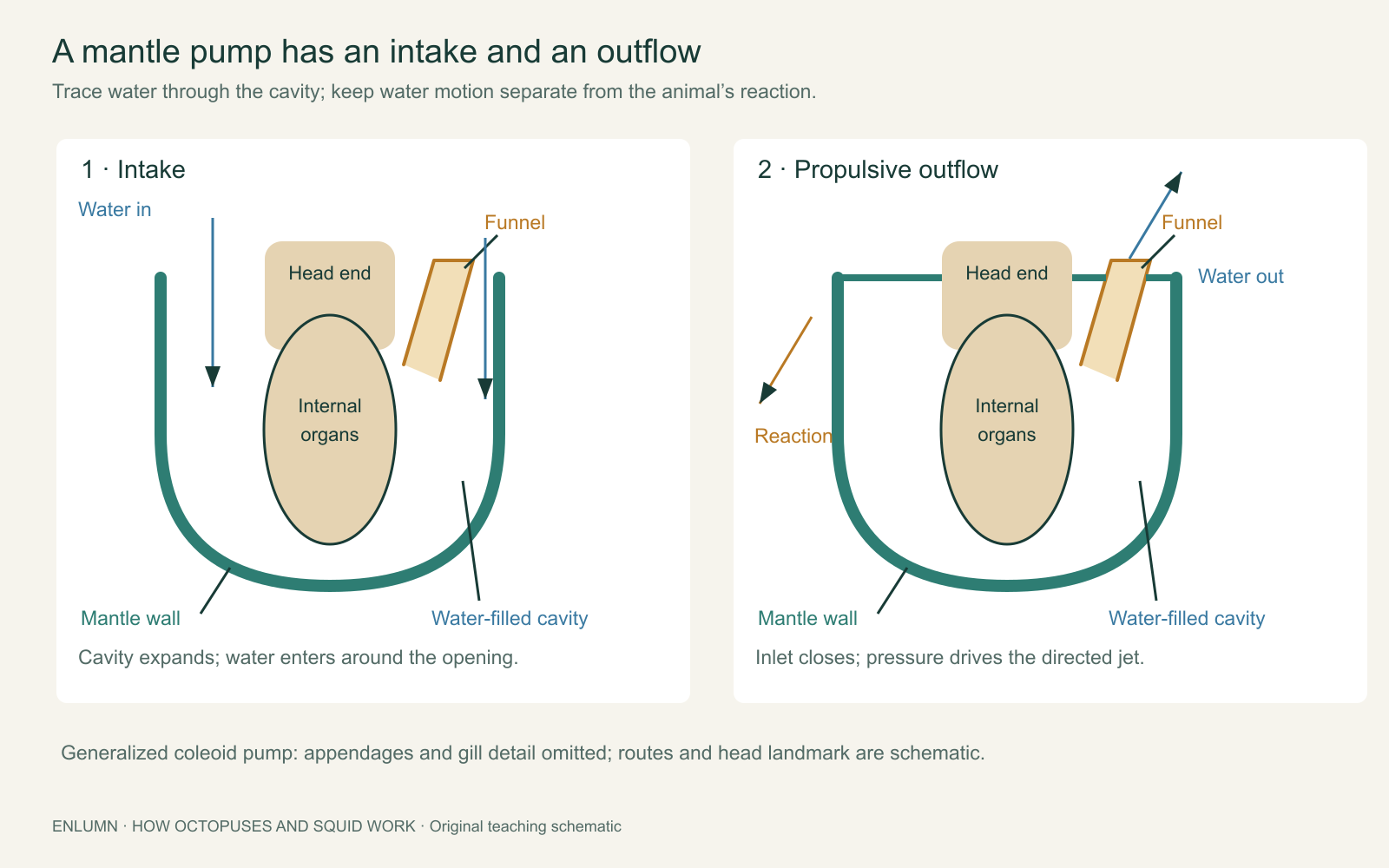
The jet is the directed outflow. Thrust is the propulsive force associated with accelerating that water. Drag is resistance arising from movement relative to the surrounding fluid. An animal can produce thrust while moving at constant speed if opposing forces balance. Acceleration indicates a net force, not merely the existence of a motor or a pulse.
Do not say that the jet pushes against a distant wall of water. Momentum is exchanged locally as water is accelerated. Nor does the animal simply move by the same distance as the ejected water. The masses, velocities, changing flow and other forces differ. Direction is the simplest reliable prediction: water expelled one way contributes a reaction the other way, with orientation determining how much of that reaction assists the observed motion.
A funnel can redirect outflow. Consequently, “backward swimming” is an ambiguous description unless you identify the body reference and the direction of the jet. Draw a water arrow first, then a reaction arrow. If the reaction line misses the body's center of mass, it can also contribute a turning effect. Translation and rotation are different outcomes of forces acting on the same animal.
A propulsive reaction arrow is not necessarily a velocity arrow. Imagine an animal already moving to the left while a newly directed jet produces a force to the right. Initially, the force can slow the leftward motion rather than make the animal move right immediately. Only after sufficient momentum change might the direction reverse. A still frame cannot resolve that history. To interpret the pulse, compare positions over time and distinguish velocity, which describes motion, from acceleration, which describes a change in velocity. This distinction is especially valuable during a turn, where speed can remain similar while direction changes. A curved path requires a changing velocity even if successive equal-time segments have equal lengths.
Compare pulses without inventing an efficiency ranking
Take an idealized momentum example in arbitrary but consistent units. Pulse A ejects two mass units with a velocity change of three, giving six momentum units. Pulse B ejects one mass unit with a velocity change of six, also giving six. Equal momentum does not mean equal energy: the ideal kinetic-energy changes are nine and eighteen, respectively, using one half of mass times speed squared and assuming water starts at rest in the chosen frame.
This example explains why moving a small amount of water very fast can have a different energy cost from moving more water more slowly. It does not establish the efficiency of a squid. A real estimate must include intake, pressure, wake structure, the animal's speed, fin contributions and the chosen definition of useful output. If only the contraction phase is counted, the answer need not equal an estimate for the entire swimming cycle.
The review “Cool your jets” shows why these distinctions matter when comparing published estimates across sizes and methods. We will not assign a single universal percentage to squid propulsion. A performance number becomes informative only after its denominator and experimental conditions are clear.
Force also depends on timing. Delivering six momentum units in one time unit gives a larger average force than delivering them in three. A rapid escape and sustained travel therefore pose different questions even if the same total momentum is transferred. Peak output, average output and total expenditure should not be substituted for one another.
The simplest sensible comparison asks one question at a time. To compare turning, measure a turn. To compare the cost of holding position, include the forces required to remain at that depth. To compare escape, define the interval and relevant starting conditions. A single adjective such as “efficient” cannot replace these choices.
Fins add control, not decoration
The paired fins of a squid interact with water as moving surfaces. They can contribute to propulsion, support and stability, with their role depending on the movement. They are not equivalent to rigid wings bolted onto a jet engine. Their changing shape and timing are part of the locomotor system, and their action must be considered alongside the mantle pulse and the posture of the arms.
A 2016 study by Jastrebsky, Bartol and Krueger filmed brief squid, Lolliguncula brevis, and dwarf cuttlefish, Sepia bandensis, from two directions. It distinguished how tightly an animal turned from how rapidly its orientation changed. The squid achieved faster turns, while the cuttlefish achieved tighter, more controlled turns in the study. These are different species from our Pacific anchors and from the European cuttlefish used in the camouflage research.
To see why the distinction matters, draw two fictional paths. Animal A turns through ninety degrees in half a second while following a broad arc. Animal B takes one second but rotates in a much smaller space. A has the higher average angular speed: 180 rather than ninety degrees per second. B may have the advantage in a narrow passage. Declaring either the better turner without specifying the task discards the useful result.
Body size complicates the comparison further. A two-centimeter turning radius means something different for a three-centimeter animal than for a thirty-centimeter animal. Dividing a radius by a relevant body length produces a dimensionless comparison, but you must use the same definition of length. Mantle length and total length including arms are not interchangeable denominators.
The study also illustrates why body movements alone may not identify every force. A fin can move asymmetrically at the same time as a directed jet. Observing both does not reveal their separate contributions. Flow measurements, timing and suitable comparisons are needed to move from a description of coordination to a quantitative assignment of force.
Reconstruct two movement episodes
For an arm-based episode, begin with the substrate. Mark contact points, then identify which arm regions change shape and how the mantle moves relative to the surroundings. Ask whether an observed bend could be imposed by the contacted object. Finally, state what additional measurement would distinguish that explanation from active muscular shaping. This sequence keeps your account mechanically connected.
For a jet-based episode, begin with the mantle cycle and the funnel. Record the likely intake and outflow phases, the funnel's orientation and the animal's change in position or heading. Include fins and arm posture when visible. A mantle contraction by itself does not prove that every observed displacement resulted from jet thrust; currents, coasting and other actions may contribute.
The original arm schematic is a reminder that mechanics and control meet in organized tissue. It simplifies fiber directions and separates a shape model from a nervous-system map. It does not depict a hollow hydraulic cylinder or assign an independent brain to each appendage.
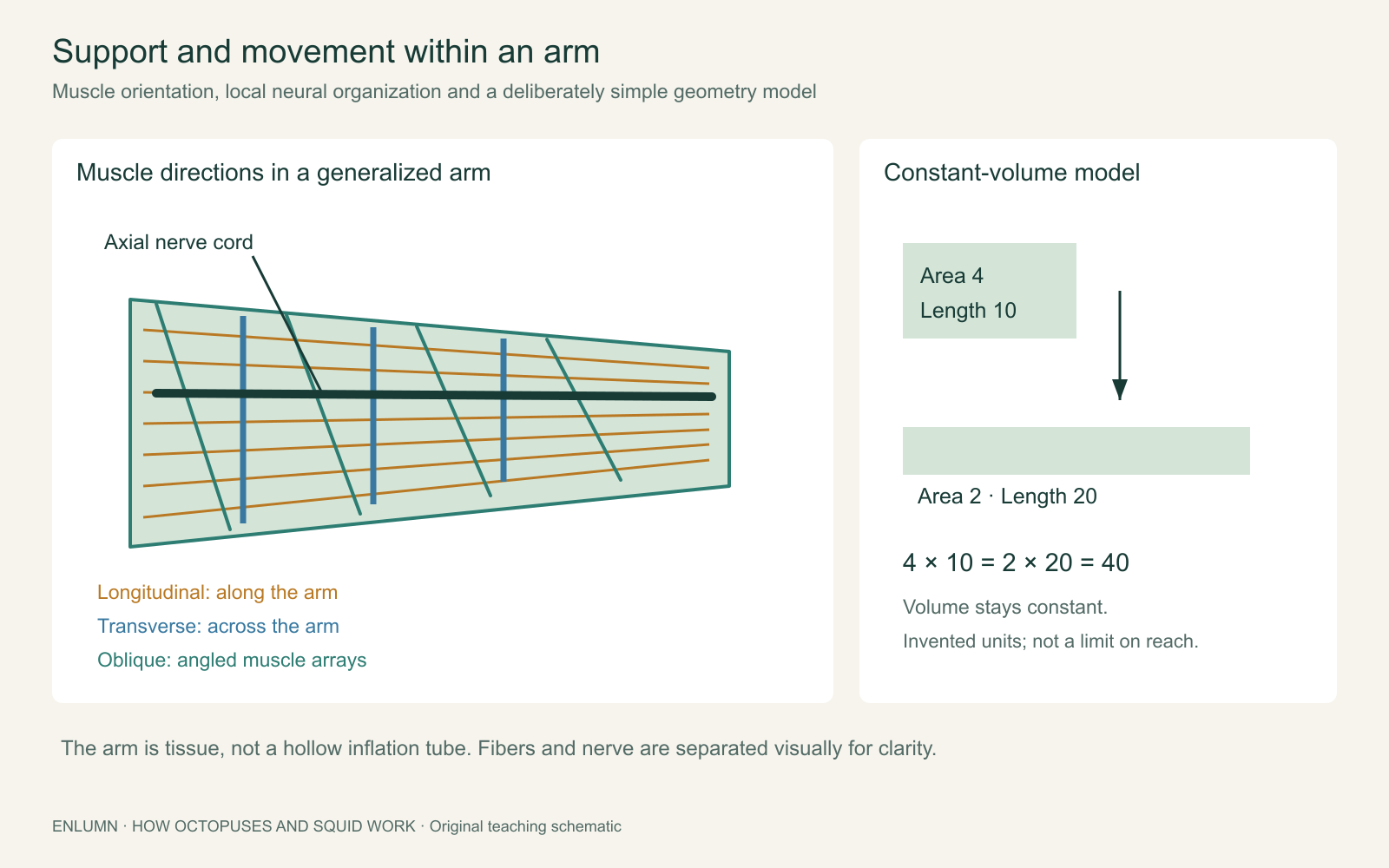
A successful explanation connects a sequence of changes: activation alters tissue dimensions or cavity pressure; forces are transmitted through tissue, contact or water; the animal's motion changes according to the net result. It also states what has not been measured. That combination is much stronger than naming a mechanism and assuming the rest of the episode follows automatically.
Check your understanding: In a constant-volume model, cross-sectional area falls from four to three square units while the initial length is nine units. What is the new length, and why is this not a prediction of a living arm's maximum reach?
Expected answer: Volume is 36 cubic units, so the new length is twelve units. The calculation describes an ideal geometry; it omits taper, tissue limits, loading, posture and control, which constrain a real arm.
Application
Draw two four-frame sequences: an arm maintaining contact while a body shifts, and a mantle intake followed by directed outflow. These are explanatory schematics, not invented field observations. Use separate colors or labels for water motion, tissue change and reaction force.
For each sequence, identify one visible event that would support your account and one uncertainty a single camera view would leave. Add a 100-word comparison of turning quickly and turning tightly, using the named species in the linked study. Allow 10–15 minutes.