Eyes, arms, and nervous coordination
A flexible arm can change shape at many locations. Its tip can reach the same point through different paths, and an object can contact many suckers along the way. Coordinating such a structure is a different problem from specifying the angle of a single hinge. Yet “different” does not mean inexplicable, and a surprising solution does not automatically tell us what the animal experiences.
We will distinguish four questions: what information is detected, where signals are processed, how movement is organized and what experience changes behavior. A fifth question—what the animal feels—is important, but it cannot be answered merely by renaming a nervous structure or watching one successful action.
Light becomes a signal, not a miniature observer
In Octopus vulgaris, a camera-type eye directs light through an optical system onto a retina containing photoreceptors. Those cells transform light into electrical responses that can influence nervous activity. An image formed at a retina is not a picture viewed by a smaller animal inside the head. It is a spatial distribution of stimulation from which neural processing extracts information.
The review by Hanke and Kelber describes similarities and differences between octopus and vertebrate eyes, including their retinal organization. Similar optical geometry does not imply identical circuitry or identical perceptual abilities. Nor does a colorful skin display establish how its producer distinguishes wavelengths. Anatomy, behavior and the conditions of a visual test must be connected before drawing that conclusion.
Imagine two targets that differ both in hue and brightness. An animal consistently approaches one. You cannot tell whether it used the hue difference, the brightness difference, an edge contrast or another correlated cue. A fair test changes or controls these alternatives. Calling the response “color vision” at the outset would put the desired conclusion into the description of the task.
The same caution applies to apparent failures. If an animal does not choose between two targets, perhaps the relevant difference is not visible under the conditions. Perhaps the animal is not motivated, the response is difficult to perform or it has learned a different feature. Failure in one task is evidence about that task; a broader claim about inability requires stronger support.
A sensory system can be highly effective while sampling a world unlike ours. There is no need to rank it as a better or worse version of human vision. The useful question is which environmental differences it can detect and how those differences affect actions that matter in its life.
Contact supplies more than pressure
A sucker is both a contact structure and a site of sensory interaction. Mechanosensation concerns physical deformation or movement; chemosensation concerns chemical stimuli. The phrase chemotactile sensing describes chemical information encountered in close association with contact. It should not be taken to mean that an arm has a human tongue or experiences flavors as we do.
Van Giesen and colleagues' 2020 work on Octopus bimaculoides connected specialized receptors and distinct sensory-cell responses to this contact-associated sensing. It identified receptors responsive to poorly soluble compounds and differentiated chemical from mechanical responses. The paper's abstract and figure descriptions connect molecular, cellular and behavioral evidence; they do not make every compound encountered by every octopus equivalent.
Consider why solubility matters. A readily dissolved molecule can be carried through water and provide information at a distance. A poorly soluble compound associated with a surface may be sampled more effectively through contact. That is a physical distinction about how information becomes available. It does not imply that an animal with contact-associated sensing lacks all distance chemosensation.
A fictional observation illustrates the ambiguity. An arm withdraws quickly after touching surface A but remains on surface B. Perhaps their chemistry differs. Perhaps their texture differs. Perhaps A was contacted more forcefully or at a different stage of exploration. To distinguish these explanations, the chemical and mechanical properties must be varied or measured separately. The withdrawal itself does not announce its cause.
Linking receptor function to whole-animal behavior requires several steps. A molecule can activate a receptor in a preparation without demonstrating what the animal does when it encounters that molecule naturally. A behavioral response can depend on a sensory pathway without revealing every intervening circuit. Strong studies connect levels of evidence while recognizing that each level answers a different question.
Distributed control is still coordinated control
The central nervous system includes major integrating structures in the head. Peripheral neural structures lie outside that central concentration, including extensive circuitry associated with the arms. These terms describe organization and location; they do not divide the animal into a thinking part and an entirely passive remainder. Signals can travel between levels while local circuits organize aspects of a response.
A useful abstract model has three components: a request to initiate an action, a local pattern that organizes its execution and sensory signals that can modify what happens. This is an explanatory model, not a complete octopus circuit diagram. It shows how a central command could be relatively compact without individually specifying every muscle fiber's activity at every instant.
Compare two hypothetical controllers for a flexible device. Controller A continuously sends a separate instruction to every segment. Controller B initiates a local sequence and adjusts a few variables while local interactions organize much of the detailed motion. Both could produce a similar visible path. Watching the final path alone would not tell us which architecture operates.
To distinguish them, ask what happens when communication between levels is interrupted under a controlled research preparation, what activity remains and what the remaining structures can generate. Such evidence concerns causal organization. It does not establish that each local circuit has a separate viewpoint or that central structures are irrelevant during ordinary behavior.
The popular phrase “nine brains” compresses a complex distribution of nervous tissue into a misleading count of independent agents. A nervous system can be distributed without being a committee of nine minds. We need the more precise questions: which circuit supports which action, which inputs it receives and what coordination remains necessary for the intact animal.
Read an experiment that separates two explanations
Sumbre and colleagues studied Octopus vulgaris arm extension in 2001. In preparations with an arm's central connection severed, stimulation could evoke a propagating bend resembling a natural reach. Their comparisons also examined passive movement and muscle activity. The results supported substantial local organization of extension, rather than continuous central specification of every detail. The procedures were invasive laboratory research; our task is analysis of the published record, not replication. Original paper, public university copy.
The original schematic below separates the alternatives. It is a teaching diagram, not copied data or a full anatomical reconstruction. A similar-looking movement is compatible with several mechanisms until the additional evidence distinguishes them.
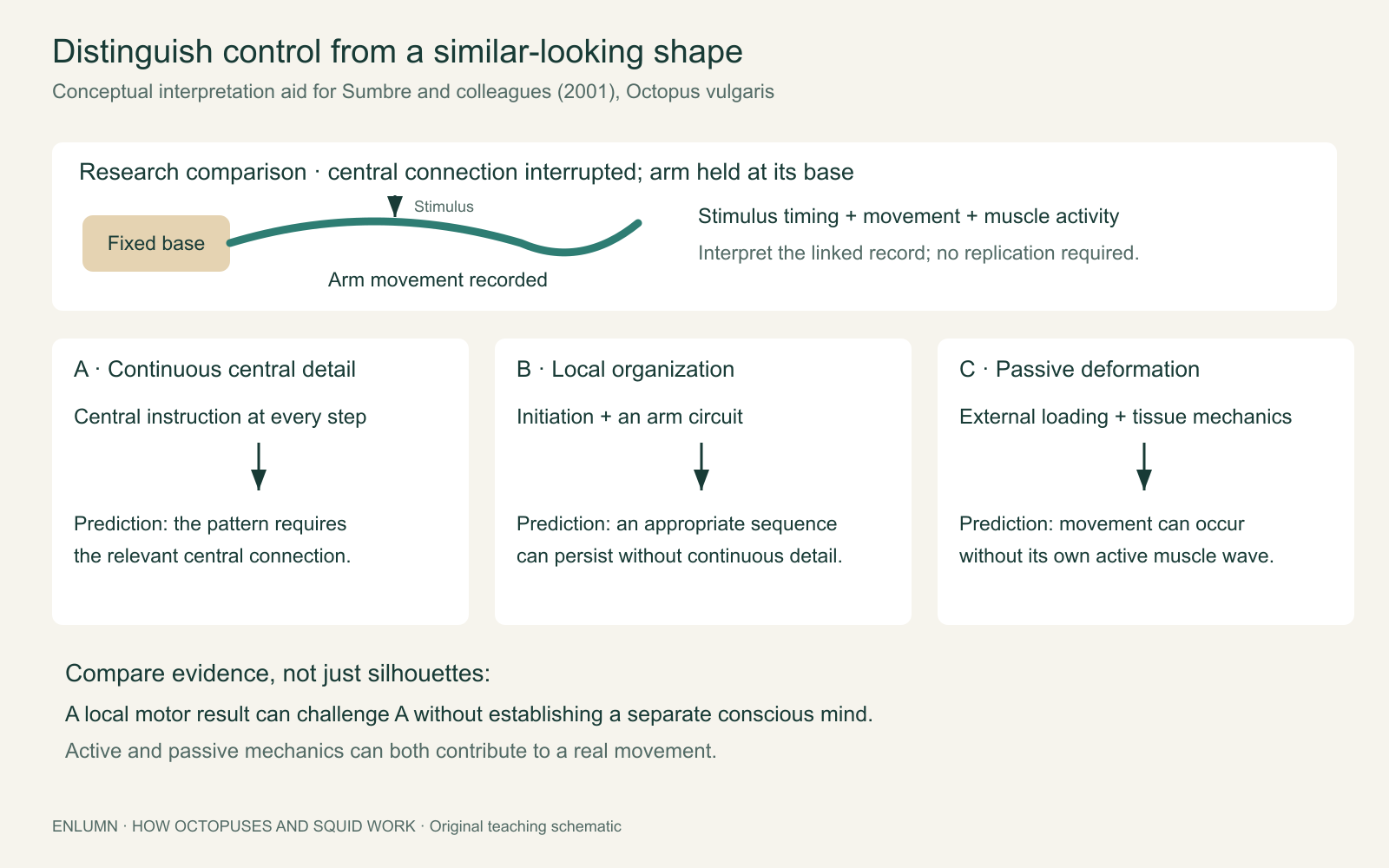
Open Figure 1D and 1E on the paper's printed page 1846, the third PDF page. Both sequences show a bend progressing toward the arm's distal end. Their timestamps differ, so matching rows are not equal-time measurements. Figure 1C adds timing information about stimulation and movement; photographs alone would not supply that relationship.
Now formulate two explanations in your own words. One says that the observed shape change is simply passive deformation. Another says that organized muscular activity contributes to the propagating movement. Ask which measurement would separate them. Electrical activity in muscle can support the second account, but its timing relative to the movement matters. A signal measured long before or after an event would be a weaker connection.
A second pair of explanations concerns control location. One demands continuous detailed input from the central structures for that movement. Another permits a local circuit to organize the sequence once activated. If a preparation lacking that connection generates an appropriate sequence, the first claim needs revision. That inference does not show that an intact animal never uses central feedback or that every movement follows the same rule.
Notice the asymmetry. Demonstrating that a preparation can generate one movement is enough to challenge a claim that it cannot. It is not enough to establish everything the preparation can do. Evidence for a capacity under particular conditions supports a bounded conclusion, while claims of universality require broader investigation.
Learning changes the question
Learning is an experience-dependent change in behavior or its underlying organization. A flexible response is not automatically learned during the observed episode; it may depend on existing circuitry and current inputs. Conversely, a learned response can look simple. The distinction concerns the contribution of experience, not how impressive the movement appears to a viewer.
In a 2011 study, Gutnick and colleagues used a three-choice task requiring Octopus vulgaris to guide an arm toward a visually marked compartment. The reported success connected visual information with arm control in a goal-directed task. The authors' publicly available paper provides a counterexample to treating peripheral control as an inability to integrate information centrally. It does not prove that every unfamiliar problem is solved by insight.
Here is a separate invented learning record. Across three blocks of twelve trials, correct first choices rise from four to seven to nine. That pattern is consistent with improvement, but it is not sufficient by itself to identify the learned cue. Perhaps a target stayed in one position, an experimenter supplied an unintended signal or familiarity with the apparatus improved performance independently of the intended association.
Move the target while preserving its visual feature and you can test a position-based explanation. Alter irrelevant handling cues and you can investigate inadvertent guidance. Include an appropriate comparison group or baseline to distinguish exposure from the particular training contingency. These are possible design improvements, not claims about uninspected details of the published study.
A good report also distinguishes first choice from eventual success. An animal allowed to search every compartment may eventually find the goal without selecting it accurately at the start. Time to completion, errors and route can reveal different aspects of performance. Changing the scoring rule after viewing the results risks turning almost any behavior into success.
Retention and transfer are different tests. Repeating the same task after a delay asks whether performance persists. Applying the learned relation to a changed setting asks how broadly it generalizes. An animal can succeed at one and fail at the other. A report should name which was tested instead of treating a successful immediate repeat as evidence for both long memory and general problem solving.
What does the task leave open?
Evidence for learning, sensory integration and local motor organization matters. None should be dismissed because it lacks a human form. But these findings answer functional questions more directly than they answer questions about subjective experience. A claim about consciousness requires a broader argument and converging evidence; a count of neurons or a single task is not a shortcut.
This does not mean that uncertainty makes the animal's experience irrelevant. It means that explanations should identify their evidential basis honestly. We can say a preparation generated a movement, an animal learned a discrimination or a receptor responded to a compound without claiming either complete access to the animal's mind or proof that no experience exists.
The strongest habit is to replace a broad adjective with a testable sentence. Instead of “the arm is intelligent,” specify the information available and the action organized locally. Instead of “the octopus understands the maze,” describe the choices, transfer tests and alternatives excluded. Instead of “it acts just like us,” identify the particular similarity and the anatomical differences that remain.
That precision makes the subject more interesting. A central system interacting with flexible, sensory-rich arms presents genuine problems of coordination. Understanding part of the solution does not reduce its significance. It reveals where the next question lies: how local activity, central signals, body mechanics and experience combine during an intact animal's ordinary life.
Check your understanding: A centrally disconnected arm preparation produces a coordinated movement. What claim does this challenge, and what claim does it fail to establish?
Expected answer: It challenges the claim that continuous detailed central input is necessary for that movement under those conditions. It does not establish an independent conscious mind in the arm, complete autonomy in ordinary behavior or the same organization for every movement and species.
Application
Use the supplied link to Figure 1D–E of Sumbre and colleagues, printed page 1846. Annotate the sequence in your own sketch: identify the moving bend, the part of the arm left extended and the unequal timestamp intervals. Do not reproduce the published images as your own work.
Write 200 words comparing a passive-deformation explanation with an active-movement explanation, then identify the additional evidence the paper uses. Keep this annotation for the final task. Allow 15–20 minutes. A satisfactory answer distinguishes a visible sequence from a measurement of muscle activity and a claim about where control is organized.