The self in interaction
At a fictional project meeting, Eli proposes changing a deadline. His manager pauses, glances at the schedule, and asks whether the team can discuss it afterward. Eli hears a public rebuke. A colleague hears a sensible attempt to finish the agenda. The manager thinks she has protected Eli from having to explain a personal difficulty in front of everyone. Later, Eli withdraws his proposal and apologizes. The manager is surprised. A short exchange has altered what each thinks the other thinks, although nobody explicitly announced those judgments.
This chapter asks how such exchanges help constitute a sense of self. It does not promise a technique for decoding hidden motives. Instead, it separates the action that occurred, the meanings participants attach to it, and the evidence available to an observer. We will follow the meeting through several possible continuations and use two primary theoretical passages to make the puzzle more exact.
Seeing oneself through an imagined audience
Charles Horton Cooley's 1902 discussion of the looking-glass self emphasizes “the imagined judgment, which is quite essential.” His account connects imagining how one appears to someone else, imagining that person's judgment, and experiencing a corresponding feeling about oneself. The other person's identity matters: approval from one audience may carry a different significance from approval by another. The passage concerns an interpreted social reflection, not a literal mirror giving objective access to other minds. Selected primary passage.
Apply this carefully to Eli. The observable event is a pause followed by a request to postpone discussion. Eli imagines himself appearing unprepared, attributes that judgment to the manager, and feels embarrassed. That sequence is one possible explanation of his response. It does not establish that the manager judged him unprepared. Indeed, the fictional scene stipulates a different intention. The self-feeling can be consequential even when the attributed judgment is mistaken.
An audience also has unequal weight. Eli might shrug off the same response from a stranger but dwell on it from someone who evaluates his work. The significance could arise from respect, affection, dependence or fear of a consequence. We should distinguish these relationships rather than use “social approval” as one undifferentiated reward. Wanting a friend's understanding and anticipating a supervisor's evaluation can produce similar caution through different pathways.
There is an important limit. Not every feeling about oneself must be reconstructed as an immediate response to an audience. A person can act from an established commitment, bodily state or private memory. The theory directs attention to a social process that may be operating; it does not license inventing an audience behind every emotion. Its value here is that it reveals a gap between another person's action and the judgment Eli attributes to it.
Taking roles is more than copying people
In section 20 of Mind, Self and Society, George Herbert Mead uses play and organized games to discuss taking others' attitudes. Participation in a game requires attention to connected positions and expectations, rather than imitation of one person at a time. His “generalized other” names an organized social standpoint that a participant can bring to their own conduct. This historical text supplies a conceptual comparison, not a universal timetable for children's development. Primary section, available through indexed text.
For an original example, imagine organizing a small relay. A runner must know more than the motion of running. The runner anticipates a teammate's approach, a handover zone, the next runner's departure and an official's judgment. Coordination depends on an organized activity. Even if nobody is watching a practice handover, the runner can evaluate it against the shared requirements. The standard is carried into the act, not supplied only by a visible observer afterward.
At the meeting, Eli may similarly ask what a responsible team member is expected to do. The answer can include reporting a problem early, respecting colleagues' time and avoiding promises the group cannot keep. These expectations may conflict in the same moment. The organized standpoint is therefore not necessarily a perfectly coherent voice. Nor does calling it shared mean that every colleague endorses every expectation equally.
Role-taking also differs from accurate prediction. Eli can attempt to consider the manager's perspective and still get it wrong. He may know the agenda pressure but not her wish to protect his privacy. The skill is an effort to interpret relations, not telepathy. A useful test asks what information the participant had and which expectations that information made plausible. Otherwise the analyst judges people using knowledge they could not possess.
A role network around one person
Eli is simultaneously a colleague, an employee, a friend to one teammate, and a caregiver outside work. Each relation supplies possible expectations. A manager wants reliable delivery; a colleague wants timely warning; a friend may expect personal candor; a relative needs Eli at a particular hour. These are stipulated demands in our example, not claims about all managers, friends or families.
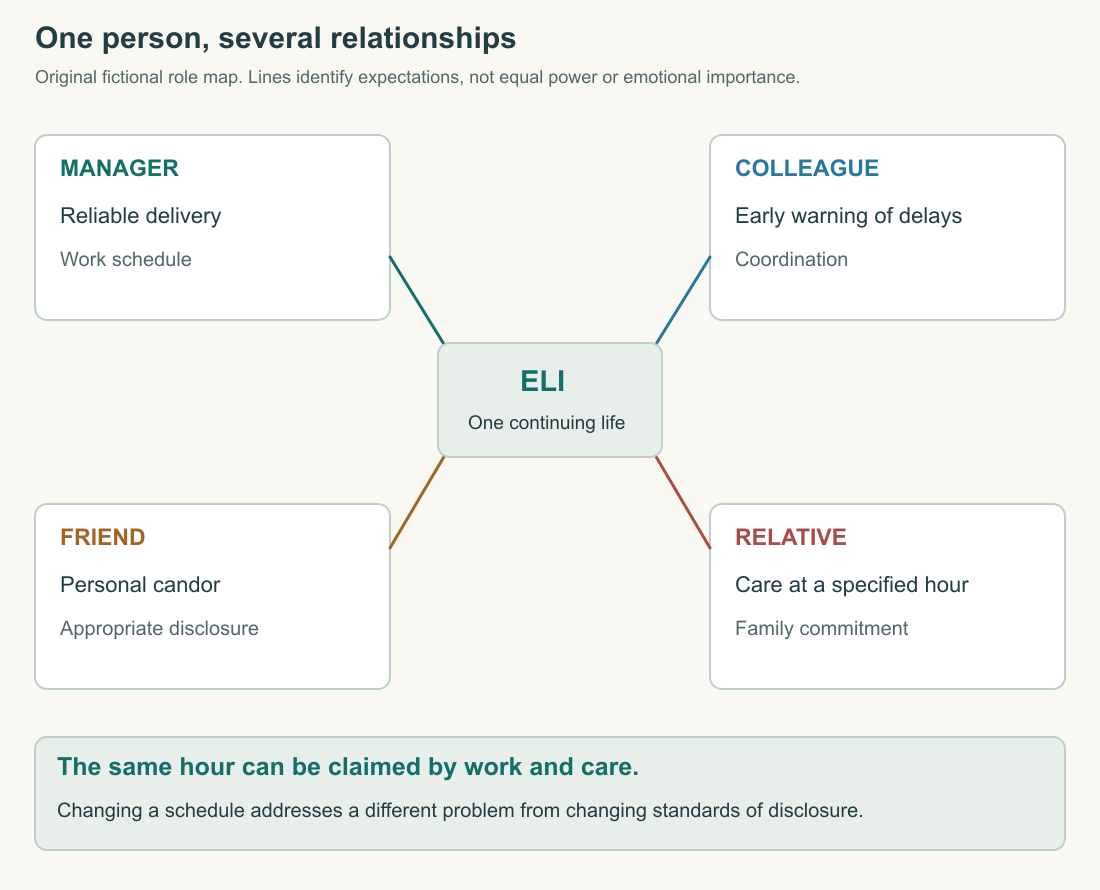
A role is an organized set of expectations connected with a position or relationship. The diagram makes an important distinction visible: one person does not have only one social position. A conflict between work and caregiving can be a conflict between roles. Tension between speed and careful review within the same job can arise among expectations attached to one role. Naming the distinction helps identify which arrangement could change.
For example, moving a meeting may resolve the competing appointments while leaving the speed–quality tension untouched. Providing a review checklist may help the second problem without freeing the needed hour. The distinction earns its place by separating two problems that demand different responses.
It would be a mistake to infer that the person has a separate authentic self for every connection. A person can understand several commitments as belonging to one continuing life. The difficulty is often practical: incompatible schedules, different standards of disclosure, or a request that makes one obligation visible to another audience. Explaining the tension requires both the person's account and the organization of the demands.
The map is also incomplete by design. It omits differences in power, emotional importance and access to alternatives. Four lines do not make four relationships equally consequential. A useful next version would annotate who can impose a penalty, who can negotiate, and which demands are flexible. A network picture becomes explanatory only when its connections have a defined meaning.
Presentation without assuming deception
Eli chooses his words differently in the meeting than in a conversation with a friend. That difference is a form of presentation: he shapes what becomes available to an audience. It need not be dishonest. Explaining a scheduling problem briefly to a team and emotionally to a friend can be appropriate to different activities. Truthfulness does not require telling every person everything in the same manner.
Presentation becomes more interesting when several audiences overlap. A friend in the meeting knows the personal background but the rest of the team does not. A sympathetic remark could unintentionally disclose it. Eli now manages both the schedule issue and the boundary around private information. His hesitation may arise from this coordination problem rather than from uncertainty about the deadline itself.
Written communication changes what an audience can inspect. A short message preserves words but may omit tone, timing and the surrounding exchange. Forwarding it introduces readers for whom the original context is unavailable. This is a general possibility of records and audience movement, not a claim about a particular platform. The same sentence can acquire a different interpretation because the conditions of reception change.
The serious objection to analyzing presentation is that it can become cynical. If every considerate act is redescribed as image management, sincerity disappears by definition. Avoid that trap by separating the visibility of an act from its motive. An act can express a real commitment and also communicate that commitment to others. Evidence of careful presentation does not by itself establish manipulation, just as an unpolished presentation does not guarantee honesty.
An encounter unfolds in a sequence
Return to the manager's request to talk afterward. Its meaning depends partly on what preceded it. If Eli has just raised a confidential concern, postponement may protect him. If several colleagues received public discussion of comparable requests, postponing only his could appear dismissive. If the manager has announced that every schedule issue will be handled after the meeting, the same response fits an established procedure. The words alone underdetermine the interpretation.
The next turn matters too. Eli might say, “I can explain the delivery impact now without discussing the personal details.” That response clarifies what he is asking the group to consider. The manager might acknowledge the distinction and allow a brief discussion. Alternatively, she might repeat the postponement without explanation. Each continuation supplies new evidence and creates new conditions for the exchange.
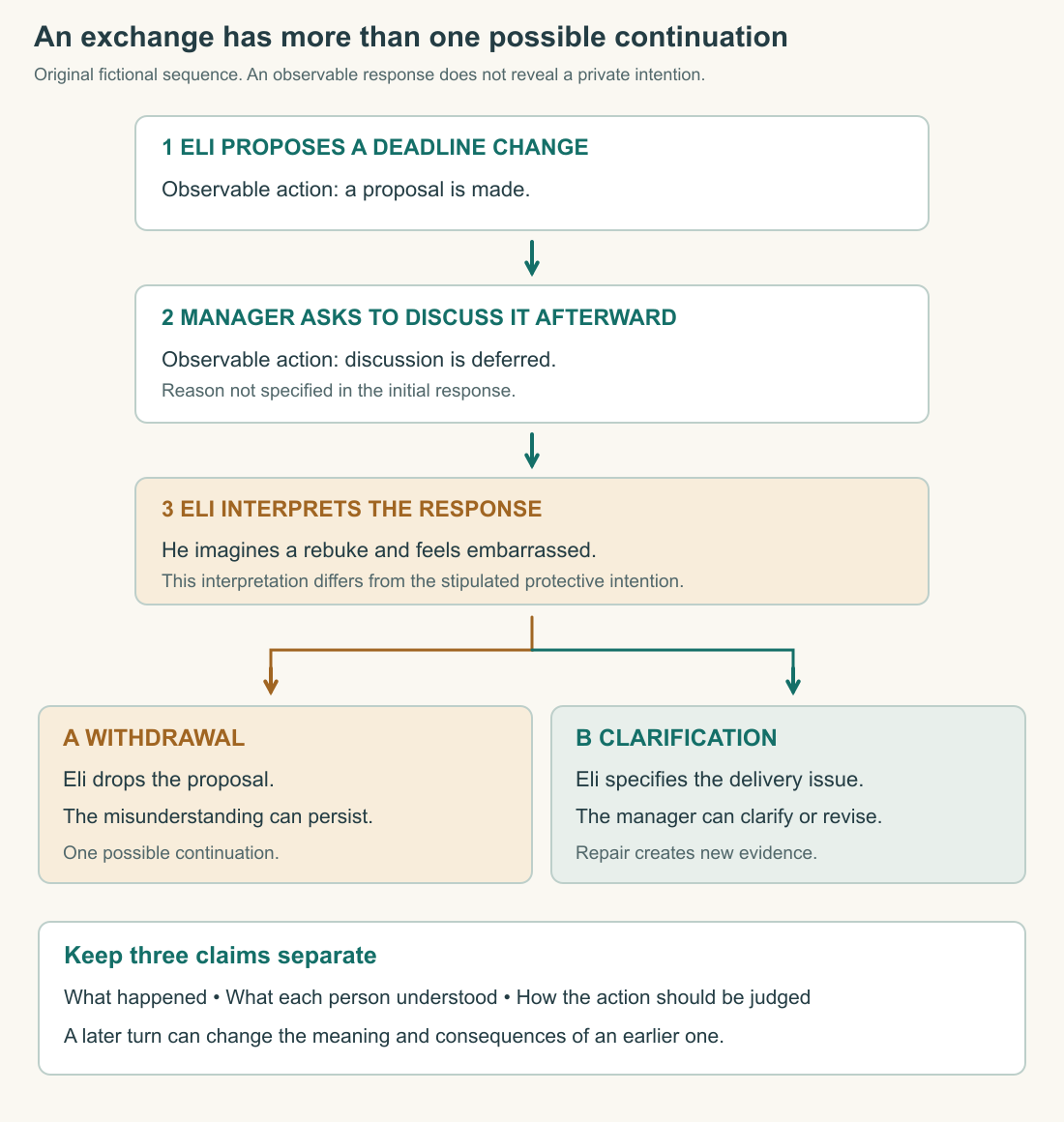
Repair is the work of addressing a trouble in understanding or coordination. In this example, a clarification can repair the mismatch between Eli's request and the manager's interpretation. Repair may concern a factual detail, the intended action, or the relationship implied by it. “I meant the delivery impact” repairs a different problem from “I wasn't questioning your commitment.” The first specifies the issue; the second addresses an attributed judgment.
Repair has costs. Asking for clarification can delay a meeting or expose uncertainty. A junior participant may anticipate being judged for pursuing the point. A manager can reduce that cost by explaining the reason for postponement or inviting correction. The sequence therefore cannot be understood solely as two minds exchanging information. Authority and local expectations affect which repairs feel available and what risks accompany them.
What an observer may legitimately say
Suppose a researcher has only a written record: proposal, pause, postponement, apology. The record supports a description of those actions. It does not independently establish embarrassment, protective intention or hostility. Those states require additional evidence, such as participants' accounts, surrounding conduct or a repeated pattern. Even interviews may disagree because participants experienced different aspects of the exchange.
A careful account can preserve that disagreement. It might say that Eli described the request as a rebuke, while the manager described it as protection of privacy. The analyst can then examine whether the sequence made both interpretations plausible. This is more informative than choosing one account simply because one participant has greater authority or because the other seems more sympathetic.
Nor must disagreement end analysis. If comparable proposals by others were routinely heard and Eli's were consistently deferred, that pattern would bear on an explanation of unequal treatment. If every confidential scheduling issue received the same procedure, that would support another account. Neither comparison alone reveals every motive, but evidence can still distinguish explanations. Respecting interpretive complexity does not require treating all claims as equally supported.
Keep three statements apart: the manager postponed discussion; Eli interpreted postponement as criticism; postponement was unjust. The first describes an event, the second attributes a meaning, and the third makes an evaluative judgment. The third can be argued, but it needs a stated standard and relevant circumstances. Sliding between them makes an interpretation look like a fact and a preference look like an inevitable conclusion.
From one encounter to a durable identity
An isolated misunderstanding may be quickly repaired. Repeated experiences can become a pattern through which a person anticipates future interaction. If Eli repeatedly expects his contributions to be unwelcome, he may speak less. Colleagues then have fewer opportunities to hear his ideas and may interpret his silence as lack of interest. This is an original possible feedback sequence, not a diagnosis of Eli or a universal effect of embarrassment.
The sequence includes points where it can change. A colleague asks for Eli's view; a manager explains the procedure; Eli tests his expectation with a low-risk clarification; the group changes how proposals are collected. Each change targets a different link. Simply telling Eli to be more confident targets the person while leaving the pattern of response unexamined. Simply blaming the institution may overlook a misunderstanding that a specific repair could resolve.
To test the proposed feedback, we would need evidence across occasions. Did reduced participation follow the discouraging exchanges? Do colleagues actually interpret silence as disinterest? Does a changed procedure alter participation? The questions prevent a compelling story from masquerading as an established mechanism. They also turn identity into a process with a history rather than an adjective attached to a person.
The self in interaction is therefore neither a private object untouched by others nor a passive copy of their opinions. People interpret an audience, bring learned standards to their conduct, manage disclosure and respond to consequences. Other people interpret those actions in turn. The meeting's small misunderstanding matters because a sense of who one can be in a setting is continually supported, challenged and sometimes revised through such exchanges.
Application
Write two 150-word accounts of the meeting: one from Eli's available information and one from the manager's. Underline every sentence that requires access to a private intention. Then write a neutral description using only observable actions. Propose one clarification that addresses the scheduling issue while leaving personal details private.
Check your understanding: Does Eli's embarrassment prove that the manager judged him incompetent, and does his careful wording prove that he is being deceptive?
Expected answer: Neither follows. Embarrassment may respond to an imagined judgment that differs from the manager's intention. Careful wording shapes presentation but can serve truthful, appropriate disclosure. Additional evidence is needed to distinguish interpretations and motives.