An ordinary scene, a different question
At nine on a Saturday morning, twelve people wait outside the registration desk of a fictional neighborhood learning center in San Francisco. Two employees sit behind the counter. A handwritten notice points toward one line. A newcomer pauses at the entrance, looks toward the desk, and joins the people waiting. A few minutes later, someone walks past the line. An employee waves that person forward. One waiting visitor frowns; another says nothing.
This is an invented scene for the course, not a report about an actual center. It contains enough detail to begin an investigation, but far too little to finish one. Perhaps someone has received special treatment. Perhaps they are returning with a document an employee requested. Perhaps there are two service categories and the sign does not explain them. Before deciding, notice how much interpretation has already entered an apparently simple description.
Describe before deciding what it means
“A person walked past the line” reports a visible movement in our supplied scene. “A person cut the line” adds a claim about the order they were entitled to occupy. “An entitled person ignored everyone else” adds a motive and a character judgment. The sentences may eventually turn out to describe the same event, but they do not rest on the same evidence.
Separate your notes into three columns: what happened, what you think it meant, and what would help you tell. In the first column, place the movement and the employee's wave. In the second, place preferential treatment, a return visit, and a separate service category. In the third, place the registration procedure and the sequence of the person's earlier interactions. A frown belongs in the first column; its meaning still needs investigation.
This discipline does not require pretending that people have no intentions. It helps us avoid filling the unseen parts of an encounter with the first story that occurs to us. The waiting visitor might be angry about the queue, concentrating on a form, or reacting to something outside the observer's attention. An expression does not carry a complete explanation on its surface.
Nor does the presence of several possible stories make them equally well supported. The employee's invitation is evidence that the movement was recognized by someone at the counter. It weakens a story in which the visitor simply went unnoticed. It does not establish why the invitation occurred or whether the arrangement was fair. Evidence can narrow an interpretation without settling every part of it.
The line is something people accomplish
Imagine replacing everyone waiting with twelve different people while retaining the desk, the notice, and the same registration procedure. Would a line form again? Our scene cannot answer empirically, but the question changes the object of investigation. We are asking about an arrangement that could persist despite a change in its participants.
The queue is not merely twelve bodies near one another. Its participants orient themselves to an order: who arrived earlier, where the end is, what counts as leaving, and who may be called forward. These are proposed features of our model, to be checked in an actual study. Two groups can occupy the same physical shape while recognizing different orders of service.
Consider an assigned contrast. At another counter, visitors take numbered tickets and sit wherever they wish. The room contains no standing line, yet service follows an order. At a third counter, people gather closely while an employee calls appointment names. A photograph of body positions would not reveal which system operated. Spatial appearance and social organization are related questions, not identical ones.
The comparison makes ordinary competence interesting. A familiar visitor may know where to stand without asking. A newcomer may need instructions. Employees may repair ambiguity by pointing, calling a name, or explaining an exception. What looks effortless can depend on learned expectations and repeated small acts of coordination.
A classic question about constraint
In his 1895 account of social facts, Émile Durkheim directed attention to practices and obligations that a particular person did not invent and cannot freely alter alone. Their constraint may become especially noticeable when someone resists them. He was arguing for sociology as a distinct field of inquiry, not describing our learning center. Durkheim: What is a Social Fact?.
His argument gives us a question to ask of the scene: what happens if a participant disregards the recognized order? A correction, refusal of service, or disapproving comment could reveal an expectation. But we have not observed those events. They remain possible evidence, not facts we can insert into the story because a theory predicts them.
The absence of an explicit reprimand would also need interpretation. People might agree that the exception was legitimate, avoid confrontation, fail to notice it, or lack influence over the desk. An orderly appearance cannot establish universal agreement. Durkheim's question helps locate a phenomenon; it does not license us to infer every participant's beliefs from silence.
Keep one qualification close to the concept. An arrangement can constrain a person without determining everything they do. Visitors can ask questions, negotiate, leave, complain, or help another newcomer understand the procedure. Which possibilities are practical, costly, or effective is part of the investigation. “There is a rule” and “nobody has any choices” are very different claims.
Change the level of the question
Sociology studies interactions and larger social patterns. A micro-level question might concern how two people recognize a turn in conversation; a macro-level question might concern a pattern across large populations or institutions. These labels describe the scale of the inquiry, not a ranking of which experiences matter. OpenStax: What is Sociology?.
For our case, distinguish three working levels. At the interaction level, ask how an employee's gesture gets interpreted. At the organizational level, ask who designed the appointment procedure and how staff apply it. At the wider institutional level, ask how funding arrangements, work schedules, or educational requirements affect access to the classes offered. Each question identifies a relationship to investigate.
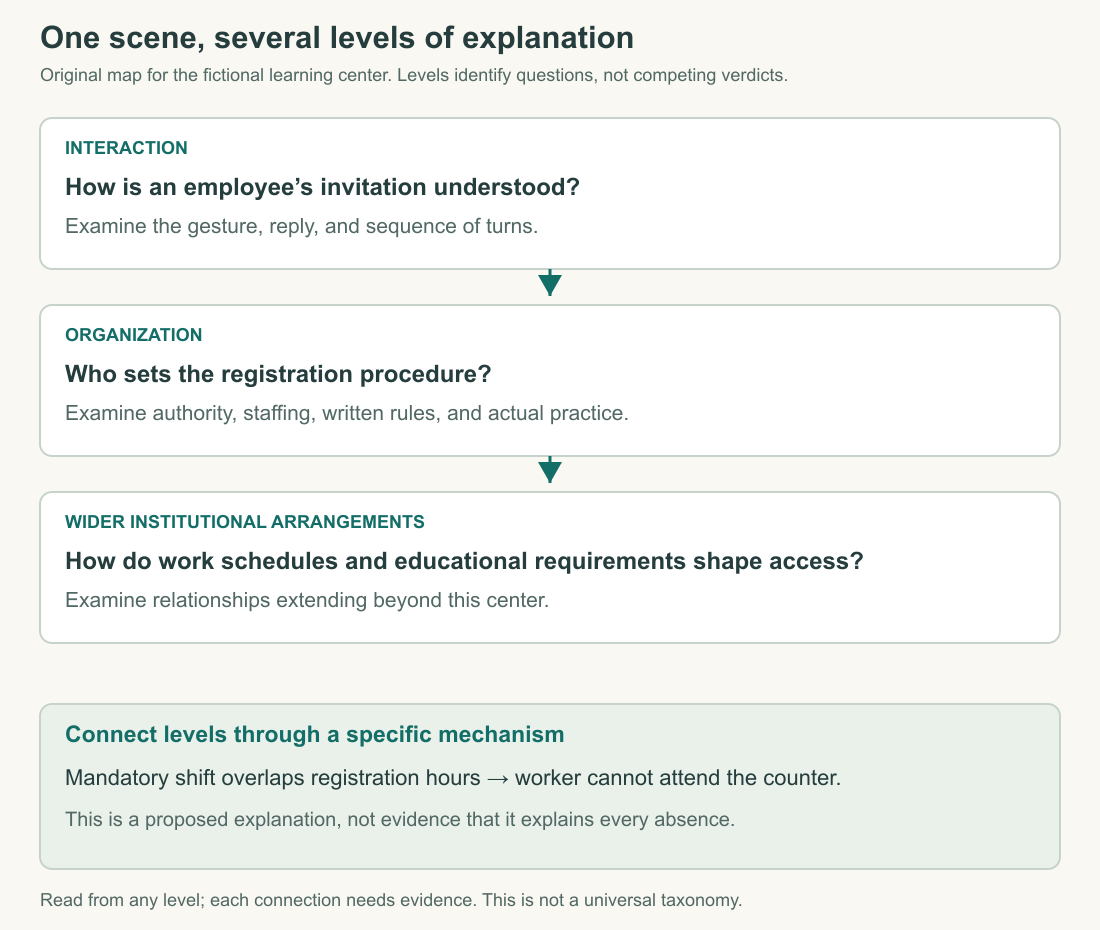
A useful explanation connects levels through specific steps. Suppose, by assignment, the center registers visitors only during hours when a nearby employer schedules mandatory shifts. A worker who cannot leave that shift misses registration. The explanation runs through two organizations' schedules and the person's available actions. Saying “society prevented attendance” leaves out the mechanism; saying “the worker chose not to enroll” leaves out a relevant constraint.
This example does not show that schedules explain every absence. Another person might decline a course because its subject does not interest them. The question is which explanation fits which case and which recurring pattern. Individual motives and organizational arrangements need not compete for exclusive ownership of the explanation.
Biography belongs in a historical setting
C. Wright Mills's 1959 discussion of the sociological imagination connected individual lives to historical circumstances. He distinguished troubles experienced within someone's immediate situation from public issues involving wider institutional arrangements. The point was to examine their relationship rather than treating biography as detached from history. Mills: The Promise.
Apply that question to an invented change at our center. Last year, a person registered at the desk; this year, the center requires an online booking before a visit. The person's interests and persistence may be unchanged, but the steps necessary to obtain a place differ. An explanation of this year's difficulty should examine the changed procedure as well as the individual's experience.
Now widen the proposed investigation. Did other visitors encounter the same obstacle? Which alternatives existed? Did the new procedure reduce waiting for some people while creating another burden for others? These questions move from a biography to a patterned distribution of experiences. We have not yet established that the change produced any particular result; we have identified where evidence would matter.
A widespread difficulty does not automatically have one common cause, and a rare difficulty can still arise from an institutional rule. The number affected is relevant but cannot replace tracing the process. Mills offers a reason to connect personal accounts and wider arrangements; research must establish the connection in the case at hand.
Define the pattern you want to explain
Suppose two assigned mornings each include twelve registration attempts. On the first, nine people complete registration. On the second, six do. The completion proportions are 75 and 50 percent. That is a clearly defined difference in the supplied record, though it tells us nothing yet about why the difference occurred.
Now alter the denominators. Suppose the second morning includes twenty-four attempts and twelve completions. It has more completions than the first morning but a lower completion proportion. “The center registered more people” and “a smaller share of attempts succeeded” can both be true. Choosing a quantity is part of defining the question, not an administrative detail after the interesting work is over.
The unit matters too. Are we counting people, visits, attempted bookings, or completed registrations? One person may make several attempts. A visit might concern two courses. If the research question concerns access for people, a count of transactions may fail to answer it. Before calculating anything, write down what one row of your proposed record represents.
Even “waiting” needs a boundary. Time from joining the physical line to reaching the counter differs from time spent obtaining an appointment beforehand. An online system could shorten visible queues while leaving the total time burden unchanged or shifting it elsewhere. This is a possibility to investigate, not an empirical conclusion about online booking in general.
A familiar setting is not the whole population
Someone who visits the center on Saturday morning sees the people present then. They do not see those who tried another day, could not obtain an appointment, gave up beforehand, or had no interest in enrolling. A vivid scene can generate a question without providing a representative answer.
Real social research often needs a deliberate way to reach beyond a convenient encounter. The General Social Survey, conducted in the United States since 1972, gathers information about social characteristics, attitudes, and behaviors using a documented survey design. Its existence illustrates a different evidential task from narrating one room: defining and studying a population through organized data collection. NORC: about the GSS.
The survey's reputation does not make it evidence for any claim we choose. We would still need to inspect the actual question, population, year, and method before using a result. A survey answer about a person's attitude is not automatically an observation of what that person did at a registration desk. Later chapters will make these method choices concrete.
For now, practice stating the boundary of a claim. “In the supplied twelve-attempt record, nine attempts ended in registration” is supported by the assignment. “Three-quarters of San Franciscans can access adult education” is not. The second sentence changes the population, setting, outcome, and evidential reach while retaining the convenient number.
Explanation and judgment ask different questions
Return to the visitor waved forward. Suppose later information establishes that the person had an appointment. That finding could explain why the employee called them. It does not by itself establish whether appointment holders should have priority, how appointments should be allocated, or whether the system serves the center's purposes fairly.
These are not reasons to avoid questions of value. They are reasons to state them clearly. A claim about what the procedure does needs evidence about the procedure and its consequences. A judgment about what it ought to do also needs a stated standard: equal waiting time, priority by need, predictability, accessibility, or another defensible goal. Different standards can recommend different arrangements.
You can investigate whether a policy advances a chosen goal without pretending that the goal appeared automatically in the data. Likewise, you can criticize a policy while remaining careful about its actual effects. A mistaken description weakens a moral argument rather than making it more forceful.
Leave with a question that could change your mind
“Why are people so inconsiderate?” assumes the motive it claims to investigate. “Why is society unfair?” names a concern but leaves the setting, outcome, and mechanism unresolved. A more workable question is: under what circumstances do staff call visitors ahead of the physical line, and how do waiting visitors understand those calls?
That question identifies an event, a setting, two perspectives, and evidence that could bear on the explanation. It permits several answers, including a result that contradicts your first impression. You might discover a clearly communicated procedure, an ambiguous practice, inconsistent decisions, or several distinct processes that originally looked alike.
The ordinary scene has become more interesting because it now contains investigable relationships. You have not made the people less individual or the setting more mysterious. You have learned to ask how their actions fit together, what arrangements they encounter, and which observations would justify a claim. The next chapter gives us a more precise vocabulary for those arrangements: norms, roles, organizations, and institutions.
Application
Use the supplied learning-center scene; no observation of actual visitors is required. Produce a short investigation note with four parts.
- Write three statements describing only supplied events. Then write two interpretations and identify what additional evidence could distinguish them.
- Form one interaction-level question and one organizational question. Connect them through a specific proposed mechanism rather than the phrase “social forces.”
- In an assigned record, Monday has 8 completions from 10 attempts and Tuesday has 12 from 20. Compare counts and proportions. State why these records do not establish a change in residents' overall access to education.
- Rewrite “People who dislike waiting should just book ahead” as an empirical question and a separate value judgment. Do not assume that appointments are equally available or equally practical for everyone.
Model interpretation: The person's movement, employee's wave, and another visitor's frown are supplied events. Appointment priority and a return visit are interpretations requiring procedural or sequence information. An interaction question might ask how the employee signals an authorized exception; an organizational question might ask which exceptions staff are instructed to recognize. A communicated rule could connect them, but its existence must be established.
Monday's completion proportion is 80 percent and Tuesday's 60, despite Tuesday having four more completions. We do not know whether attempts represent distinct people, why attempts failed, or who never attempted registration. An empirical question could ask how booking availability affects total time spent obtaining registration. A separate judgment could argue that the center ought to provide a workable route for visitors unable to book online, while stating the accessibility standard behind that position.