Information and public belief
A message appears in a neighborhood group: a fictional transit agency is about to cancel every evening bus. Several people forward it. An angry comment receives hundreds of reactions. By the next morning, someone says that the message has changed public opinion. But what exactly happened? People encountered a claim, some expressed a response, and others may have changed a belief. These are separate events.
The message might be false, partly accurate or an exaggerated interpretation of a real proposal. Its popularity cannot settle that question. Nor can a count of reactions show how many people believed it, how strongly they believed it or whether it changed their conduct. A useful analysis follows the steps between information becoming available and an observable consequence.
This chapter examines that chain. It treats readers as people situated in networks and institutions, with limited attention and different reasons for relying on sources. It also examines an actual experiment on media-literacy tips, then asks what the study can establish about belief and what remains outside its design.
Separate the stages
Begin with availability: the message exists somewhere a person could access it. Next comes exposure: the person actually encounters it. Attention means that some of the content is processed. Interpretation concerns what the person understands it to say. Belief concerns whether the person accepts the claim, perhaps with uncertainty. Behavior concerns what the person does afterward.
These stages can diverge. A person may scroll past the message without reading it, notice the headline while missing a correction, or understand it and reject it. Someone may believe the cancellation is possible and still take no action because it would not affect their route. Someone else may forward the message precisely to ask whether it is true.
An original numerical example illustrates the problem. Suppose a platform records 1,000 displays, but some people see the message repeatedly. There may be only 600 distinct accounts exposed. If 120 accounts open it and 30 forward it, neither 1,000 nor 30 is a count of believers. Even the opening count is an imperfect measure of attention, because opening a page does not establish careful reading.
The outcome should therefore be defined before an explanation is proposed. A study of forwarding behavior needs different evidence from a study of factual belief. A study of route usage needs evidence about travel, alternatives and service conditions. Calling each outcome “influence” without specifying it makes incompatible results appear to answer the same question.
Selection can resemble persuasion
Imagine that people who read the fictional cancellation message are more likely to oppose the agency than people who did not. One possibility is that the message caused opposition. Another is that existing critics were more likely to join the group, notice the message and share it. A third is that a real service problem caused both information seeking and dissatisfaction.
This is selection: people do not encounter all information at random. Their interests, relationships and circumstances influence what reaches them. A comparison of exposed and unexposed people can therefore mix an information effect with differences that existed before exposure. Knowing the exposure came first in the recorded sequence does not remove every earlier cause.
A before-and-after survey helps establish whether an individual's answer changed, but it still may not isolate why. During the same period, the agency could alter its timetable, a newspaper could publish an investigation or a rider could miss an important appointment. A comparison group helps only when it offers a credible account of what would have happened without the message.
Random assignment can improve that comparison for a specific intervention. If otherwise comparable study participants are randomly shown different information, their later average responses can be compared under the study's assumptions. This does not make the sample representative of everyone or guarantee that an artificial exposure matches ordinary life. Internal comparison and broader generalization are distinct achievements.
Networks shape what arrives
A network describes relationships among units such as people or organizations. For this chapter, a link means an opportunity for a message to pass between two people. It does not necessarily mean friendship, agreement or equal attention. The same pair may communicate about transport while never discussing other matters.
Consider an original network of two groups, each with four people. Within each group, everyone can contact everyone else. Only one person in each group connects across the boundary. A message can circulate repeatedly inside one group before crossing to the other. The bridging relationship matters for reach, while internal ties may matter for repeated confirmation and coordination.
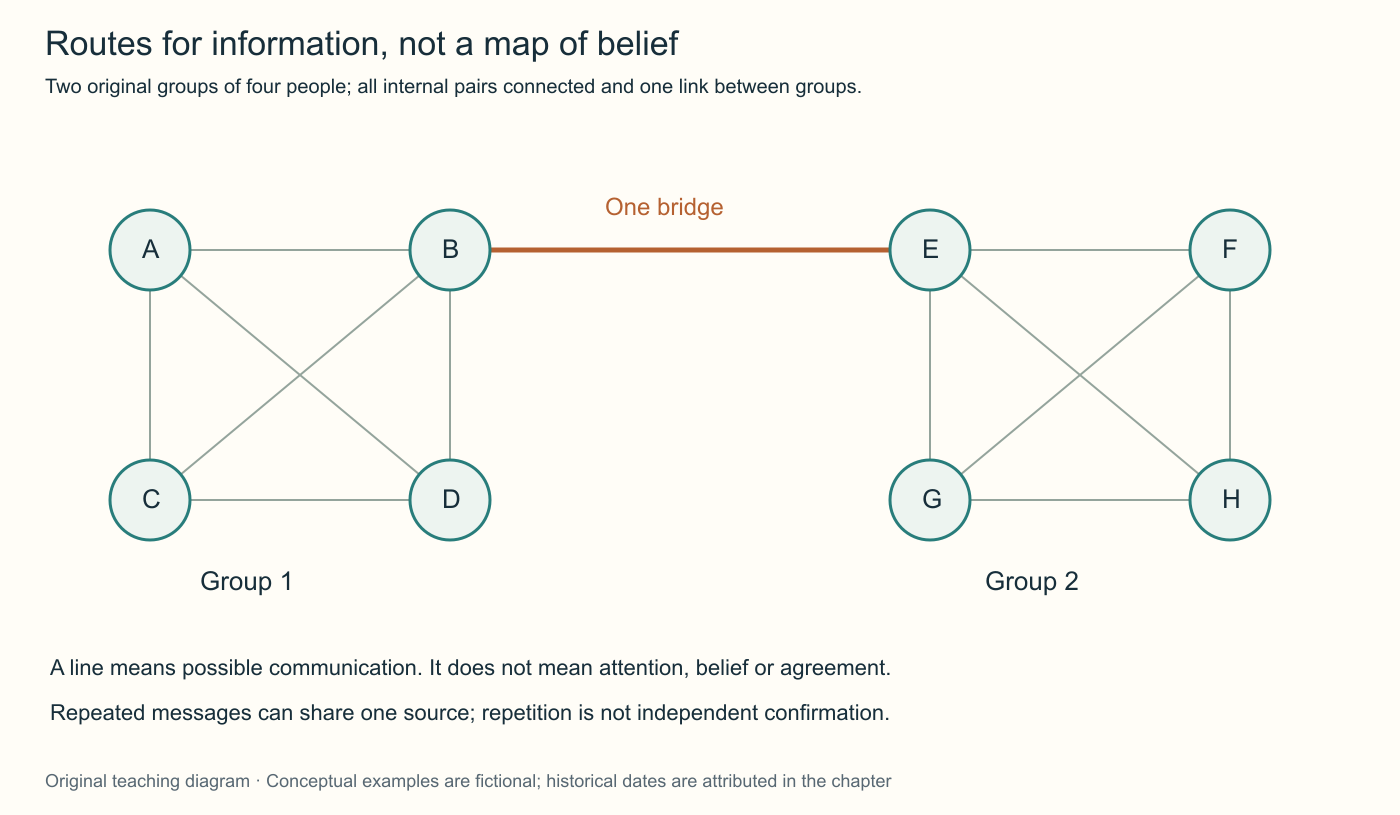
Original network. Lines indicate possible communication, not observed influence. Removing the bridge separates these groups in this simplified model; real people may have unmeasured outside connections.
Repeated messages are not necessarily independent evidence. If five acquaintances all repeat a claim copied from one unverified post, there are five social encounters but possibly only one underlying source. The experience can feel like broad corroboration while the evidential basis has not grown. Tracing provenance asks where a claim originated and whether later reports add independent support.
The same structure can transmit a correction or useful practical information. Dense relationships are not inherently deceptive, and bridging relationships are not inherently truthful. Network structure concerns routes and dependencies; the quality of the content requires separate evaluation. Combining the two questions helps explain why a well-supported correction may have limited reach or why a weak claim may circulate efficiently.
Institutions organize credibility and attention
A source's credibility can depend on expertise, past accuracy, transparency and accountability. It can also depend on a reader's relationship to the source and expectations about its motives. A technically correct announcement from an agency with a history of unclear communication may not be received in the same way as the same information from a trusted local intermediary.
That does not mean truth is whatever a group accepts. It means that the route by which people judge a claim is itself a social process. An analyst can investigate those routes while still checking whether the claim is supported. Understanding why someone believes a statement does not require endorsing the statement.
Media organizations and platforms also allocate attention. An editor chooses a headline and placement; a platform orders material; a group moderator decides what is permitted. These decisions affect visibility under particular systems. A claim about the effect of a specific ranking system needs evidence about that system, its users and the outcome, rather than a general statement that “the algorithm” controls belief.
The fictional cancellation rumor may reveal an institutional communication failure. Perhaps the original notice used an ambiguous map and gave no clear effective date. Improving individual skepticism could help, but so could publishing a readable notice and maintaining a visible correction history. Information quality depends partly on the organizations producing and circulating it, not solely on the vigilance of each recipient.
What an actual experiment tested
Andrew Guess and colleagues tested brief media-literacy tips in randomized survey experiments reported in 2020. The study included a US online sample in 2018–2019 and separate Hindi-language online and face-to-face samples in India in 2019. Participants were randomly assigned tips before rating headlines. Discernment improved in the online samples initially; the face-to-face study in four Uttar Pradesh constituencies did not show the same effect. These populations and delivery settings were not interchangeable. The primary article reproduced by Cleveland State University describes the design and findings.
The intervention reduced perceived accuracy of mainstream material as well as false material, with a larger reduction for false material in the relevant online comparisons. The 2023 correction fixes wording about the mainstream-news rating categories. The useful finding concerns discrimination between kinds of headlines, not simply greater confidence in established outlets. It does not establish that every form of media education works everywhere.
The distinction can be understood with original numbers. Suppose a fictional comparison group rates accurate headlines at 3 and false headlines at 2 on a four-point scale. Its discernment gap is 1. A treatment group rates them at 2.8 and 1.4, a gap of 1.4. Both kinds receive lower ratings, but the separation increases. An analysis reporting only the false-headline decline would miss the cost in evaluations of accurate material.
A different intervention could lower both ratings by exactly 0.5, leaving the gap unchanged. That would produce greater general skepticism without better discrimination on this measure. A third could raise both ratings equally, creating greater acceptance without greater discernment. The chosen outcome determines what counts as an improvement, so researchers should report enough components to make that judgment visible.
Cross-setting differences also require restraint. If one sample shows an effect and another does not, that alone does not establish a statistically reliable difference between the effects. The samples may differ in precision as well as estimated response. Nor can a difference between online and face-to-face results be assigned entirely to delivery mode when the sampled populations and materials also differ. A useful follow-up would vary delivery within a comparable population, while measuring whether the same content was understood. This turns an intriguing contrast into a more discriminating research question.
Assignment is not mastery
Randomly offering tips does not ensure that everyone reads, understands or remembers them. The effect of assignment therefore answers a different question from the effect among people who fully engage. Comparing diligent participants with less diligent participants can reintroduce selection: attention, prior knowledge and motivation may influence both engagement and later performance.
The clean starting point is usually the contrast created by assignment. Further claims about receipt or mastery require additional assumptions and a definition of engagement that does not simply select people who would have performed well anyway. Passing a comprehension check can provide useful evidence, but it does not turn engagement into a randomly assigned trait.
The same issue appears in a hypothetical civic workshop. If attendees improve more than nonattendees, the workshop may have helped, but attendees may also have been more motivated before it began. Randomly inviting people can estimate the effect of the invitation under suitable conditions. It cannot automatically establish the effect of attendance without considering who accepts and what the invitation itself changes.
Longer-term outcomes pose further questions. A person may learn a useful distinction during a survey and forget it later, or remember it without applying it while hurried. Follow-up measurements need to state their timing and account for missing respondents. Immediate performance, retained knowledge and habitual behavior should not be compressed into a single claim of permanent resilience.
From belief to action
Suppose an intervention makes the cancellation rumor less believable. Would it reduce complaints to the agency? Possibly, but complaints might also reflect real dissatisfaction or a desire for clarification. Would it increase ridership? That depends on whether uncertainty about cancellation affected travel in the first place. A change in one link does not establish the entire causal chain.
Behavior can also carry several meanings. Sharing a headline may express identity, humor, alarm or a request for verification. A self-reported intention to share is different from actual sharing, and actual sharing is different from persuasion of another person. Each translation needs evidence rather than an assumption that the next stage follows automatically.
The experiment is therefore valuable as a bounded test, not a complete model of public belief. It shows how to ask a more precise question about an intervention and a measured outcome. Applying it elsewhere requires attention to language, prior experience, delivery, source material and the social setting in which people act.
The objection: does individual literacy distract from institutional responsibility?
It can, if the problem is framed as a failure of ordinary people to scrutinize an endless stream of material. Institutions determine what is produced, how corrections are handled and which signals of credibility are available. A reader cannot independently reconstruct every scientific, financial or governmental claim from first principles.
But institutional responsibility and individual skill need not be substitutes. A clear public document is more useful when readers know how to distinguish a proposal from a decision. A correction system works better when people can trace a claim to its source. The empirical question is which combination of changes improves which outcomes, for whom and at what cost.
Another objection is that teaching skepticism may erode justified confidence. The worked rating example shows why that possibility belongs in the evaluation. An intervention should be assessed against both false acceptance and false rejection, not celebrated merely because belief falls. The aim is better discrimination and more defensible reliance, rather than suspicion as an end in itself.
For the transit case, a reasonable evidence plan would compare the original notice with a clarified version, define a comprehension outcome and separately observe whether people can correctly identify the affected route and date. It would not claim that a higher comprehension score solves every source of dissatisfaction. That limited success would still matter because it addresses a clearly identified failure.
Check your understanding: An intervention lowers ratings of accurate and false headlines. What must you examine before claiming that it improves judgment, and why would a sharing count be insufficient?
Expected answer: Compare the changes and the resulting discrimination gap, alongside the quality of the materials and uncertainty. Lower belief alone may be indiscriminate skepticism. Sharing has several possible meanings and does not directly measure acceptance, persuasion or later behavior.
Application
Allow thirty minutes. Use the fictional cancellation message to draw a chain from availability to travel behavior. At each link, name a possible measure and one reason the next link might not follow.
Then write a short experimental comparison: original notice versus a clarified notice, one comprehension question, one behavioral question and a follow-up interval. State the population and distinguish random assignment from actual attention. Finish with a result that would show the clarification failed or created a new misunderstanding.