Movements and institutional responses
On December 19, 1956, the Montgomery Improvement Association circulated guidance for people preparing to return to integrated buses. The document anticipated hostility and urged disciplined nonviolent conduct. The legal victory did not make the next bus ride a simple administrative detail. People still had to use the changed institution, and organizers were preparing for that encounter.
The pamphlet, Integrated Bus Suggestions, gives us a productive place to begin. It is a primary document about intended conduct, not evidence that every subsequent encounter followed its advice. Its existence shows that organizers distinguished a change in formal rules from the practical work of using and sustaining that change.
The Montgomery bus boycott is often remembered through an arrest and a famous leader. Both matter, but an explanation requires a longer chain: prior organization, a triggering event, decisions to continue, practical support, opposition, litigation and implementation. We will trace those connections while resisting the temptation to treat a known outcome as inevitable.
A trigger is not the entire cause
Rosa Parks was arrested on December 1, 1955, after refusing to surrender her seat. The boycott began on December 5. Jo Ann Robinson and the Women's Political Council helped publicize the initial action; E. D. Nixon and other local leaders were also involved in organizing. The King Institute's boycott history places the event within earlier complaints and organizing, including the Women's Political Council's efforts before Parks's arrest.
A trigger helps explain timing: why action began at this moment. A background condition helps explain why the event could mobilize people. A mechanism explains how the event was connected to coordinated conduct. These are complementary questions. Saying that the arrest triggered the boycott does not show that an arrest alone would produce the same response in any city.
Imagine an explicitly fictional comparison. In two towns, a similar service injustice occurs. One has a network that can distribute information, convene a meeting and arrange alternatives; the other has widespread anger but no reliable way to coordinate. Different responses would not establish that residents in the second town cared less. They might reveal different capacities to turn a grievance into sustained action.
Historical comparison is more complicated because towns differ in many ways. Still, the thought experiment clarifies the evidence to seek: prior organizations, communication routes, practical support and the sequence of decisions after the event. A moving personal story can be accurate while leaving these explanatory links underdeveloped.
Read a demand in its own time
The December 25, 1955 public statement To the Montgomery Public, signed by ministers and their congregations, described accumulated grievances and unsuccessful efforts to obtain redress. It proposed courteous treatment, a seating arrangement beginning from opposite ends of the bus without forcing a seated rider to yield when no seat was available, and Black drivers on predominantly Black routes. The proposal still retained racial separation. It should not be rewritten as though it already expressed the eventual integrated seating rule.
This distinction is analytically important. Public demands can change during a campaign, and an initial proposal may differ from an actor's ultimate aspiration. The statement supplies evidence about what its signatories publicly offered at that date. It does not disclose every private discussion or establish that all participants preferred exactly the same settlement.
The document also describes the movement as nonviolent and voluntary. Those are significant claims about identity and legitimacy. A historian can analyze how the statement sought to persuade its audience while separately investigating actual conduct. Treating an organization's self-description as automatically complete would confuse a source with an independent evaluation of the source's claims.
The useful reading question is therefore double: what does the document say, and what was its author trying to accomplish by saying it here? A public advertisement can inform, justify, recruit and signal willingness to negotiate. Recognizing these purposes does not mean dismissing it as insincere. It means interpreting it as an intervention in the conflict.
Organization made continuation a different problem
A one-day action and a campaign lasting more than a year require different arrangements. Missing one bus trip can be managed as an exception; avoiding the service repeatedly requires durable alternatives. Meetings, fundraising and transportation become part of the mechanism by which willingness can remain action over time.
The MIA's founding minutes record elected officers, committee work and plans for an evening meeting at which recommendations would be presented. This document helps locate leadership within an emerging organization. It does not justify treating one officer as the source of every decision or every resource.
For an original operational example, consider a campaign needing one hundred rides each morning. If twenty drivers each promise five rides, nominal capacity matches demand. But a driver becoming unavailable, a mismatch in locations or a delay can leave people stranded. A dispatch system and reserve capacity can matter as much as the total number of promises. This arithmetic is illustrative, not a reconstruction of Montgomery's carpool records.
The MIA history describes fundraising, recurring meetings and transportation work alongside negotiation and legal coordination. Such tasks connect personal commitment to collective endurance. They also help explain why support work deserves attention even when it produces fewer memorable public images than a speech or arrest.
The historical question is not whether organization or conviction mattered more in the abstract. It is how particular commitments became usable under difficult conditions. An explanation that praises determination while omitting the means of sustaining it remains incomplete. An explanation that counts cars while ignoring why people volunteered them is incomplete in another way.
Opposition could attack several links
Opponents did not have to persuade every participant to abandon the campaign in order to weaken it. They could target transportation, finances, employment, leadership or the perceived legitimacy of the action. These are distinct potential mechanisms: raising practical costs, reducing usable resources, intimidating people or dividing support.
In Montgomery, officials acted against transportation alternatives, and segregationist violence included bombings of the homes of King and Nixon. The boycott history documents these pressures. We should not retell them as obstacles whose only role was to make eventual victory more dramatic. Their costs were real, and the participants did not know in advance how long the campaign could continue.
A sociological explanation asks how a particular pressure affected participation and strategy. Did it remove a resource? Did others replace that resource? Did public knowledge of the pressure alter support? The answers need records and testimony. It is not enough to assume either that repression always defeats protest or that it automatically creates solidarity.
The distinction also matters for moral description. Explaining how intimidation operated does not excuse it. Nor does explaining a strategic response require claiming that participants had an unconstrained choice. Agency can be meaningful under severe constraints, and those constraints can be central to the account of what people accomplished.
Litigation was a related, distinct route
The federal case Browder v. Gayle was filed on February 1, 1956, by attorneys Fred Gray and Charles Langford. Its plaintiffs included Aurelia Browder, Susie McDonald, Claudette Colvin and Mary Louise Smith; Jeanatta Reese initially joined but withdrew under pressure. Parks was not a plaintiff in this case. The district court ruled against the bus-segregation requirements on June 5; the Supreme Court affirmed on November 13. The King Institute's case account distinguishes this litigation from Parks's prosecution.
The distinction corrects a common compression of the story. The arrest that helped trigger mobilization and the lawsuit that produced the decisive ruling were not the same proceeding. Different people, strategies and institutional rules connected the two routes. Recognizing the plaintiffs and attorneys gives the legal pathway its proper actors rather than assigning every contribution to the most familiar name.
It would also be too simple to say that either protest or courts alone explains the change. A legal ruling has a specific institutional authority that a boycott does not. A campaign can sustain attention, organization and pressure in ways a court filing does not. To determine the contribution of each, we need to trace their interaction rather than select a single heroic mechanism.
A counterfactual question can sharpen the issue: what would likely have happened to the campaign without the ruling, or to the implementation of the ruling without organized participants? The historical record may support parts of an answer without allowing a precise numerical division of credit. Uncertainty about that division is not a reason to erase either pathway.
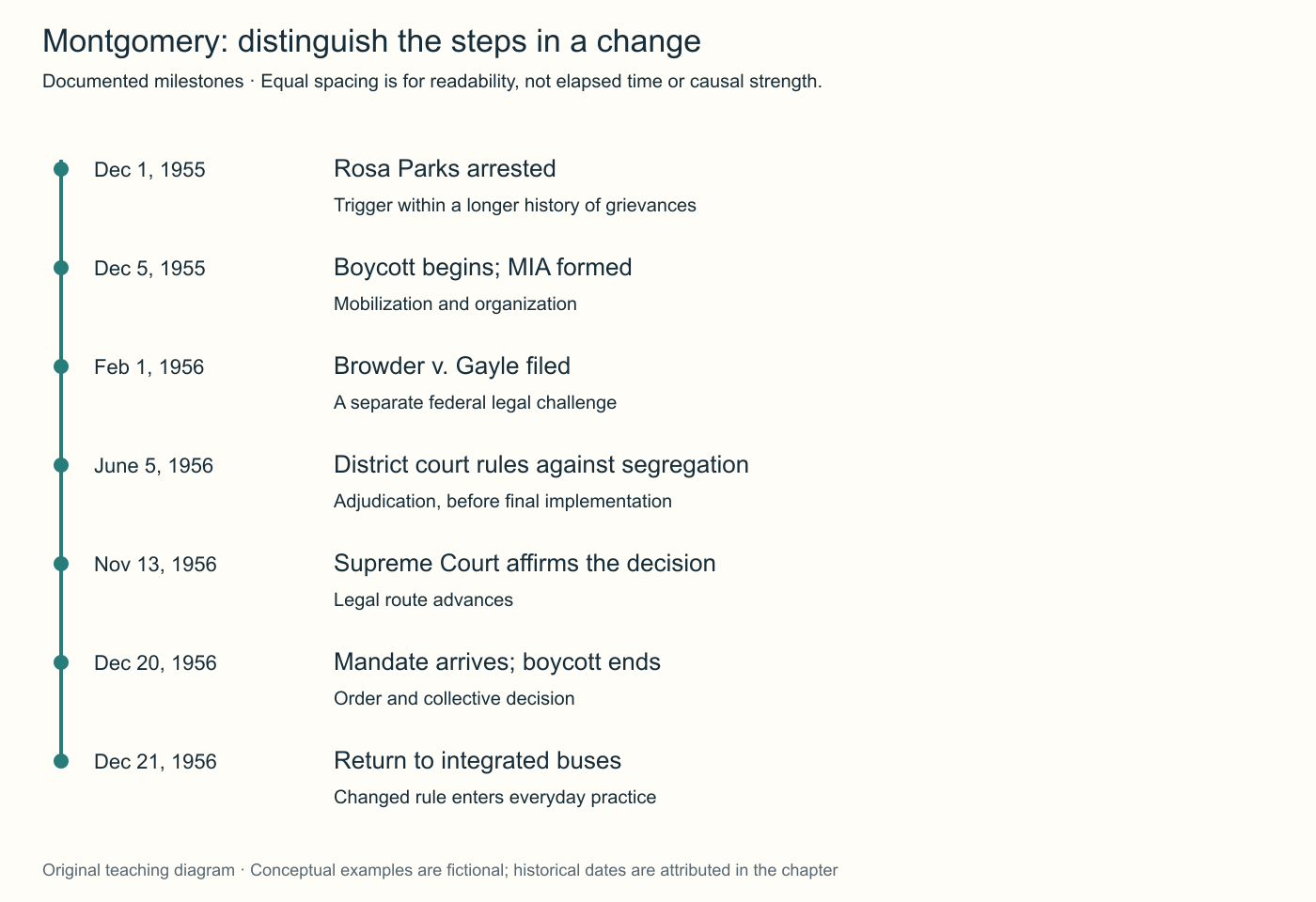
Original timeline of documented milestones. Equal spacing is for readability, not elapsed time. Arrows show chronology and do not establish that each event alone caused the next.
A judgment still has to become practice
On December 20, 1956, the desegregation mandate arrived and the MIA voted to end the boycott. Riders returned to integrated buses the next day. The King Institute's December 20 chronology records the delivery of injunctions and meetings. Formal adjudication, delivery of an enforceable order and practical return to the service were connected but separate moments.
The December 19 guidance we began with anticipated this transition. It advised riders about taking seats, maintaining nonviolent conduct and facing possible hostility. As evidence, it reveals preparation and expectations. It does not prove that hostility disappeared, that every rider felt safe or that every other form of inequality had ended.
This is a general lesson about institutional change. A rule can change before all routines, expectations or relationships change. Staff need to implement it; users need to understand and be able to exercise it; violations need to be recognized and addressed. The existence of a new rule is a major outcome, but claims about its everyday effects require further evidence.
An original analogy is a workplace adopting a transparent promotion procedure. The written change matters, yet we would still ask whether jobs are advertised, applicants receive the promised consideration and decisions can be reviewed. This analogy is about implementation logic, not an assertion that workplace promotion is equivalent in stakes or history to racial segregation.
Measure more than one outcome
A campaign can be evaluated through several outcomes: a formal rule, access to a service, treatment during encounters, organizational capacity, public recognition and consequences for participants. These outcomes can move differently. A legal victory can coexist with continuing hostility, and a campaign can build durable organization while imposing severe personal costs.
A useful evaluation identifies the baseline and the period. “The boycott succeeded” may refer to desegregated seating by December 1956. It should not silently mean that every initial employment demand was achieved, every participant benefited equally or racial hierarchy in the city disappeared. A precise statement of success can be strong without claiming completeness.
Participants may also judge the result differently because they prioritize different ends. Some may value an immediate material change; others may emphasize dignity, collective capacity or unfinished demands. The analyst should distinguish what changed from the values used to assess it. Respecting the importance of the struggle does not require pretending that one number could summarize its consequences.
The sources themselves differ in what they preserve. A court account can establish a ruling and its procedural sequence. Minutes can establish recorded organizational decisions. A public statement can establish publicly articulated demands. A later memoir can illuminate remembered experience while introducing the distance of hindsight. No single document supplies all these kinds of evidence equally well.
The objection: is careful explanation diminishing a victory?
It can feel deflating to qualify a familiar story of progress. But identifying the distinct work of organizers, riders, plaintiffs and attorneys enlarges the account of agency. It shows how a major achievement depended on many contributions and how participants acted without certainty of success.
A more difficult objection asks whether analysis should give opponents' explanations equal space. Equal evidential treatment does not require moral equivalence or equal credibility. A segregationist assertion can be studied as evidence of an actor's position without being accepted as a valid account of human worth or constitutional justice. Fair description of a historical position is different from endorsing it.
What matters is that the explanation can withstand the records. It should not attribute an action to someone who did not take it, move an early demand backward from a later outcome or assume that a public declaration proves unanimous private belief. These corrections strengthen the account by making it more accurate and more useful for comparison.
The final chapter will bring this work together. We will compare Montgomery with a related earlier campaign, examine how different sources support different claims and build an explanation that gives both organized action and institutional constraints their place.
Check your understanding: Why should Parks's arrest, Browder v. Gayle and the return to integrated buses be treated as distinct parts of the explanation?
Expected answer: They involve different actors and mechanisms: a mobilizing event, a separate legal challenge and practical implementation following the mandate. Connecting them explains the change more accurately than collapsing them into one proceeding or attributing every outcome to one person.
Application
Allow thirty-five minutes. Create an evidence table with four rows: initial public demands, organizational arrangements, legal change and intended conduct after the ruling. Use the primary statement, founding minutes, case account and return-to-bus guidance linked above.
For each row, record the source's date, what it directly supports and one claim it cannot establish. Then define two measures of campaign success and one important consequence those measures would miss. Keep the table and timeline for the final 1,000–1,500-word explanation.