Work backward from dinner
A recipe says thirty minutes. Another says twenty. A third says ten. You begin half an hour before dinner and discover that the thirty-minute dish needed chopped ingredients, a hot oven and a clean pan before its clock could start. Meanwhile, the other two dishes want the same burner. Adding recipe times is wrong, but simply taking the largest number is wrong too.
A meal schedule describes dependencies and resources. A dependency means that one step cannot begin until another is complete. A resource is something the step needs: equipment, space or attention. Working backward from serving exposes both. This chapter develops a complete hypothetical schedule, then shows how to revise it when the kitchen does not follow the forecast.
Separate preparation, cooking, waiting and finishing
Read each complete method and divide it into meaningful stages. Include ingredient preparation, preheating, cooking, resting, cooling where required and final assembly. The title's time estimate is a useful invitation to read; it is not a substitute for this sequence.
Some waits free your hands but occupy equipment. Rice resting in its covered pot may no longer need the burner, yet the pot and lid remain unavailable for another task. A chilled dough occupies refrigerator space. A tray cooling on a rack occupies a landing area. These are different resource demands that a single “cooking time” number conceals.
Finishing also deserves its own stage. Checking the center, adjusting a safe-to-taste component, transferring food and serving three portions take time. If the plan ends when the oven timer sounds, it has not yet scheduled dinner. Include the work needed to turn ready components into the meal people receive.
Use estimates from the chosen methods and your previous attempts. Where information is missing, label an allowance as your estimate. An honest five-minute preparation allowance is something you can revise after practice. A borrowed number presented as certain invites disappointment without teaching you where the forecast came from.
Draw the dependency chains
For the grain, a simple chain might be measure and prepare, heat to the specified starting condition, simmer, rest and serve. For the vegetables, it might be wash and cut, arrange on the tray, roast with checks, then finish. Each arrow says that the next stage depends on the previous one reaching the required condition.
The chains can share an earlier task. A preparation block may include measuring the grain, cutting vegetables and opening commercially cooked beans. They can also converge at serving: the plate is ready only when the required components and final assembly are ready. The longest necessary chain helps establish the earliest possible finish under the stated assumptions.
This longest chain is often called the critical path. A delay on it delays the whole completion unless another part of the plan changes. A shorter chain may have some flexibility, sometimes called slack. These terms are useful because they distinguish work that must start now from work that can move without affecting serving.
However, a dependency diagram alone assumes that required resources are available. Two independent chains may still need the same cook or skillet at the same moment. The next step is to place the chains into an actual kitchen, where independence on paper does not create another pair of hands.
An optimistic calculation misses the cook
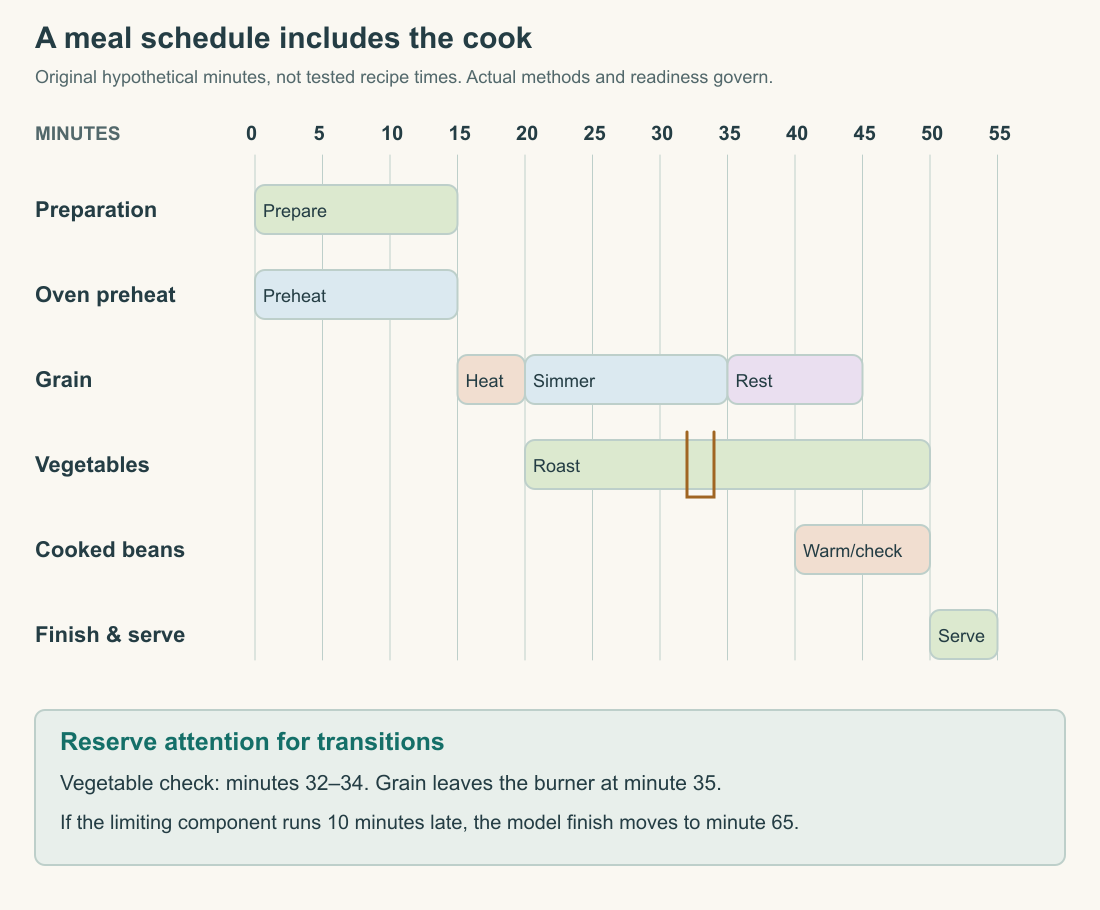
Use this explicitly invented timing model. It is not a tested fifty-minute recipe or a replacement for complete cooking instructions. Assume preparation takes fifteen minutes, and the oven can preheat during that period. After preparation, the grain requires five minutes of initial heating, fifteen of simmering and ten of resting: thirty minutes in total.
Assume the vegetable roasting stage takes thirty minutes, the cooked-bean component needs ten minutes for its prescribed warming and checks, and final assembly takes five. If all necessary starts could happen without conflict, preparation plus the longest thirty-minute branch plus assembly would total fifty minutes. The ten-minute branch could begin later and still finish with the others.
That arithmetic is a lower bound within the fictional model, not a promise. Dev cannot give close attention to starting the grain and loading the vegetable tray in the same instant. He chooses to complete the grain's initial five-minute stage before starting the oven branch. The vegetable stage therefore moves five minutes later, extending the planned completion to fifty-five minutes.
The extra five minutes are not evidence of incompetence. They make a resource requirement visible. A schedule that includes the cook can be more accurate than a shorter schedule built from the same recipe durations. The goal is to find feasible overlap, not to erase all overlap or pretend that attention is unlimited.
A feasible sequence for the fictional kitchen
Dev uses the following illustrative sequence with one oven, two burners, a grain pot and a separate vessel for the cooked beans. Actual recipes, readiness and handling requirements govern a real meal. The listed windows are planning assumptions for understanding coordination.
| Minutes from start | Planned action or state |
|---|---|
| 0–15 | Prepare ingredients; oven preheats in parallel |
| 15–20 | Start grain and reach its specified simmer condition |
| 20–35 | Grain simmers; vegetable tray enters oven at minute 20 |
| 32–34 | Reserved attention window to check and turn vegetables |
| 35–45 | Grain rests as directed, freeing its burner |
| 40–50 | Prepare the cooked-bean component under its warming instructions |
| 45–50 | Grain ready; manage the brief serving interval appropriately |
| 50–55 | Final checks, finish, portion and serve |
The vegetable oven window is minute twenty to fifty. The model assumes the turning/checking work fits within that window; it does not guarantee that a particular vegetable is ready at fifty. Its actual endpoint can move the finish. A real schedule should note which observations trigger an extension.
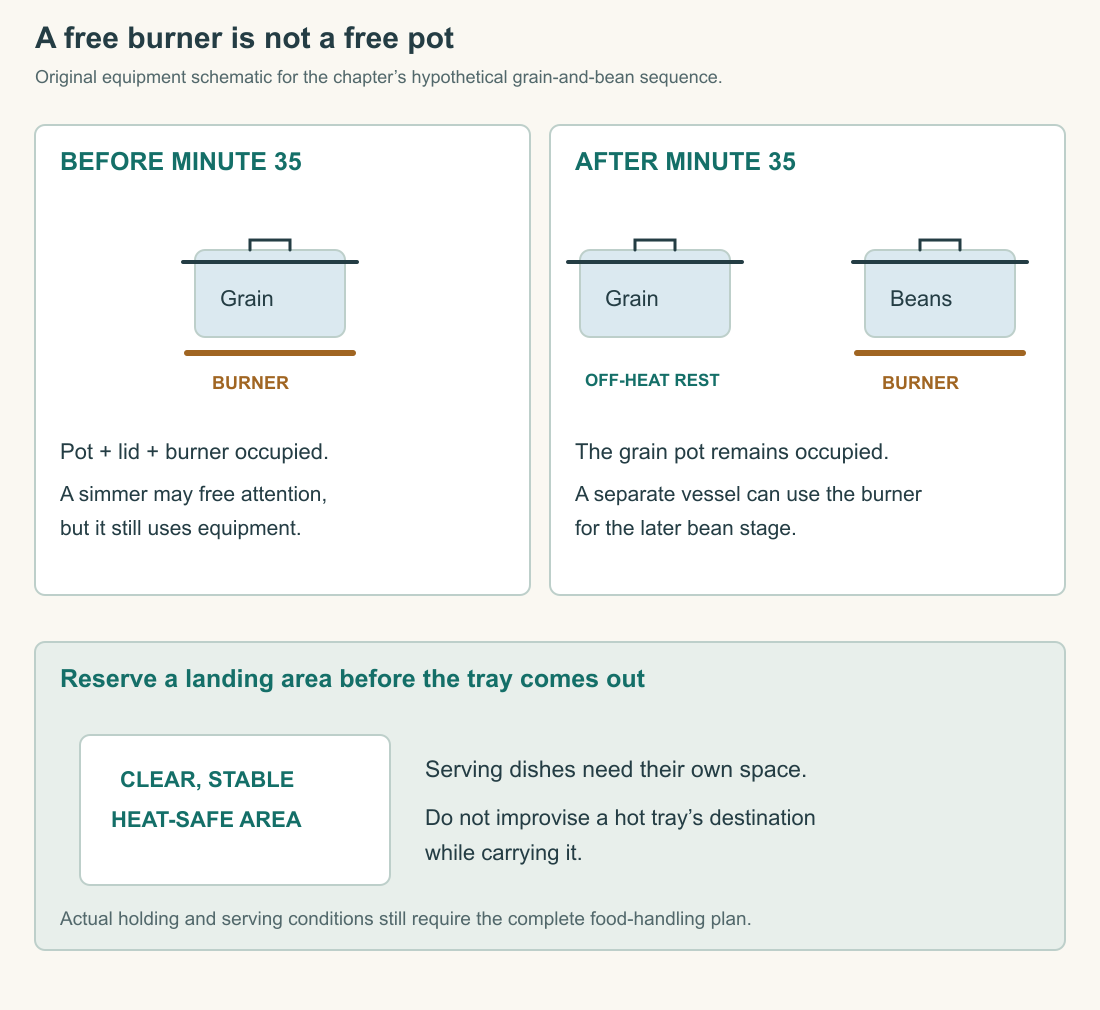
The bean stage begins at forty, after the grain has left the burner. With a suitable separate vessel, the freed burner can be used even though the grain pot remains occupied. If Dev had only one pot, this overlap would not be feasible without another appropriate method. Burner availability and vessel availability are different facts.
The five-minute interval between the grain becoming ready and final assembly is a planned short wait within the immediate meal sequence. It is not permission for indefinite room-temperature holding. Track actual time and use suitable holding if the delay grows. We will address the safe temperature and storage decisions explicitly below and in chapter five.
Schedule transitions as well as steady states
A simmer may be mostly passive, but reaching it and adjusting the heat require attention. A roasting interval may be mostly passive, but loading, turning and unloading a hot tray are active events. The dangerous or stressful moments often occur at these transitions rather than during the quiet middle of a cooking stage.
Mark the transitions on the schedule before adding optional tasks. In Dev's model, the vegetable check occupies minutes thirty-two to thirty-four, leaving the next moment clear for moving the grain into its rest. The bean setup begins later. This is more credible than assigning all three actions to minute thirty-five and hoping each takes no time.
If a check reveals a need for more work, reassess the next transition. Perhaps the vegetables need redistribution across the tray, taking longer than expected. Dev should not begin a delicate new task while his hands are occupied with hot equipment. A modest delay in starting beans may be the correct adjustment, even if it shifts serving.
Preparation can remove some transitions from the hot period. Open cans, measure the finishing ingredients and set out serving utensils earlier when appropriate. Keep perishable ingredients under suitable conditions until needed. The aim is to reduce searching and uncertainty during active cooking, not to leave every ingredient out for the entire evening.
Give equipment its own row
A timeline organized only by food can hide a resource conflict. Add rows for the oven, each burner, each scarce vessel and the main preparation area. Mark when they are occupied. If two tasks claim the same resource, either move one, change the equipment arrangement or simplify the menu.
For the fictional meal, the grain pot is occupied from minute fifteen through serving, although burner use ends at thirty-five. The oven is occupied by the vegetable stage from twenty to fifty. A separate bean vessel uses a burner from forty to fifty. The distinction explains how one burner could potentially support the two sequential heating stages, while one pot could not do so without transferring or changing a method.
Counter space matters at the end. A hot tray needs a stable heat-safe landing area just when serving dishes may cover the counter. Clear that area before unloading. Do not make a hot pan's destination an improvisation performed while carrying it.
A helper adds capacity only when the task and workspace are clear. “Help with dinner” can produce collisions and repeated questions. “Set out three bowls and the clean serving spoons” is a bounded contribution. Assign hot or knife work according to the person's ability and the available space, rather than assuming that another body automatically doubles throughput.
Work backward from a real serving time
If the fictional fifty-five-minute sequence is intended to finish at seven, its calculated start is six oh five. That is the result under the model's assumptions. If Dev wants a preparation contingency, he can begin selected work earlier, while preserving appropriate storage and the intended cooking starts.
Do not place all contingency at the end as a long uncontrolled wait for finished food. Some uncertainty is better absorbed before cooking begins: checking equipment, finding ingredients, completing knife work or correcting a missing purchase. Moving those tasks earlier can protect quality as well as reduce stress.
Suppose Dev allows ten extra minutes for preparation because the vegetable is unfamiliar. Beginning at five fifty-five gives him a chance to complete that work before the planned six twenty grain start. If preparation finishes early, he can keep ingredients appropriately stored and retain the later heating schedule. Starting the hot stages early by habit would consume the very timing flexibility he created.
The backward calculation should end with a feasible start, not a demand to become faster. If arriving home at six thirty makes the chosen menu impossible, change the serving time or menu. The arithmetic has done its job by identifying a mismatch before the food and cook are under pressure.
Revise the path when a stage runs late
At minute fifty, suppose the vegetables need ten more minutes to reach the intended condition. Final assembly can now begin no earlier than sixty, making the revised model finish sixty-five. That change shifts attention from the original clock to the actual limiting component.
Check the other components' conditions and elapsed times. They may need appropriate hot holding, prompt cooling and later reheating, or a changed serving arrangement. Do not keep reheating a delicate component impulsively while waiting. Choose a complete response that preserves safety and an acceptable result.
USDA's home guidance calls for holding hot food at 140°F or above and cold food at 40°F or below, and refrigerating perishables promptly within the applicable two-hour limit, shortened to one hour above 90°F ambient temperature. Measure actual holding conditions rather than relying on an appliance's label. These limits are not recommended waiting targets. USDA leftovers guidance.
If the necessary equipment cannot maintain an appropriate holding arrangement, simplify or change the meal. A schedule is a decision tool. It should help you recognize when the original plan no longer fits, not encourage you to hide the deviation by serving something before it is ready.
Distinguish a check from a deadline
A timer tells you to observe. It does not establish tenderness, a safe internal temperature or the completion of a rest that began later than planned. Write both the expected check time and the condition you are checking. This prevents the schedule from replacing the recipe's actual endpoint.
Similarly, record when a stage truly begins. If the grain reaches its specified simmer five minutes late, counting the simmer from the original planned start shortens the actual process. Update the subsequent stages rather than borrowing time from a required step. A later serving time is more honest than a falsely completed cooking interval.
After dinner, compare planned and actual stages. Identify whether the difference came from preparation, equipment, a biological or physical process, or an attention conflict. These categories suggest different corrections: an earlier start, a different vessel, a better estimate or a simpler finish. “Everything took longer” is a feeling; a stage comparison gives you something to improve.
Application
Build a backward schedule for your selected meal, including preparation, preheating, cooking, required waits, checks and serving. Add equipment and attention rows. Then test two disruptions: one component takes ten minutes longer, and one planned vessel is unavailable. Revise the sequence and holding decisions. Use complete recipe endpoints rather than treating the fictional fifty-five-minute example as a tested menu.
Check your understanding: In the fictional schedule, why can the burner become available at minute 35 while the grain pot remains unavailable? If the vegetable stage ends at minute 60 and assembly takes five minutes, what is the revised earliest finish under the model?
Expected answer: The grain has moved into its off-heat rest but still occupies its covered pot; a separate vessel is needed to use the freed burner. The revised finish is minute 65, assuming other components and resources are ready and safely managed. Time on the clock does not replace their actual readiness checks.