Leftovers as a second meal
The meal ends with food still in the pan. One cook sees tomorrow's lunch; another sees a problem to deal with after the dishes. The difference can begin before dinner: suitable containers, a clear storage plan and an intended second use make the remainder part of the meal's design.
Leftovers are useful only when their handling history supports using them. A new sauce, a hotter pan or a more appealing name cannot repair every earlier mistake. This chapter connects safe cooling, storage and reheating with the culinary task of making a second meal that people actually want. Those two tasks belong together, but they answer different questions.
Distinguish three kinds of remainder
An unused raw ingredient is different from a deliberately reserved cooked component, which is different again from food returned from a diner's plate. Their histories and possible uses differ. A shopping plan that labels all three simply leftovers loses information needed for the next decision.
The first category might be the remaining half of a cabbage or dry rice left in its package. It needs appropriate ingredient storage and a future preparation. The second might be cooked beans set aside with clean utensils before serving, then cooled and refrigerated promptly. The third has been served and handled during eating; it should not be mixed back into a clean shared batch for other diners.
Plan reusable components before they become plate scraps. If you intentionally cook extra, portion the amount for later use with clean equipment and begin the appropriate cooling process. Do not leave the entire batch on the table throughout the meal simply because part of it is intended for tomorrow.
Also distinguish an expected remainder from an accidental one. A planned extra portion has a person, meal and date assigned to it. An accidental remainder needs an honest decision about likely use. Freezing can extend a suitable plan, but it should not become a way to avoid deciding whether anyone wants the food.
Cooling is a process, not a waiting instruction
A large hot mass can cool slowly, especially at its center. Dividing it into smaller portions in shallow containers helps heat leave more quickly. The relevant task is to cool promptly under appropriate conditions, not to wait on the counter until the whole pot feels like room temperature.
USDA guidance allows small amounts of hot food to go directly into the refrigerator and advises dividing a large pot into shallow containers. It also permits rapid chilling in an ice or cold-water bath before refrigeration. Use clean, suitable containers and protect the food from contamination during the process. USDA cooling guidance.
The home guidance calls for refrigerating perishables within two hours, shortened to one hour when the surrounding temperature exceeds 90°F. These are outer limits, not targets for leisurely cooling. Plan to act promptly, including when dinner is long or cleanup feels inconvenient. Food mistakenly left out overnight is not rescued by placing it in the refrigerator the next morning.
Have the containers ready before serving. Clear appropriate refrigerator space, divide the food and label it. This turns an abstract rule into a feasible action at the moment when the cook is tired. A safe plan that requires containers you do not own is still an incomplete plan.
The refrigerator slows change without erasing history
Keep the refrigerator at 40°F or below and use an appliance thermometer to check its condition. A control dial's number is not necessarily the food-storage temperature. Avoid assuming that a container is safe merely because it is somewhere inside a refrigerator.
FoodSafety.gov gives ingredient-specific storage guidance. Soups and stews and cooked meat or poultry leftovers generally have a three-to-four-day refrigerated window under appropriate handling. Other foods differ. Use the actual food's entry and its preparation instructions, including any shorter limit. Cold food storage chart.
Label the contents and original preparation date, adding the freezing date if applicable. If you combine an older component with a newly prepared one, preserve the older component's history in the record. The date of assembly does not prove that every ingredient began its safe storage life that day.
Do not use smell or appearance as the sole safety test. Food can look acceptable while its handling history makes it unsuitable. Quality observations are useful for deciding whether a safely handled component is still pleasant, but they do not replace time and temperature information. When the history is unknown, do not write a confident new date and hope it becomes true.
Rice needs the specific routine already introduced
The grain course adopted a conservative UK consumer routine for cooked rice, and we retain it here: cool quickly, ideally within one hour; keep refrigerated rice no more than one day; reheat only once; or freeze appropriately for later use. This is the Food Standards Agency's recommendation, identified as such rather than presented as the US general leftover rule. FSA student guide, rice and leftovers.
That distinction matters when planning a week. A general three-to-four-day leftover statement should not silently replace the shorter rice routine used in these exercises. If the second rice meal is later, cook the rice fresh or use a deliberate suitable freezer plan. Do not stretch the interval simply because the shopping allocation looked efficient.
Dev's earlier inventory assigned 150 g dry rice to each of two dinners. Sharing a bag of dry rice does not require sharing one cooked batch. He can cook the appropriate amount on each night under the actual package method. This keeps purchasing efficiency separate from a storage decision that adds more responsibility.
If using a commercially prepared rice product, follow its label for storage, opening and heating. Its packaging and processing may differ from a pot cooked at home. The useful habit is to identify the product and history before selecting the rule, not to assign one universal treatment to everything called rice.
Freezing extends a suitable plan
Freezing is useful when a safely handled portion will not be eaten within its refrigerated period. Portion it in an appropriate container, label it and record the intended use. Smaller useful portions reduce the need to thaw a large batch simply to obtain one lunch.
Continuous storage at 0°F or below has a different relationship to safety and quality from refrigeration; FoodSafety.gov's freezer durations generally describe quality. This does not mean texture remains unchanged forever, or that freezing destroys every hazard. Food mishandled before freezing does not become suitable merely because it is now solid.
Plan safe thawing as well. Refrigerator thawing keeps the food under cold conditions, but takes time and needs a container that prevents drips from contaminating other food. Follow the complete preparation or package instructions for the product, including whether it can be heated from frozen. Do not invent a counter-thawing shortcut to preserve an unrealistic dinner time.
A freezer inventory can be very small: name, portion, date and intended meal. Review it before shopping. A frozen portion that repeatedly loses its place to a new purchase has not reduced waste yet. The benefit arrives when it is safely prepared and eaten.
If the reserved portion is intended for lunch away from home, include the journey and destination in the plan. A refrigerator at home does not keep food cold during a commute or on a desk. Use an appropriate cold source and storage arrangement, and confirm that suitable reheating equipment is available if the meal requires it. A lunch container is packaging, not temperature control. If the destination cannot support the intended handling, choose another suitable meal rather than allowing the portion to spend an unplanned morning unrefrigerated. The second meal begins when the food leaves storage, not only when someone starts eating it.
Reheating should reach the whole portion
For reheated leftovers, USDA's home guidance specifies 165°F, checked with a food thermometer. It advises bringing sauces, soups and gravies to a rolling boil and paying attention to uneven heating. A steaming surface does not establish the temperature of every part of a dense portion. USDA Kitchen Companion, leftovers.
In a microwave, use a suitable covered arrangement with venting as instructed, stir or rotate where appropriate and check several places. Follow the appliance and food instructions for standing time. These actions address the possibility of colder regions, not merely the appearance of an evenly heated plate.
Choose a reheating method that also suits the food's texture. A moist preparation can help a component that would otherwise dry out, while a crisp surface may require a different complete method. The safety endpoint and the eating quality remain separate requirements. Reaching one does not guarantee the other.
Reheat the amount you intend to use rather than repeatedly warming a large shared batch. This simplifies the record and limits unnecessary temperature cycling. If using the rice routine above, its one-reheat instruction remains part of the plan. A smaller portion is often easier to heat evenly and more likely to be eaten.
Transformation does not undo unsafe handling
Suppose a fictional container of cooked beans was left on the counter overnight. Turning it into soup and boiling it is not the appropriate way to make it safe. Some hazards associated with improper handling can involve heat-resistant toxins, and cooking cannot be assumed to reverse the earlier exposure. Discard unsuitable food rather than hiding its history in a new dish. USDA explanation of temperature abuse.
Now consider beans reserved with clean utensils, cooled promptly and stored appropriately for a planned next-day meal. This is a different case. You can choose a suitable transformation and reheating method because the handling record supports further use. The new dish succeeds through that history as well as through its seasoning.
The distinction is especially important when minimizing waste feels like a moral obligation. Preventing waste begins with purchases, portions and prompt storage. Once a food is unsuitable, serving it is not a successful waste-prevention strategy. Record why the loss occurred and change the earlier decision next time.
Give the second meal a different structure
A useful transformation changes the relationship among components rather than merely renaming the same plate. Intact cooked beans can become part of a moist skillet mixture or a suitable spread. Roasted vegetables can be incorporated into another complete preparation when their handling and storage permit it. The second dish needs a method that fits the already cooked texture.
Avoid cooking an already tender component for the full duration intended for a raw one without considering the consequence. It may lose its shape while another ingredient is still becoming ready. Additions and sequence should reflect the actual starting states. A published recipe designed for cooked components provides stronger guidance than an improvised raw-ingredient schedule.
The finish can also change. A first dinner might present separate grains, beans and vegetables; a second might combine safely stored beans with freshly prepared vegetables in a skillet, using a different suitable finish. This is a composition proposal, not a newly tested recipe. Select and follow complete methods for the actual ingredients and equipment.
Do not confuse variety with concealment. It is acceptable for the second meal to contain recognizable beans from the first. The goal is an appealing use with a coherent texture and flavor, not a trick that prevents diners from knowing what they are eating.
Trace the ingredient and the cooked component separately
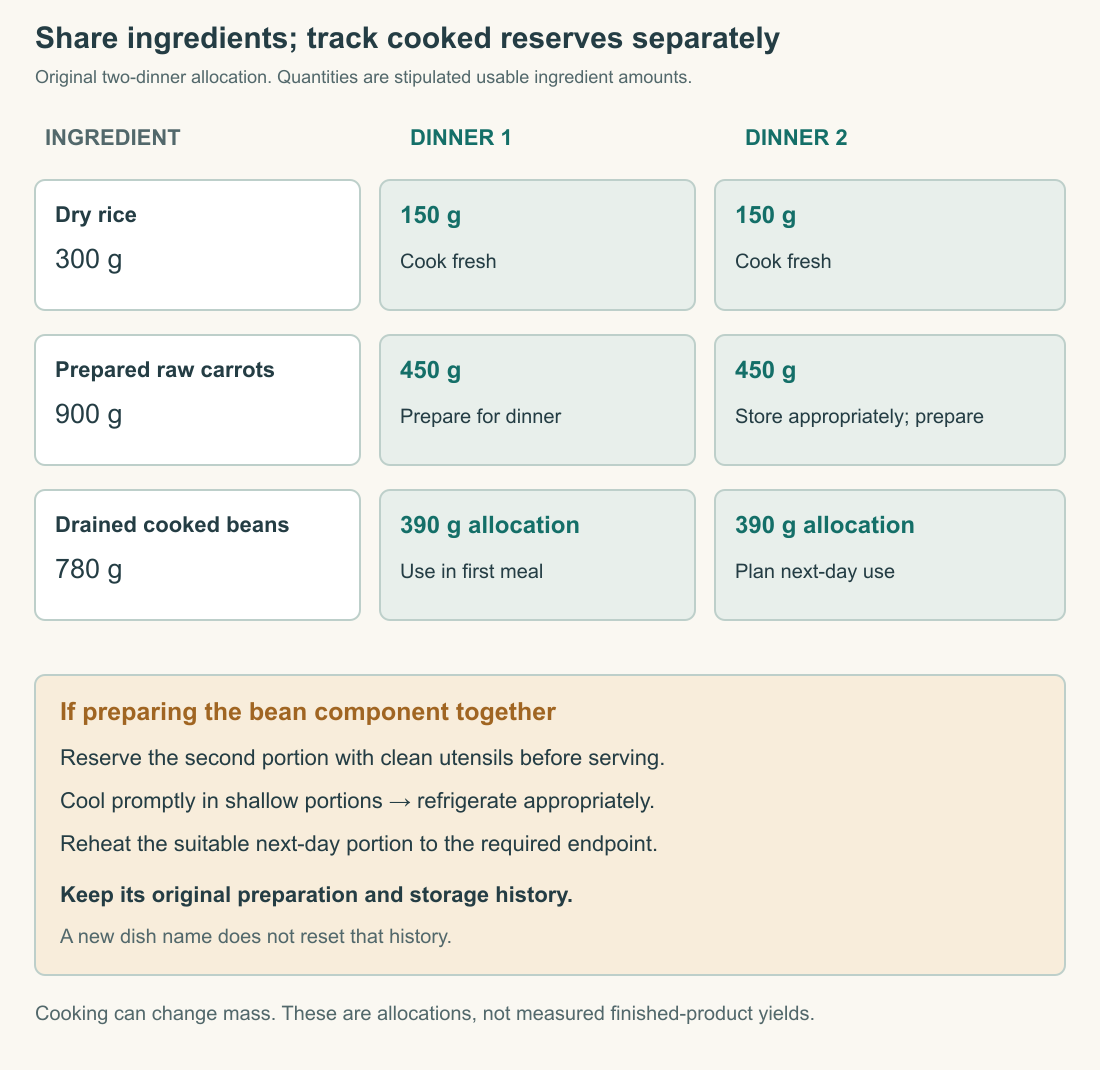
Return to Dev's hypothetical quantities: 900 g usable carrots, 300 g dry rice and 780 g drained commercially cooked beans across two dinners. One straightforward plan prepares half of each amount for each meal. The unused ingredients follow their own storage instructions; there is no need to cool a second portion of home-cooked rice because it has not yet been cooked.
A different plan prepares the bean component together, reserves half with clean utensils, cools it promptly and reheats it for the next day's meal. The two plans use the same shopping quantity but require different handling steps. The record must state which occurred. An ingredient allocation alone does not establish a cooked-food storage history.
The diagram distinguishes those paths. It is an original planning example with balanced quantities, not evidence that the combined menu has been kitchen-tested. Use it to see where storage and reheating enter the workflow, then apply the complete guidance for your actual preparations.
Application
Write a second-meal plan for one component of your menu. Identify whether the remainder is unused ingredient, deliberately reserved cooked food or plate waste. Record the original preparation, cooling, storage and intended use; apply the food's specific limit and a suitable reheating method. Explain how the second dish changes texture or assembly. If analyzing an invented case, label the history as supplied rather than measured.
Check your understanding: Does freezing a container of food left out overnight repair its history? Does buying one bag of dry rice for two dinners require cooking the whole amount on the first night?
Expected answer: No to both. Freezing does not make previously mishandled food suitable, and transformation or reheating cannot be assumed to reverse every hazard. Dry ingredients can be allocated across meals and cooked separately. A planned cooked reserve requires its own prompt cooling, storage and reheating record, including the course's shorter rice routine where applicable.