Materials and surfaces
A pale metal case, a dark case, and a glossy white case sit beside one another in a photograph. A viewer confidently identifies steel, titanium, and ceramic. Perhaps the guesses are correct. Perhaps the dark case is coated steel and the white one is polymer. Appearance is evidence about appearance. Identifying the material requires something more, and evaluating its suitability requires more again.
Material language becomes misleading when it compresses several questions into one adjective. “Durable” might mean resistant to scratching, resistant to fracture, resistant to corrosion, or capable of economical repair. Those are different properties. A watch can retain a glossy surface yet suffer a serious impact failure. Another can collect visible scratches while continuing to function. This chapter gives you a way to describe the material, its surface, and the relevant kind of durability separately.
Start with the claim you can actually establish
A specification might say that the case is stainless steel, that a bracelet contains titanium, or that the crystal is sapphire. Record the component as well as the material. A watch is an assembly, not a homogeneous lump. Its bezel, case back, clasp, links, and crystal can use different substances. The phrase “titanium watch” does not establish the material of every visible or hidden part.
Likewise, distinguish a material from a treatment. A coating changes the surface of a substrate, the underlying material to which it is applied. Surface hardening changes properties near the surface through a specified process. A polished finish describes a surface appearance and preparation. These categories can coexist: an identified alloy may be shaped, polished, treated, and combined with other components. The final color alone cannot tell you that sequence.
This is why a useful material record has three fields: component, documented composition, and documented treatment or finish. Add “not stated” where necessary. If the case is described only as silver-colored, do not improve the specification by inventing an alloy. If a proprietary name appears, find the manufacturer's explanation and retain its status as a manufacturer account. A trade name can identify something real without explaining all the details needed for comparison.
Our Citizen example makes this distinction tangible. Its documentation identifies a particular treated titanium construction and a bracelet with a differently treated link. The result is visually varied, but the variation should not be read as a map of bulk composition from color alone. We will collect the exact product facts in the final chapter; here the lesson is how to ask the material question without letting a striking photograph answer it prematurely.
Four meanings of resistance
Hardness concerns resistance to localized deformation or scratching under a defined kind of test. Different hardness scales and test methods are not interchangeable rankings that can be mixed casually. Toughness concerns resistance to fracture and the energy involved in producing it. Corrosion resistance concerns chemical attack in an environment. Wear involves material loss or surface change during repeated contact. A material can perform differently across these dimensions.
Consider an original hypothetical comparison. Sample A retains its glossy surface under ordinary rubbing but cracks under a severe impact. Sample B scratches more readily but dents instead of breaking in the same imagined event. Which is more durable? The answer depends on the failure you care about, and the example has not supplied enough information to rank the complete objects. Real behavior also depends on shape, thickness, defects, support, and the direction and energy of loading.
The same reasoning applies to a watch crystal. Scratch resistance matters because scratches can affect appearance and reading. Resistance to breaking matters for a different reason. Neither property by itself establishes water resistance, which belongs to an assembled and sealed watch under specified conditions. An excellent crystal material does not rescue a damaged gasket or an improperly closed case. Material selection and assembly performance must be evaluated at their proper levels.
Rado's material FAQ explicitly pairs its discussion of high scratch resistance with warnings that its watches can still break when dropped and that hard surfaces are not indestructible. That qualification is more useful than treating a hardness number as a promise against every form of damage. We use the distinction, not the page's numerical values as universal constants for every ceramic or sapphire component.
Steel and titanium require more than a color name
Stainless steels are a family of alloys. Chromium contributes to the protective passive surface layer that helps resist corrosion; the alloy and environment affect the outcome. The industry organization worldstainless explains this role of chromium. “Stainless” therefore describes a useful material family, not immunity to every chemical environment or permission to ignore a watch's care instructions. A photograph cannot identify the alloy grade or its treatment history.
Titanium is attractive in many applications because useful strength can be achieved with relatively low mass. But the weight of a finished watch also depends on how much material is present and on the movement, bracelet, crystal, and other components. Comparing a small steel watch with a large titanium watch does not isolate density. To attribute a weight difference to material alone, you would need a comparison with controlled geometry and otherwise comparable construction.
Citizen's explanation of Super Titanium links its product to titanium processing and the company's Duratect surface-hardening technology. This is evidence of how the manufacturer describes its material system. It is not proof that every untreated titanium watch has the same surface properties, or that a particular owner's watch is immune to scratching. The treatment is part of the claim and should remain part of the name when that claim is discussed.
Weight itself is not a quality certificate. Some readers enjoy a perceptible mass; others value an object that attracts little physical attention. A heavy bracelet may feel reassuring before it becomes tiring in another setting. A light case may be comfortable without being flimsy. The disciplined description reports measured weight when available and treats the feeling of substance as a wearing response. It does not convert either heaviness or lightness into automatic superiority.
Precious metals: composition, color, and purpose
Gold used in watch cases is commonly alloyed with other metals rather than treated as pure gold. The karat system expresses the proportion of gold in twenty-four parts: eighteen-karat gold contains eighteen parts gold out of twenty-four, or 75 percent by mass. Fineness expresses composition in parts per thousand, so 750 communicates the same nominal proportion. The World Gold Council's material explanation also shows that different alloy mixtures can produce different colors.
Color is consequently an unreliable purity test. A yellow surface might be an alloy throughout the component, a layer over another material, or a coating chosen for color. White-colored precious metal may resemble steel in a photograph. A stamp or hallmark is evidence to interpret alongside provenance and, where necessary, professional examination; a photograph of a mark does not independently authenticate the object that bears it. Authentication belongs to a different level of investigation from identifying what a catalogue claims.
The value of a precious-metal case can include appearance, mass, manufacturing choices, cultural meaning, and the material itself. Those are legitimate objects of interest. None establishes that its movement keeps better time. An expensive case can surround an ordinary timekeeping architecture; a modest case can protect a highly effective one. Keeping the categories separate allows you to appreciate the case without inventing a mechanical advantage on its behalf.
Repairability also requires a specific question. Can a component be replaced? Can a surface be refinished while preserving its geometry? Are parts and qualified service available? A material may be workable in principle while a particular component is difficult to restore economically. Removing scratches can remove material and alter edges or markings. This course therefore does not offer a home-polishing exercise or promise that a visible mark can be erased without consequences.
Ceramics, polymers, and the clear front
Technical ceramics used in watches should not be understood simply as household pottery, but neither should the word “ceramic” be treated as one exact composition with universal properties. Manufacturing and formulation matter. The distinction between resisting scratches and resisting fracture remains essential. A chip at an edge and a fine scratch across a surface are different observations, with different implications for the part. Do not propose the same remedy because both look like cosmetic damage.
Polymers can serve in cases, straps, seals, and transparent front coverings. Their properties depend on the material and formulation, so “plastic” is often too broad to explain a particular behavior. Flexibility may be useful in an attachment and undesirable in another component. Low mass may serve a wearing purpose. The absence of a metallic shine does not establish careless construction. It tells you that the object is pursuing a different material and visual vocabulary.
For crystals, identify the actual specification before comparing. Synthetic sapphire is crystalline aluminum oxide; ordinary watch glass and polymer coverings are different material systems. Citizen's crystal explanation identifies sapphire's composition and high scratch resistance. Its absolute suggestion that only diamond can scratch sapphire is not adopted here. The Rado guidance is more appropriately qualified: contact with sufficiently hard material can damage a hard surface.
Anti-reflective treatment, curvature, thickness, and viewing angle can change the experience of a clear covering. A visible reflection is therefore not a reliable material test. Nor does a clear photograph prove that a crystal will remain unobtrusive under all lighting. Our task is to separate documented material from observed optical behavior and from the performance of the complete watch. Once those distinctions are made, a comparison becomes more useful and considerably less theatrical.
Read the finish as a surface
A brushed or grained finish presents fine directional texture. A polished surface can produce stronger reflections. Satin is commonly used for a less mirror-like appearance, but commercial terminology is not perfectly standardized. Describe what the image shows: parallel lines, a bright edge, a diffuse face, or a transition between them. Then connect the appearance to a named finish if the documentation supports it. A dark-looking polished surface may simply be reflecting a dark part of its environment.
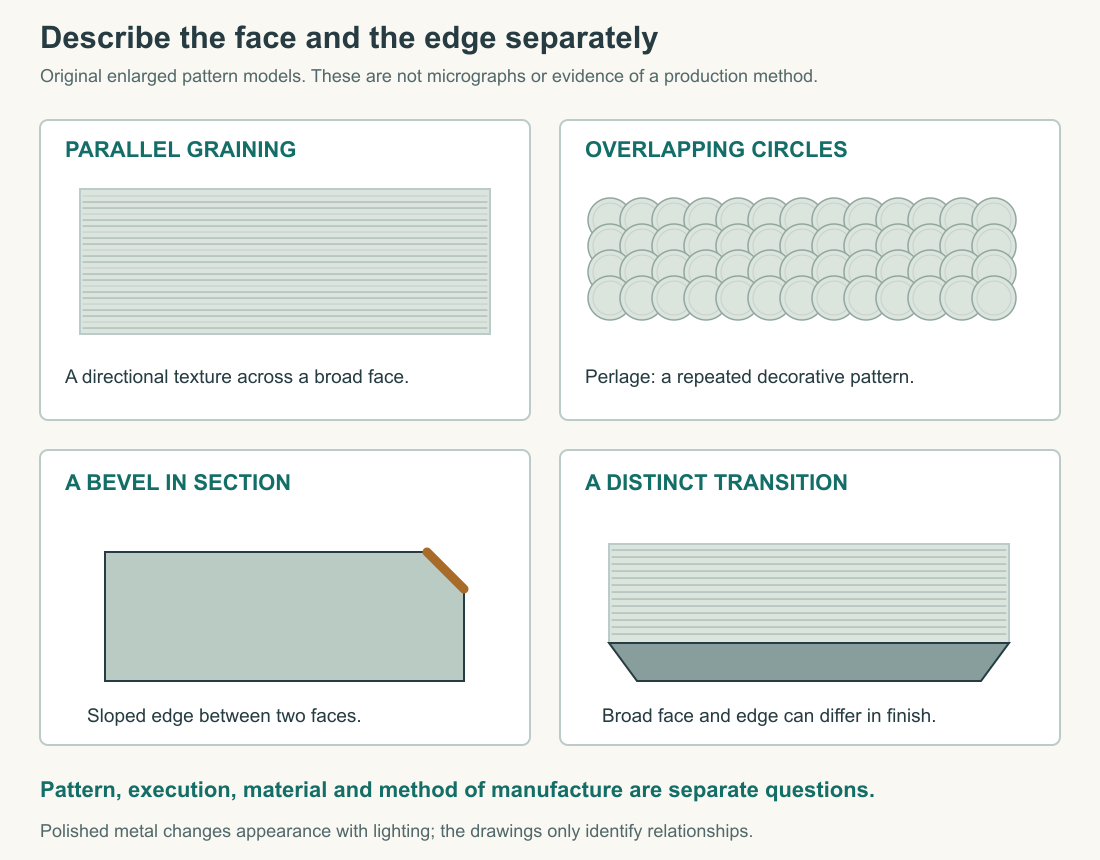
The figure deliberately makes the patterns legible. It does not simulate the exact optics of polished metal. Its value lies in separating a broad face from an edge treatment and a linear pattern from overlapping circles. The latter is called perlage or spotting; FHH defines it as a decorative pattern of overlapping circles. Chapter 5 will ask what such decoration does and does not tell us about the mechanism beneath it.
Look closely at boundaries. Does a polished bevel remain visually distinct from a brushed upper face? Does a line that seems irregular persist in another image, or is it a reflection? Is the photograph sharp enough to support a claim about the edge? An enlarged product image can invite judgments at a scale where compression, focus, and lighting become decisive. The appropriate response is to qualify the observation, not to invent precision by using more technical vocabulary.
Make a material judgment answer a purpose
Return to the three cases at the beginning. You can now write useful questions instead of material guesses. Which components are identified in the specification? Is the color part of the material or a treatment? Which damage mechanism matters for the proposed use? What evidence supports an expectation about weight, surface wear, corrosion, or repair? Each question points toward information that could change the conclusion.
Imagine a reader who dislikes visible scratches but also needs a watch for activities with frequent impacts. A single hardness ranking cannot resolve that brief. Imagine another who values an easily worn, light object and accepts surface marks. Their priorities are different. The course does not need to select a product for either person to show why their evaluations might diverge. A material is suitable in relation to an object, a use, and a set of values.
The most important habit is to keep four sentences separate: what the part is claimed to be made from, how its surface appears, what performance evidence exists, and why those facts matter to the reader. That structure lets you discuss beauty and engineering in the same account without confusing them. Next we apply it to information: a watch may advertise many functions, but the reader must still determine what each indication means and what its limits are.
Application
For each statement, identify the unsupported jump: “The dark case is titanium”; “The sapphire crystal makes the whole watch shockproof”; “The heavier watch must be better made”; “The circles on the movement prove that every part was finished by hand.” Rewrite each as a defensible observation or a question for documentation.
Then choose a surface in one linked official product photograph. Describe its appearance in 100 words, separate composition from finish, and name one additional view or document you would need. Use the original surface diagram if the external image is unavailable. Label that alternative as schematic analysis.
Model interpretation: Color does not establish titanium, scratch resistance does not establish resistance to impact failure, mass does not establish execution, and a decorative pattern does not establish its entire production process. A useful revision says which component and surface are visible, what the manufacturer identifies, and what remains unverified. No scratching, dropping, chemical testing, or polishing of a real watch is part of the exercise.