Selecting and controlling movement
You reach toward the cup, then notice that someone has moved it. Your hand changes course. The correction feels like part of one action, but it reveals several demands: selecting a target, organizing forces, estimating the hand's position, comparing what happens with what was expected, and adjusting the movement. Muscles supply force. Nervous systems organize when and how that force contributes to a task. Neither “the motor cortex did it” nor “the muscles remembered” explains the whole event.
Begin at the muscle end
A lower motor neuron sends its axon from the spinal cord or brainstem to skeletal muscle. Its terminals act at neuromuscular junctions, where neural signaling initiates electrical and mechanical processes in muscle fibers. For the hand-reaching example, spinal motor neurons provide the final neural output to the arm and hand muscles. An axon from the cerebral cortex does not run uninterrupted all the way into the cup-gripping muscle fiber.
This arrangement creates an important common route. Descending commands, local spinal circuits, and sensory inputs can all influence lower motor neurons. A movement can be consciously intended while much of its detailed coordination occurs without conscious access. Calling it voluntary describes the person's relationship to the action; it does not identify a separate set of muscles or exempt the movement from local feedback.
A motor unit consists of a motor neuron and the muscle fibers it innervates. Changing which motor units are recruited and how they fire contributes to changing muscle force. The resulting movement also depends on muscle length, contraction conditions, tendon forces, joint geometry, gravity, and contact with objects. Neural output matters through a mechanical system. It is not a finished trajectory that the body follows independently of its physical circumstances.
For an original example, imagine holding two outwardly identical cups, one empty and one containing water. The same initial muscle activation may produce different acceleration because the loads differ. A control system must use information about the expected load and the actual movement. The problem exists even when the visual target is perfectly recognized. Seeing the object and generating the appropriate forces are connected but distinct achievements.
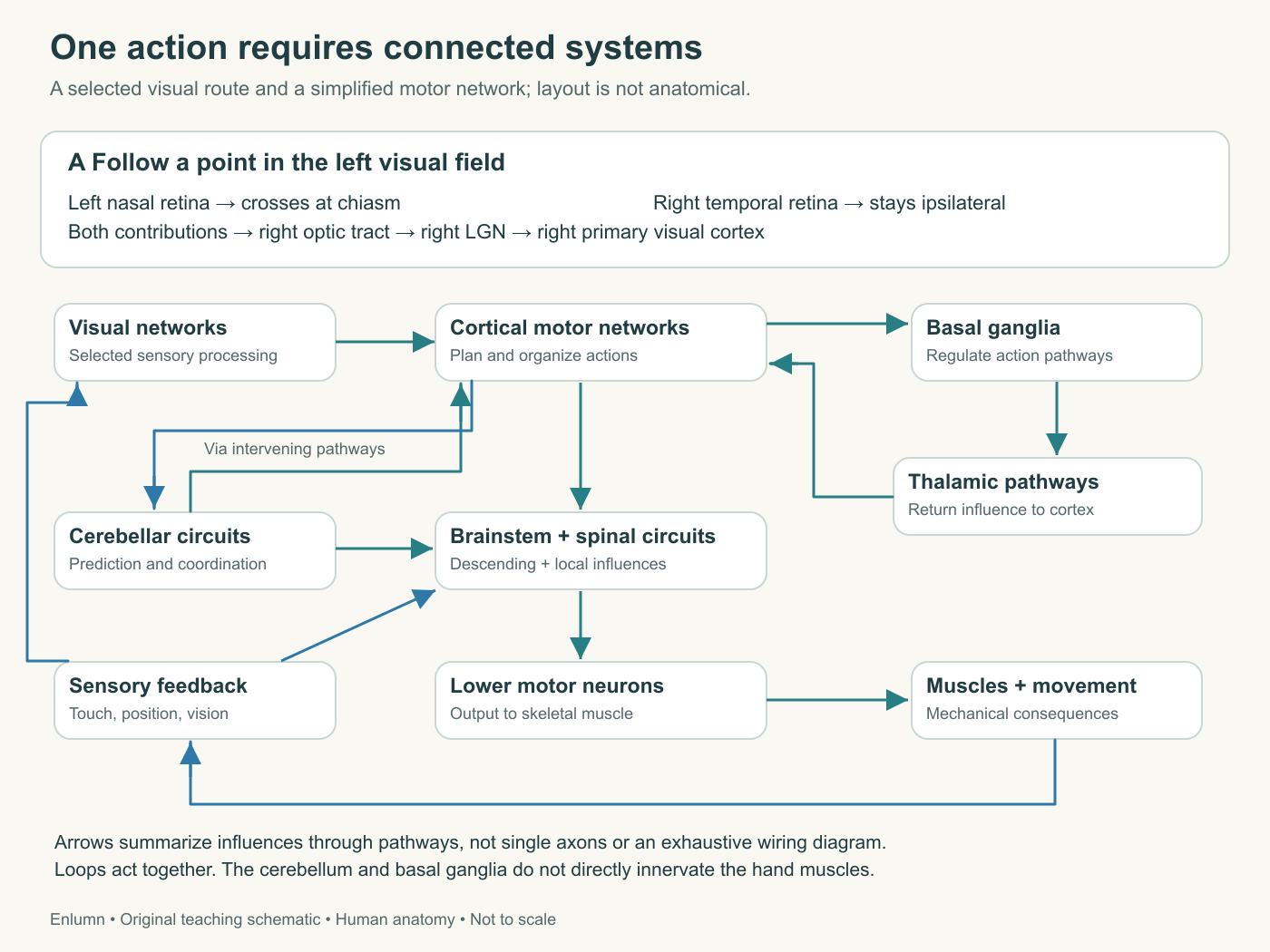
Follow the final output through lower motor neurons to muscle, then return along the sensory routes. The loops summarize influences through intervening pathways rather than claiming direct single-axon connections between every box. Diagram positions are chosen for legibility; the brainstem is not literally below a cortical box, and feedback is not a separate organ.
Descending pathways organize local circuits
Upper motor neurons are neurons in cerebral cortex and brainstem whose descending projections influence motor circuits. The corticospinal tract is a major route from cortex toward spinal circuitry. Many of its fibers cross in the lower brainstem, contributing to the prominent control of one side of the body by the opposite cerebral hemisphere. This is a major organizational pattern, not a rule that every muscle and every descending pathway has an identical crossing.
The primary motor cortex lies in the frontal lobe, just anterior to the central sulcus. Premotor and supplementary motor areas participate in organizing actions, with contributions that depend on task and context. Parietal regions supply information relevant to body position and spatial relationships. A movement is therefore supported by interacting cortical regions, not assembled by a single isolated patch after every other region has finished its work.
The brainstem also provides descending influences important for posture, orientation, and coordinated activity. Reaching changes the body's balance as well as the hand's position. Muscles outside the reaching arm help stabilize the body. The spinal cord contains local circuits that combine descending influences with sensory information. It is an active part of the control system rather than a bundle of extension cables below the “real” brain.
The motor-system overview in Neuroscience distinguishes descending pathways, local circuits, basal ganglia, and cerebellar contributions. Its division is useful for orientation. Our cup example emphasizes their interaction: target information, posture, force, and feedback must remain coordinated while the environment changes. A textbook division of labor should not become a rigid schedule in which one structure completely finishes before the next begins.
A body map with limits
A drawing of the motor homunculus represents the uneven relationship between parts of the body and motor cortex. Hands and face occupy prominent space in the familiar illustration. It does not show a tiny person living on the cortical surface. Nor does the size of a pictured hand measure how much a person values hand movements. The image summarizes an organization inferred from particular observations and methods.
Cortical representations overlap, and movement control involves populations of neurons. A single neuron need not correspond to one muscle, one joint angle, or one complete action across every task. The activity relevant to grasping a cup can depend on posture, context, and what the person is trying to do. Treating the cortical map as a keyboard with one key per muscle misses that flexibility.
Consider a fictional model with three groups contributing differently to forward movement, sideways movement, and grip. Increasing one group's contribution changes the combined output, but the final action still depends on the others. The model illustrates population involvement; it does not assert that the brain literally computes three arrows and adds them in one place. Mathematical descriptions can capture relationships without identifying the complete cellular implementation.
This is also why a brain region can contribute to more than one action without becoming functionally meaningless. A hand muscle participates in writing, lifting, and buttoning, but its contribution remains anatomically specific. Similarly, a cortical network can be reused across tasks while making a particular contribution in each. Specialization and reuse are compatible; neither requires an isolated center for every familiar verb.
Selecting among possible actions
At the table, you could lift the cup, move the plate, or keep your hand still. Basal ganglia circuits contribute to selecting and regulating actions in interaction with cortex, thalamus, and brainstem. Relevant structures include the striatum, pallidum, subthalamic nucleus, and parts of the substantia nigra. Their detailed pathways are complex, so we will use the circuit logic from Chapter 3 without pretending that a three-cell drawing reproduces the whole system.
Many basal ganglia output neurons exert ongoing inhibition on their targets. Changing this inhibition can alter which downstream activity is permitted or favored. Disinhibition is therefore an important organizing idea. But “direct pathway means go, indirect pathway means stop” is too crude as a complete account of actual movement. Different pathways can be active together, their effects depend on timing and context, and action regulation includes more than a binary decision.
Use an original choice model. Let two candidate actions receive different levels of cortical support. A regulatory circuit reduces inhibition of one candidate while other influences continue to constrain the alternatives. The selected action still requires appropriate downstream activity and functioning muscles. Removing inhibition does not create a movement from nothing, just as the three-cell model required an independent drive to its final neuron.
Dopamine influences basal ganglia circuits through different receptor and cellular mechanisms and participates in learning and action regulation. It is not a universal “pleasure fluid” whose amount directly tells us what a person wants. A change in a neuromodulatory influence can alter the operation of a circuit without specifying the content of every action it supports. The distinction between a chemical's mechanism and a human-level description remains essential.
A person can also decide to act and still have difficulty initiating or scaling movement. Such possibilities show why conscious intention, action selection, and motor execution should not be collapsed into one event. They are educational distinctions, not labels readers should use to diagnose themselves or others. We can understand the organization without turning an anatomy course into a symptom checklist.
Predicting consequences and correcting errors
The cerebellum participates in coordination, timing, prediction, and learning through its connections with other motor and nonmotor systems. For the cup task, one useful question is how expected sensory consequences relate to actual feedback. If the cup is heavier than expected, the observed movement may differ from the predicted movement. The nervous system can respond during the current reach and adjust how it prepares a later one.
Those are not the same adjustment. An online correction changes an action while it unfolds. Adaptation changes performance over repeated experience with a systematic alteration. A person might correct each movement without fully changing their initial command, or might learn a better initial command even when little opportunity exists to correct the ongoing action. Distinguishing the two lets experiments test what teaches the adjustment.
A sensory prediction error is a difference between expected and observed sensory consequences. A task error is a difference between the desired outcome and the achieved outcome. These can come apart. Imagine that a cursor unexpectedly moves sideways while a participant's hand follows its intended path. The cursor might accidentally end on a newly positioned target, producing little final task error despite unexpected sensory feedback. This is a conceptual example, not the protocol of the study below.
In a human experiment, Tseng and colleagues compared seven participants with hereditary cerebellar ataxia and seven matched controls. Participants moved a handle controlling a cursor while its displayed path was rotated. Pointing allowed corrections during movement; rapid shooting movements largely prevented them. Controls adapted in both conditions, while the cerebellar group showed reduced adaptation in both. The results supported a role for sensory prediction error rather than requiring an online correction as the teaching signal in this task. The small clinical sample and specific perturbation limit generalization; some participants also had mild pontine atrophy, so this was not an experiment that selectively switched off one perfectly isolated structure.
The value of that comparison lies in its competing predictions. If performing a correction were necessary for adaptation, removing the opportunity should eliminate the learning under otherwise suitable conditions. If the mismatch itself can provide relevant information, adaptation can remain. The experiment therefore goes beyond observing that the cerebellum is “active during movement.” It asks what sort of information contributes to a particular adjustment.
Following an invented adaptation record
Suppose a fictional participant encounters a constant ten-unit visual shift. Before learning, their initial compensation is zero, so the mismatch is ten. In a deliberately simple update rule, the next trial adds one quarter of the preceding mismatch to the compensation. After the first update, compensation is 2.5 and the remaining mismatch is 7.5. After the second, compensation is 4.375 and mismatch is 5.625. Each update is smaller because the remaining error is smaller.
The rule produces gradual convergence. It does not imply that a human cerebellum always learns twenty-five percent of an error, nor that all adaptation follows a single exponential process. Real behavior includes retention, multiple timescales, strategies, sensory uncertainty, and changing task demands. The calculation makes a hypothesis explicit enough to test: if updates depend on remaining mismatch, their size should change as that mismatch changes.
Now remove the imposed shift while the participant still compensates by 4.375 units. The initial action is biased in the direction of the learned compensation. Such an aftereffect can provide evidence that the control system changed, rather than merely correcting the original error anew on every trial. The precise interpretation depends on the design; aftereffects do not reveal all of the underlying cellular mechanisms.
Compare this with a second fictional strategy: always wait until the cursor visibly misses, then steer it onto the target. Final accuracy could improve without an equivalent change in the initial movement. Recording only final position would miss that difference. Measuring the trajectory and its timing reveals more about how the outcome was achieved. This is why “the participant got better” is an incomplete description of motor learning.
Feedback has a route and a delay
Proprioception is sensory information about the body's position and movement, arising from receptors associated with muscles, tendons, and other structures. Vision and touch provide additional information. These inputs do not all arrive with the same timing or precision. A control system cannot wait for unlimited perfect feedback before every change; the body continues moving while signals are processed.
Imagine an invented hand movement proceeding at half a meter per second. Over a delay of one tenth of a second, it travels five centimeters if speed remains constant. This arithmetic shows why delay can matter. It is not a measured universal human correction time, and actual reaches accelerate and decelerate. The lesson is that information about the recent past must be used to control a body that has already moved onward.
Predictive control and feedback are therefore complementary. Expectations can help organize a movement before its consequences are fully observed; feedback can reveal mismatches and support correction. A model relying only on prediction would struggle with surprises. A model relying only on delayed feedback could be unstable or inefficient in some tasks. Their interaction allows flexible action, though the detailed implementation differs across movements and circuits.
The cup's surface also changes what feedback is useful. Touch after contact provides information unavailable during the approach. Grip forces must relate to the load and contact conditions. If the cup shifts, the resulting sensory changes can alter ongoing output. An action is a sequence of changing information opportunities, not a fixed command sent once from brain to hand.
Check your understanding: Why is improved final accuracy insufficient to show that a participant has adapted their initial movement command?
Expected answer: Accuracy could improve through corrections made later in the movement. Comparing initial trajectory, correction timing, and behavior after the perturbation is removed helps distinguish changed preparation from better online correction. Both involve learning or control, but they are different mechanisms and require different evidence.
Application
Allow 15–20 minutes. Draw the cup task with cortex, basal ganglia, cerebellum, brainstem, spinal circuits, lower motor neurons, muscle, and sensory feedback. Use separate arrows for the output to muscle and the loops influencing that output. The basal ganglia and cerebellum should not connect directly to the cup or bypass the final motor pathway.
Calculate one more update in the fictional ten-unit adaptation problem. State the new compensation, remaining mismatch, and predicted initial bias if the shift is then removed. Finish with a three-sentence explanation of why the study's pointing and shooting comparison is more informative than measuring final target accuracy alone.