Sensing head movement and orientation
Imagine a passenger inside a windowless train carriage. The train begins moving smoothly, then continues at a steady speed. The passenger has changed position considerably, but an inner-ear sensor does not provide a running map coordinate announcing the distance traveled. It responds to particular mechanical consequences of motion and gravity. Meanwhile, if the passenger turns toward a companion, another set of inner-ear structures responds to rotation. Explaining these differences is the key to understanding the vestibular apparatus without calling it a universal motion detector.
Separate position, velocity and acceleration
Position specifies where something is relative to a reference. Velocity describes how position changes with time, including direction. Acceleration describes how velocity changes. A train traveling east at a steady speed has a changing position but, in the simple straight-line model, no continuing acceleration. Starting, stopping, or changing direction changes that situation. These terms describe related features of motion; they are not interchangeable labels for moving quickly.
Take an invented sequence of velocities measured at one-second intervals: 0, 2, 4, 4, and 4 meters per second. During the first two intervals, velocity rises by two meters per second each second. During the following intervals, it remains constant. The passenger still covers distance during those constant-speed intervals. A sensor responsive to acceleration can therefore quiet while the journey continues. Quiet output would not establish that the train had returned to its starting position.
Rotation has corresponding quantities. Angular position describes orientation; angular velocity describes its rate of change; angular acceleration describes changes in angular velocity. Turning the head left and holding it there involves rotation during the transition and a new orientation afterward. The vestibular system has different structures whose mechanical behavior contributes different information across that sequence. Their responses are also shaped by the duration and frequency of movement, not merely by a verbal category such as “turn.”
The semicircular apparatus responds through relative motion
Each ear has three semicircular ducts in differently oriented planes. An expanded region, the ampulla, contains a sensory ridge called a crista. Hair bundles project into the cupula, a gelatinous structure spanning the duct there. When the head begins rotating, inertia and fluid mechanics produce relative movement that deflects the cupula and hair bundles. The resulting cellular responses alter vestibular nerve activity. The three orientations allow different components of rotation to influence the apparatus. Purves and colleagues, The Semicircular Canals.
The cupula is not a loose pebble rolling around a circular pipe, nor a freely spinning wheel. It is mechanically coupled to the surrounding structures. A drawing should therefore show a sensory region within an expanded portion of the duct, not hair cells scattered uniformly around the whole loop. “Semicircular canal” is common shorthand, but distinguishing the enclosing bony canal from the membranous duct helps keep the fluid spaces intelligible.
A simplified model can begin with a ring, fluid, and a flexible partition. When the ring accelerates, the relative mechanical response bends the partition. Elastic restoring forces and viscous resistance shape what happens next. If the ring then continues at constant angular velocity, the deflection need not remain indefinitely at its initial value. After stopping, the transient response can reverse. The teaching model concerns the apparatus's response history, not a claim that the fluid remembers a person's intention.
Why a simple acceleration label is incomplete
The mechanical input arises from angular acceleration, but over a substantial range of ordinary movement frequencies, canal responses carry information related to angular velocity. Their time-dependent behavior matters. A sudden increase to a maintained angular velocity produces a transient cupular displacement followed by relaxation; a maintained angular acceleration is a different input. Neural adaptation adds further dynamics beyond cupular motion alone. Rabbitt, Semicircular Canal Biomechanics in Health and Disease.
Consider a supplied model that begins with deflection eight and halves its remaining deflection after each equal time interval: eight, four, two, one. This is a mathematical illustration of relaxation, not a measured human response or a universal vestibular time constant. After three intervals, the response is one-eighth of its initial value. A persistent rotation could therefore coexist with a smaller peripheral response than at its onset. The model prevents the mistaken inference that every ongoing movement must produce an unchanging maximum signal.
Now compare a second model that declines eight, two, one-half, one-eighth across the same intervals. Both begin at eight but have different dynamics. One initial measurement cannot distinguish them. A sequence can. Nor should either sequence be treated as a person's perception of spinning: the nervous system combines the input with other signals and its own processing. Mechanical displacement, afferent firing, and conscious experience are separate measurements connected by a physiological account.
Opposing responses carry directional information
Vestibular hair bundles have a preferred orientation. Deflection toward the kinocilium tends to depolarize the cell; deflection away tends to hyperpolarize it. Changes in synaptic signaling then influence the firing of afferent neurons. Different receptor arrangements make increases and decreases useful for describing movement direction. A baseline response allows modulation on both sides of the resting condition. Purves and colleagues, Vestibular Hair Cells.
The horizontal canals provide a useful paired example: a leftward head turn tends to increase activity associated with the left horizontal canal and decrease activity associated with the right. Other canal pairs have their own geometrical relationships, including an anterior canal on one side paired with a posterior canal on the other. The horizontal example should not be copied indiscriminately onto every vertical movement. A three-dimensional system cannot be reduced to “left ear means left” for every input.
Use a fictional paired signal with resting values 50 and 50. One direction gives 70 and 30; the other gives 30 and 70. The total stays 100, but the difference changes from zero to plus 40 or minus 40. If you measured only the total, you would miss the directional information in this model. The numbers are not human nerve-firing rates. They illustrate how a pattern across channels can carry something that a sum cannot.
Otolith organs have a different mechanical load
The utricle and saccule contain sensory patches called maculae. Hair bundles interact with an overlying layer containing calcium-carbonate particles, the otoconia. These particles add mass, helping create shear relative to the sensory epithelium during relevant linear accelerations and changes of orientation with respect to gravity. The utricular and saccular patches have different predominant orientations, with varied directional sensitivities across their cells. They do not each sense only a single rigid axis under every head position. Purves and colleagues, The Otolith Organs.
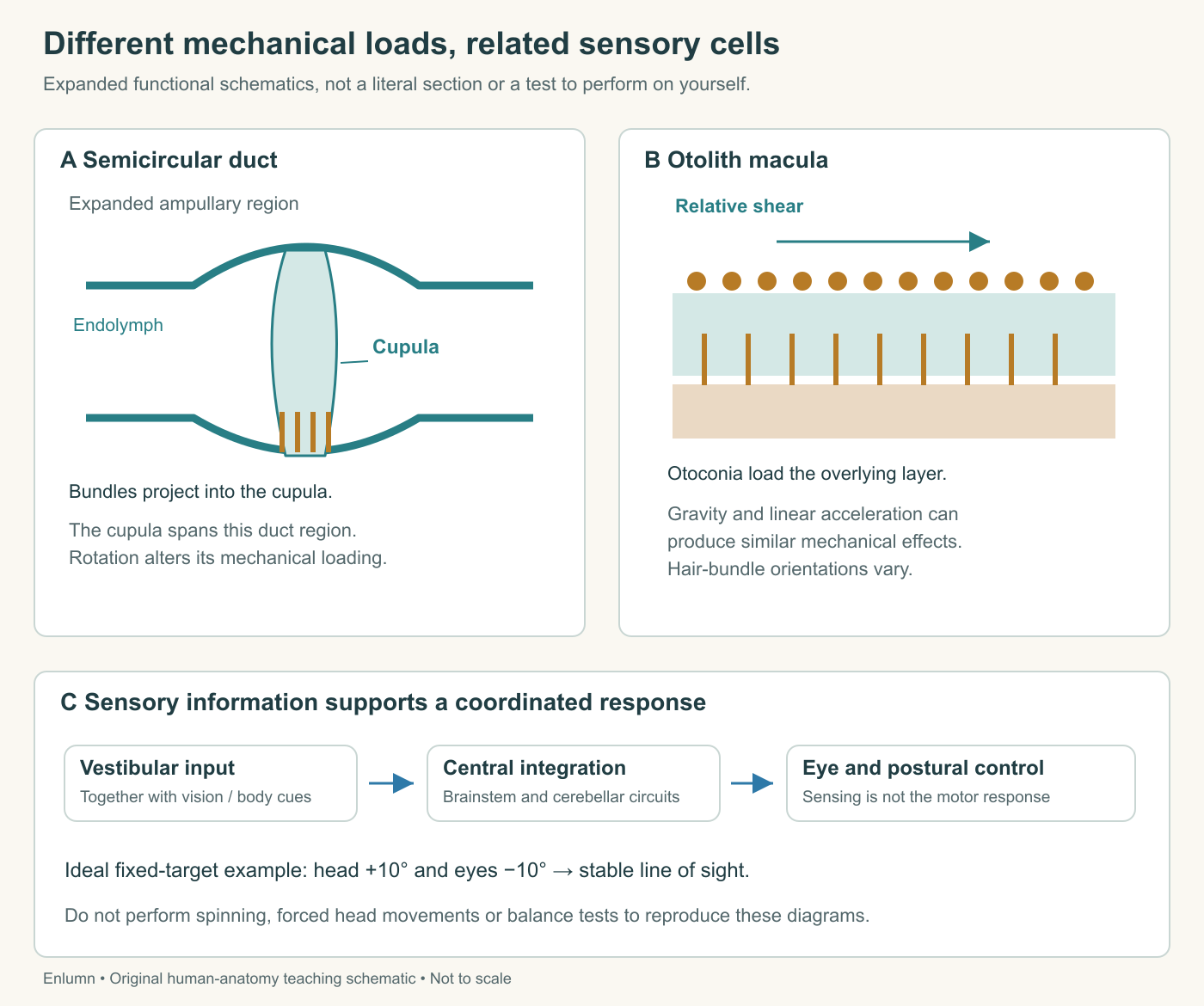
The added mass is essential to the comparison. A flexible structure having nearly the same density as its surrounding fluid behaves differently under gravity from a structure loaded with denser particles. This does not mean the ordinary cupula is a level gauge that slowly sinks toward the earth. The two receptor arrangements use different mechanical relationships. Explaining their materials and attachments does more work than memorizing that one is “for rotation” and the other “for balance.”
Tilt and translation can create ambiguity
A sustained head tilt changes the component of gravity acting along a receptor's sensitive direction. A linear acceleration can create a mechanically similar contribution. The otolith signal alone therefore cannot uniquely distinguish every combination of tilt and translation. Information from semicircular canals, vision, body sensation, and central processing helps resolve the situation. A receptor can be highly sensitive to a force while still leaving its cause ambiguous.
For an invented one-dimensional model, define output as G minus A, where G is the gravity-related component along the sensitive direction and A is translational acceleration in matching units. A condition with G = 3 and A = 0 gives three. A condition with G = 0 and A = −3 also gives three. The same output arises from different physical situations. These values simplify a three-dimensional physiological problem; they are not a direct equation for an individual hair cell.
Adding another measurement may distinguish the cases. If an independent source indicates that orientation changed while translation did not, the first account becomes more plausible. If it indicates linear acceleration without a tilt, the second does. But the independent source also has limits. A visual scene can move while the observer is still, so visual motion is not perfect ground truth for body motion. Integration means comparing informative but imperfect signals, not assuming one source can never mislead.
The train example now becomes more precise. Starting the carriage changes linear acceleration; continuing smoothly at constant velocity does not require a continuing signal of the same kind. Looking out a window could provide additional information about ongoing travel, while the inner-ear signals describe other aspects of the motion. This is a useful division of labor. No single receptor needs to measure speed, position, tilt, and intention all by itself.
Stabilizing the eyes requires an appropriate response
Vestibular signals reach brainstem and cerebellar circuits involved in integrating head-motion information. The vestibulo-ocular reflex, or VOR, helps generate eye movements countering head movement so a visual target can remain stable on the retina. For a simple leftward head rotation while viewing a distant fixed target, compensating eye rotation is rightward relative to the head. This is eye movement, not a change in lens accommodation. Purves and colleagues, Central Vestibular Pathways.
A simple angular bookkeeping model explains the direction. Let head rotation in the world be plus ten degrees and eye rotation relative to the head be minus ten. Their sum is zero, so the line of sight remains fixed in the model. If the eye rotates only minus six, the sum is plus four: compensation is incomplete. The calculation omits translations, target distance, and detailed eye geometry. It illustrates the relationship rather than setting a clinical criterion.
The target matters. If the intended object moves with the head rather than remaining fixed in the world, the desired eye behavior changes. A control system must relate sensory input to the task, not blindly execute the same correction in every circumstance. Central regulation and other eye-movement systems contribute to real gaze behavior. This is another reason that a small reflex diagram should be read as a selected circuit serving a selected situation.
Balance requires more than detecting motion
Signals from the ears cooperate with vision and information from muscles, joints, and skin. Motor systems must then produce effective forces and movements. A person can have informative sensory input yet insufficient strength or coordination for a particular postural challenge. Conversely, reliable motor capacity cannot guarantee success if the relevant sensory information is unavailable or misleading. The outcome belongs to the interacting system. NIDCD, Balance Disorders.
A fictional controller demonstrates the distinction. Its sensor correctly reports that a platform tilted, but its actuator cannot produce the necessary correction. The final position is unstable despite accurate sensing. In a second version, the actuator is adequate but the sensor reports the wrong direction. Both fail to stabilize, yet they require different explanations. Observing failure alone does not identify whether the input, interpretation, output command, or mechanical execution was responsible.
An additional complication is compensation. Suppose the first sensor becomes less reliable and the controller begins weighting another source more heavily. Performance may improve under conditions where that source is informative and worsen when it is not. A successful result in one environment does not establish that the original sensor recovered. This is a general lesson about functional tests: specify the task and available cues before drawing a conclusion about a component.
A complete account names the missing information
For every vestibular explanation, identify the mechanical input, receptor arrangement, neural signal, and relevant behavior. Then name what the observation cannot resolve. A changing paired signal may support an account of rotation without measuring the person's world position. An eye movement can reveal a compensatory output without being a direct measurement of cupular displacement. A report of dizziness cannot by itself locate a lesion or establish that the inner ear is the cause.
This discipline makes the course's final comparison possible. Hearing begins with acoustic mechanical input; vestibular sensing uses other mechanical relationships to inform orientation and motion. Both involve hair-cell transduction and neural processing, but their structures and tasks differ. A shared cellular strategy can support distinct sensory functions because the surrounding apparatus determines what moves the bundle and the connected circuits determine how that information is used.
Check your understanding: In the fictional otolith model, why can an output of three not establish whether the head tilted or underwent linear acceleration?
Expected answer: Different combinations of the gravity-related component and linear acceleration yield the same output. Additional information about orientation and motion is needed; sensitivity to a resultant force does not uniquely identify its physical cause.
Application
Allow 20 minutes. Draw one semicircular duct with its ampulla, crista, hair bundles and cupula. Beside it, draw an otolith macula, bundles, and an otoconial layer. Label the different mechanical inputs and note the simplified geometry.
Calculate the paired differences for 50/50, 70/30 and 30/70: zero, plus 40 and minus 40. Explain why their identical sums miss direction. Next, use the gaze model for head rotation plus twelve and eye rotation minus nine: residual rotation is plus three. Explain why this is not a measure of lens focus.
Finish with 150 words explaining the windowless-train ambiguity and one additional cue that could help. Identify a limitation of that cue. All movements are imagined or supplied on paper; do not spin, provoke dizziness, or attempt a balance challenge.