Movement and elimination
A person finishes breakfast and soon feels the need to use the bathroom. It is tempting to imagine breakfast already arriving at the end of the digestive tract. Yet a signal can travel much faster than the meal whose arrival produced it. Eating can change colonic activity while the new food remains far upstream. The material being moved may belong to earlier meals, already mixed with secretions, microbes, and shed cells.
That distinction introduces the problem of this chapter. Material must move, but movement is not continuous forward travel at a single speed. The large intestine also retains contents, exposes them to its surface, accommodates changing volumes, and coordinates an outlet. We will follow those operations separately before explaining how they work together.
Contraction is an event; transport is an outcome
Smooth muscle in the intestinal wall changes the shape of the lumen. Circular muscle can narrow a region, while longitudinal shortening changes its length and geometry. Their effects depend on coordination along the bowel, the state of adjacent regions, and the mechanical properties of the contents. A squeeze does not carry an instruction saying how much material must move or in which direction.
Imagine a flexible tube containing a thick suspension. Narrowing its middle could displace material toward both ends. If the downstream region relaxes while the upstream region provides resistance, forward displacement becomes more favorable. If neighboring contractions repeatedly rearrange contents without a large net displacement, there can be substantial mixing but little progress toward the rectum. These are mechanical distinctions, not separate ingredients of the stool.
Colonic motor activity includes localized and propagating patterns. Some activity moves contents over relatively short distances; some larger coordinated events support movement over longer distances. The familiar term mass movement describes substantial movement of contents. A high-amplitude propagated contraction, by contrast, is usually identified through a pattern of pressure measurements. The two concepts are related, but one describes material transport and the other an observed motor pattern.
The abstract of a human colonic-motility review discusses this relationship. Its useful warning for our purposes is methodological: the way movement is named can reflect the instrument used to observe it. We have accessed the abstract, not reconstructed its entire evidence base. A pressure recording alone cannot tell us the exact mass, composition, or final destination of everything displaced.
For an original example, place three fictional pressure sensors along a segment. They register peaks in upstream-to-downstream order. That supports propagation of a pressure event across the sampled locations. It does not establish that one marked particle traveled the entire distance. To answer that question, we would need a method that follows contents, alongside a clear account of how the marker behaves.
Local control participates in a wider network
The bowel wall contains the enteric nervous system, networks of neurons that help coordinate movement and secretion. The myenteric plexus lies between major muscle layers and has an important role in motor control. Enteric circuits can respond to local conditions, while communication with the spinal cord and brain changes the behavior of the system. Local organization and central influence coexist.
Sensory information reports features such as distension and the state of the gut environment. Motor pathways influence smooth muscle and other effectors. Autonomic pathways modulate this activity, but labeling one branch as a universal accelerator and another as a universal brake loses the regional and task-dependent organization. Coordinated passage requires some structures to contract while others relax.
Eating can recruit a gastrocolic response: increased colonic motor activity associated with a meal. The response is not proof that the meal has physically reached the colon. Its timing and expression vary. A useful analogy is a warehouse receiving an arrival notice and reorganizing existing stock before the new delivery reaches the loading area. The analogy explains the separation between information and cargo; it does not imply conscious planning by the bowel.
Sleep, waking, meals, nervous-system activity, and properties of the contents can all influence the observed pattern. Consequently, a brief recording taken under one set of conditions is a sample of behavior. It should not automatically stand for an entire day. Nor should a person be expected to reproduce a diagram's sequence at fixed clock times.
Transit has a distribution, not just an average
Transit time describes how long material takes to pass through a defined region under a specified measurement method. The region could be the whole digestive tract or a particular colonic segment. The endpoint could be first appearance of a marker, passage of half the markers, or another predefined measure. Those endpoints need not have the same value.
Consider two fictional groups of four markers. Group A leaves a defined segment at 10, 10, 30, and 30 hours. Group B leaves at 20, 20, 20, and 20 hours. Both groups have a mean of 20 hours. Group A nevertheless includes earlier departures and longer retention. If an experimental outcome depends on time spent in a particular environment, those distributions could matter even when the averages match.
The markers must also represent what we want to study. A particle, dissolved molecule, gas bubble, and water molecule need not share an identical trajectory. Mixing and exchange complicate the idea of tracking a whole meal as one coherent object. A measurement of one component can be informative without becoming a universal stopwatch for all components.
Retention affects the opportunity for epithelial exchange and microbial transformation. However, opportunity is not a guaranteed rate. Longer contact does not ensure more water removal if transport is impaired or if luminal solutes retain water. Shorter contact does not reveal whether altered movement started the disturbance or developed in response to inflammation or secretion. We therefore connect transit to other processes without letting it explain everything by itself.
Storage depends on a living wall
The colon can retain contents upstream of the rectum. The rectum then participates in temporary storage and signaling as material arrives. Its wall can accommodate some additional volume without pressure increasing in direct proportion at every step. This capacity helps separate arrival from immediate evacuation.
Compliance expresses a change in volume relative to a change in pressure over a specified range. In a simplified comparison, one reservoir accepts 40 arbitrary volume units while pressure rises by 4 units. Another accepts the same volume while pressure rises by 10. Their calculated compliances over those ranges are 10 and 4 volume units per pressure unit. These invented values illustrate a relationship; they are not human reference ranges.
Real pressure-volume relationships can be nonlinear and affected by active muscle responses, the speed of filling, and the measurement procedure. Sensation adds another layer. Two reservoirs with similar mechanical responses need not produce the same reported urge in two people. Nerve signaling, interpretation, and prior conditions influence the experience.
Accommodation also explains why an urge can change over time without the contents simply disappearing. Altered wall tension and neural responses can modify sensation. That observation should not be converted into advice to habitually postpone elimination. Our question is how storage can occur at all, not how long any individual should delay.
The outlet contains more than one control
The internal anal sphincter is smooth muscle continuous with the bowel's circular muscle. It contributes to resting closure through activity that is not ordinarily under direct voluntary command. The external anal sphincter is skeletal muscle with voluntary and reflex control. Calling it voluntary does not mean it remains inactive unless a person consciously thinks about it.
The puborectalis is a sling-like part of the pelvic-floor musculature around the anorectal junction. Its activity contributes to the angle and support of that junction. During effective evacuation, its relaxation helps reduce the resistance associated with the maintained angle. It works with the sphincters and other structures rather than serving as an isolated lever that determines the entire outcome.
Rectal distension can evoke the rectoanal inhibitory reflex, a transient reduction in internal-sphincter activity. This is one component of a larger response. A temporary pressure reduction in one muscle region does not mean the entire outlet has opened or that evacuation must occur. Other muscular contributions can preserve closure while sensory information is processed.
The introductory mechanism in Physiology, Defecation supports the distinction between smooth-muscle, skeletal-muscle, and neural contributions. Here we use those selected anatomical relationships, not the source's fixed stool-composition percentages or its oversimplified clinical categories. The chapter's movement model does not require either of those additional claims.
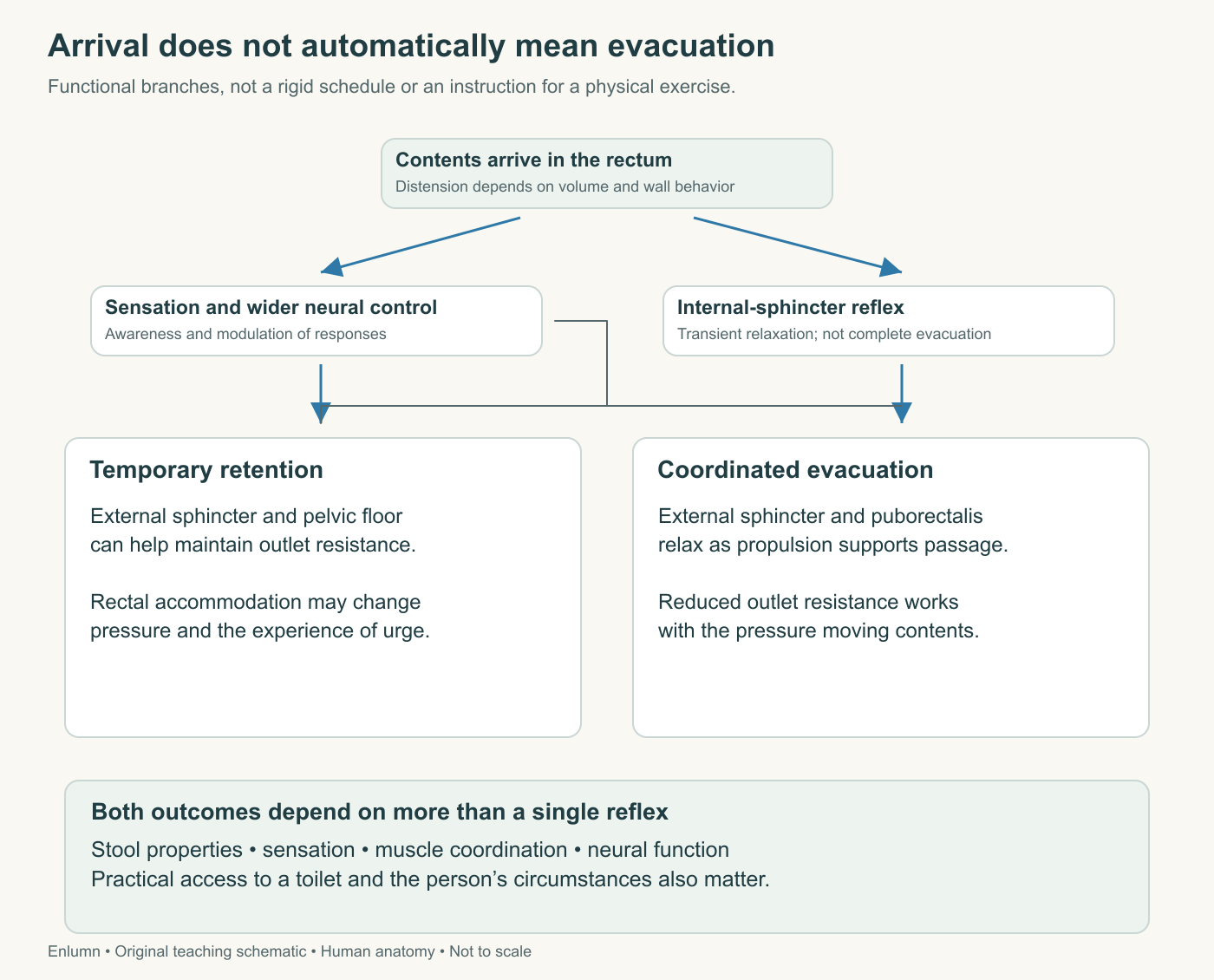
The branches are functional possibilities, not a rigid timed program. Reflex relaxation of the internal sphincter is not equivalent to relaxing every outlet structure.
Measuring a reflex without turning it into a verdict
A 2012 human study by Cheeney and colleagues examined ten healthy volunteers using a probe with 256 pressure sensors and graded rectal balloon distension. The researchers found that the recorded relaxation varied with location around and along the anal canal and with distension volume. They interpreted different pressure regions in relation to muscular contributions. The study makes sensor placement consequential: a recording from one location can miss a response more evident elsewhere.
This is a small physiological study under an artificial distension procedure. It does not establish universal diagnostic cutoffs, describe ordinary stool passage in every participant, or show that one reflex measurement explains someone's daily continence. Selected methods and results were inspected; the underlying figures and raw recordings were not independently reanalyzed.
Now apply that lesson to a fictional instrument. Sensor A records pressure falling from 70 to 30 units. Sensor B, farther along the outlet, records 55 to 45. A headline saying pressure fell by 40 units is incomplete unless it identifies where, when, and under what stimulus. The two sensors may be describing different aspects of the same coordinated response. Their disagreement need not mean one instrument is broken.
Retention and evacuation require different coordination
When elimination is postponed, external-sphincter and pelvic-floor activity can help maintain closure, while accommodation changes the response to filling. When elimination proceeds, outlet relaxation must be coordinated with forces that move contents through it. Abdominal and rectal pressures contribute, but greater pressure is not a substitute for appropriate reduction of outlet resistance.
Think of a fictional reservoir connected to a controllable opening. Raising reservoir pressure while keeping the opening tightly closed does not ensure effective discharge. Opening the outlet without adequate propulsion may also produce an incomplete result. This model explains why movement and outlet behavior must be evaluated together; it does not prescribe straining, breath holding, or a particular posture.
Stool consistency matters as well. A system able to retain one material may face a different challenge when contents become much more liquid. Sensation can provide warning, but warning must connect with functioning muscles and a practical opportunity to reach a toilet. Mobility, access, and the person's circumstances belong in an account of successful continence alongside tissue physiology.
The NIDDK explanation of fecal incontinence distinguishes leakage associated with an urge from leakage without awareness. Neither pattern is evidence of laziness or inadequate character. Continence depends on several interacting capacities, so losing it cannot reasonably be reduced to insufficient willpower.
Put the evidence beside the proposed explanation
Suppose a fictional case reports retained markers in the colon and difficulty emptying the rectum. One explanation emphasizes slow movement upstream. Another emphasizes impaired outlet coordination. The observations could also reflect more than one contribution. A single total transit measurement may not resolve their relative importance, especially if downstream retention affects upstream passage.
A stronger explanation would identify what additional evidence bears on each part: regional movement information for passage, pressure and coordination measurements for the outlet, and sensory assessment for awareness. Such information is interpreted clinically in context. For this course, the important achievement is recognizing that these measurements answer different questions.
The movement chapter therefore adds a time dimension to the material-flow account. The same amount of material entering the colon can be mixed, retained, redistributed, and discharged in different patterns. Those patterns change the conditions for exchange and sensation without replacing either. At the end of the route, an anatomical opening becomes a controlled passage through coordinated muscle activity, neural information, and circumstances outside the organ itself.
Check your understanding: A rectal stimulus produces a temporary fall in internal-sphincter pressure, but no stool passes. Does this show that the reflex failed? Give two other processes relevant to the outcome.
Expected answer: No. Internal-sphincter relaxation is one component, not equivalent to complete evacuation. External-sphincter or puborectalis activity may preserve outlet resistance, and propulsion or the presence and properties of contents also matter. The measurement must be interpreted at its recorded location and under its specific stimulus.
Application
Spend about 15 minutes drawing two branches from “contents arrive in the rectum.” One branch should show temporary retention and the other coordinated evacuation. Include sensation, the internal-sphincter reflex, external-sphincter activity, puborectalis, and movement-producing pressure. Label at least one connection as modulation rather than an all-or-nothing command.
Then explain in 150–200 words why an urge after breakfast does not demonstrate that breakfast has reached the rectum. Add a measurement that could follow material rather than merely record a signal.
A successful answer distinguishes information from cargo, places the reflex before either possible behavioral outcome, and shows that effective evacuation involves reduced outlet resistance as well as propulsion. A suitable material measurement follows a defined marker with stated limitations; pressure alone does not establish the marker's destination. This is a paper exercise, with no physical demonstration required.