Energy and exchange
Two animals swallow the same mass of food. By evening, one has stored material for later use while the other has drawn down its reserves. There is no contradiction. Equal food mass need not contain equal chemical energy, equal amounts may not be absorbed, and the animals may have spent the day doing different things. Even a perfectly measured meal is only one entry in a body's account.
The previous chapters traced routes and compared geometry. We can now ask what moves along those routes and what happens to it. A living animal needs both material and energy. These requirements are connected, but they are not interchangeable: carbon atoms can become tissue or leave in carbon dioxide, while chemical energy can support work and ultimately disperse as heat. A complete explanation has to follow both accounts.
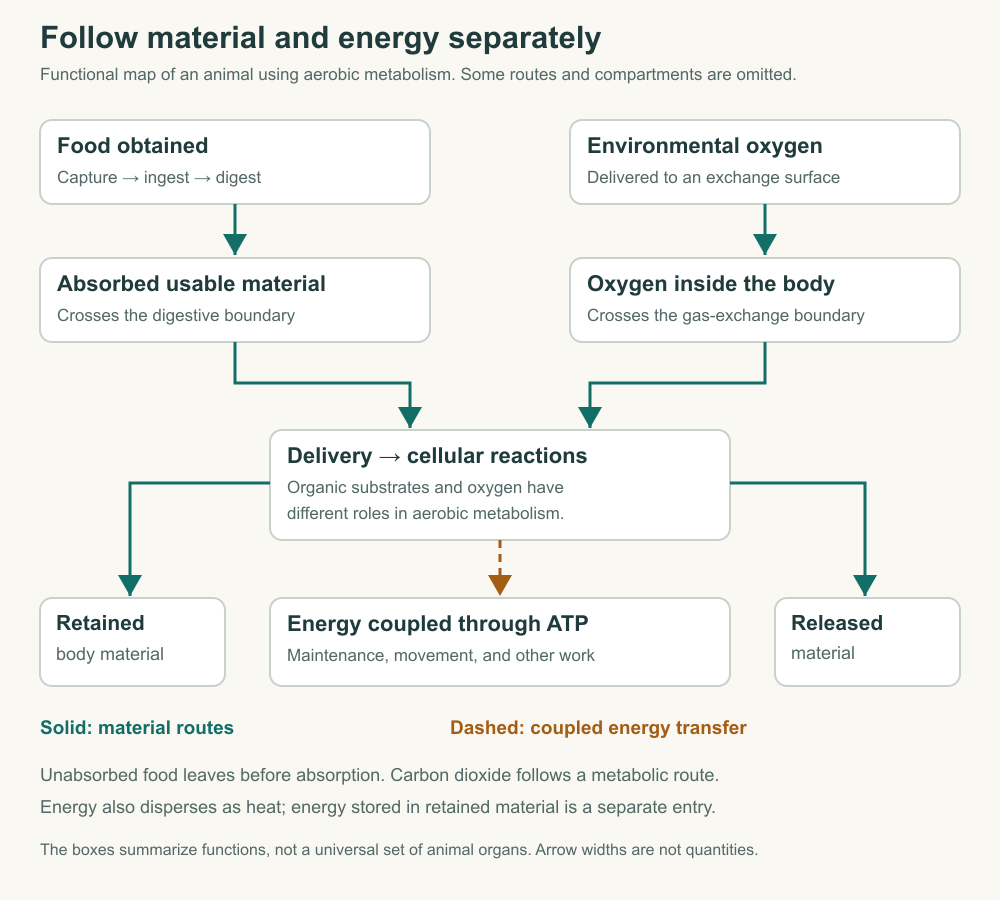
A meal supplies ingredients as well as energy
Food contains molecules that can contribute to cellular construction, storage, and energy-releasing reactions. Water and mineral ions also matter, although they are not interchangeable with an energy-rich organic molecule. A calorie count alone cannot establish whether a food supplies everything required to build and maintain a particular body. Enough of one resource does not guarantee enough of another.
Imagine a construction exercise in which you have abundant fuel for tools but too few suitable fasteners. More fuel will not supply the missing metal. The analogy has limits—cells can transform many of the molecules they receive—but it makes one important distinction visible. Energy enables processes; the material products still require appropriate atoms and usable chemical starting points.
Suppose a fictional food sample contains more water than another sample of the same mass. The wet masses match, but the amount of dry organic material may differ. Even comparing dry mass does not establish identical energy content or digestibility. Before drawing a conclusion from “the animals ate the same amount,” ask what amount was measured and which comparison it supports.
There is a second distinction between food available and food obtained. An animal may encounter many particles but capture only some, ingest a subset, and absorb only part of what it ingests. Each stage can alter the quantity and composition that reaches tissues. The body's effective supply begins with an environmental resource and passes through a series of selective events.
Digestion changes material; absorption changes its location
Digestion includes processing that makes food material available in usable forms. Mechanical actions can change particle size and expose surfaces; chemical reactions can change the molecules themselves. Absorption concerns transfer across an exchange boundary into the body's internal routes. A particle becoming smaller and a nutrient crossing a lining are different events, even when they occur close together.
OpenStax's digestive-process overview distinguishes ingestion, digestion, absorption, and elimination. We use those functional distinctions without transferring its detailed mammalian sequence to every animal. The animal courses will identify where digestion takes place and how particular feeding structures work. OpenStax: digestive system processes
Imagine a marked food molecule entering a digestive space. You cannot infer its later location simply because the food disappears from view. It may have been chemically changed, incorporated into another substance, transported elsewhere, or passed onward in unabsorbed material. A meaningful trace specifies what the marker follows. An atom label follows atoms through transformations; a measurement of one intact molecule may stop detecting it after a reaction.
This matters when interpreting an experiment. Less of a substance in the digestive contents could reflect absorption, chemical conversion, or a change in the amount of content sampled. The investigator needs measurements that distinguish those possibilities. A diagram with separate processing and boundary-crossing arrows helps reveal what the measurements would have to establish.
ATP connects energy transformations to cellular work
Cells use coordinated chemical reactions to couple energy release to processes that require an input. ATP, adenosine triphosphate, participates in many of those couplings. Its hydrolysis to ADP and phosphate can be joined to changes in proteins or other reactions so that the combined process can proceed. Regenerating ATP requires another energy input. The same small pool can therefore turn over repeatedly.
The relevant energy change belongs to the complete reaction, including the bonds broken and formed and the surrounding conditions. It is misleading to imagine that breaking a particular bond, by itself, releases a packet of energy. OpenStax describes ATP hydrolysis and regeneration through the difference between reactants and products and the coupling of reactions. OpenStax: ATP and energy coupling
Consider an invented ATP account that begins with twenty arbitrary molecular units. During a short interval, twenty units are regenerated and twenty are used. The pool still contains twenty at the end. A single measurement of pool size would miss the turnover. If use briefly exceeds regeneration, the pool can fall even though the animal has substantial stored food material elsewhere.
The missing link in that situation could be access, processing, or the capacity of the relevant pathways. Stored chemical material is not automatically an immediately available rate of ATP supply. When an animal increases activity, the problem includes how rapidly it can regenerate ATP at the working tissues, not just the total energy represented by its reserves.
Oxygen supports a particular chemical route
In mitochondrial aerobic metabolism, electrons pass through a chain of reactions, and molecular oxygen serves as the final electron acceptor, forming water. The associated energy transformations help maintain a proton gradient that can drive ATP production. Oxygen supply matters because it participates in this route; it is not a substitute for the organic substrates being processed. OpenStax: oxidative phosphorylation
At the whole-body level, this connects feeding and gas exchange without making them the same process. One route delivers usable organic material; another supplies oxygen for oxygen-dependent reactions. A body can have one resource available while the other limits a particular activity. Adding more food cannot, by itself, replace a missing oxygen supply to a tissue using that route.
Not every ATP-producing step directly requires oxygen. Glycolysis processes glucose and produces a net ATP yield without directly consuming oxygen; continuing the pathway also requires regeneration of its electron carrier. The distinction prevents the false inference that all cellular ATP production instantly stops whenever oxygen-dependent production is restricted. OpenStax: glycolysis
The ability to continue activity under restricted oxygen depends on the animal, tissue, pathways, available substrates, and duration. The existence of an alternative process does not prove it can sustain the same work indefinitely. We will examine documented examples in the animal-group courses. Here, identify the route being discussed before claiming that a single resource explains all energy supply.
Build an energy account with a clear boundary
Use a fictional daily account measured in kilojoules, abbreviated kJ. A joule is a unit of energy; a kilojoule is one thousand joules. Assign the ingested food 100 kJ of chemical energy. Suppose 30 kJ leaves in unabsorbed material, leaving 70 kJ absorbed. Of that absorbed amount, assign 5 kJ to chemically energetic excreted products, 50 kJ to metabolic expenditure, and 15 kJ to a net increase in retained chemical energy.
The account balances: 100 = 30 + 5 + 50 + 15. Metabolic expenditure here includes the energy released during the day's processes that is not retained or exported in the chemical categories already listed. Its eventual destinations include heat and work. We are not claiming that every animal has these proportions, or that one day's food immediately follows this exact schedule.
The boundary prevents double counting. If you already count energy leaving in an excreted compound, do not also place that same energy under heat released within the animal. If work exported to the surroundings later becomes heat there, that does not constitute a second expenditure by the animal. The location and time interval of the account determine which crossing is counted.
Now increase expenditure from 50 to 70 kJ while leaving the other assigned entries unchanged. Net retained energy becomes −5 kJ: 100 − 30 − 5 − 70. The minus sign means the animal has drawn on previously retained chemical energy in the model. It does not mean the animal swallowed a negative meal or that energy disappeared.
An energy balance is not a mass balance
The same animal also has a material account. Atoms entering in food, water, and gases can be retained, transformed, or released. A gram is a unit of mass, whereas a joule is a unit of energy. You cannot add fifty grams of food to ten kilojoules of expenditure and call the result a body balance. The quantities describe different properties.
Suppose the animal's mass rises while its retained chemical energy falls. That can happen in a conceptual account if, for example, water retention more than offsets a loss of energy-rich material. The scale would record a net mass increase. It would not measure the composition of that increase or establish that stored energy increased. Conversely, an unchanged mass can conceal changing proportions of water and organic material.
An atom-based trace also reveals why waste routes extend beyond undigested food. Carbon that entered in an absorbed nutrient may later leave as carbon dioxide after cellular reactions. Material that never crossed the digestive lining belongs to a different route. Calling both simply “waste” can obscure whether the change occurred before absorption or during metabolism.
These distinctions become practical reading tools. If a study measures body mass, ask whether it also measures composition. If it measures food intake, ask whether it measures absorption. If it estimates expenditure, ask what observations and assumptions support the estimate. You can respect the measurement while refusing to let it answer a different question unnoticed.
Rate can limit activity despite a large reserve
A total reserve answers how much energy-bearing material is available within an account. Power is an energy-transfer rate: energy per unit time. In SI units, one watt is one joule per second. A reserve may be large enough for a proposed task in total while the body cannot deliver the required rate at the working tissue.
Imagine two fictional animals each retaining 600 joules of usable reserve for a particular modeled activity. One pathway can support expenditure at ten joules per second; another can support only two. Ignoring all other costs, the first could sustain that rate for sixty seconds and the second for three hundred seconds. Neither comparison alone says which could perform a task requiring five joules per second.
Under those assigned limits, the second cannot meet the task's instantaneous demand even though its low-rate operation lasts longer. The first has sufficient modeled rate, but the duration of the task still matters. This is a capacity comparison, not a statement that real animals operate at constant rates until a reserve suddenly reaches zero.
Duration and history also affect interpretation. The same present activity can follow a meal, a prolonged period without feeding, or earlier exertion. The visible action does not reveal all previous inputs and expenditures. A biological account gains explanatory force when it connects the current rate to the stores and processes that make it possible.
An inactive animal still has cellular work to support. Stopping visible locomotion does not remove the demands of maintaining gradients, processing molecules, and replacing components. A reserve-duration calculation that assigns every joule to movement would omit those continuing costs.
Read an oxygen measurement as evidence
Researchers can use oxygen consumption as evidence about oxygen-dependent metabolism, but the measurement is not identical to every possible energy transformation. A change in oxygen concentration inside a chamber must first be connected to the animal rather than another process in the setup. The interpretation then depends on conditions and on what kind of metabolic activity is being estimated.
Consider a fictional measurement system. A chamber containing an animal shows an oxygen decrease of twelve units during an interval, while a comparable chamber without the animal decreases by two. Subtracting the blank suggests ten units associated with adding the animal, if the blank represents the relevant background and the other assumptions hold. It does not prove that all twelve units were consumed by the animal itself.
Suppose the chamber also changes the animal's movement or the oxygen available during the measurement. The recorded rate describes those conditions. It cannot be transferred automatically to a freely behaving animal throughout its day. More precise instruments can reduce one kind of uncertainty while leaving the biological comparison uncertain. Precision does not make the setup disappear.
By now, “the animal needs food for energy” can become a connected explanation: resource encounter, ingestion, processing, absorption, delivery, cellular transformation, work, retention, and release. Each step has a quantity, a rate, and conditions. The next chapter asks how animals respond when those conditions change while their cells still have to function.
Application
Reconstruct the day's account
Use the fictional 100-kJ daily intake. Keep unabsorbed chemical energy at 30 kJ and excreted chemical energy at 5 kJ. Calculate net retained chemical energy if metabolic expenditure is 40, 65, or 75 kJ. State the boundary and explain each sign. Do not convert the result to body mass without additional information.
Diagnose the missing step
A report says, “The animal had plenty of food, so its reduced activity cannot be an energy-supply problem.” Give two different missing steps between food availability and tissue activity. Then explain why an unchanged ATP pool does not demonstrate unchanged metabolic activity.
Model interpretation
Retained chemical energy is 25, 0, or −10 kJ, respectively: 100 − 30 − 5 minus the specified expenditure. The negative result represents a net draw on previous reserves within this account. A zero result means balanced retained chemical energy, not absence of feeding, metabolism, heat release, or work.
Food may not be captured or absorbed at a sufficient rate, or usable material may not be delivered and processed at the working tissue's required rate. Oxygen supply may constrain an oxygen-dependent route despite abundant organic substrate. These are candidate explanations to investigate, not diagnoses established by observing reduced activity alone.
An ATP pool can remain unchanged while both regeneration and use accelerate together. Measurements of amount, turnover, food mass, energy expenditure, and body composition therefore answer related but distinct questions. A strong explanation identifies which one was actually measured.