Sensing and exchanging heat
A cool metal chair and a wooden chair can stand in the same room for hours and still feel different when touched. The explanation is not necessarily that the metal has a lower temperature. Materials differ in how they exchange heat with the skin, and sensory responses reflect the changing conditions at the contact. The feeling belongs to an interaction between a surface, a tissue, and a nervous system.
Now add a second question: does feeling cool mean the body is losing enough heat overall? Not necessarily. A local sensation and whole-body heat balance are different outcomes. This chapter keeps two routes in view: information traveling from skin toward the nervous system, and control signals influencing blood vessels and sweat glands. They interact, but one is not a substitute for the other.
A stimulus changes cellular activity
Sensory transduction converts a physical or chemical event into a change in cellular signaling. In a cutaneous sensory ending, deformation or temperature can influence membrane proteins and ion movement. The resulting electrical change can alter the activity sent along a sensory nerve. The nervous system receives patterns of activity, not tiny pieces of texture or temperature carried intact to the brain.
A receptor potential is a local graded electrical change. An action potential is a propagated electrical event with different properties. In an individual nerve fiber, a stronger stimulus is not generally represented by proportionally taller action potentials. Changes in firing rate, timing, and recruitment across fibers can carry information about the stimulus.
For an original example, imagine a sensor producing three spikes in one observation window and nine in the next. The spikes need not become three times taller for the pattern to change. Nor does three times as many spikes guarantee three times the perceived intensity. Perception depends on the participating pathways and further processing, not one universal conversion factor.
The word receptor can refer to a membrane protein, a specialized cell, or an entire sensory end organ. We will make the scale clear. A Pacinian corpuscle includes an organized ending and its surrounding structure. A mechanically sensitive ion channel is a molecular component. Confusing those levels makes it difficult to explain how tissue mechanics influences neural activity.
Location and adaptation give different kinds of information
A receptive field is the region in which stimulation changes the response of a specified sensory neuron. Fields vary in size and can overlap. A small field can help distinguish nearby locations, while the collective activity of many neurons contributes to spatial information. The brain's processing also matters, so receptor density alone is not a complete explanation of tactile acuity.
Adaptation describes how a response changes during a sustained stimulus. A rapidly adapting unit responds especially to changes, such as the beginning, movement, or ending of an indentation. A slowly adapting unit can continue responding during a maintained stimulus. Rapid adaptation does not mean the receptor is defective or exhausted. It can make the unit informative about changing events.
Consider two fictional traces produced by the same maintained indentation. Trace A shows a burst at onset, little activity during the middle, and another burst when the indentation ends. Trace B continues firing throughout, though its rate changes. A is well suited to announcing transitions. B preserves information about the sustained contact. Neither trace alone describes every feature of the object.
The Purves textbook section on tactile mechanoreceptors provides selected human examples. Meissner corpuscles lie superficially in glabrous skin and have rapidly adapting responses. Pacinian corpuscles lie deeper and are particularly sensitive to vibration. Merkel cell–neurite complexes provide slowly adapting information relevant to sustained indentation and spatial detail. These are complementary contributions rather than one receptor for each everyday sensation.
Tissue around an ending helps shape the message
The capsule around a Pacinian ending affects how mechanical disturbances reach the nerve. The structure therefore participates in filtering a stimulus before central processing begins. A receptor is not merely a bare wire reporting whatever happens nearby; its surrounding material changes the relationship between external force and membrane deformation.
Hair-bearing skin adds sensory endings associated with follicles. Movement of a hair can influence activity without requiring deep compression of the whole region. Skin stretch and distributed mechanical forces recruit further responses. The result is a varied sensory population rather than an identical grid of touch buttons across the body.
An original mapping exercise makes that variety useful. Suppose one fictional unit responds within a small patch, while another responds to vibration transmitted across a larger region. A response from the second unit does not identify the source location with the same precision as the first. Its broad sensitivity may still provide valuable information about a rapid event.
Afferent means carrying information toward the central nervous system; efferent means carrying output away from it. Those terms describe direction relative to the central system, not whether a signal is good or bad. A peripheral nerve can contain multiple fiber types, so damage to a nerve can affect more than one function without every fiber having the same role.
Temperature sensation is not a universal thermometer
Cutaneous thermosensory endings respond to temperature and its changes over particular operating ranges. Their activity depends on the tissue's recent state as well as the current stimulus. Heat transfer at a contact can alter that local state rapidly. This is why the metal-and-wood example begins with material properties and change over time, not simply the room's temperature reading.
Imagine two materials initially at the same temperature below skin temperature. One transfers heat away from the contact more effectively during the first moments. The skin at that contact can cool faster, changing the sensory response. The stronger cooling sensation does not establish that the entire object began colder or that the body as a whole has cooled substantially.
Nociceptors respond to damaging or potentially damaging conditions. Their activity is distinct from the complete experience of pain. Pain includes sensory and emotional dimensions and is affected by processing throughout the nervous system. It is not a direct meter of visible tissue damage, and its reality does not depend on an observer seeing a wound.
The NINDS pain explanation describes how sensitization can change responses and how pain can persist beyond an initial injury. For this course, the implication is narrow: a change in a skin stimulus, sensory signaling, and a person's experience are related but distinct events. None should be dismissed merely because another measurement appears unchanged.
Blood brings heat toward the surface
Skin circulation supports its cells and participates in heat exchange. When more warm blood reaches superficial vascular networks, it can deliver more heat toward the body's boundary under suitable conditions. Vasodilation is widening of vessels; vasoconstriction is narrowing. Their effects on local flow depend on the wider circulation and pressure relationships.
Sending heat toward the surface is not the same as successfully releasing it to the environment. If the surrounding conditions favor heat gain, increased surface exposure to those conditions cannot be assumed to cool the body. We must distinguish transport within the body from transfer across its outer boundary.
The abstract of Smith and Johnson's review of human skin blood flow and sweating links vascular and sweat responses to heat balance while noting other influences on their control. Blood-pressure demands and other physiological conditions can interact with thermoregulation. A skin vessel does not operate independently of the rest of the circulation.
In a fictional balance, the body generates 300 watts of heat and loses 250 watts through all counted routes. Net storage rises at 50 joules per second. Over ten minutes, that is 30,000 joules. This calculation does not predict a particular person's temperature rise without further information about body size, heat distribution, and changing responses. It establishes that a small continuing imbalance can accumulate.
Sweat secretion creates an opportunity for evaporation
Thermoregulatory sweating chiefly uses eccrine glands. Neural control includes sympathetic pathways that release acetylcholine at the gland. Sympathetic does not mean that every target uses the same neurotransmitter. The secretory coil produces fluid, and the duct modifies its ion composition before it reaches the surface.
The abstract of Gagnon and Crandall's human sweating review describes this cholinergic pathway and ductal ion reabsorption. It also notes thermal and nonthermal influences on sweating. The course uses these selected mechanisms without treating a sweat rate as a simple reading of internal temperature.
Evaporation is the transition from liquid water to water vapor. It requires energy. When sweat evaporates under conditions in which heat is drawn from the skin and nearby body tissues, it supports cooling. Sweat that drips away or remains liquid on the surface has not supplied the same evaporative heat loss merely because the gland produced it.
Suppose a fictional person secretes 100 grams of sweat during an interval, but only 60 grams evaporate in the relevant heat-exchange setting. Using an approximate teaching value of 2.4 kilojoules per gram, that evaporation corresponds to 144 kilojoules. Multiplying secretion by the same factor would give 240 kilojoules and overstate the evaporative amount by 96 kilojoules. These values illustrate energy accounting, not a hydration or exercise prescription.
The surroundings determine how much cooling is available
Heat exchange also occurs by conduction, through contact; convection, involving moving air or fluid; and radiation, through electromagnetic exchange with surrounding surfaces. Each route has its own relevant conditions. Air temperature alone does not describe the temperature of every surface seen by the body or every object it touches.
When air is hotter than skin, convection can add heat rather than remove it. Evaporation can still support cooling if the water-vapor conditions permit it. Radiative exchange must be considered separately: a cooler surrounding surface can receive radiant heat even while the air is warmer. Broad statements about the environment should therefore identify which route they mean.
Humidity affects the water-vapor gradient between the skin's immediate environment and the wider air. Clothing and air movement alter resistance to transfer. Consequently, equal sweat secretion can produce different evaporation in different settings. A wet surface is evidence of liquid present, not proof that cooling is keeping pace with heat production and gain.
This distinction explains why the body's two useful responses—moving heat toward skin and secreting sweat—still operate within physical limits. A control system can increase effort without achieving its target when the available transfer conditions are unfavorable. The result depends on the system plus its environment.
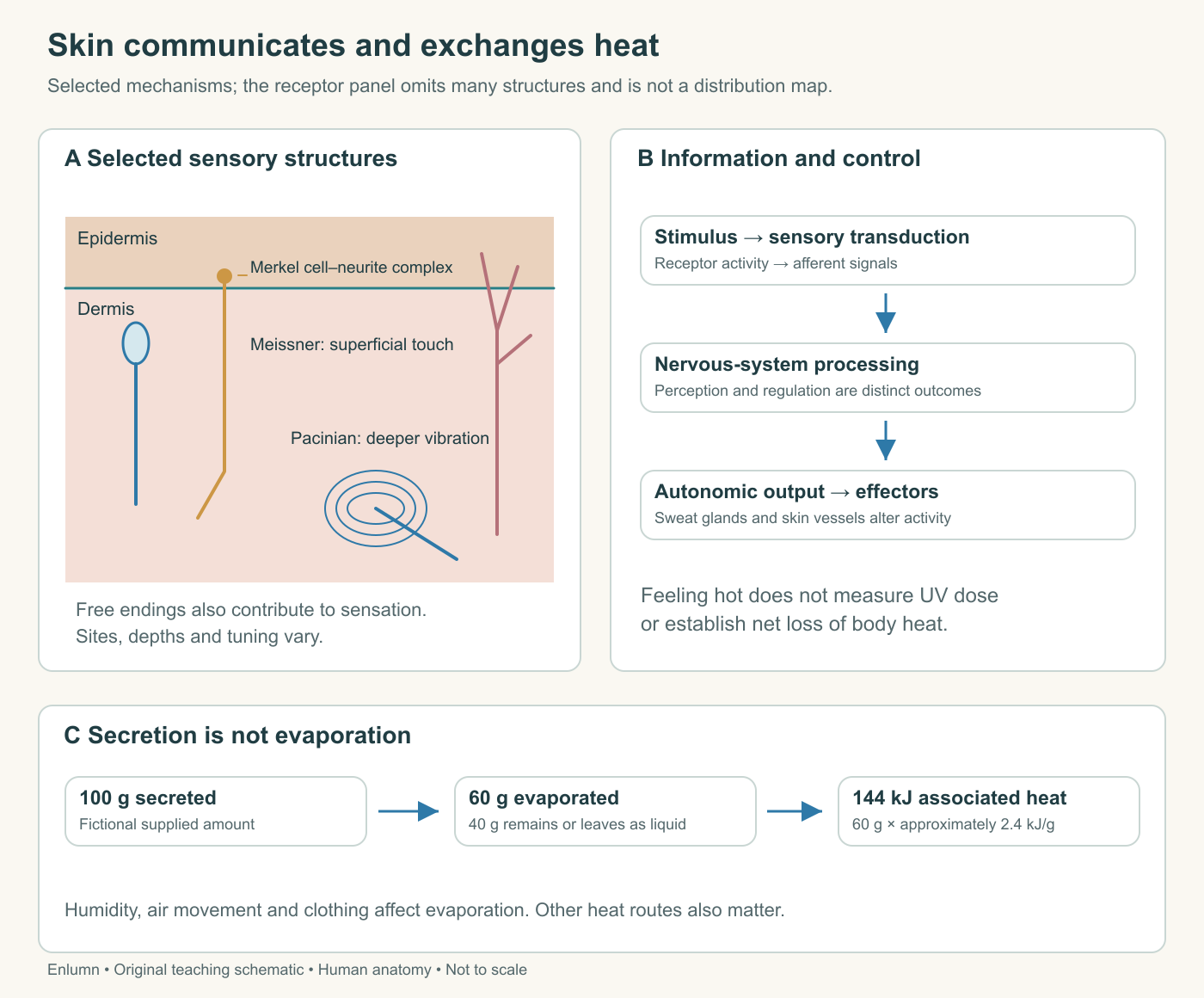
Sensory activity, sweat production, evaporation, and net heat loss are different stages. The diagram preserves those distinctions rather than using a single arrow labeled cooling.
Three measurements reveal different stages of sweating
A 2018 human study by Gerrett and colleagues followed sixteen participants through a controlled exercise-and-rest protocol. It compared regional surface sweating, stratum-corneum hydration, and electrical skin conductance. The variables changed at different times, so they could not simply replace one another as measurements of the same event.
The accepted manuscript's selected methods and limitations also matter. Participants were healthy university staff and students; the measurements sampled particular sites and conditions. Contact electrodes covered skin and restricted evaporation beneath them, complicating interpretation as sweating declined. This is evidence about a defined protocol, not a universal mapping from a wearable's conductance reading to sweat output or emotional state.
The lesson extends beyond this one study. A sensor can alter the local environment it measures. Different instruments can sample different depths, areas, or stages. If their signals disagree, the first question should be whether they were ever measuring the same quantity under equivalent conditions.
Link the routes without collapsing them
Imagine a fictional patch of skin with impaired sensation but intact sweat-gland output. The person might receive less useful warning from that patch even though one effector continues to work. Now imagine preserved thermal sensation but reduced local sweating. Awareness does not establish that evaporation is available. These are separate possible disruptions in a connected system.
The same reasoning applies when more than one pathway changes together. A nerve disorder could affect sensory and autonomic fibers, but the pattern depends on which components are involved. A local skin observation does not establish the state of every pathway or the person's whole-body heat balance.
Skin therefore participates both in knowing about the environment and in changing the body's exchange with it. The receptor, the neural message, the subjective experience, the control signal, the gland or vessel response, and the physical transfer each deserve their own place in an explanation. Keeping those stages visible makes the system easier to understand and prevents a single familiar sensation from standing in for all of physiology.
Check your understanding: A fictional sensor reports increased skin conductance while no sweat is yet visible. Does this prove the sensor is wrong? Does visible sweat later prove adequate cooling?
Expected answer: Neither follows. Conductance and visible surface liquid can reflect different stages and measurement conditions. Visible sweat does not establish how much evaporates or whether total heat loss matches heat production and environmental gain. The measured quantity and its conditions must be specified.
Application
Spend about 15 minutes drawing two linked routes. The first starts with a skin stimulus and ends with central processing. The second starts with control signals and ends with vessel behavior or sweat secretion. Add a separate step from liquid sweat to evaporation and a surrounding box for environmental conditions.
For a fictional comparison, 80 grams are secreted in each of two settings. In setting A, 60 grams evaporate; in B, 30 do. Use 2.4 kilojoules per gram to calculate the evaporative quantities and state what is still needed to infer whole-body heat balance.
Model interpretation: A corresponds to 144 kilojoules and B to 72. Equal secretion has produced different evaporation. Whole-body balance additionally requires heat production, other losses and gains, and the relevant interval. The diagram should distinguish afferent information from efferent control and perception from physical transfer. No heat exposure, pain stimulus, or induced sweating is required.