Sharing a home with other animals
At first, the arrangement looks peaceful. Rowan occupies the kitchen chair. Pip sleeps in the bedroom. Nobody hisses. Nobody has needed a plaster. Their people announce that the introduction has worked.
Then someone notices that Pip only leaves the bedroom after Rowan has gone to the balcony enclosure. His water bowl is beside the kitchen doorway, and the only litter box is beyond Rowan's chair. Pip has not agreed to a bedroom tenancy. He may simply have found that staying there avoids an encounter he cannot comfortably manage.
A shared home needs more than an absence of combat. Each animal needs practical access to ordinary life: food, water, toileting, rest, movement, exploration, and attention. This chapter asks you to evaluate those opportunities for every resident. The household is the unit you arrange; the individual animal is the unit whose experience you check.
Friendship is one possible outcome
Cats that choose to rest in contact, rub against one another, or groom one another may have an affiliative relationship. Describe the actual behavior and its recurrence. One photograph of two cats on a sofa is less informative than repeated voluntary choices when several comfortable places are available.
Other cats share a household without close companionship. They use different rooms, pass without confrontation, and pursue their separate projects. That can be a satisfactory arrangement. Requiring them to share a bed would improve the family photograph while potentially making their lives worse.
A third arrangement looks similar from a distance but contains restriction. One cat waits to eat, abandons an approach, changes route when the other appears, or occupies fewer parts of the home. These observations do not establish a complete diagnosis, but they deserve investigation. In its intercat tension guidance, FelineVMA emphasizes recognizing subtle tension, including spatial exclusion and changes in normal behavior, rather than looking only for overt fighting.
Return to Rowan and Pip. Record who enters the kitchen, at what times, and what happens when the other cat is present. Does Pip turn around after seeing Rowan? Can he drink elsewhere? Is he equally hesitant when Rowan is asleep behind a closed door? These questions turn an impression into a useful account of access.
The interpretation should remain open to health and other environmental explanations. A cat avoiding a room may dislike a noisy appliance or find its floor difficult. The purpose of observing the social sequence is to identify a plausible contributor, not to put Rowan on trial.
Draw routes, not just objects
An inventory says the home contains two bowls, two beds, and two scratching posts. A map may reveal that all six are in the same corner. The objects are numerous; the choice of location is not.
Draw the rooms and mark narrow passages, doorways, elevated routes, hiding places, and important resources. Trace a journey from each cat's preferred resting place to water and a litter box. Mark where another animal could interrupt that journey simply by sitting still.
For our fictional apartment, a practical first change is a water station within Pip's comfortable area and a separate accessible litter location. A second is moving the chair away from the kitchen entrance so it no longer overlooks the entire passage at close range. A third is adding a stable alternative route where the layout permits it. None of these changes requires deciding that one cat is dominant or the other is defective.
Think about sightlines as well as distance. Two feeding places across an open room may still leave one cat watching the other. A suitable screen or furniture arrangement can provide visual separation. It should not create a cramped dead end or obstruct ventilation and household safety.
Height is useful only if the cat can reach and leave it comfortably. A shelf accessible through one narrow route can become another place to be trapped. For a less mobile cat, a low resting place with more than one approach may be better than an impressive climbing structure.
Resources must remain usable during temporary separation. A cat behind a door needs its own complete living arrangement, not merely a bowl supplied until everyone calms down. This is particularly important when an introduction lasts longer than the weekend its people allocated.
An introduction is a sequence of decisions
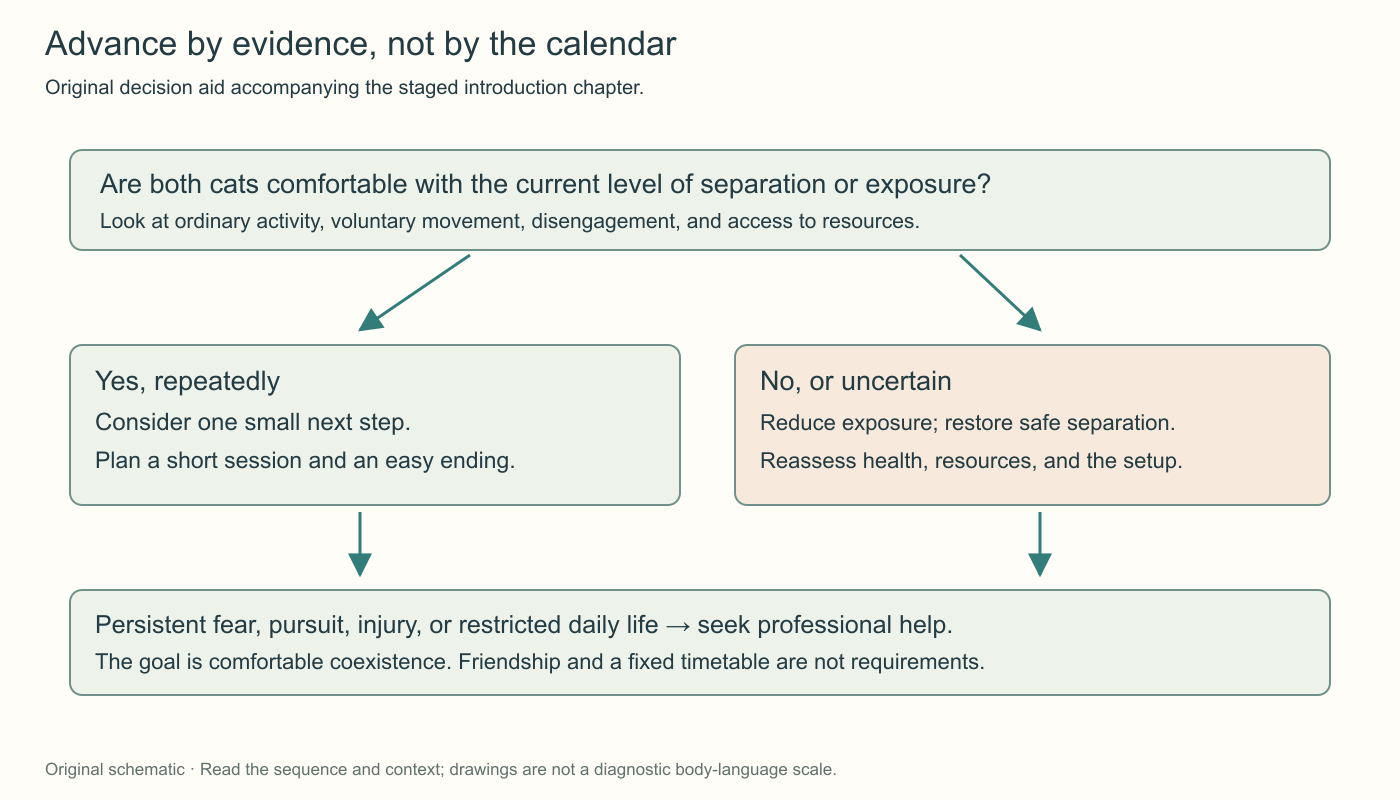
The FelineVMA introduction guide describes a gradual progression: prepare separate resources and a secure transition room, allow the newcomer to settle, introduce scent, provide separate exploration, then carefully managed visual access and supervised proximity. Advance according to both cats' comfort. The guide explicitly allows a process lasting days, months, or longer; a calendar is not evidence of readiness.
Before arrival, arrange veterinary advice about health, infection precautions, and the suitability of the proposed match. Obtain the newcomer's known history without treating shelter behavior as a guaranteed prediction of home behavior. Decide how doors will be managed and who will care for each cat. The logistical plan is part of the welfare plan.
Imagine newcomer Tansy arriving in a quiet study while resident Otis retains his familiar rooms. The carrier opens inside the secured study. Tansy may investigate or remain in shelter. Her first assignment is not meeting Otis. It is becoming comfortable enough to carry out ordinary activities in an unfamiliar place.
Write down what that looks like for her: eating her usual food, using the litter area, exploring when the room is quiet, and choosing a resting place. These are observations, not a checklist that guarantees emotional certainty. If appetite or health is concerning, address that separately rather than declaring the introduction merely slow.
Next, a small item carrying Otis's familiar scent is offered at a distance from Tansy's essential resources. She must be able to avoid it. Her response might be a brief sniff followed by ordinary activity, or prolonged vigilance and avoidance. The same object can be a modest novelty to one cat and a substantial challenge to another.
Do not hold the object against her face to complete the exercise. The useful result is how she responds when she has a choice. If she becomes unsettled, remove or increase distance from the item and reassess the setup. Repetition should make the task familiar, not repeatedly overwhelm her.
Define what earns the next step
“Went well” is too vague to guide tomorrow. For a brief visual session across a secure barrier, a more useful note says: both cats could look away, move freely within their separate spaces, and return to a familiar activity; neither repeatedly rushed the barrier or remained fixed on the other.
Food can help create a pleasant association, but eating alone does not prove comfort. Read the rest of the sequence. Nor should meals be withheld to force participation. The ability to retreat and resume normal activity is useful information alongside appetite.
Plan an easy ending. If Tansy looks briefly and then moves to her bed, the session can finish there. The household does not need to wait for a dramatic display of friendship. Ending while the task remains manageable gives tomorrow a better starting point.
A difficult session calls for less exposure: more distance, less visual access, a shorter duration, or a return to separate activities. Change the factor that seems to have made the encounter difficult. Do not add several new challenges and hope treats will compensate for them.
Direct shared space comes after comfortable earlier experiences and requires an arrangement suited to these cats, with escape routes and close supervision. A history of serious conflict, persistent fear, or injury warrants professional help before attempting it. Never improvise by holding two reluctant cats face to face. Restraint removes the very options you need to observe.
The people also need a separation plan. During escalating tension, avoid reaching between cats or picking up an aroused cat. Use distance and a safe solid barrier to interrupt visual contact when this can be done without putting yourself at risk, and allow separate recovery. A fight is not an educational stage that cats must complete.
Play has an answer from both participants
Two cats race down a hallway. Is it play? Watch what follows. Does the pursued cat return voluntarily? Are there pauses? Can either disengage? Does the interaction change direction, or does the same animal continually flee into a refuge and remain there?
Reciprocity does not mean perfectly equal turns counted with a stopwatch. Animals differ in style and energy. What matters is whether both appear willing to continue and retain practical opportunities to stop. A fast sequence can be compatible play; a quiet sequence can contain intimidating pursuit.
In a fictional recording, Jasper chases Nori behind the sofa. Jasper stops. Nori emerges, approaches loosely, and starts another chase in the opposite direction. Compare a second recording in which Nori stays hidden while Jasper waits at the only exit. Calling both videos “zoomies” discards the most informative difference.
If uncertain, arrange a calm pause without grabbing either cat and see what they choose at a safe distance. Do not use repeated forced reunions as a test. A cat that elects to rest elsewhere has supplied a valid answer for that moment.
A young cat may want much more activity than an older housemate. Provide individual play and appropriate outlets rather than expecting the older cat to become the entertainment department. Separate sessions let you adjust pace, movement, and reward to each participant without competition.
Cats and dogs require a different safety calculation
A dog can be friendly with people and still chase a cat. Prior peaceful encounters with one cat do not establish safety with every cat, particularly when an unfamiliar animal runs. Size, speed, predatory behavior, and the consequences of a mistake make some pairings unsuitable for informal experimentation.
Cats Protection's guidance on introducing cats to other animals describes gradual introductions and controlled separation. Treat this as preparation for an individual plan, especially where a dog has pursued or injured small animals. An experienced qualified behavior professional and the veterinary team can help assess whether shared housing is feasible.
For a suitable pairing, physical management comes first: secure separation, a cat area inaccessible to the dog, and routes that do not require the cat to pass within reach. A gate is only useful if these particular animals cannot jump, climb, squeeze through, or knock it over. A dog leash during a carefully planned supervised session is an added control, not a substitute for adequate distance and barriers.
Watch the dog as carefully as the cat. Fixed attention, stalking, escalating pursuit, or an inability to disengage are reasons to stop and obtain help, not to bring the cat closer so the dog can investigate. The cat should never be restrained as a practice object for the dog.
Rewarding a dog for orienting back toward a person can be part of a planned progression, but a successful response to a cue does not erase risk. The household needs reliable physical arrangements when people are distracted or absent. Some homes require permanent separation; some proposed pairings should not proceed.
Likewise, a cat should not have access to a bird, small mammal, reptile, or fish because the enclosure appears entertaining. Protect the smaller animal from physical access and persistent threatening attention. An enrichment plan for one resident cannot depend on making another resident feel hunted.
When the household changes again
A relationship that was comfortable can change after illness, a veterinary visit, a move, construction noise, or a shift in mobility. Do not assume a previous success means the animals must now resolve every difficulty alone.
If Otis returns from a clinic and Tansy reacts fearfully, temporary comfortable separation may prevent a difficult encounter from escalating while the veterinary team advises on recovery and reintroduction. Pain, altered movement, unfamiliar odors, and the disruption of routine are possibilities to consider. The cat who reacts is not being disloyal.
Use the same practical questions as before. Can each animal eat, rest, toilet, and move without pressure? What changed just before the problem? Which arrangements make ordinary behavior easier? What evidence would justify a gradual return to shared space?
The success measure is a sustainable life for everyone. Close friendship is delightful when it develops. Peaceful separate routines are also valuable. If a carefully managed arrangement still leaves an animal persistently frightened or restricted, the plan needs professional reassessment, including whether the living arrangement itself is fair and feasible.
Check your understanding: Two cats never fight, but one waits until the other is shut in the living room before using the hallway litter box. What should you investigate before declaring them comfortable housemates?
Expected answer: Examine access, routes, sightlines, and the sequence of approaches or retreats. Provide a separate accessible litter option while investigating, and consider health or environmental explanations as well as social tension. Lack of fighting is insufficient evidence that both cats can use the home comfortably.
Application
Draw a fictional apartment with a bedroom, living room, kitchen, and narrow connecting hall. Place three litter boxes in the kitchen, both food bowls beside the hall entrance, and one tall resting platform with a single approach. Resident Fern spends much of the day beside that entrance; newcomer Kit remains in the bedroom.
Propose three changes that improve Kit's options without depriving Fern of essential resources. Then outline a return to gradual introduction, with one observable criterion for advancing and one for stepping back.
Model interpretation: Move or add a litter option in Kit's comfortable area rather than counting three adjacent kitchen boxes as three independent destinations. Feed separately behind a visual barrier or in separate rooms. Improve the route and resting choices so Kit need not approach Fern to reach every important resource. Maintain complete resources for both during separation. Advance from a brief controlled visual session when both repeatedly disengage and resume ordinary activity; reduce exposure if either fixes on the other, blocks movement, hides persistently, or abandons normal routines. A health change also calls for veterinary assessment rather than simply adjusting the social schedule.
Evaluate your plan: A strong answer describes the experience of both cats, includes secure door management, and uses behavior rather than elapsed days to guide progress. It does not promise that the final outcome will be friendship.