Reading the whole cat
A photograph shows a cat lying on its back, belly exposed, paws loose. Below it someone has written, “Trust.” A second photograph shows almost the same arrangement, but a hand is approaching and the cat's feet are positioned to catch it. The caption says, “Trap.” Neither caption is a reliable guide to what you should do next.
A posture is part of an event. To interpret it, we need to know what happened before, what else the body is doing, what choices are available, and what happens when the situation changes. The same visible feature can occur in different circumstances. A useful observer learns sequences, not a dictionary in which each body part translates into exactly one word.
Our practical task is modest and valuable: decide whether to continue, pause, offer more distance, or seek help. We do not need to label an emotion with perfect certainty before making an encounter easier for the cat.
Start with the scene
Imagine two cats with large pupils. One is watching a toy in a dim room. The other is crouched beside a carrier while a stranger leans over it in a bright room. Pupil size alone cannot distinguish these situations. Light affects the pupil; arousal and other factors can affect it too. The body and surroundings change what the observation means.
Begin your reading with four questions. Where is the cat? What just changed? What is the person or animal nearby doing? Can the cat comfortably leave? These questions often explain why an encounter becomes difficult before we reach the details of ears and whiskers.
Now add direction. Is the cat closing the distance, holding it, or increasing it? An approach may invite investigation without inviting touch. A retreat is already useful information: following the cat may remove the solution it just chose. Remaining still can mean resting, watching, waiting, or freezing. We need the rest of the evidence before calling stillness relaxation.
Finally, compare the scene with the cat's usual behavior. A familiar cat who normally strolls across the room but now moves low and stops repeatedly deserves attention. The change matters even if you cannot assign a textbook label to every movement. Your knowledge of the individual complements general guidance; it does not replace veterinary assessment when something is wrong.
Look at the body as a coordinated system
Posture, muscle tension, and movement belong together. A loose body that shifts easily, approaches voluntarily, and disengages without urgency presents a different picture from a compressed body with fixed attention and restricted movement. We should describe the difference before interpreting it.
Ears can orient toward sounds as well as change with the encounter. A tail can help reveal activity or arousal, but its position must be read alongside the body. Eyes provide information about attention and facial tension, but room light and health matter. Whiskers are part of the sensory and expressive picture. No feature grants permission to ignore the others.
Veterinary handling guidance uses this whole-animal approach because misreading inhibition as acceptance can lead people to intensify an uncomfortable interaction. The 2022 AAFP/ISFM interaction guidelines discuss emotional state, approach, handling, and the benefits of giving cats more control over posture and movement. At home, the transferable lesson is to observe responses throughout contact rather than treating the first moment as permission for everything that follows.
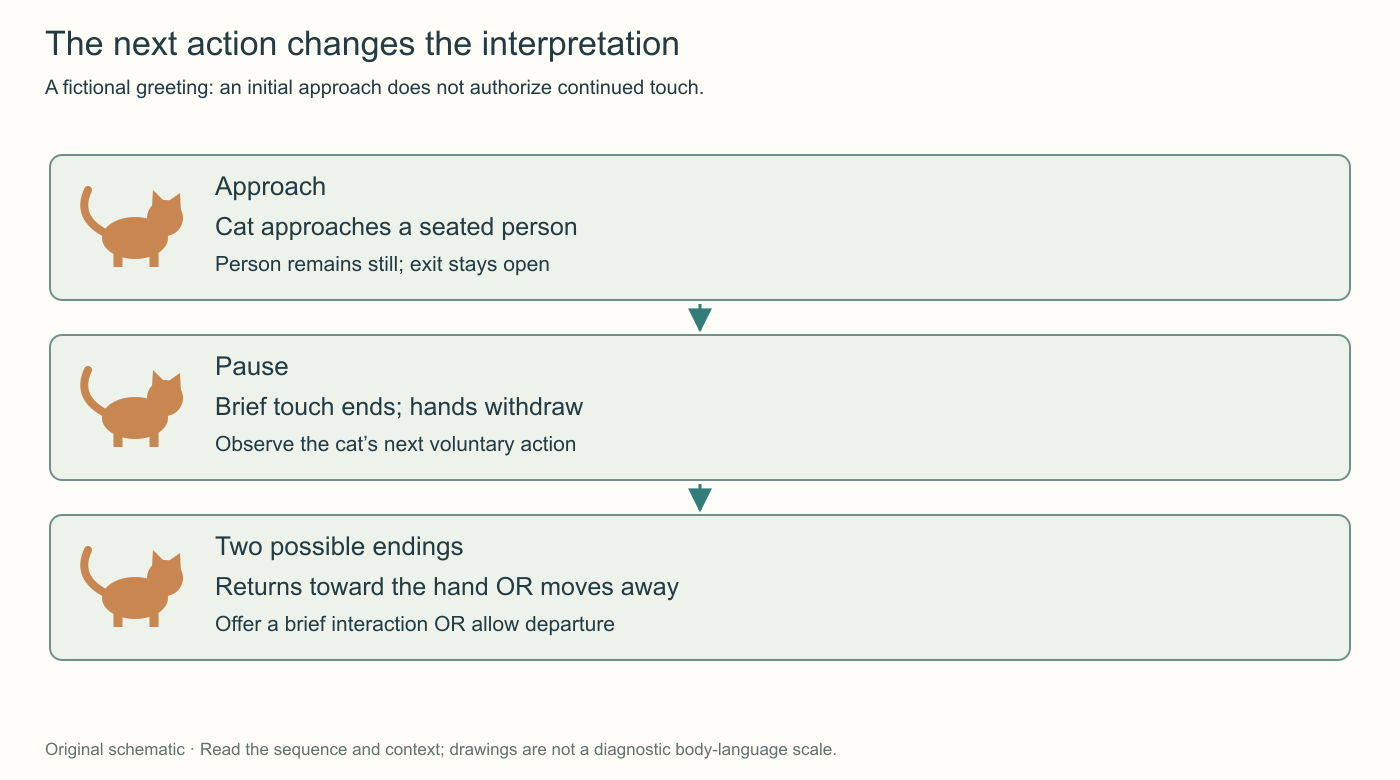
Here is a fictional sequence. Basil approaches a seated person, rubs his cheek against a hand, and remains nearby. The person strokes his head. After several strokes, Basil turns his head toward the moving hand, changes his posture, and moves away. The earlier approach and later departure are both real. The departure does not cancel the affectionate beginning. The beginning does not cancel the request for a break.
This is why a good interaction can end while everyone is still comfortable. Ending before a dramatic objection does not mean the interaction failed. It means the observer acted on smaller information.
Arousal is not a verdict
Arousal describes activation or readiness to respond. It does not, by itself, tell us whether an experience is pleasant. Play, anticipation, fear, frustration, and startling events can involve activation. Confusing high energy with happiness can make us continue a situation that needs a pause.
Suppose a cat follows a fast-moving toy with intense focus. It catches the toy, releases it, and later returns for another brief round. Compare a cat that repeatedly strikes a barrier while another cat passes outside. Both are active. The context, target, ability to disengage, and aftermath differ. Calling both “excited” is too vague to guide care.
The same caution applies to low activity. A cat resting in a chosen sheltered place may be comfortable. A cat that remains motionless while cornered may have few workable options. Our question should be what the cat can do and what happens when we make the situation easier.
You can often learn something by reducing intensity: stop moving the toy, lower your hand, turn your body slightly away, or increase distance. These changes are not diagnostic tests. They are practical ways to avoid pressing ahead while you are uncertain. If the cat relaxes or chooses another activity, you have useful feedback about the arrangement.
Do not deliberately escalate an encounter to discover the cat's maximum tolerance. A ceiling is not a goal. Repeatedly pushing until a cat hisses teaches the person to overlook every earlier signal and gives the cat fewer reasons to trust a gentle response.
Three scenes, three decisions
In the first scene, a visitor sits sideways on a chair. The cat approaches, sniffs the visitor's shoe, looks away, and walks to a window perch. The visitor asks whether the cat dislikes them. The observation supports a simpler account: the cat investigated and chose another activity. The appropriate next action is to allow that choice. A social encounter does not require a closing handshake.
In the second scene, the cat remains under a table while the visitor crouches and repeatedly extends a hand. The cat's body stays low; it turns away when the hand advances. The visitor says the cat needs encouragement. Yet the offered encouragement keeps making distance smaller. A better response is to stop reaching, provide space, and let the cat decide whether to emerge. If food is appropriate, it can be offered without luring the cat into contact it cannot comfortably accept.
In the third scene, a cat is resting beside its owner. When the owner touches one side of its body, the cat abruptly turns and objects. The owner has never seen this response before. It would be premature to diagnose “petting aggression” from the scene. Stop touching the area and contact the veterinary team about the new sensitivity. A behavioral description does not tell us whether discomfort contributed.
These cases illustrate a useful asymmetry. We can choose a lower-pressure response with incomplete knowledge. We should need stronger evidence before increasing pressure or deciding that a sudden change is merely personality.
What sounds can and cannot tell us
People easily learn the sound associated with a familiar routine. A particular meow may often accompany breakfast preparation. But the sound's meaning is partly learned from its context. If that same cat begins vocalizing at unusual times, “she is asking for breakfast” may no longer be a sufficient explanation.
Hissing and growling deserve space, not a contest. They are information about an encounter that is already difficult. Punishing the sound can make the observer's problem look smaller while leaving the animal's problem untouched. Our aim is to change the situation and understand its cause.
Purring is similarly poor as a universal comfort certificate. Evaluate the cat's whole state and circumstances. A sound that occurs during pleasant contact cannot, by itself, rule out pain or distress in another setting. When you speak with a vet, describe eating, movement, posture, grooming, and the timing of the sound rather than using the sound as the entire report.
Silence also has no single meaning. The quiet cat may be resting, observing, inhibited, or simply a less vocal individual. Good care is not a volume meter.
For a practical sound diary, describe duration and timing without inventing a translation. “Three short vocalizations when the cupboard opened; followed the person; ate when food was offered” is a stronger record than “said she was starving.” The humorous translation is welcome at the dinner table. Keep the factual version available for decisions.
Facial expression and pain
Facial changes can help identify concern, but owners should not turn an illustration into a self-diagnosis system. The Feline Grimace Scale's developer resource provides training for recognizing features used in acute-pain assessment. Its purpose and validation concern pain assessment under specified conditions, not the decoding of every feline mood.
A sleepy face, an eye problem, lighting, camera angle, and the animal's state can complicate interpretation. The resource's FAQ advises seeking veterinary help rather than administering medication independently when pain is suspected. In this course, a concerning facial or behavioral change is a reason to obtain appropriate assessment, not a prompt to select a drug.
Your contribution is often a clear account of change. “She used to jump to the chair, now pauses and uses the lower stool; she is also grooming her back less” conveys more than “she looks grumpy.” A short video obtained without provoking the behavior may be useful to the veterinary team. Do not make the cat repeat a painful movement to improve the recording.
There are limits to home observation. A cat can have a problem without displaying the particular sign you learned to recognize. Absence of a dramatic expression should not override changes in appetite, breathing, elimination, mobility, or responsiveness. Later chapters identify specific situations needing prompt help. Here we are learning why no single reassuring detail should erase the rest of the evidence.
Read the ending as well as the beginning
Suppose a cat tolerates a visitor's touch for several minutes and then hides for the rest of the evening. Another cat accepts a brief greeting, moves to a perch, grooms, and later returns. The duration of touch is not enough to rank these encounters. What follows helps us understand their cost and compatibility with normal activity.
Likewise, a play session that looks impressive on camera may be a poor fit if the cat remains unable to settle or repeatedly redirects onto people afterward. The response does not establish one cause, but it tells us to adjust the session and examine the pattern.
Consider a simple timeline: before, during, after. Before includes the cat's baseline and immediate circumstances. During includes choices, movement, contact, and changes in tension. After includes recovery, withdrawal, normal routines, and later willingness to engage. This sequence prevents a memorable instant from taking over the whole account.
The method works especially well when two household members disagree. One says, “She loves that game.” The other says, “She hates it.” Ask each to describe the same sequence. Perhaps they have observed different versions of the game, at different times, with different movements. A shared description can reveal an adjustable difference instead of turning the cat into evidence in a human argument.
A practical confidence scale
Use three levels of confidence in your notes. An observation is something visible or audible: “moved behind the chair.” An interpretation connects observations to a possible state or function: “may be seeking distance.” A stronger conclusion needs repeated, relevant evidence and must still allow exceptions: “in these visitor encounters, direct reaching consistently precedes retreat.”
These levels are not academic decoration. They help choose an action. The observation alone justifies allowing a retreat. The interpretation suggests a quieter arrangement. The repeated pattern supports changing visitor instructions. None requires claiming that the cat secretly resents a particular profession, hairstyle, or political opinion.
When signals conflict, make the next step smaller. A cat can approach and hesitate. Interest and uncertainty can coexist. You can acknowledge interest by remaining available while respecting hesitation by not advancing. The animal does not owe you an unambiguous performance before you respond kindly.
For cats with missing tails, unusual ear conformation, visual impairment, or other differences, adjust what you observe. Movement, orientation, context, voluntary proximity, and individual baseline still matter. A picture chart based on one body shape should never make another cat unreadable.
Check your understanding: A cat approaches a guest, sniffs a hand, then turns away when the guest begins stroking its back. The guest says, “But she came to me.” How should you interpret the sequence?
Expected answer: Approach and sniffing show voluntary investigation, not unlimited permission for touch. The later turn away is new information. Pause contact, allow departure, and consider whether a quieter interaction or a different form of company suits this cat. Read the whole sequence rather than treating its first moment as decisive.
Application
Write a three-frame description of an ordinary interaction: before, during, and after. Use a safely observed real encounter or one of this chapter's fictional cases. For each frame, record the cat's position, movement, available exit, and the person's behavior. Then choose one point where the person could make the interaction easier.
Model interpretation: Before: Basil approaches a seated guest with space to leave. During: he sniffs a hand; the guest reaches over his body; he turns away. After: he moves to the chair behind the owner. The useful adjustment occurs before the guest extends the interaction: pause after investigation and wait for renewed voluntary contact. The move away is sufficient reason to stop. It does not establish that Basil dislikes the guest permanently.
Evaluation guide: A good account uses observable details, distinguishes uncertainty from missing care, and proposes a proportionate response. It does not require touching, startling, restraining, or confronting a cat to collect evidence. Add the sequence to your notebook beside the earlier environmental observations.