The apartment from a cat's point of view
The apartment has everything a cat is supposed to need. There is a bowl, a fountain, a litter box, a scratching post, and a tall tree. All five are arranged neatly in the laundry corner. The washing machine starts. The household dog lies across the entrance. The cat remains on the kitchen counter.
An inventory says this home is well supplied. A map tells a different story. Resources exist, but their location, access, and relationship to one another make them difficult to use. The cat has chosen the counter because it offers height, visibility, and distance from the dog. We can object to the choice while learning from the problem it solves.
This chapter treats a home as an arrangement of opportunities. You will learn to examine routes, resting places, sensory conditions, and resource access. The aim is a home that works for the cat and the people who live there, including people with limited space or money.
Draw journeys rather than furniture
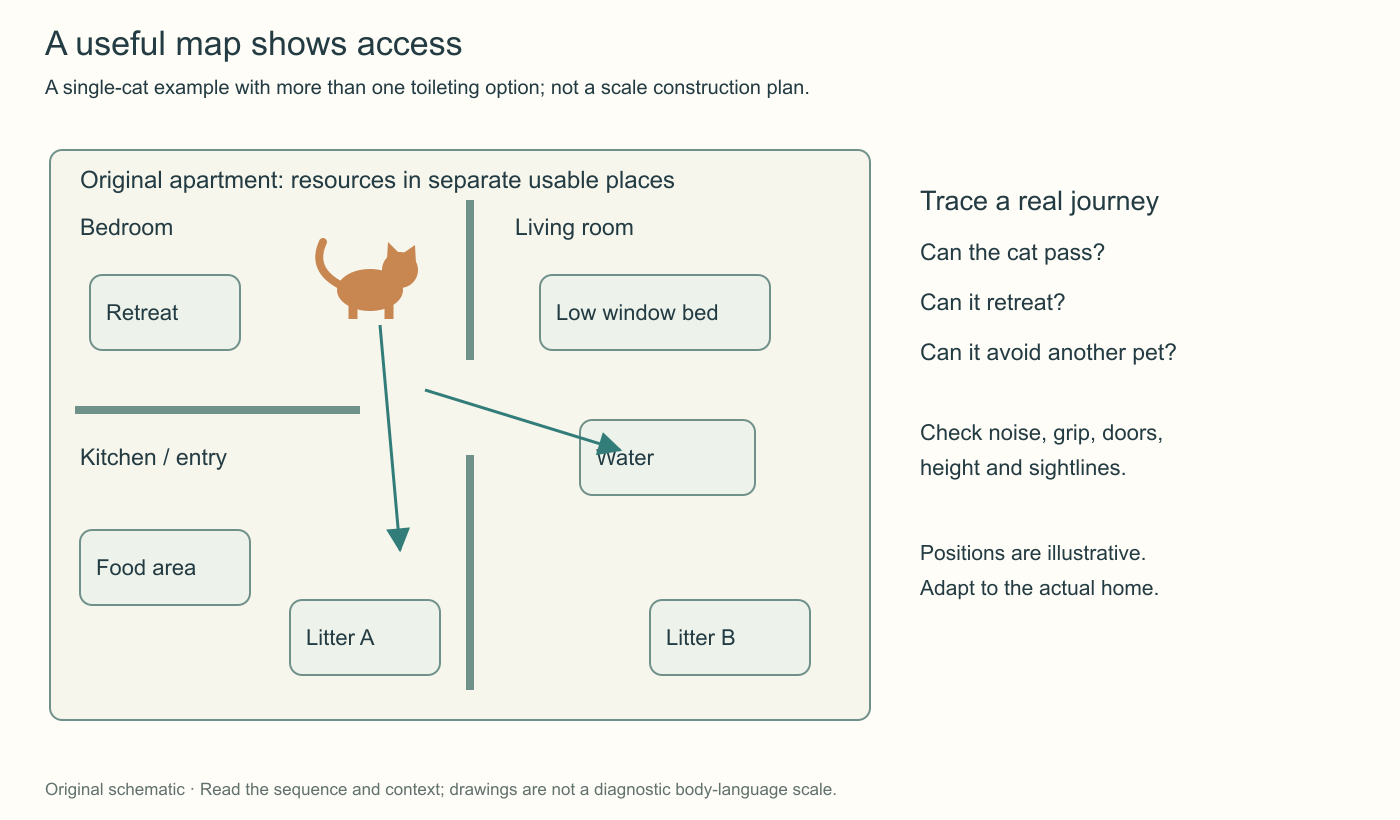
Begin with a rough floor plan. Artistic skill is unnecessary. Mark doors, windows, noisy appliances, frequently occupied human spaces, and each animal's usual resting places. Add food, water, litter, scratching surfaces, and play areas. Then draw the routes a cat must take between them.
Look for bottlenecks. A narrow passage can matter when another animal occupies it. A room with one exit can become uncomfortable during an encounter. An elevated resting place may be attractive but have only one awkward descent. The important question is whether the cat has more than one workable way to navigate ordinary life.
Now add time. The laundry corner is quiet until the machine starts. The hallway is open until guests arrive. The bedroom is available until someone closes the door at night. A resource map without a schedule can overstate access.
In our fictional apartment, moving a water bowl away from the laundry area improves one journey. Providing a resting place near the kitchen but away from food preparation gives the cat an alternative to the counter. Keeping the dog from occupying the narrow entrance during meals improves another route. None of these changes requires replacing every object.
Make one distinction explicit: a place can be reachable but unpleasant to use. The cat may be physically capable of passing the dog yet consistently avoid doing so. Care concerns practical access, including social conditions, not merely whether a determined animal could complete the route.
A safe place is an available option
Cats need places where they can rest and withdraw from unwanted interaction. The FelineVMA's 2025 indoor-cat position statement emphasizes meeting physical, emotional, and cognitive needs through a species-appropriate environment. Shelter and choice are part of that environment, not signs that the animal has failed to become sociable.
A safe hiding place should be accessible and should remain respected. A box with a stable opening can work. So can suitable furniture or an open carrier made comfortable over time. Remove hazards such as handles, staples, loose strings, or unstable parts. Choose materials and dimensions appropriate to the animal's size and behavior.
The household rule matters as much as the object: people do not reach into the retreat to demand affection. Children and visitors need this explained. If the cat is allowed to hide only until someone wants to show it to a guest, the refuge is unreliable.
There are times when access for care is necessary. Plan for those needs rather than allowing the only hiding place to be an unreachable cavity inside machinery or a reclining chair. Offer appealing accessible alternatives and block dangerous spaces safely before the cat uses them. Check appliances and moving furniture before operating them when a cat could be inside or underneath.
For a newly adopted cat, a manageable initial area can reduce the number of unfamiliar choices. Provide needed resources with sensible separation and introduce more space according to behavior. “The whole house is yours” can be a generous human announcement and a complicated first day for an animal.
Height is useful only when the route works
An elevated place can offer a view, distance, and a resting location. But tall is not automatically better. Stability, surface grip, comfortable dimensions, and safe access matter. A perch that wobbles when the cat lands may be avoided for good reason.
Trace the route up and down. An older cat may need intermediate steps or a lower destination. A larger cat needs a platform that supports its body comfortably. A cat with a mobility problem needs a plan informed by veterinary advice. Do not interpret avoidance of a difficult jump as laziness.
In a small apartment, usable height can add opportunities without occupying much floor space. Secure shelves or suitable furniture may help, but installation must be appropriate to the wall, load, and setting. The course does not ask you to improvise structural attachments. A stable low platform is more useful than an ambitious unsafe climbing wall.
Consider social access as well. If two cats share a tall tree with one narrow approach, one can effectively control the other cat's route. Separate resting options can be more useful than a single grand tower. Space becomes richer when it creates alternatives rather than a prestigious location everyone must compete for.
A window view may provide interest, but observe the cat's response. Another cat outside can be upsetting rather than entertaining. If a particular view repeatedly precedes agitation, change access or visual screening and examine the wider pattern. Enrichment is judged by the experience it produces, not by how attractive the photograph looks to us.
Scratching belongs in the design
Scratching is normal feline behavior with several functions, including stretching, claw maintenance, and marking. A home that offers no acceptable scratching surface has left a predictable need to chance. The furniture may then become the most suitable option available.
The FelineVMA caregiver brochure on scratching alternatives provides guidance on selecting and locating suitable surfaces. The practical design variables are surface, orientation, stability, location, and the individual cat's demonstrated preference.
Suppose Olive scratches a vertical sofa corner after waking. A small horizontal pad hidden behind a door differs from the chosen site in several ways. Calling the pad a scratching product does not make it an equivalent alternative. A stable suitable vertical surface near the existing location may be a more informative trial.
Some cats prefer horizontal or angled surfaces. Offer manageable alternatives and observe. Secure them so they do not slide or fall. Reward voluntary use in a way the cat enjoys. Avoid grabbing the cat's feet and dragging them over the surface; that changes the experience from exploration to restraint.
Protecting furniture and providing an alternative can work together. The protection should be safe and should not rely on frightening or hurting the cat. If you remove access to a favored surface, make sure a suitable replacement is available nearby. The goal is to redirect a normal behavior to a workable place, not make the behavior disappear.
Resources need separation and maintenance
Food, water, toileting, resting, and activity have different requirements. Clustering everything into one convenient cleaning corner may create conflict between those functions. The feline environmental client guidance identifies multiple separated key resources as an important part of a healthy environment.
Separation is both physical and social. Two bowls touching each other may not give two cats meaningful independence. Two litter boxes side by side can still share one difficult access route. Exact arrangements depend on the home; the question is whether each animal has usable alternatives.
Maintenance matters too. A fountain with inaccessible dirty parts, a litter box that is difficult to clean, or a scratcher that tips over repeatedly will not fulfill its purpose reliably. Choose arrangements the household can sustain. An elegant system that nobody can maintain is an unfinished design.
Use the cat's ordinary habits to identify priorities. If a cat avoids a particular water location, offer another clean option rather than assuming a more expensive fountain is needed. If a resting surface becomes uncomfortable, examine temperature, texture, noise, and access. The cheapest effective change is often moving or stabilizing an object you already own.
Do not remove the familiar option immediately when introducing a replacement. Overlap lets the cat learn about the new resource without losing reliable access. Once you have evidence that the new arrangement works, you can simplify carefully.
Smell and sound are part of the floor plan
Humans tend to design visually. Cats experience odors, sound, surfaces, and movement alongside what they see. A household change that looks minor to us can alter several of those dimensions at once.
Cleaning is necessary, but preserve appropriate familiarity where possible. Wash bedding and maintain hygiene without assuming that making every surface smell strongly of a new fragrance improves the cat's environment. Use products safely according to their instructions, keep animals away during use when required, and avoid leaving residues or accessible chemicals.
Noise should be considered at the cat's resting and resource locations. A refrigerator motor, washing machine, door buzzer, or irregular construction sound may affect how a place is used. You cannot eliminate every sound, but you can offer quieter alternatives and avoid putting essential resources beside predictable disturbances.
Consider a fictional cat who stops using a bed after it is moved beside a speaker. The fabric has not changed, and the bed remains expensive. A useful investigation includes the new sound environment. This is a reminder to describe the whole change rather than the one feature most obvious to a person.
Predictability also matters. A cat may cope differently with a familiar quiet routine than with frequent unpredictable interruptions. Build a household pattern in which rest, food, play, and interaction have understandable opportunities. The next chapter examines timing in more detail.
Safe access to the wider world
An indoor home can offer a rich life, but it requires active provision for movement, exploration, observation, and play. A secure enclosed outdoor space or carefully taught harness activity may suit some cats. It is not a requirement that every cat enjoy those experiences.
Before offering outdoor access, consider escape, traffic, wildlife, other animals, parasites, infectious risks, weather, and the cat's individual response. Discuss relevant preventive care with the veterinary team. An enclosure must be genuinely secure and appropriate to the location. Ordinary insect screens should not be assumed to support a cat's weight or prevent escape.
Windows and balconies need particular attention. Avoid leaving a cat with access to an opening or tilt-window gap that can trap it or allow a fall. A confident jumper can still misjudge a surface. Protect the setting rather than relying on the cat to understand a hazard it has not encountered.
Harness learning belongs in small indoor steps before any outdoor experiment, with properly fitted equipment and a safe plan for unexpected events. Some cats will prefer an indoor lookout and a good game. The quality of care is not measured by whether the cat produces an adventurous social-media photograph.
A short hazard walk
Walk through the home at cat height. Look for loose string, thread, ribbons, small swallowable parts, unsecured medication, cleaning products, open appliances, and unstable objects. Put hazardous items away rather than expecting training to make unsupervised access safe.
Plants and bouquets deserve checking by exact identification. The FDA's warning about lilies and cats explains that true lilies and daylilies can cause severe poisoning in cats. If exposure is suspected, contact a veterinarian or animal poison service immediately; do not wait for symptoms. A vague label such as “pet-friendly bouquet” is less useful than knowing what the flowers are.
The goal is not to make the home barren. It is to separate ordinary opportunities from preventable hazards. Safe cardboard, stable resting places, appropriate toys, and clean accessible resources can make a modest room interesting. Remove risky attachments and inspect objects as they wear.
Finish by asking what happens when you are absent. Is there water if a powered device fails? Can a door swing shut and block the only litter box? Can another animal prevent access? A good home design remains workable during an ordinary interruption.
Check your understanding: A home contains two litter boxes, two bowls, and a tall cat tree, all behind one doorway where another cat often sits. Why might adding a third bowl in the same corner fail to solve avoidance?
Expected answer: The shared bottleneck can limit practical access to every resource. More objects in the same place may not create a meaningful alternative. Map routes, distribute suitable resources, provide separate resting options, and observe both cats. Avoidance may also have medical or other causes that need assessment.
Application
Draw a resource-and-route map for your home or the fictional laundry-corner apartment. Mark one bottleneck, one opportunity for a protected resting place, one improvement to resource separation, and one hazard to remove. Rank the changes by benefit and ease, using existing objects where suitable.
Model redesign: Move one water bowl to a quiet accessible part of the living room. Provide a stable resting platform near the kitchen but outside the preparation area. Arrange the dog's rest location so it does not block the cat's resource route. Add a safe accessible retreat and keep its opening respected by guests. Verify that doors and appliances cannot make essential resources unavailable.
Evaluation guide: Every proposed change should name the experience it improves and how you will check use. A good design considers time, other animals, maintenance, and the cat's ability. A longer shopping list without improved access does not meet the task.