Yes, you can train a cat
Every evening, the cat arrives when a particular cupboard opens. Every evening, the owner says the cat is impossible to train. The cupboard would like some credit.
Learning is already happening. Deliberate training makes the arrangement clearer: we choose a useful behavior, create an easy opportunity, and provide a consequence the cat values. We observe what happens and adjust. This is a practical craft, not a battle over which species is in charge.
Our projects are modest: touching a target, going to a station, and entering a carrier. Each can make daily life easier. They also teach a way of working that respects the animal's comfort and makes the person's instructions more understandable.
Begin with a behavior you can see
“Be good” is not a trainable description until we decide what the cat should actually do. “Place all four feet on this mat” is observable. “Touch the target with the nose” is observable. “Feel grateful that I bought a carrier” is not.
An observable goal lets us choose a starting point and recognize progress. It also exposes when our expectations are too large. Entering a carrier, remaining inside, accepting a moving door, hearing it latch, being lifted, and traveling are different tasks. A cat that accomplishes the first has not automatically agreed to all the others.
The FelineVMA positive-reinforcement toolkit provides a veterinary framework for using rewards and gradual learning in feline care. The exercises below are original worked progressions applying those principles. They are examples to adapt, not schedules that every cat must complete at the same speed.
Choose a quiet, safe setting and a time when the cat is available for interaction. Have appropriate rewards ready within the feeding plan. Keep sessions brief enough that you can maintain attention to timing and body language. End while the work remains manageable.
The consequence tells you whether it was a reward
In learning terminology, reinforcement increases the future likelihood of a behavior in relevant circumstances. A person can intend to reward without actually reinforcing. If the cat dislikes a pat, the pat does not become useful merely because the owner calls it praise.
Try a few suitable options in ordinary low-pressure contexts. Does the cat approach for a small food reward? Does a brief toy movement create interest? Does access to a comfortable place matter? Preference can change with timing and circumstances. A cat that has just eaten may value the same food differently later.
Food rewards should be small enough for repeated learning opportunities without excessive intake. Reserve an appropriate portion or use a suitable treat within the diet. Do not withhold necessary food to make the cat participate. For a therapeutic diet, ask the veterinary team which rewards are compatible.
Timing connects the consequence to the action. If the cat touches a target, walks away, scratches a chair, and then receives food, the person has made the intended connection less clear. Prepare the setup so you can respond promptly to the chosen action.
A marker can help. A quiet consistent word or click is first paired with a reward so it becomes a useful signal that the desired moment has occurred. Choose a sound that does not startle the cat. The marker is not magical; it depends on a reliable learning history. Follow it with the promised reward rather than using it as a substitute for one.
Practice your part first
Before involving the cat, rehearse the sequence: notice the action, mark, deliver the reward. You can practice with an imaginary target touch or a partner moving an object. Keep your reward hand still until after the marker so unnecessary movement does not obscure the signal.
Decide where the reward will arrive. Placement can influence the next action. If teaching a mat, delivering the reward on the mat may help the cat remain there. If you need to reset a target exercise, an appropriately placed reward can create another easy opportunity without pushing the animal into position.
Also decide what happens after an unsuccessful attempt. The useful answer is usually to pause, make the setup easier, or end the session. Repeating the cue louder does not explain the missing step. Frustration in the person can turn a simple task into an unpleasant encounter very quickly.
Keep a small record: the criterion, the number of easy successes, the signs of comfort, and the next change. “Criterion” simply means the specific action that earns the reward at this stage. A clear criterion prevents you from changing the rules halfway through an attempt.
Project one: a nose target
Use a safe target object that is too large to swallow and has no sharp or detachable parts. Present it near enough to invite investigation, but do not push it into the cat's face. For a confident curious cat, a brief nose contact may occur naturally. Mark that contact and provide the reward.
If contact does not occur, make the starting criterion easier. You might reward orienting toward the object or a small approach. This is shaping: reinforcing successive steps toward a final behavior. Advance only when the current step is easy enough that the cat remains engaged.
For an original example, Lumen first looks toward the target. Her owner marks and rewards the look. On later easy attempts, Lumen approaches. The criterion gradually becomes a brief nose touch. The owner does not alternate unpredictably between rewarding a glance and demanding a long press. Each session has a clear, manageable aim.
Once the touch is reliable in the easy setting, vary the target's position slightly. A movement of a few inches may be enough. Changing height, distance, room, and person all at once makes the task unnecessarily complicated. If performance drops, return to an easier version.
A target can later help invite movement to a location. It should not become a way to lure the cat into an unpleasant surprise. If every successful target touch leads to restraint, the target may acquire a different meaning.
Project two: a station
A station is a place the cat learns to occupy, such as a stable mat or low platform. It can give the cat a useful role while you prepare food, work at a desk, or open a door under controlled conditions. It is not a guarantee of safety when hazardous food or an open escape route is accessible; management remains necessary.
Begin with a comfortable surface in an easy location. Reward investigation or a paw on the surface, then gradually reward the full behavior you want. Deliver the reward so the cat can remain comfortably on the station. Let it leave between attempts.
Next add a very short duration. Do not jump from arriving on the mat to staying through an entire meal preparation. Reward a brief successful pause, then release the cat from the exercise with a consistent ending. Gradually add time while preserving a high rate of manageable success.
Only after arrival and short duration are comfortable should you add modest distractions. Move one utensil, take one step, or briefly turn toward the counter. Each change is another learning task. If the cat leaves, your first question is whether the criterion became too difficult, not whether it is disrespecting you.
In Lumen's kitchen, the station begins beside the owner's chair, far from hot surfaces. Later the owner practices a single movement toward the counter. Food preparation with hazards is managed separately until the setup is reliable enough for the intended use. Training supports safety; it does not remove the need for barriers and supervision.
Project three: the carrier becomes ordinary
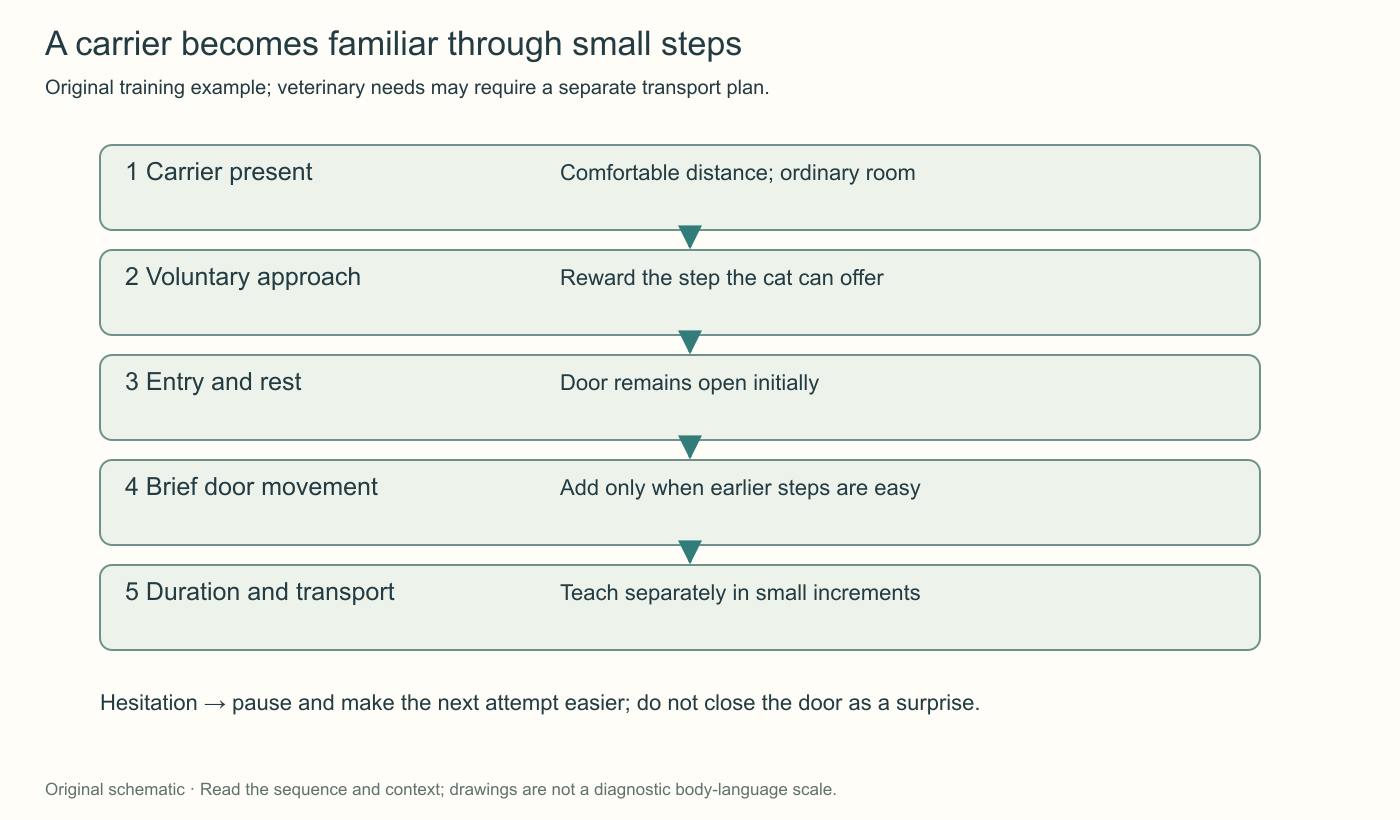
A carrier often appears only before a difficult trip. From the cat's perspective, its arrival predicts capture, transport, and unfamiliar handling. We can change some of those associations by making the carrier a familiar part of the home and teaching its components separately.
The FelineVMA carrier handout recommends creating a comfortable familiar carrier space and introducing it early. Begin with a suitable stable carrier in an accessible quiet place, its door safely open or removed if the design allows. Familiar bedding can help make it an ordinary resting option.
For a cat already frightened by the carrier, the starting point may be simply being comfortable at a distance. Place appropriate rewards where the cat can obtain them without being drawn into more proximity than it can manage. Do not rush to put food at the far end and then shut the door as soon as the cat enters.
Break the task into observable steps: look toward the carrier; approach; investigate the entrance; place a paw inside; enter; remain briefly; tolerate a tiny door movement; tolerate the door closing briefly; tolerate reopening calmly; then, in later work, tolerate small lifting and transport components. These are conceptual steps, not one session's checklist.
At each stage, preserve an easy retreat and repeat comfortable success. If the cat hesitates or becomes tense, make the next attempt easier. Do not keep increasing difficulty because a planned appointment is approaching. When necessary travel is imminent and training is incomplete, ask the veterinary team for an individualized plan.
Why the door is a separate lesson
Entering a space and being enclosed in it are different experiences. A cat that eats inside an open carrier may still be concerned when the door moves. Treat that movement as a new stimulus with its own gradual introduction.
An original progression starts while the cat is comfortable inside and can leave. The owner makes a very small movement of the door, then provides a suitable reward and returns the door to its familiar open position. Later, if the cat remains comfortable, the movement becomes slightly larger. Closing for a moment and reopening is taught before duration.
Do not hold the door closed through escalating distress in the hope that the cat will learn there is no escape. Lack of movement after a struggle is not the learning outcome we want. We want a cat that can remain comfortable enough to participate in the next small step.
Lifting, walking, vehicle sounds, and travel add further components. Secure transport must follow the carrier and vehicle requirements, and the cat should remain safely contained during travel. The teaching plan should make those experiences more manageable without creating unsafe practice conditions.
Cues come after a clear pattern
A cue is a signal that a particular behavior can now be useful. If you repeat a new word while the cat has no idea which action matters, the word may become background noise. Build the behavior in an easy arrangement, then introduce a consistent cue shortly before the expected action.
Use one clear cue and allow a reasonable opportunity. If it does not work, examine the setup. Is the cat able to perform the action? Is the environment different? Is the reward useful? Is the cat uncomfortable or distracted? The answer determines whether to simplify, pause, or seek advice.
Generalization means learning that a behavior applies beyond the original setting. A target touch learned in the kitchen may need easier practice in the living room. A station learned with one person may need introduction with another. Treat these as normal parts of learning rather than evidence that the cat has forgotten everything out of spite.
Maintenance matters too. Continue making useful behavior worthwhile. A skill that is asked for repeatedly but never produces a valued consequence may weaken. The goal is a sustainable relationship between cue, action, and outcome.
Troubleshooting without blaming the learner
If progress stops, reduce the question to its parts. The antecedent is what happens before the behavior: the location, cue, object, and circumstances. The behavior is the observable action. The consequence is what follows. Which part is unclear or difficult?
For example, Lumen touches the target but receives food only after the owner searches a pocket. Preparation is the immediate fix. If she refuses to approach a noisy carrier, reward timing alone may not solve the problem; the starting distance and carrier arrangement need revision. If she suddenly avoids a familiar movement, consider comfort and health.
Training should enrich life and make care easier. It is not a test of intelligence or love. A cat that declines a session provides information about the session. A skilled trainer uses that information, changes one thing at a time, and recognizes when an individualized professional plan is needed.
Check your understanding: A cat enters an open carrier for food, but the owner immediately closes the door, lifts it, and walks to the car. Next time the cat refuses to enter. What was missing from the training plan?
Expected answer: Entry was treated as if it also established comfort with enclosure, lifting, movement, and transport. Those are separate components. Return to an easier comfortable stage, rebuild a reliable positive history, and introduce each component gradually. Obtain veterinary support for necessary travel rather than forcing rapid progress.
Application
Choose one project and write five small criteria toward the final behavior. Include the setup, reward, marker if used, reward placement, an ending, and a way to make each step easier. Do not assign a fixed completion date.
Model carrier plan: Comfortable at a chosen distance; voluntary approach; investigation of the entrance; a paw inside; full voluntary entry with immediate opportunity to leave. The owner rewards each current criterion promptly and stops before difficulty escalates. Door movement is explicitly reserved for later learning. A looming trip triggers a call to the veterinary team, not a compressed sequence of forced steps.
Evaluation guide: The plan names visible actions and distinguishes learning components. It preserves adequate food, avoids surprise restraint, and includes a response to hesitation. Save the progression in your cat's care guide so another person can maintain the same cues and expectations.