Strangers, children, and the front door
The doorbell rings while a pan is smoking, a child is looking for shoes, and a guest is saying, “Dogs love me.” This is an ambitious moment to introduce a nervous animal to someone new. For the dog, the event includes sudden sound, an opening boundary, unfamiliar movement, changed voices, and possibly an approaching hand. A successful visit starts before any of those things happen. It starts with deciding what the dog needs to do, where everyone can go, and whether a greeting is useful at all.
A good host can offer distance
There are several acceptable outcomes when a dog meets an unfamiliar person. The dog may seek friendly contact. He may remain comfortably nearby without interacting. He may spend the visit in a familiar resting area with appropriate care. Only the first outcome produces the conventional photograph, but all three can represent thoughtful hospitality.
Start with the individual and the occasion. A dog who enjoys one quiet visitor may struggle with a crowded dinner. A dog who knows an adult seated on a sofa may respond differently when that adult arrives wearing a helmet and carrying a folded ladder. Familiarity is attached to a history of situations, not merely a name in your contacts.
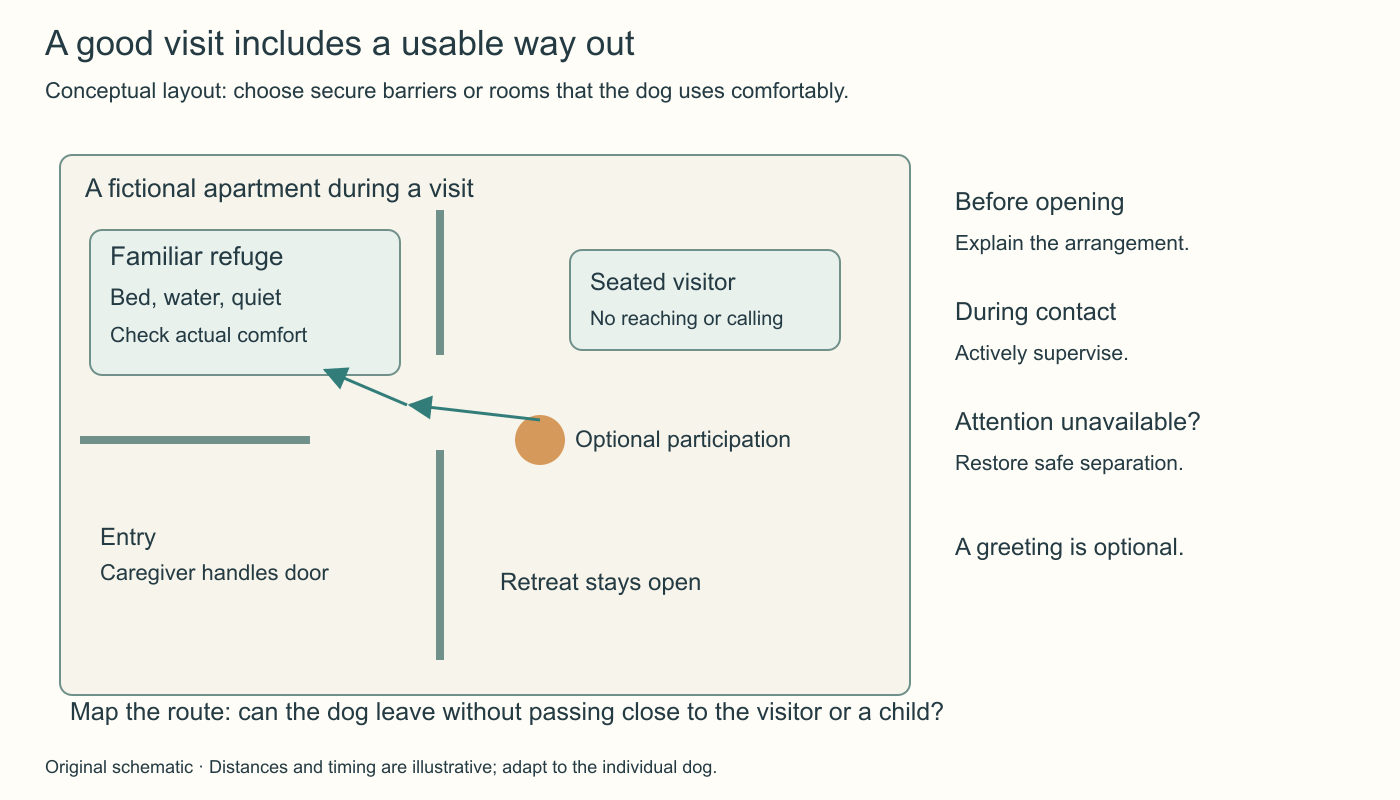
Tell visitors the arrangement before they enter. A useful message is concrete: “Please come in and sit down without reaching toward Finn. He has space behind the gate. I'll let you know if we are going to offer a greeting.” This is easier to follow than “He's a bit funny.” It gives a well-meaning person something successful to do immediately.
You remain responsible for the arrangement even if the visitor is confident. Confidence around dogs is not evidence that this dog welcomes this approach. Equally, a visitor who prefers distance deserves it. Affection for your animal does not oblige someone else to participate in a contact exercise. The household can protect both parties without making either one an embarrassment.
Build the arrival in separate pieces
Choose a resting area the dog already uses comfortably, with water, a suitable bed, and any safe activity appropriate to unsupervised or supervised use as arranged. A barrier should prevent unwanted access, not trap the dog at the busiest point in the room. Some dogs are more frustrated by a view through a gate than by settling behind a closed door. Observe which arrangement actually works for the individual.
Practice this location before the visit. If separation from the household causes distress, a gate is not automatically a solution; arrange another familiar caregiver or seek help to build comfort. You cannot introduce a frightening isolation routine and call it a break. A workable refuge is defined partly by the dog's response to being there.
The sound of an arrival can be practiced at an intensity the dog handles comfortably. Use a quiet, controlled version, pair it with a suitable pleasant event, and stop before the dog is overwhelmed. A recording may not resemble the real bell closely enough to transfer perfectly. Treat the real doorway as a separate situation and manage it securely throughout.
When the guest arrives, one adult handles the door while another attends to the dog if needed. Avoid an arrangement in which a leash is held by someone also receiving a hot casserole. Prevent bolting with secure boundaries. Delivery workers do not need to become training assistants; a completed delivery with the dog safely elsewhere is an entirely satisfactory outcome.
Consider two versions of Finn's evening. In the first, he rushes the door, barks, is grabbed by the collar, and is then asked to accept a hand over his head. In the second, he is already comfortable away from the entrance, hears a predictable cue, and receives a quiet check-in after the guest is seated. The visitor has not become more lovable. The sequence has become easier to understand.
Let contact begin without a trap
If a greeting is appropriate, allow space and an unobstructed retreat. The visitor can sit or stand without looming, avoid sustained staring, and let the dog investigate at his own pace. Sniffing a trouser leg does not automatically invite stroking. Pause and observe whether the dog actively seeks further contact with a loose body and the ability to move away.
A brief touch to an area the dog is known to enjoy may be followed by a pause. Does he reapproach comfortably, remain neutral, or leave? Continuing contact should depend on this unfolding information. A dog who freezes is not necessarily consenting. Neither is a dog who remains because the leash is short and the exit is blocked.
Food can support a pleasant association, but it can also lure a worried dog closer than he feels comfortable being. Do not make reaching a stranger's hand the price of obtaining a treat. Where appropriate, the caregiver can reward at a comfortable distance or arrange food placement that preserves retreat. If the dog is fearful or has a bite history, design this with a qualified professional rather than improvising a visitor exercise.
Notice the end of the interaction. A visitor standing up, hugging the owner, or walking toward the bathroom may be more difficult than sitting quietly. Keep routes open and be ready to restore distance before tension escalates. A good first minute is encouraging evidence, not an all-evening guarantee.
Children need adult arrangements
Children move, sound, and interpret situations differently from adults. A delighted child may run toward a dog, hold tightly, or repeat a touch after the dog turns away. A dog accustomed to adults has not thereby learned comfort with every child. The Dogs Trust child-safety guidance emphasizes adult responsibility, safe space, and attention to the interaction. The AVMA's bite-prevention guidance likewise places prevention ahead of assumptions about a dog's friendliness.
Active supervision means an attentive adult is close enough and free enough to intervene before trouble, not merely somewhere in the house. When that attention is unavailable, use secure separation that neither child nor dog can defeat. Cooking, answering a call, and watching a complex interaction are competing tasks. A gate or closed door can make the real limits of human attention less consequential.
Teach children routines they can perform. Invite rather than pursue. Let a resting or eating dog remain undisturbed. Keep faces away from the dog's face. Leave beds, food, chews, and stolen objects to adults. These are household habits, not a test a child must pass to earn safety. Young children cannot reliably manage risk, so the physical arrangement must continue protecting them when they forget.
Adults can create enjoyable parallel activities. A child draws the dog's sleeping posture from a distance. An adult places an easy food-search activity while the child watches from the other side of a barrier. An older child, with appropriate guidance, can help prepare the walking bag or record a training session. Caring for a dog includes many valuable jobs that do not involve hugging him.
Suppose a toddler repeatedly approaches a resting dog, who turns his head away. The first intervention is not to praise the dog for enduring it. Move the child away, protect the resting area, and revise the arrangement that allowed repeated approaches. If the dog growls, take the warning seriously and calmly separate. Punishing a warning does not make the underlying situation comfortable.
A new baby changes sounds, smells, routines, and the distribution of adult attention. Prepare practical arrangements in advance where possible: resting spaces, safe boundaries, help with walks, and predictable care. No dog should have unsupervised access to a baby. If you are uncertain about the dog's response, obtain qualified guidance before direct access becomes possible. A gentle history is valuable information, but it cannot substitute for protection.
Socialization is learning about a world
For a puppy, socialization means building useful experiences with the kinds of people, environments, handling, sounds, and animals that life will contain. It is not a count of how many strangers touched the puppy. The American Veterinary Society of Animal Behavior's position statement identifies early puppyhood as an important period and supports appropriate socialization before the full vaccination series is finished, with precautions. Veterinary guidance should determine suitable local infection protection and class participation for the individual puppy.
That balance matters. Avoiding all experience until much later has behavioral costs; exposing a young puppy indiscriminately to contaminated areas or unknown dogs has health risks. Ask the veterinary team for a concrete plan based on vaccination status, local disease conditions, and the proposed setting. Carrying a puppy to observe suitable surroundings, meeting selected healthy animals in controlled circumstances, and attending a well-run appropriate class are different exposure decisions.
Make each experience small enough to remain manageable. A puppy can watch a person using an umbrella from a comfortable distance while enjoying a familiar activity. The lesson does not require the umbrella to open directly overhead. End or simplify when the puppy shows concern. More intensity is not necessarily more learning of the kind you intended.
Variety also requires recovery. A morning containing a bus ride, a busy café, several dogs, and a party may exceed what this puppy can process comfortably even if each item appears on a checklist. Build a rhythm of ordinary rest and modest novelty. Record the response, not just the exposure: approached freely, watched comfortably, withdrew, recovered quickly, or remained unsettled afterward.
The AAHA canine life-stage behavior guidance places behavior within ongoing care. Development does not end after a puppy class. Adolescents encounter changed bodies and social situations; adults continue learning; older dogs may need adjustments as senses or comfort change. A course certificate cannot freeze a living animal at one stage of confidence.
An adult dog is not a missed deadline
An adult dog with limited experience can still learn, although progress may require careful management and professional support. Begin from observed comfort. If a person at the far side of a quiet open space is manageable, that distance is useful information. A crowded entrance may not be an appropriate next step simply because it occurs in normal human life.
Avoid flooding: overwhelming exposure with no effective escape in the hope that the dog will eventually stop responding. Reduced movement can mean many things, including inhibition, and does not prove that fear has disappeared. Choose sessions in which the dog can remain engaged, take a break, and recover. A professional can help identify whether the planned intensity is actually below the level that causes distress.
Neutrality is a valuable social skill. A dog who can notice a stranger and continue walking comfortably has learned something useful even if he never seeks a pat. Many adult people also prefer to pass strangers without being handled. This comparison is not a claim that canine and human minds are identical; it is a reminder that sociability has more than one acceptable expression.
Be specific about progress. Finn once barked throughout every visit. Now, with a familiar refuge and a quiet guest, he rests after the arrival and briefly investigates when invited. That is meaningful improvement. It does not yet establish comfort with a children's birthday party. Preserve the conditions that made success possible while testing only small, safe changes.
Write instructions a guest can use
A good visitor note fits on a small card. It names the dog's resting area, explains whether greeting is planned, states who handles doors and food, and tells the visitor what to do if the dog approaches or moves away. Avoid personality labels such as “dominant” that offer no practical next action. “Let him walk away; don't follow him behind the chair” is useful immediately.
Include a recovery plan. If the dog becomes tense, the caregiver restores distance and ends contact. If a barrier fails, the adults calmly secure separation rather than asking a child to control the dog. If a bite or credible threat occurs, attend to human and animal safety, obtain appropriate medical or veterinary care, and arrange professional assessment before repeating the situation.
Review the visit afterward using observation. Which part was easiest? Did the dog settle in the refuge? Was the guest able to follow instructions? Did someone need a clearer route to the bathroom? This is practical design work. The purpose is not to find a guilty participant but to make the next event less demanding.
Over time, some dogs will choose more participation. Others will remain happier with a predictable alternative. Love includes making that alternative pleasant and socially acceptable. A dog who spends a dinner resting comfortably has not failed to join the family. The family has arranged an evening that includes his needs.
Check your understanding: A worried dog approaches a visitor's hand to obtain food and then recoils when touched. Why is approaching for the treat insufficient evidence that the dog wanted contact?
Expected answer: Food can draw the dog into a distance that remains uncomfortable. The approach shows motivation to obtain food, not necessarily willingness to be touched. Restore space, avoid luring into contact, and judge the whole sequence with a genuine option to retreat.
Application
Prepare a visitor plan for Finn, a fictional adult dog who barks at arrivals but rests comfortably in the bedroom. Two adults and a six-year-old are coming for lunch. Decide where Finn begins, what the visitors hear beforehand, whether a greeting is necessary, and who supervises if he later enters the room.
Model response: Finn begins in his familiar bedroom with his ordinary comfortable setup and a caregiver checking that he remains settled. Visitors are asked to enter without approaching him. A greeting is optional and can be omitted entirely. If a suitable quiet interaction is later offered, an adult focuses exclusively on the child and dog, retreat remains available, and food or resting areas are protected. If that attention becomes unavailable, secure separation resumes. The child's disappointment is handled by adults, not by making Finn endure contact.
Evaluate your work: Does the plan work during the busiest minute of arrival? Does it protect a guest who is nervous around dogs? Does the dog have a pleasant alternative to greeting? Replace “they should be fine” with an actual arrangement.