A good life together over time
At eleven, Wren no longer runs the long ridge trail. She still pauses at the same gate to inspect the neighborhood, carries a soft toy into the kitchen, and becomes visibly interested when her person opens the walking drawer. The household initially treats the shorter route as a reduced version of her former life. Then someone notices that she spends more time investigating it and returns comfortably. A good life is not a fixed itinerary. It is a continuing effort to preserve what matters while the animal and the household change.
Begin with a life you can provide
Before bringing home a dog, describe an ordinary week honestly. Include work, travel, housing rules, finances, physical capacity, other animals, children, and available help. Then consider which individual dog could plausibly thrive within that life, and what changes you are willing and able to make. A photograph may create interest; the daily arrangement determines much of the relationship.
Ask about known history, health, behavior, and the conditions in which observations were made. Shelter behavior, a foster home, and your apartment are different contexts. A quiet visit provides useful information but cannot reveal every future situation. Treat uncertainty as part of adoption planning: arrange support, protect introductions, and allow time to learn rather than promising yourself that the dog will arrive fully explained.
Prepare the basics before arrival: suitable food and water arrangements, safe resting places, secure boundaries, appropriate equipment, veterinary contact, and a realistic toilet and companionship schedule. Resist filling the first day with visitors. The dog needs opportunities to discover where ordinary needs can be met. A calm welcome can be generous without being eventful.
There is no universal adjustment timetable that every dog must follow. Some explore quickly; others remain cautious; behavior can change as the setting becomes familiar. Observe eating, sleep, elimination, exploration, and social choices. Seek help when welfare or safety is concerning rather than waiting for a popular milestone to expire. A calendar is a planning aid, not a diagnosis.
Puppyhood requires a household curriculum
A puppy is learning where to sleep, eliminate, chew, play, and find security while developing bodily control and experience. Arrange frequent care and suitable rest. Puppy biting and chewing require safe outlets, thoughtful play, and management of access to hazards. A puppy cannot learn the household's preferred chew objects if the only interesting material available is a shoe beside a tired adult.
Divide jobs among people. Who handles early toilet trips? Who provides companionship during work? Which words and rewards will everyone use? What happens when the puppy is too excited to continue playing comfortably? Agreement before frustration makes a greater contribution than inventing a stricter rule after an accident.
Combine early positive experience with individualized veterinary guidance about infection risk. Meet suitable people and environments at manageable intensity, include comfortable handling, and protect rest. The puppy does not need to collect every possible experience in one weekend. Learning that the world is predictable and that help is available is more useful than enduring a checklist.
Do not confuse physical growth with mature coping. A large puppy can look imposing while still needing a simple task and frequent support. Provide equipment and boundaries that fit the current body, but expectations that fit the actual learning and development. The AAHA canine life-stage definitions distinguish developmental stages and emphasize that timing varies with the dog.
Adolescence calls for renewed teaching
During adolescence, behavior may become less consistent across settings. Interests, arousal, physical capacity, and social responses can change. It is tempting to interpret every difficulty as a deliberate challenge. A more useful response is to review what the dog can do in the present environment and rebuild manageable practice where needed.
Keep worthwhile rewards available and protect against serious mistakes. A recall that seemed easy earlier may need renewed work around new distractions. Continue using safe management. Do not remove the leash merely because the dog is now physically capable of running far; increased capacity raises the consequences of an unreliable response.
Preserve sleep and suitable activity. A busy adolescent may need more thoughtful opportunities, but that does not mean an endless exercise escalation. Observe whether the day includes sniffing, play, learning, ordinary quiet, and genuine rest. If the dog cannot settle or behavior changes markedly, discuss health and behavior with appropriate professionals.
Family expectations may also need adjustment. The dog has become stronger, a child wants to walk him alone, or a caregiver can no longer manage pulling safely. Reassess the arrangement rather than relying on the habits formed when the puppy was small. Responsibility includes matching handling tasks to the people who can perform them safely now.
Adult life deserves more than maintenance
Once routines become easier, it is possible to stop noticing the dog very carefully. Food appears, walks happen, and the relationship becomes familiar. Familiarity is valuable, but it can also conceal a narrowing life. Ask occasionally whether the dog still has opportunities to investigate, choose, learn, and enjoy social contact suited to him.
Add modest novelty rather than constant excitement. A different quiet route, a new arrangement of an easy search game, or a small cooperative task may be enough. Keep familiar pleasures available. A dog should not have to confront a new puzzle every time he wants breakfast. Variety works best within a life that remains understandable.
Review body condition, dental care, mobility, and preventive care with the veterinary team. Record meaningful changes in ordinary behavior. A dog who stops jumping into the car may be making an economically sensible decision about discomfort rather than becoming lazy. A baseline helps you recognize the difference between a stable preference and a new limitation.
Life events alter the arrangement: a move, a baby, a new job, a household separation, or a caregiver's illness. Prepare where possible and rebuild routines in small pieces. The dog does not need every human circumstance explained in words to be affected by changed schedules and access. Preserve predictable care while learning what the new setting requires.
Aging changes the route, not the relationship's value
Older dogs may experience changes in mobility, senses, sleep, cognition, and medical needs. These changes deserve assessment rather than dismissal as inevitable old age. The AAHA senior-care guidelines emphasize individualized care, comfort, monitoring, and practical environmental adaptations. Age alone does not tell you which activity is suitable or which symptom is untreatable.
Make the home easier to use. Nonslip routes, comfortable accessible beds, suitable assistance with steps, and shorter paths to toilet areas may help according to the dog's needs. Ask the veterinary team about appropriate supports and exercise restrictions. A ramp that is too steep, slippery, or unfamiliar can introduce another problem; teach and evaluate its use rather than assuming the purchase solved access.
Adapt games while preserving their purpose. Wren can search for a few easy food pieces at nose height instead of climbing for them. She can choose between two short routes. She can participate in a brief target game on a stable surface. These changes preserve investigation, agency, and companionship without demanding her earlier physical performance.
Sensory changes require predictable communication. Avoid startling a sleeping dog; approach in ways suited to what he can perceive comfortably. Maintain familiar layouts where helpful. If disorientation, nighttime waking, altered interaction, or house soiling develops, consult the veterinarian. Several medical and behavioral explanations can resemble one another, and a household observation cannot establish cognitive dysfunction by itself.
Track function in ordinary terms. Can Wren rise comfortably? Reach water? Sleep without repeated disturbance? Enjoy a short outing? Recover afterward? A short video from the same safe location can help show changes over time. Keep the record useful rather than turning every afternoon into an examination.
Quality of life is a conversation with evidence
Quality of life includes comfort, useful function, enjoyable engagement, and the ability to meet basic needs. It is not captured by appetite alone. Some animals continue eating despite serious difficulties elsewhere. Nor does one happy moment necessarily cancel a day of uncontrolled distress. Look across the pattern with the veterinary team.
The AAHA end-of-life guidance frames this work as a collaborative effort to reduce suffering and support caregivers. Discuss what can be treated, what improvement is realistic, what monitoring is needed, and which changes require urgent contact. Palliative care, hospice arrangements, and euthanasia conversations depend on the individual clinical situation and the family's circumstances.
A quality-of-life diary can support those conversations, but a score is not an automatic verdict. Name the activities and functions that matter for this dog and record their pattern. Agree with the veterinary team on concerning changes and a plan for nights or weekends. Preparing does not mean giving up; it prevents a crisis from being the first time difficult choices are discussed.
Caregiver capacity also matters. Sleep loss, lifting demands, finances, grief, and work can affect what care is possible. Speak honestly and seek practical support. The AAHA discussion of the end-of-life team includes caregiver burden and additional support. Concealing exhaustion does not expand capacity; it makes planning less accurate.
Grief can begin before a death and continue afterward in uneven ways. People in the same household may express it differently. Preserve memories if that feels helpful, seek support when needed, and avoid treating a future dog as a replacement that must reproduce the same relationship. Each life has its own history.
Build a guide to living with this dog
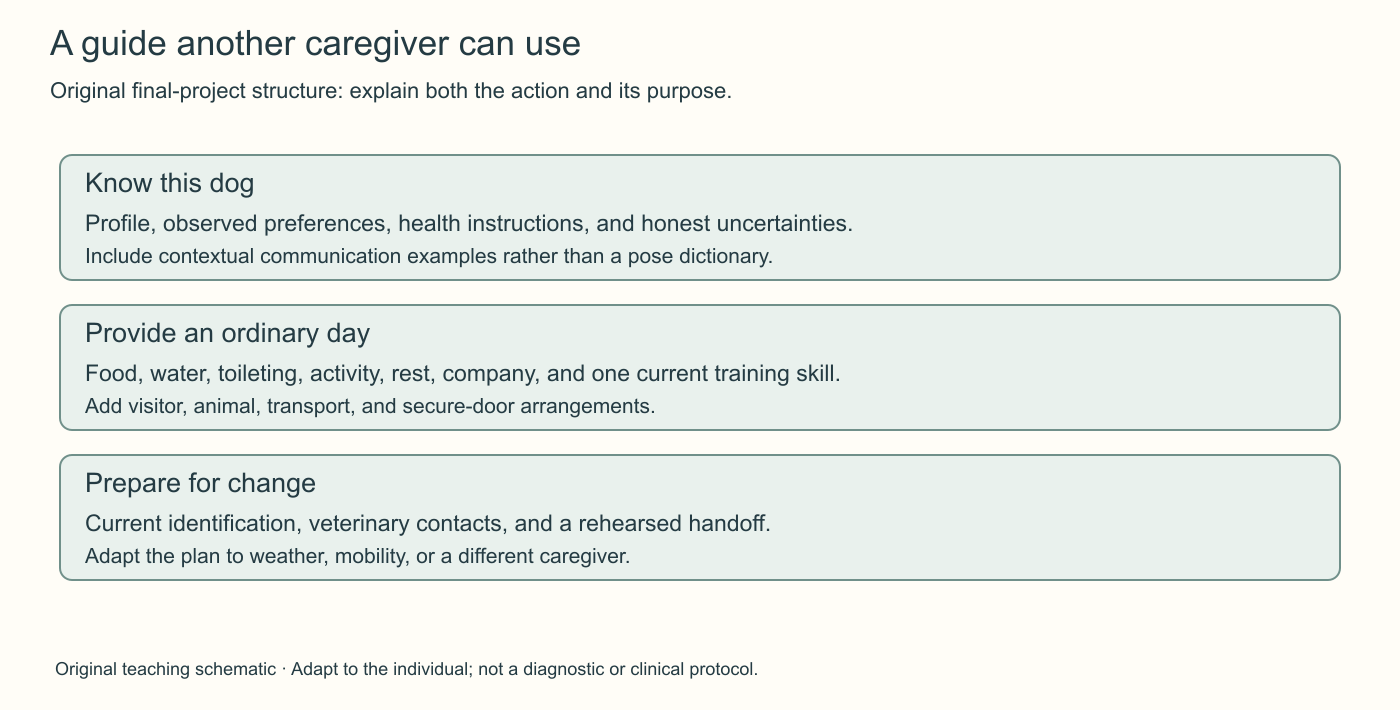
Your final project is a practical guide another caregiver could use and you could revise. Begin with a short profile: known age and history, health information, observed preferences, uncertainties, and the veterinary team's relevant instructions. Separate facts from hypotheses. “Wren avoids the slippery hallway” is an observation; “she is afraid of all indoor floors” is a broader claim that needs evidence.
Add the daily routine: measured food and water arrangements, toilet access, suitable exercise, rest, enrichment, and companionship. Explain why the routine fits this dog. Include alternatives for weather, illness, or an unexpectedly busy day. A guide that works only when the owner has unlimited time is an aspiration rather than a usable plan.
Describe communication through short sequences. What does the dog do when he wants a break? What precedes comfortable approach? What changes make you pause or increase distance? Avoid a dictionary in which one tail position always means one emotion. A substitute caregiver needs contextual examples and clear actions.
Choose one training project and define its current level. State the cue, starting setting, reward, success criterion, and way to simplify. “Recall trained” is less useful than “comes from three steps away in the quiet enclosed yard; use the leash elsewhere.” Honest boundaries protect both the dog and the caregiver.
Include visitor and animal arrangements, secure door routines, transport, identification, emergency contacts, and medication instructions from the veterinary team. Keep sensitive details in an appropriate private place. The course project can use placeholders; a real household guide needs current usable information.
A four-week project with room for reality
In the first week, observe a small number of ordinary routines. Record meals, rest, walks, and one interaction each day without changing everything at once. Identify a question you can investigate safely, such as whether a quieter walking route improves recovery afterward. Do not delay veterinary assessment of concerning signs in order to complete a diary.
In the second week, make one modest environmental improvement. Perhaps add a nonslip route to a resting place or move a bed away from repeated interruption. State what you expect to change and what would count against the idea. If the dog ignores the new bed, investigate placement, temperature, texture, and access rather than insisting that gratitude is the missing ingredient.
In the third week, practice one small skill or activity at the dog's current level. Keep sessions brief and record enough to see progress. For a reader without a dog, use the fictional case and compare proposed sessions rather than acquiring an animal for an assignment. The intellectual work is designing a clear, humane progression and interpreting evidence.
In the fourth week, rehearse a handoff and a change scenario. Ask another person to explain the routine from your guide. Then adapt it to a heat advisory, a move, or a veterinary restriction. Which elements remain essential, and which methods can change? This tests whether you understand the purpose of the arrangement rather than merely remembering its current form.
Four weeks is a project structure, not a promise that a behavior problem will be solved in that time. Some changes are immediate, some develop slowly, and some require continuing management. The course's standard is thoughtful care with evidence of learning, not a deadline imposed on an animal.
Wren's revised week
Wren's guide now includes two short sniffing outings on suitable days, a comfortable route through the house, an easy search game, and protected rest. Her veterinary plan governs physical limits. A caregiver knows how she asks to end an interaction and whom to call if her mobility changes. The household keeps one small training activity because Wren still enjoys participating.
When rain makes the usual route slippery, they change the route and shorten the outing. They do not remove every enjoyable activity, and they do not insist on completing the old mileage. The guide explains the purpose: movement within comfort, opportunities to investigate, and contact she welcomes. Those purposes survive the change in weather.
The relationship has become more observant over time. Love is still present in delight, affection, and the familiar absurdity of a toy arriving at breakfast. It is also present in accurate portions, an unobstructed route, a canceled difficult encounter, and a call made before discomfort becomes a crisis. These ordinary decisions are how a good life is assembled.
Check your understanding: Why should an older dog's reduced activity lead to both practical adaptation and veterinary assessment, rather than being attributed automatically to age?
Expected answer: Aging changes risks and capacity, but reduced activity may reflect treatable pain, illness, sensory change, or another issue. Adaptations can improve access and comfort while assessment investigates the cause. The plan should preserve suitable pleasures and respond to the individual rather than assume all decline is inevitable.
Application
Complete Wren's guide using the fictional information in this chapter. Then respond to this change: her caregiver will be away for three days, and the substitute caregiver cannot safely lift her. Identify the missing information and revise the arrangement.
Model response: Confirm Wren's current veterinary mobility instructions and whether any transfers require lifting. Arrange a capable helper or a suitable accessible care setting if necessary; do not ask an unprepared caregiver to improvise. Rehearse equipment and routes before departure, supply current feeding and medical instructions, and preserve short suitable outings, easy enrichment, and rest. Include emergency contacts and a clear threshold for seeking help if she cannot rise or appears painful. The plan's adequacy depends on what Wren actually needs, not on the owner's hope that lifting will be unnecessary.
Evaluate your work: Your guide should contain a profile, routine, communication examples, one training project, visitor and animal arrangements, preventive and emergency care information, and a tested change scenario. Each section should distinguish known facts, reasonable hypotheses, and matters requiring professional input. Another caregiver should be able to explain both what to do and why it matters.