Reading a dog before things go wrong
A visitor sees a wagging tail and steps closer. The dog turns its head, closes its mouth, and shifts backward. The visitor notices none of those changes because the tail is still moving. A moment later, the dog growls, and everyone says it happened suddenly.
It may have happened quickly. That is different from happening without earlier information. This chapter teaches you to watch the whole animal and the sequence of an encounter, then make a practical decision: continue gently, pause, increase distance, or obtain help.
The purpose is not to become a walking dictionary of poses. A dictionary suggests that one visible sign always translates into one emotional sentence. Dogs vary in shape, movement, experience, health, and context. Good observation is more like following a conversation whose meaning develops over time.
Begin with the arrangement
Before studying the face, identify the situation. Who approached whom? Is the dog on a leash, behind a barrier, cornered by furniture, resting, eating, or holding an object? Can it leave? Are other dogs, children, traffic, or loud sounds involved?
The same head turn can occur during relaxed exploration or while avoiding a reaching hand. Context helps you interpret its relevance. You do not need certainty about an internal emotion to stop an interaction that appears uncomfortable.
Imagine a dog lying beside a sofa while a person bends over it. The sofa blocks one direction; the person's knees block another. Calling the dog “free to leave” overlooks the actual geometry. A better arrangement begins with the person moving back and leaving a usable route.
Dogs Trust's body-language guidance emphasizes looking at the whole dog and context, including subtle signs that can precede more obvious defensive behavior. Use that approach to notice change, not to assign a permanent label after one photograph.
Read weight, movement, and muscle tension
Observe where the dog's weight is carried and how it moves. Is the body loose and mobile, or stiff and still? Does the dog approach on a curved route, move directly forward, shift backward, lower its body, or repeatedly alternate between approach and retreat?
These descriptions are more useful than declaring the dog friendly or unfriendly. An animal can want information while also being uncertain about contact. A forward step is not necessarily an invitation to touch, and a retreat should not be treated as a challenge to follow.
Compare two fictional greetings. In the first, Clover approaches a seated person with loose movement, sniffs briefly, and moves away without pursuit. In the second, Clover approaches, stops rigidly just out of reach, and leans backward when the person lifts a hand. The fact that she approached in both scenes does not make the appropriate response identical.
Stillness deserves attention. A dog may be resting comfortably, concentrating, or becoming inhibited in a difficult situation. Look at the surrounding sequence and the rest of the body. A dog that suddenly becomes motionless during handling has not necessarily become cooperative.
Do not test a hypothesis by intensifying contact. If the dog appears tense, stop and create space. The cost of allowing a pause is usually small; the cost of pushing an uncomfortable encounter can be substantial.
The face contributes several clues
Notice eye orientation, the shape of the mouth, facial tension, and changes during the encounter. A mouth that was softly open may close as attention intensifies. A dog may look away, expose more of the whites of its eyes while keeping its head turned, lick its lips, or yawn.
None of these is a universal translation. A yawn can occur around sleep, a lip lick can follow food, and a closed mouth is normal in many situations. Their meaning depends on timing and combination. “Licked lips immediately as a stranger reached toward the face” is a more useful note than “lip licking means stress.”
Breed and individual anatomy affect what is easy to see. Heavy facial hair, folds, ear carriage, and eye shape can obscure or alter visible features. Learn the dog's ordinary appearance while it is comfortable, and compare changes with that baseline.
A face is also part of a body that may be painful or unwell. A new sensitivity to touch or a change in expression warrants veterinary attention when concerning. Do not convert every facial change into a training issue.
For a household observer, the practical sequence is simple: notice a change, pause the relevant interaction, consider context, and seek appropriate advice if the pattern persists or suggests discomfort. You are not expected to diagnose an animal from a raised eyebrow.
A tail is not a safety certificate
Tail position, speed, amplitude, and the rest of the body can contribute information. A broad loose movement in a relaxed greeting differs from a high stiff tail moving in a tense encounter. But morphology and habitual carriage matter; a curled tail cannot be read as though it were a long straight one.
The RSPCA's body-language resource presents whole-body examples rather than treating wagging alone as friendliness. That is the key practical lesson: never authorize an approach solely because a tail moves.
In our opening scene, the dog shifted backward and became more tense while the visitor advanced. Those changes deserved a pause regardless of the wag. A person who keeps watching only the tail is effectively ignoring most of the conversation.
Similarly, raised hair indicates arousal rather than a complete explanation of motive. It can accompany different states. Observe distance, movement, orientation, vocalization, and what the dog does when it has room. One dramatic feature should not monopolize the interpretation.
Sounds belong to the sequence
Barking can accompany many situations: anticipation, alarm, frustration, social interaction, or distress. Growling can occur during play or in a defensive encounter. The sound alone does not tell you the complete function, and a playful context does not make every growl irrelevant.
If a dog growls during unwanted contact or approach, stop adding pressure and create space safely. Do not punish the warning or insist on completing the interaction to prove that growling does not work. The immediate priority is preventing escalation and understanding what made the situation difficult.
The RSPCA's aggression guidance describes defensive communication and the need for veterinary and qualified behavioral support. Persistent or escalating threats, snapping, or bites need an individual professional plan. A generic exercise cannot establish safety for a household with a known risk.
A growl is information about a particular encounter, not a moral verdict on the dog. This does not make it harmless. Taking it seriously means changing the arrangement and obtaining help where needed, rather than either punishing it or laughing it away.
Three scenes and three decisions
Scene one: an optional greeting. A seated visitor remains still. Otter approaches loosely, sniffs a shoe, and moves toward the visitor's side. After a brief touch at the shoulder, the visitor pauses. Otter moves closer with relaxed movement. A further brief interaction may be reasonable while the person continues observing.
The evidence supports this moment, not unlimited handling. If Otter turns away or leaves, the person lets the interaction end. The visitor does not follow to finish the affection that was planned.
Scene two: an uncertain approach. Otter steps forward to investigate an extended hand, then freezes and leans away as the person bends closer. The useful response is to withdraw the pressure and allow space. The initial sniff did not authorize touch or prove comfort.
Scene three: a crowded exit. Otter is on a short leash near an elevator as another dog approaches directly. His body stiffens and he stares. Even without barking, increase distance and choose a less crowded arrangement. The dogs do not need to meet because both people are waiting for the same elevator.
Each decision follows the sequence and the available options. None requires claiming exact knowledge of Otter's thoughts. Practical observation can be careful and decisive at the same time.
Distance is an active part of the plan
People often treat distance as a failure to socialize. In fact, distance changes the intensity of an encounter and can make observation or learning possible. A dog that cannot disengage from a nearby trigger may be able to look, turn away, and resume another activity farther away.
The useful distance is individual and can vary with the day and setting. Do not borrow a number from another dog's plan. Observe whether this dog can move comfortably, respond to familiar easy cues, and recover without prolonged vigilance. Food-taking can contribute information, but eating alone does not prove comfort.
Imagine Hazel watching a skateboarder from across a wide park. She looks, then returns to sniffing. At a narrow pavement edge she lunges as one passes close by. The difference does not show that she is inconsistent in a mysterious way. The intensity and escape options changed.
For daily management, choose routes and times that reduce overwhelming encounters. Later, a qualified reward-based trainer can help build skills or a behavior plan where appropriate. Repeatedly arranging the hardest version is not necessary preparation for the easier one.
Watch recovery and the next choice
A brief reaction may end quickly, or it may affect the rest of an outing. After an interruption, does the dog return to ordinary exploration, remain vigilant, pull toward home, or react more strongly to the next event?
The end of the sequence helps you evaluate the total load. Several individually manageable events in close succession may produce a more difficult day than one event followed by quiet. You do not need to assign a precise stress score to notice that the dog is having less room to recover.
For fictional Hazel, a delivery cart startles her, two dogs bark behind a fence, and a cyclist passes close by. By the third event she no longer investigates familiar places. The sensible response may be a quiet return and rest, not a bonus training challenge because the outing has not reached its planned distance.
Record the pattern without overclaiming causation. “After three close interruptions, she scanned continuously and stopped sniffing” is useful. It tells tomorrow's caregiver why a quieter route is worth trying and gives a professional a clearer history if the problem persists.
Children need adult protection, not an interpretation exam
Adults should learn early signs, but children cannot be expected to manage dog safety by reading subtle behavior accurately. The AVMA dog-bite prevention brochure emphasizes adult responsibility and the fact that any dog can bite. Familiarity does not remove the need for appropriate supervision and separation.
A child should not approach a dog that is sleeping, eating, caring for puppies, retreating, or holding a valued object. Adults should arrange the environment so the child does not have to remember every rule perfectly. When active supervision is unavailable, use safe separation with the dog's needs met.
If an adult sees the dog turn away during contact, the adult ends the contact rather than asking the child to decide whether the next signal is serious enough. A safe household responds before a warning becomes dramatic.
The visitor chapter will develop an arrival plan in detail. Here, retain the central division of responsibility: observing a dog's behavior helps adults make better arrangements; it does not transfer responsibility to the child or to the dog to issue an unmistakable warning.
A practical observation note
Use four short fields: setting, sequence, response, and next arrangement. This keeps your notes connected to decisions.
For example: “Kitchen doorway; guest bent over dog; dog closed mouth, turned head, and shifted backward. Guest stopped and moved away; dog went to bed. Next visit: guest remains seated at a distance, no reaching, dog can choose whether to approach.”
The note avoids “aggressive,” “jealous,” or “dominant” because those labels would add little to the immediate plan. If snapping, injury, or persistent fear occurred, include it accurately and seek professional help. Plain description is not minimizing seriousness; it is making the information usable.
A short video of an ordinary event can sometimes help a professional, but never provoke a risky encounter to obtain one. Safety and comfort take precedence over documentation. If you did not see the beginning, say so. Missing information should stay visible rather than being replaced by a confident narrative.
What better reading changes
You will not predict every action. The benefit of learning body language is that you can notice more opportunities to make an encounter easier before it becomes difficult. A paused hand, a wider route, an open retreat, or a shorter visit can change what the dog has to cope with.
Over time, you also learn the individual's ordinary patterns. That makes subtle changes more visible. A dog that usually seeks contact but suddenly avoids it deserves a fresh question about comfort and context, not a complaint that it has become ungrateful.
The partnership becomes safer and more enjoyable when the person responds to small information. The dog does not have to make a scene to be heard, and the household does not have to turn every encounter into a test of tolerance.
Check your understanding: A dog sniffs a visitor's hand, then stiffens and leans away when the visitor reaches over its head. What should the visitor do, and why is the initial sniff insufficient evidence to continue?
Expected answer: Stop reaching, reduce pressure, and allow the dog space to leave. Investigation is not permission for continued contact. The change in the whole sequence matters more than the fact that the dog approached once.
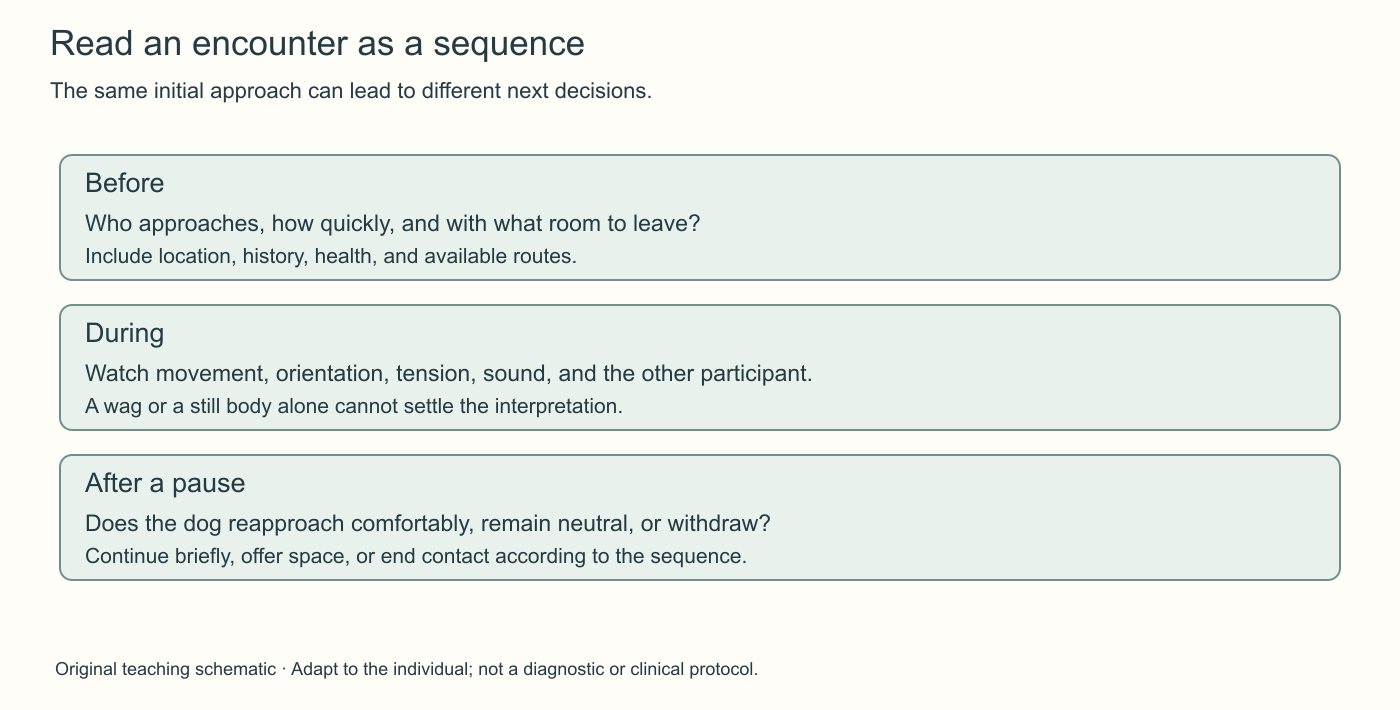
Application
Annotate this fictional sequence: a dog rests beside a chair; a child approaches with a toy; the dog turns its head, closes its mouth, and remains still; the child moves closer. Identify the relevant context, the adult's immediate action, and a safer later arrangement.
Model interpretation: The dog is resting and may have limited escape space beside the chair. The adult stops the child's approach and calmly creates separation, without requiring a growl or bite to justify it. Later play, if appropriate for this dog and child, happens with active adult supervision, a suitable game, and an open retreat. The dog can decline. If this pattern is new, persistent, or accompanied by threats or suspected pain, seek veterinary and qualified behavioral advice.
Evaluate your account: It should describe observable changes, avoid diagnosing an emotion from one sign, and place responsibility for safety on the adult. The objective is a better arrangement, not a more dramatic test.