Sleep, recovery, and learning to settle
By seven in the evening, the family has tried everything to tire Scout out. There was a long walk, a ball game, visitors, a puzzle, another ball game, and a training session. Scout is now running between the sofa and the front door while someone searches for a more difficult puzzle.
Perhaps Scout needs more appropriate activity across the day. Perhaps the day has already become too demanding. Perhaps something hurts, a noise keeps drawing attention, or the household has repeatedly restarted excitement just as rest became possible. The visible result—restlessness—does not identify the cause by itself.
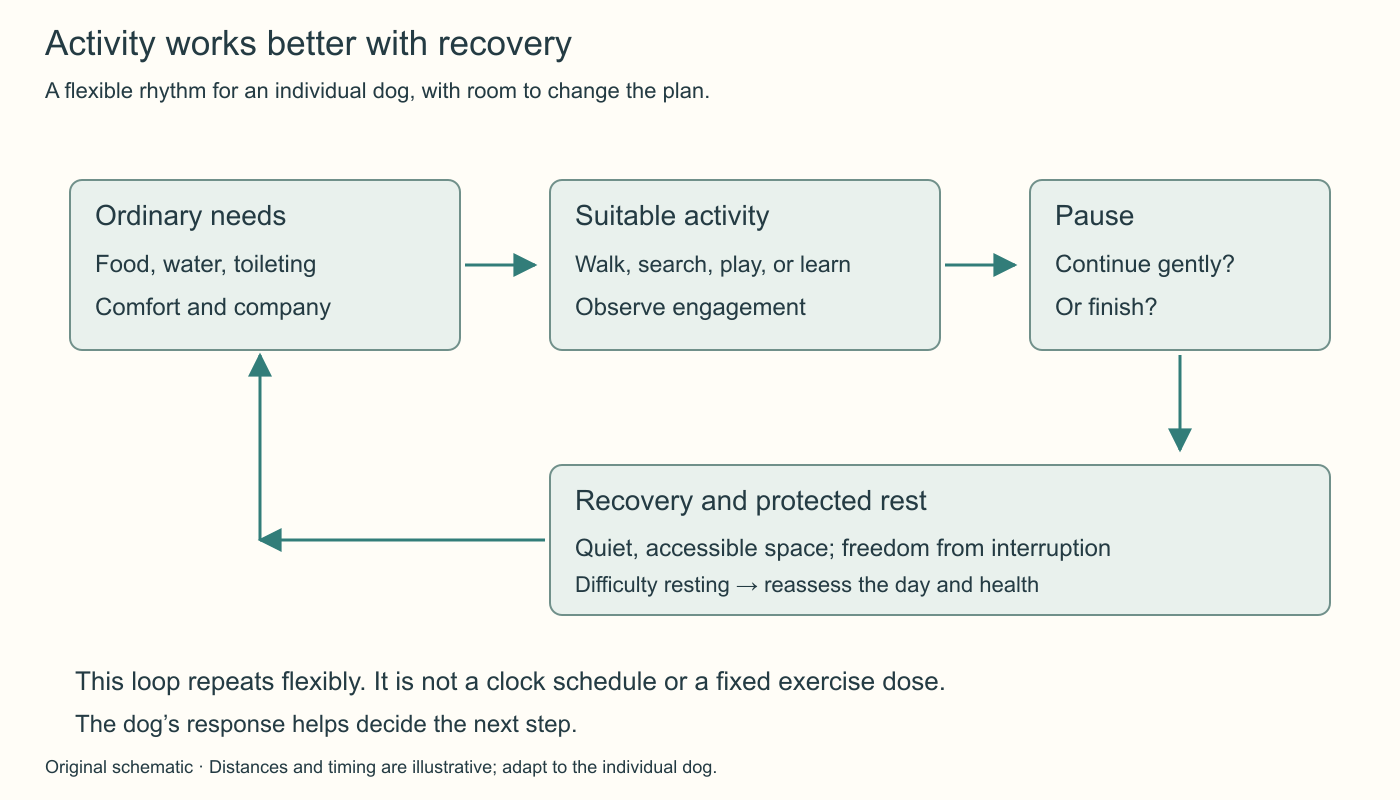
A good daily rhythm includes activity and recovery. This chapter asks what rest actually looks like, what makes it available, how to encourage settling, and when a change deserves veterinary assessment. Its goal is not to immobilize the dog. It is to help the dog use a comfortable quiet opportunity.
Rest is part of a full life
A dog lying still may be asleep, resting while awake, watching the room, or remaining tense in a difficult situation. Those states can look similar in a quick photograph. Observe breathing, muscle tension, responsiveness to ordinary background events, position changes, and the surrounding sequence without disturbing the dog to test it.
Sleep itself includes different physiological stages. At home, you do not need to classify them from every twitch. Research uses measurements such as electrical activity recorded from the scalp, together with other signals, to distinguish states more carefully than casual observation can.
In Kis and colleagues' 2017 study, dogs learned unfamiliar verbal cues for known actions, and researchers examined subsequent sleep recordings and performance. The work found relationships between learning, sleep physiology, and later performance, with an additional experiment comparing post-learning activities. It supports taking sleep seriously in learning; it does not prescribe an exact nap length after every training session or prove that more sleep always means better learning.
For ordinary care, the implication is modest and useful: do not treat rest as unused capacity that should always be filled. A dog can have a stimulating morning and still need an undisturbed period afterward.
Start with the individual's pattern
Sleep and rest vary with development, age, health, environment, and routine. A puppy, an adult, and an older dog may use the day differently. A general hour estimate cannot establish whether a particular dog is resting well.
Keep a short diary for several ordinary days. Record broad periods: active outing, meal, quiet rest, apparent sleep, alert watching, play, training, time alone, and interruptions. Note when the household was absent or unable to observe. Do not convert an unseen afternoon into four confirmed hours of sleep.
The diary can be simple. “Rested on bed from about ten until delivery at eleven; then watched door repeatedly” is informative. A device's activity estimate may add data, but it does not replace knowing what the behavior looked like or whether the dog was comfortable.
Compare the dog with itself. A new pattern of nighttime pacing or repeated difficulty lying down deserves more attention than a difference from a friend's dog's schedule. The question is what changed and whether needs are being met, not whether the household has achieved a fashionable total.
A bed is only useful if the location works
Scout's bed is technically excellent: supportive, washable, and large enough. It also sits beside the front door, where every footstep in the corridor prompts a head lift. The bed's material cannot compensate completely for its location.
Offer a quiet resting option with comfortable temperature, suitable support, a non-slip approach, and space to change position. Some dogs prefer proximity to familiar people; others need more distance from activity. More than one resting option can allow choices as conditions change.
Dogs Trust's guidance for settling a newly adopted dog includes planning spaces and predictable routines. The same principle remains useful after adoption: the dog needs a place where rest is practically possible, not merely a bed assigned by the household.
Consider visual access as well as noise. A dog that watches every passerby through a low window may benefit from a resting place outside that sightline. Preserve enjoyable observation at other times if it suits the dog; the aim is to create an option to disengage.
Household rules should protect the resting area. Children do not approach to pet a sleeping dog, and visitors do not reach into a retreat. If adults cannot actively supervise, safe separation should prevent unwanted contact while meeting the dog's needs.
Settling is different from holding a position
A trained down can be useful. It does not prove relaxation. A dog may lie on cue while rigidly watching the environment, ready to spring up. A long stay can require effort rather than provide recovery.
When encouraging settling, look for a comfortable pattern: choosing a resting position, loosening the body, placing the head down, or remaining at ease while ordinary quiet activity continues. Interpret these signs together and in context, not as mandatory poses.
The Dogs Trust settle-training resource describes reinforcing calm behavior in an undistracting setting and gradually building duration and distraction. The original progression below applies that principle to a fictional household. It is not a treatment plan for panic, pain, or severe arousal.
Choose a time when basic needs are met and the dog is already capable of being fairly comfortable. Sit quietly near an appropriate bed or mat. Notice an easy calm behavior the dog offers and deliver a small suitable reward without turning the moment into an animated performance.
If food makes the dog stare at your hands and repeatedly spring up, adjust the setup. You may need calmer delivery, a less exciting reward, a different time, or professional guidance on the training arrangement. Rewarding quiet behavior is useful only if the overall sequence is helping the intended pattern.
An original progression for Scout
Scout's first session takes place after a manageable walk, water access, and a toileting opportunity. The family chooses the quieter living-room corner rather than the front-door bed. One person sits with a book. Scout is free to move within a safe area.
When Scout briefly stands or sits quietly beside the mat, the person calmly delivers a small appropriate reward. Later, a comfortable lie-down becomes an achievable step. The session ends while it is still easy. There is no demand that Scout remain motionless for the entire evening.
On another day, Scout lies down and places his head on the mat. The person quietly rewards near the resting position rather than tossing food across the room. That delivery choice matters: the consequence should not repeatedly require a burst of movement when the goal is a quieter pattern.
Only after the basic setting is easy does the person add a small change, such as standing briefly and sitting again. If Scout immediately becomes alert and follows, the change may have been too large. Return to an easier version rather than repeating the difficult one until both participants are frustrated.
A mat can become a familiar cue for a quiet routine, but it is not a portable force field. A dog comfortable on it at home may need a much easier introduction in a different place. Taking the mat to a crowded restaurant does not transfer all the conditions that made home rest possible.
A crate is an option with conditions
Some dogs learn to rest comfortably in a suitable crate. Others find confinement difficult, and a crate can be unsafe for a dog panicking or trying to escape. It should not be introduced as a way to force distress to stop.
A comfortable resting enclosure requires appropriate size, ventilation, temperature, bedding, safe setup, gradual familiarization, and a schedule that meets toileting, movement, social, and other needs. Do not leave equipment on the dog that could catch, and follow product safety instructions. An open comfortable bed or a safely arranged room may be more appropriate in some homes.
The important distinction is between providing a learned safe place and using confinement as a substitute for care or assessment. A dog that rests voluntarily with an open door has supplied different evidence from one that stops vocalizing after prolonged struggling.
If separation or confinement causes distress, obtain qualified advice and arrange care that prevents repeated overwhelming episodes where possible. The later behavior chapter addresses being alone specifically. Settling beside a person and coping with absence are separate learning problems.
Rewrite the day instead of adding another game
Return to Scout's crowded evening. The family reviews the diary and finds that visitors repeatedly interrupted his afternoon rest. The long walk included several close dog encounters, and each return home triggered more ball play because he seemed excited.
They try a more manageable day: a suitable morning outing, breakfast, protected quiet time, a later toileting and sniffing opportunity, one short training or play session, and another quiet interval. The details depend on Scout's age, health, and needs; this is an example of alternating demands and recovery, not a universal timetable.
They also stop treating every movement toward the toy basket as a requirement to start another intense game. The dog still receives meaningful activity. The household becomes more predictable about when games begin and end, and offers calm company afterward.
Suppose Scout rests more comfortably. The result suggests the revised arrangement helped, but it does not prove which change was responsible. The family records the improvement and keeps watching. If restlessness persists or new signs appear, the next step is assessment, not ever more elaborate scheduling.
Puppies need support, not an endurance contest
A puppy entering a new home has lost familiar surroundings and may need help with proximity, toileting, and a predictable nighttime routine. An adult's desired sleep schedule does not make the puppy's needs disappear.
Arrange a comfortable safe resting area and age-appropriate toileting opportunities. Ask the veterinary team and a qualified reward-based professional for guidance suited to the puppy. A quiet, responsive plan can support gradual confidence without turning every sound into a party.
Distress should not be dismissed automatically as manipulation. Check what the puppy needs and whether the setup is manageable. The learning goal is that resting and brief separation become safe and familiar, not that the puppy discovers no one responds to discomfort.
Adolescence brings different challenges, including changing interests and arousal. Revisit the environment and training difficulty rather than assuming a previously learned routine is permanently secure. Preserve rest while adjusting activity and support to the developing dog.
When nighttime changes are medical information
A dog that newly paces, pants at rest, repeatedly changes position, struggles to get comfortable, or wakes unusually often may need veterinary assessment. Pain, illness, toileting needs, sensory changes, environmental disturbance, and behavioral problems can overlap.
AAHA's chronic-pain assessment guidance includes caregiver observations and sleep-related information among useful assessment tools. A diary can help the veterinary team, but it does not diagnose the cause or select treatment.
Record what changed, when it began, other signs, and any relationship to movement or routine. If breathing appears difficult, the dog collapses, or there is another urgent sign, seek emergency veterinary care rather than waiting to complete a diary. Do not give a human sleep aid or pain medicine without veterinary direction.
An older dog waking at night should not be labeled confused solely because of age. The final chapter will discuss changing cognition and mobility, but the principle begins here: investigate a new change before attributing it to an inevitable stage of life.
Rest during a busy household event
A celebration, repair visit, or family gathering can disrupt an otherwise good routine. Prepare before the doorbell begins. Choose a familiar safe area, arrange water and toileting access, and decide who will check the dog. Give visitors clear instructions about doors and contact.
A dog that enjoys some company may still need a break. A dog that prefers distance can spend the event apart with appropriate care. Participation is not an obligation created by the fact that guests like dogs.
For Scout, a familiar caregiver offers a quiet outing before the event and checks him in his resting area during it. The household avoids repeated visits by guests “just to see if he is okay,” which would defeat the purpose of a retreat. The plan is judged by his comfort and recovery, not by how many photographs include him.
After an unusually demanding day, keep the next period manageable. Observe what the dog chooses and whether ordinary habits return. Recovery is part of the event plan, not an afterthought once the chairs are stacked.
A rhythm that the household can sustain
The best schedule is not necessarily the most detailed. It is one that reliably supplies essential care, suitable activity, meaningful interaction, and protected rest while allowing reasonable variation.
Identify the anchors: meals, toileting, outings, quiet work periods, and bedtime. Around them, place small activities that fit the dog and the people. A short successful search game can be more useful than an ambitious enrichment project that happens once and leaves everyone exhausted.
Review the dog's response. Comfortable rest, voluntary engagement, manageable transitions, and useful skills are better indicators than whether every minute is filled. Your dog does not need a productivity dashboard. It needs a life with a rhythm it can comfortably inhabit.
Check your understanding: A dog holds a down-stay while staring rigidly at passing dogs. Why should this not be counted automatically as relaxed rest?
Expected answer: The posture is only one part of the state. Muscle tension, fixed attention, context, and the ability to disengage matter. Increase distance or choose a quieter arrangement rather than using a longer stay to force apparent calm.
Application
Rewrite Scout's day after a diary shows repeated afternoon interruptions, a busy evening walk, and several intense games before bed. Include protected rest, a suitable outing, one enjoyable activity, and a criterion for seeking veterinary advice.
Model interpretation: Protect a quiet afternoon interval, choose a more manageable route, retain an appropriate play or training session, and allow a calm transition afterward. Supply normal food, water, toileting, and companionship. Record whether Scout settles comfortably and returns to ordinary habits. New persistent restlessness, difficulty getting comfortable, altered breathing, appetite changes, or other concerning signs require veterinary advice rather than simply reducing stimulation indefinitely.
Evaluate your plan: It should meet needs rather than suppress movement, distinguish resting from holding a position, and remain feasible on an ordinary workday.