Play, puzzles, and having a job
The expensive puzzle has arrived. It contains sliding doors, rotating compartments, and the faint implication that a sufficiently clever dog will soon qualify for an engineering degree. Nell sniffs it, pushes it once, and walks away to investigate an empty delivery box.
The purchase has not failed because Nell lacks intelligence. The activity may be too difficult, unfamiliar, uninteresting, awkward, or poorly timed. The box may offer something she currently values more. Enrichment is assessed through the dog's experience, not the complexity printed on the package.
This chapter builds a menu of searching, toy play, manipulation, and simple learned activities. Each has an easy starting point, a way to adjust difficulty, and a reason to stop or change. The aim is engagement and choice, with enough success to make the next attempt worth offering.
What makes an activity enriching?
An activity can add opportunities to investigate, move, solve a manageable problem, interact, or exercise control over an outcome. A new object is not automatically enriching, and an old game is not automatically stale. What matters is how the dog uses it.
Dogs Trust's enrichment guidance emphasizes safety, individual abilities, preferences, and observation of engagement or frustration. Those are design questions rather than a demand to buy a particular product. A suitable activity should fit the dog's body, diet, current state, and household setting.
Consider four observations: the dog approaches voluntarily, makes progress, remains able to pause, and chooses to return after a brief break. Together they can suggest that the task is manageable and interesting. They do not prove a precise emotional state or guarantee a long-term benefit.
Now compare frantic repeated pawing, inability to obtain any reward, attempts to swallow the apparatus, or leaving after repeated difficulty. These call for a change. The answer is not always an easier version; sometimes the better choice is a different activity or rest.
Search game one: the visible beginning
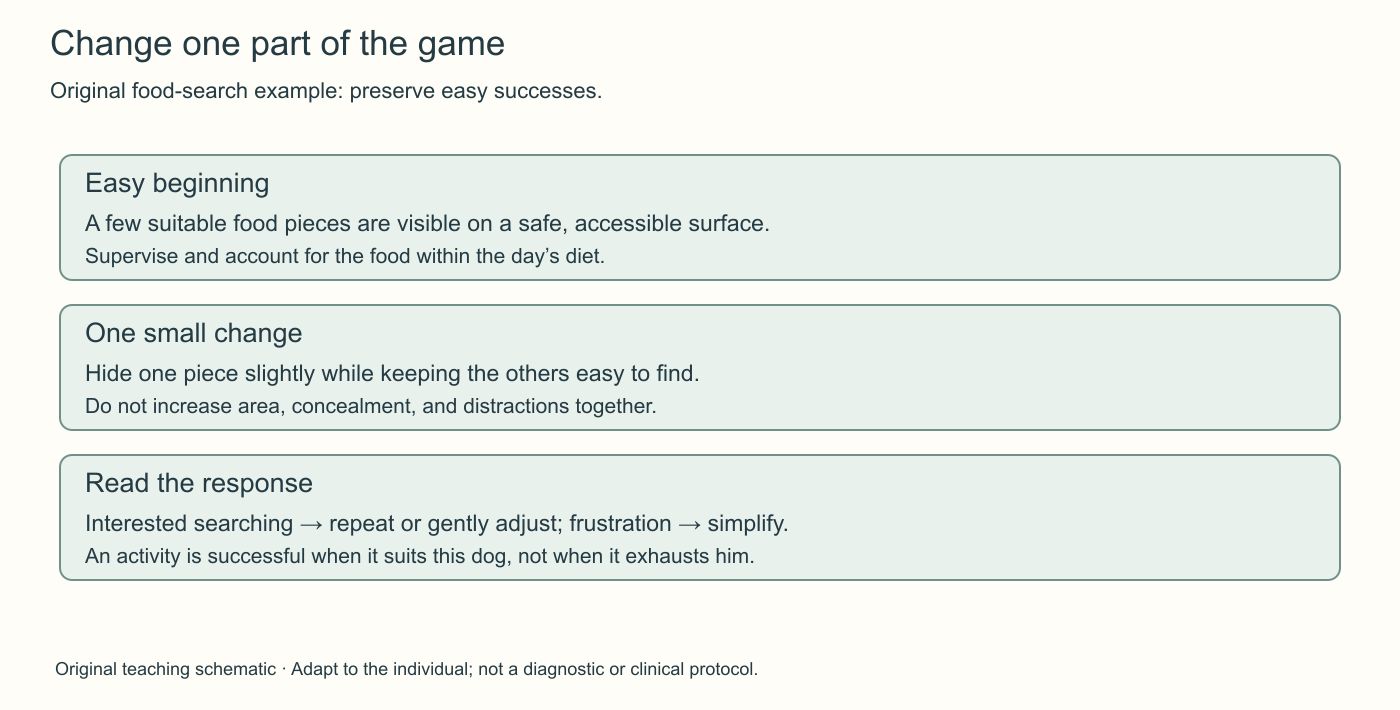
Choose a clean safe area and a small portion of appropriate food from the dog's daily plan. Let the dog see you place a few pieces in easy, reachable locations. Use a simple invitation and allow investigation without repeatedly pointing at every piece.
For fictional Nell, the first arrangement uses three pieces on an uncluttered mat. She finds them readily. This establishes what the activity offers without requiring her to solve a hidden-object problem before she understands the game.
Next time, place one piece just beside a familiar low object while leaving others visible. The change is small. If Nell struggles, reveal the piece or make the next attempt easier. The purpose is a successful search experience, not demonstrating how effectively a human can conceal a snack.
Do not scatter food where the dog may also encounter unsafe material, another animal's competition, or a household restriction. In a multi-dog home, give each dog its own suitable area unless a professional has helped establish that a shared activity is safe and comfortable. Food searching should not become a resource dispute.
Search game two: the tiny room museum
This original game uses a familiar safe room as a small exhibition of discoveries. Place appropriate rewards at a few accessible stations: beside a chair leg, near an open doorway within the safe area, and on a low stable surface the dog can reach without climbing. Avoid electrical equipment, rubbish, medicines, and places you do not want the dog to investigate later.
Begin with the dog watching or with plainly visible placements. As the game becomes familiar, make one location slightly less obvious. Keep the search area small enough that the dog can succeed without prolonged wandering.
Nell's caregiver labels the stations on a sketch: “chair,” “mat,” and “open box.” After the game, the caregiver records which station was easy and where Nell needed help. The sketch is for the person's reasoning; Nell is not expected to follow a treasure map written in English.
A useful progression might increase the number of stations, the search area, or the degree of concealment. Change only one at first. If all three become harder together, you will not know which feature exceeded the dog's current skill.
End with a clear, calm finish and account for all food placed. Do not leave inaccessible pieces behind to encourage hours of frustrated searching. Clean the area and put away materials that should not remain available.
A box can be a task, a toy, or a bad idea
The San Francisco SPCA's DIY enrichment examples show that ordinary household materials can support animal activities. Suitability still depends on the individual. A dog that swallows cardboard should use a different setup, and every box should be free of staples, tape, sharp edges, and unsafe residues.
For a dog that safely investigates materials under supervision, start with an open shallow box containing an easily reached reward. A later version can include a loose safe obstacle that the dog can move without becoming trapped or frustrated. Avoid sealing a difficult package and assuming that destruction is the only route to enrichment.
Nell nudges an open box and obtains the food. On another attempt, the box slides noisily across the floor and she steps away. The change in surface and sound matters. Stabilizing the box on a suitable non-slip surface may restore a manageable task.
If the dog begins ingesting material, stop using that material. Do not treat swallowing as merely an enthusiastic play style. Choose a durable appropriate device or a search activity without loose packaging. Inexpensive is useful only when it is also suitable.
Toy play is a conversation
Dogs can enjoy chasing, carrying, tugging, shaking, retrieving, or simply possessing a toy. One object can support several games, and not every dog wants the same one.
Offer a suitable toy in a way that invites participation. Move it gently along the ground or present it for a voluntary grip, depending on the intended game and the dog's physical suitability. Do not push it into the face or repeatedly tap the dog with it to produce a response.
Watch what the dog does after gaining the toy. Nell carries it to a bed and holds it. Her caregiver had planned fetch, but possession may be the current reward. The person can allow that appropriate choice rather than immediately chasing her to recover the equipment.
A return toward the person may invite another interaction. A move away may signal a break or a different preference. The useful question is how to make a shared game the dog chooses to continue, not how to enforce the human's original rules on every toy encounter.
Tug with sensible rules
For a dog suited to the activity, a gentle tug game can provide shared play. Use an appropriately sized toy that gives the person room for a safe grip, keep movement compatible with the dog's neck and body, and avoid lifting or swinging the dog by the toy.
Build brief play with pauses and a taught exchange or release. The later skills chapter explains dropping an item through a fair trade. Do not pry at the mouth or turn the game into a struggle over possession, especially if the dog shows guarding.
If teeth contact skin, stop the active movement calmly and reassess the toy, arousal, and game. A longer suitable toy, a slower pace, or a different activity may be needed. Children should not manage a vigorous game independently; adults are responsible for choosing safe interactions.
The RSPCA's behavior guidance encourages appropriate play and reward-based learning. Letting a dog obtain the toy during play is not evidence that household authority has collapsed. The relevant questions concern safety, willingness, and the quality of the interaction.
Retrieval contains several separate skills
A complete fetch involves orienting to an object, moving toward it, picking it up, returning, and releasing or exchanging it. A dog may enjoy some parts and not others. Calling the whole sequence one instinct can conceal what needs teaching.
Begin with a short reachable movement of a suitable object in a safe area. Reward the part the dog can offer. A dog that picks up the toy but does not return may need a separate return game; a dog that returns but holds it may need an exchange progression.
Use short distances and suitable footing. The exercise chapter explained why repeated high-speed turns and aerial catches can be physically demanding. A modest ground-level game can be plenty of fun without reproducing a sports highlight reel.
For Nell, two short retrieves followed by carrying the toy around the room may be a successful session. If the caregiver keeps throwing until she loses interest, the final image of the game is one of disengagement. Ending while the activity remains enjoyable can preserve willingness to return later.
Teach a small household job
A job need not be useful enough to appear on a résumé. It can be a predictable task with an achievable outcome: touching a target, bringing an appropriate toy a short distance, going to a mat while a cupboard opens, or finding a familiar object in an easy arrangement.
Choose a behavior compatible with the dog's body and the household. Avoid tasks involving medicines, hot objects, sharp items, small swallowable objects, or equipment that could trap or injure the dog. “Helpful” does not justify an unsafe assignment.
Nell's job is to touch a large safe target with her nose. Her caregiver first rewards a voluntary investigation, then a brief touch. Later, the target appears in a slightly different nearby position. The behavior becomes a way to practice clear timing and manageable change.
Do not repeatedly ask for a difficult chain before the pieces are familiar. A dog cannot infer the entire job description from the person's enthusiasm. The training chapter will show how to split tasks and use consequences clearly.
Productive challenge has a route to success
Difficulty can come from physical manipulation, sensory discrimination, memory, distance, duration, or distraction. A puzzle may be hard because the lid is stiff, not because the dog cannot reason. A search may fail because the reward is inaccessible, not because the nose has stopped working.
List the demands before increasing them. Can the dog reach the object comfortably? Does it understand that this action can produce something worthwhile? Is the reward suitable and valued? Is the room quiet enough? Has the activity already gone on too long?
For Nell's sliding puzzle, the first revision is to leave compartments open. Once she readily obtains food, one compartment becomes partly closed. If the slider sticks, the caregiver fixes the apparatus rather than praising persistence against an unsolvable mechanical problem.
A little uncertainty can make a game interesting. Repeated failure without useful feedback can make it frustrating. Watch the individual instead of using frustration as proof that the brain is working hard enough.
Rotate opportunities, not just objects
A toy rotation can renew interest, but a new arrangement of familiar materials may be equally useful. Change the location of an easy search, offer a different suitable movement pattern, or combine a familiar skill with a modest environmental change.
Keep favorite reliable activities available in the menu. Novelty is not a moral obligation. An older dog or a dog adjusting to change may value familiar success more than a new challenge every afternoon.
An original weekly menu for Nell might include a visible food search, a brief gentle tug game, target practice, a quiet exploratory walk, an easy room search, and a day emphasizing familiar play and rest. This is a menu to choose from, not a requirement to complete every item regardless of the dog's response.
Record one sentence after an activity: what Nell chose, what was easy, what was difficult, and what to change. The useful outcome is a growing understanding of preferences, not a collection of unused devices.
Adapt for body, age, and household
For a dog with limited mobility, place search items within easy reach and avoid slippery surfaces or awkward turns. Follow veterinary restrictions. A task advertised as mental can still require substantial physical effort.
For a puppy, choose safe materials and short manageable experiences, with close supervision and rest. For an older dog, preserve familiar cues and adjust visibility, reach, or manipulation demands as needed. A new decline in participation warrants attention rather than an assumption that the dog has lost interest in life.
For a busy household, prepare a few reliable options that fit actual supervision. A simple search before work, a short shared game later, and appropriate rest may be more sustainable than a complex daily construction project. Enrichment should improve the relationship, not become a source of guilt about unfinished crafts.
If an activity produces guarding, panic, repeated ingestion attempts, or another substantial concern, stop and seek appropriate help. More enrichment is not a universal treatment for every behavior problem. Sometimes the first need is medical assessment or a carefully designed behavior plan.
Participation includes the right to finish
A dog that leaves a game may be tired, distracted, satisfied, uncomfortable, or simply interested elsewhere. Read the context and allow an appropriate ending. Do not repeatedly lure it back to prove that it enjoyed the activity.
Nell's final contribution to the puzzle experiment is to lie beside her caregiver after a short successful search. The person puts the equipment away. The day has gained investigation, success, and shared time; it does not need a more impressive conclusion.
A well-designed game leaves both participants with useful information. You learn what the dog can do and chooses to do. The dog encounters a world where manageable actions lead to worthwhile outcomes. That is a good foundation for the more deliberate teaching that follows.
Check your understanding: A dog repeatedly paws at a puzzle without obtaining food, then walks away. What should you examine before increasing the difficulty or calling the dog unintelligent?
Expected answer: Check access, mechanics, prior understanding, reward value, physical comfort, distraction, and session length. Offer an easier version or another activity, and observe voluntary participation. Failure in one setup does not establish a general cognitive limitation.
Application
Create three versions of a room search: an easy introduction, a modest next step, and an accessible version for a dog with a vet-defined movement limitation. Include the food allocation, materials, supervision, and ending.
Model interpretation: Start with a few visible suitable food pieces in a small clean area. Next, make one placement slightly less obvious while preserving reachable success. For the restricted dog, keep all permitted searching within easy reach and avoid any movement outside the care plan. Use part of the appropriate daily ration, prevent competition with other animals, account for all pieces, and stop if the dog struggles, disengages, or shows discomfort. The next step follows the dog's response rather than a fixed level printed on a toy.
Evaluate your menu: Each activity should have a distinct experience to offer. Include a familiar easy choice and an observation-only option for readers without a dog.