Flour, water, and structure
A piece of bread dough stretches between your hands, thins and resists tearing. A piece of short pastry should eventually break tenderly under a fork. Both can begin with wheat flour and water. Their different destinations depend on how much water is present, which flour supplies the structure, what other ingredients intervene and how the mixture is handled. The instruction to “mix well” is therefore incomplete until we know what we are trying to build.
This chapter follows the change from separate particles to a connected dough and then to a baked structure. It also develops a practical distinction between elasticity, extensibility and simple wetness. These are properties you can observe. Naming them accurately makes it easier to choose a useful response when a mixture feels different from the recipe's description.
Flour contains more than one structural ingredient
Wheat flour contains starch and several kinds of protein, alongside other components whose proportions depend on the wheat and milling. The gluten-forming proteins are central to the behavior of many wheat doughs, but they are not the whole flour. Starch has its own role, particularly during heating in the presence of water. A good explanation should not make gluten responsible for every feature of a finished crumb.
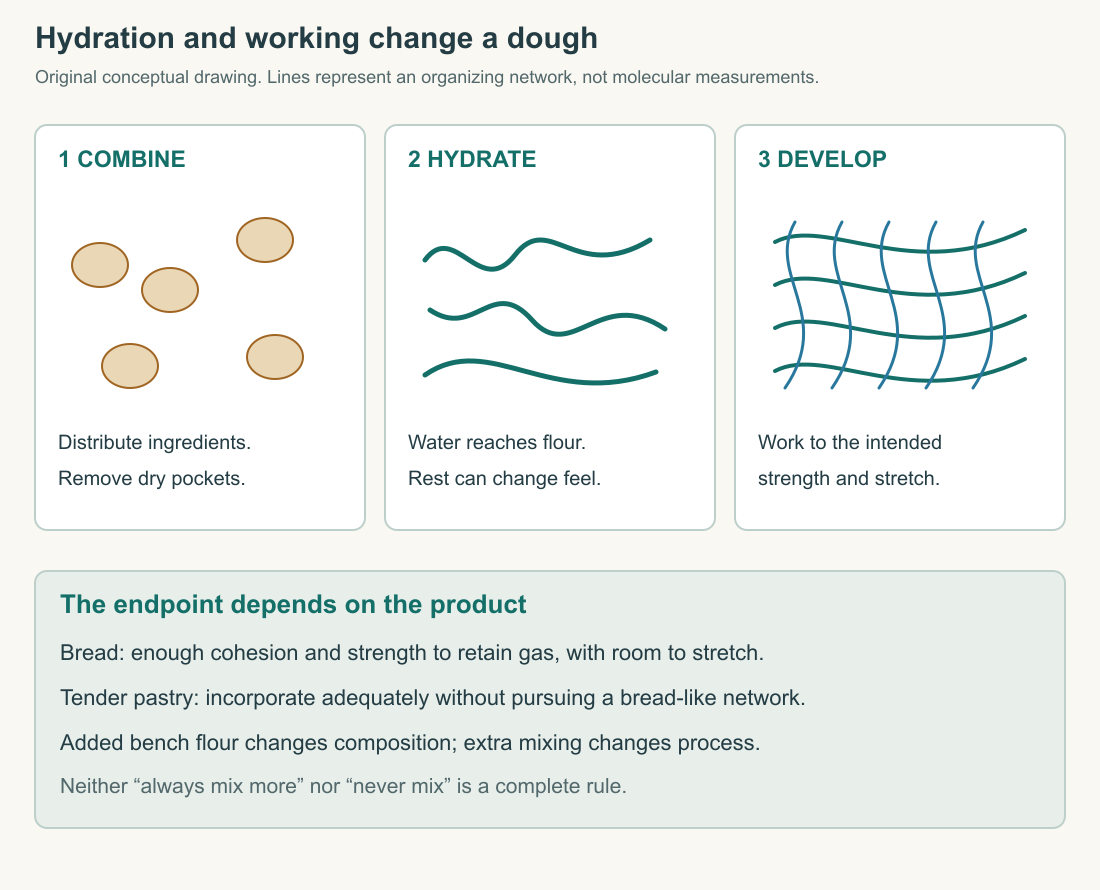
When flour is hydrated, its components interact with water. Mixing distributes that water and brings the material together. In wheat dough, gluten-forming proteins contribute to a connected network that can deform and retain gas. This is a developed physical structure, not a new ingredient that appears because every protein in the flour has changed into the same substance.
The distinction is useful when reading flour labels. Protein content gives information about the material's potential, but the amount alone does not specify the quality of the network or the behavior of the full formula. Milling, flour composition, hydration and handling also matter. We should resist turning a single percentage into an all-purpose ranking of flour quality.
The ingredient explanations in this chapter draw selectively on Understanding Ingredients for the Canadian Baker, rewritten and extended through original examples. The BC Cook Articulation Committee's 2015 text is available under CC BY 4.0. Its flour discussion provides a starting point; its broad quality judgments and universal-sounding numerical rules are not adopted here.
Elasticity and extensibility need to work together
Elasticity is the tendency to recover after deformation: stretch a piece and it pulls back. Extensibility is the capacity to stretch before it breaks. A useful bread dough needs an appropriate combination. If it resists every attempt to lengthen it, shaping becomes difficult. If it stretches without sufficient strength to hold together, it may spread or tear rather than retain a useful form.
The two properties are not opposites on a single scale. A material can be both stretchable and capable of some recovery. Think about what you actually observe: how much force seems necessary, how far the piece extends, whether it thins evenly and what happens after you release it. “Strong” or “weak” becomes more informative when connected to these specific behaviors.
Suppose a dough pulls back repeatedly while you try to roll it into a log. Adding water is not automatically the right response. The immediate problem may concern relaxation rather than an insufficient total water amount. Conversely, a dough that tears because it contains dry, unincorporated flour needs a different diagnosis. Similar frustration at the bench does not establish a common cause.
The King Arthur gluten guide connects gluten development with hydration, mixing and the contrasting needs of bread and tender baking. Use that framework while following the particular formula's cues. More development is not an unlimited good: the required structure depends on what the product must do.
Hydration changes both handling and interpretation
Recall the water-to-flour relationship from chapter one. In a simple comparison using one flour, 100 grams of flour with 60 grams of water differs from the same flour with 75 grams of water. The second mixture has more water relative to the structural material. That can change how readily it spreads, sticks and deforms, but the exact result depends on the flour and the handling conditions.
This is why “sticky” and “weak” should not be treated as synonyms. A wet dough may adhere to your fingers while possessing a developed network. A drier mixture may feel manageable because it contains less water, yet still lack the development needed for its intended product. Ease of handling is valuable, but it is not the sole measure of whether a dough is correct.
Different flours also take up water differently. A water amount that produces one consistency with a particular flour can produce another with a different flour. Flour particles and components need time to hydrate, so a newly mixed mass may not behave exactly like the same mass after a covered rest. Judge it at the stage specified by the recipe rather than correcting it instantly toward a remembered texture.
Adding bench flour changes the formula. Suppose a dough begins with 400 grams of flour and 260 grams of water, giving sixty-five-percent hydration. If an additional 40 grams of flour is incorporated during handling, the ratio becomes 260 divided by 440, about 59.1 percent. A seemingly casual response to stickiness can therefore move the dough substantially from the intended relationship.
That calculation does not mean you must never use bench flour. It means that the amount matters. Use the method the recipe specifies, and avoid repeatedly adding flour until every trace of tackiness disappears. A scraper, a brief pause or a different hand movement may address handling without making the same compositional change. Which response is suitable depends on the formula and stage.
Mixing does several jobs at once
The first task of mixing is distribution: dry pockets need to meet liquid, and ingredients need to be dispersed. In a wheat dough, continued handling also contributes to development. In some batters, mixing incorporates air or preserves air introduced earlier. A single verb therefore covers several physical tasks, and the recipe's sequence tells us which one matters now.
Kneading repeatedly deforms and folds dough. The movement helps organize the hydrated material into a useful network. It also changes the dough's temperature through work and contact with its surroundings. A machine and a pair of hands do not necessarily deliver the same mechanical input in the same number of minutes. Use timing as a guide alongside the specified condition of the dough.
Folding can contribute to development as well. A recipe may distribute handling across rests rather than demand one long kneading session. That does not make the process effortless or universally interchangeable with intensive mixing. It changes when the dough is worked and how development combines with time. The complete schedule matters more than the name of one technique.
A batter presents a different problem. Once a tender cake's flour is added, prolonged agitation may develop more structure than desired or alter its air distribution. Yet stopping before the ingredients are incorporated leaves uneven material. “Do not overmix” should not become permission to leave dry flour at the bottom of the bowl. The target is adequate incorporation with the handling appropriate to that formula.
A rest is an active part of the process
Leaving a mixture covered does not mean that nothing happens. Water continues to distribute through the flour, and the material's response to deformation can change. In bread methods, a rest between stages can make later handling easier. Covering matters because a dry surface introduces another variable that can resist stretching and interfere with an even comparison.
An autolyse conventionally begins with flour and water before later additions. It is one specific use of a rest, not a requirement for every bread. In King Arthur's published comparison, different rest arrangements produced varying results and practical difficulties incorporating ingredients afterward. The lesson is to integrate a technique into the formula rather than attach it as a guaranteed improvement. Autolyse comparison.
For our first yeast loaf later in the course, follow the selected recipe's own mixing and rise sequence. You do not need to add an extra technique before understanding the baseline. If you later test a rest, define when it occurs, what ingredients are present and what you expect it to change. Otherwise, “I tried autolyse” can describe several different interventions.
Rest and fermentation must also be distinguished. A flour-and-water pause without added yeast is not the same stage as a yeast dough's rise. Once yeast is present, gas production and other changes accompany the time interval. The next chapter will separate the source of gas from the material that retains it. Here, notice that a pause's meaning depends on what is in the bowl.
Choose flour for the intended structure
Bread, all-purpose, cake and pastry flours are categories associated with different uses, but exact specifications vary among products and countries. Bread flour often supplies more gluten-forming potential than a flour intended for delicate cakes. All-purpose flour supports a range of applications. The useful question is whether the particular flour fits the formula, not whether its label places it at the top of a hierarchy.
A cake recipe developed for all-purpose flour is not necessarily improved by switching to cake flour. Its other ingredients and method may already be balanced around the original flour. Likewise, a loaf recipe can be designed successfully around all-purpose flour. The selected sandwich bread in this course is an example. Follow a tested substitution when one is supplied, and record any untested change as an experiment.
Whole-wheat flour includes components removed from more refined white flour. It can change water uptake, flavor, handling and the structure of the dough. Those changes are not evidence that it is dirty or inferior. Nor does a high total protein figure guarantee the same loaf volume as a white flour. The composition and its interaction with the process require attention.
Self-rising flour introduces another distinction because it includes leavening and salt. Replacing plain flour with it while leaving all other additions unchanged can duplicate ingredients. A gluten-free flour blend changes the structural system more fundamentally and may require a formula designed for it. These are reasons to check the complete product and recipe, not to improvise a universal conversion. Flour types.
Starch helps transform a mixture during heating
Before baking, the dough or batter must hold together while remaining deformable. During baking, gas can expand while the surrounding material changes. Starch granules absorb water and undergo gelatinization under suitable heating conditions, contributing to the developing structure. Proteins also change with heat. The finished crumb is the result of these interacting processes, not simply raw dough with larger bubbles.
Gelatinization depends on available water, temperature, time and the surrounding ingredients. It is not a universal switch that every cake reaches at one exact temperature. Sugar and other components can alter the process. A thickening example using starch and abundant water therefore cannot be transferred unchanged to every bread or batter. Starch explanation, BC Cook Articulation Committee, CC BY 4.0.
This helps explain why expansion and setting must be coordinated. A mixture that expands before it develops enough support may not retain that volume. A structure that becomes too resistant too early can limit expansion. The gas source, heating and material properties must work together. We will return to this timing problem when diagnosing a sunken cake or a dense loaf.
The implication for a novice is practical: surface color alone cannot describe the entire interior. A browned exterior and a properly developed internal structure are related outcomes of heating, but they are not identical observations. Use the complete recipe's readiness cues and cooling directions rather than assume that an attractive surface settles every question.
Compare one property at a time
You can investigate hydration through a small optional handling exercise. Use two separate bowls containing 100 grams of the same flour. Add 60 grams of water to one and 75 grams to the other, using water at the same measured or shared starting condition. Mix each until no dry flour remains, cover both and compare them at the same time points. These are original classroom samples, not complete bread recipes.
Record whether each sample spreads, adheres to a clean utensil and stretches before tearing. Keep the handling comparable rather than kneading one much more because it seems difficult. After a short shared rest, repeat the observations and note what changed. Do not taste the samples; keep raw-flour handling contained, clean the equipment and work area afterward, and discard the samples when finished.
This comparison changes water amount while holding several other features approximately constant. It does not isolate every molecular process, and your flour may produce a different feel from another reader's. The valuable result is a specific description linked to known quantities. If you next compare flours, keep the water relationship and process fixed enough to understand the new difference.
For a finished product, choose a complete published formula and assess the cooled crumb as well as the raw mixture. A dough that feels convenient is not automatically the one that bakes best for your purpose. Bread and short pastry require different balances of cohesion, expansion and tenderness. The skill is learning which structure you are building, then handling the ingredients in a way that helps it form.
Application
Make a two-column prediction for the optional hydration samples, or reason through them on paper. Separate stickiness, elasticity, extensibility and spreading instead of calling one sample simply better. Calculate the hydration after adding 20 grams of flour to the 400-gram-flour, 260-gram-water model. Then explain why a bread dough may benefit from development while a tender pastry calls for more restrained handling.
Check your understanding: Does a sticky dough necessarily lack a developed network, and will switching to a higher-protein flour always improve a cake or loaf?
Expected answer: No. Stickiness can reflect water content and handling while a network is present. Flour choice must match the formula and intended structure; protein amount alone does not determine the result. Adding 20 grams of flour to the stated model gives 260/420, about 61.9-percent hydration. Bread needs suitable gas-retaining strength and extensibility; tender pastry limits unwanted toughness while retaining enough cohesion for handling.